Research of problems and prospects of economic adaptation of military servicemen: sociological and statistical analysis
DOI:
https://doi.org/10.15587/2706-5448.2025.329096Keywords:
adaptation, creative potential, military personnel, labor market, self-employment, entrepreneurial activitiesAbstract
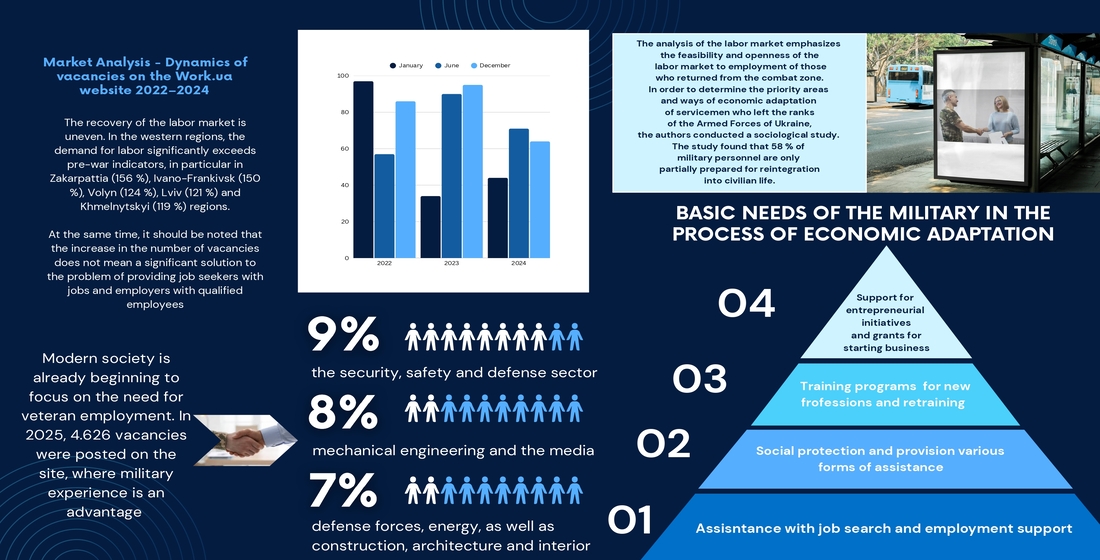
The object of research is the system of economic adaptation of military personnel returning to civilian life after participating in hostilities during the full-scale war in Ukraine. As a result of the conducted analysis and sociological research, several key deficiencies in the functioning of this system were identified, including: insufficient level of state support during the transition to civilian employment, low level of informational assistance, difficulties with job placement, and limited access to retraining and entrepreneurial development.
To identify and address these shortcomings, a comprehensive approach was applied, including statistical analysis of the labor market, regional analysis of job vacancies, study of veteran support initiatives, and a sociological survey of servicemen using an online questionnaire. These methods made it possible not only to detect weaknesses in the adaptation system but also to develop proposals for its improvement.
The study found that 58 % of military personnel are only partially prepared for reintegration into civilian life. The main reserves for improving adaptation include expanding access to training programs (noted by 48 % of respondents), promoting entrepreneurship (important to 34 %), and developing digital and creative skills (needed by 22 % and 28 %, respectively). The results also revealed a high potential for self-employment among veterans, with 26 % intending to start their own business, which could become a growth driver for regional economic activity.
The authors interpret the results by asserting that effective economic adaptation is achievable through the creation of an integrated institutional support model. This model should combine state policy, digital labor market tools, human capital development, and the utilization of veterans’ creative potential. The results of the sociological study of the needs of military personnel, presented in the article, give grounds to argue about the possibility of their involvement in entrepreneurial activity. Such an integrated system can ensure not only employment but also economic self-realization and sustainable reintegration of veterans into post-war society.
References
- Tsymbaliuk, M., Zhyhaylo, N. (2023). Psychological adaptation to civilian life of demobilised from the arms of the army and other military forms. Lviv University Herald. Series: Psychological Sciences, 16, 46–55. https://doi.org/10.30970/ps.2023.16.7
- Kurkova, K., Lutsenko-Myskiv, L. (2024). Social adaptation of military personnel in the post-war period. Law and Public Administration, 1, 309–316. https://doi.org/10.32782/pdu.2024.1.43
- Petrechenko, S. (2024). The process of adapting severely injured soldiers to civilian life. Psychology Travelogs, 3, 108–118. https://doi.org/10.31891/PT-2024-3-11
- Khvostenko, T. (2015). Sotsializatsiia uchasnykiv boiovykh dii pislia povernennia do tsyvilnoho zhyttia. Available at: https://iqholding.com.ua/articles/sotsializatsiya-uchasnikiv-boiovikh-dii-pislya-povernennya-do-umov-mirnogo-zhittya
- Kramer, C. B., Nelson, K. M., Sayre, G., Williams, J. L., Spruill, L., Fennell, T. et al. (2024). “Veteran to Veteran, There’s Automatically a Trust”: A Qualitative Study of Veterans’ Experiences in a Peer Health-Coaching Program for Hypertension. AJPM Focus, 3 (6), 100257. https://doi.org/10.1016/j.focus.2024.100257
- Verkamp, K. M. (2021). From Warrior Ethos to Obscurity: Veteran Reintegration Literature Review. The Journal for Nurse Practitioners, 17 (5), 564–569. https://doi.org/10.1016/j.nurpra.2020.12.016
- Oh, J., Shirmohammadi, M., Jeong, S., Wang, J. (2021). Leaving the military to work in civilian society: career adaptability by South Korean short- and mid-term veterans. Career Development International, 26 (3), 415–434. https://doi.org/10.1108/cdi-09-2020-0227
- Gonzalez, J. A., Simpson, J. (2021). The workplace integration of veterans: Applying diversity and fit perspectives. Human Resource Management Review, 31 (2), 100775. https://doi.org/10.1016/j.hrmr.2020.100775
- Werum, R., Steidl, C., Harcey, S., Absalon, J. (2020). Military service and STEM employment: Do veterans have an advantage? Social Science Research, 92, 102478. https://doi.org/10.1016/j.ssresearch.2020.102478
- Hertseva, D. (2025). Obozrevatel. Rynok pratsi u 2025 rotsi: shcho shukaiut ukraintsi ta yaki profesii staly naibilsh zatrebuvanymy. Available at: https://www.obozrevatel.com/ukr/ekonomika-glavnaya/economy/rinok-pratsi-u-2025-rotsi-scho-shukayut-ukraintsi-ta-yaki-profesii-stali-najzatrebuvanishimi.htm
- Kuzenkova, Ye. (2025). Pislia 3 rokiv povnomasshtabnoho vtorhnennia rynok pratsi vidnovyvsia na 93 %. Work.ua. Available at: https://www.work.ua/articles/analytics/3547/?setlp=ua#comments
- Derzhavna sluzhba zainiatosti. Statystyka 2024. Available at: https://dcz.gov.ua/stat/infograph
- Miroshnychenko, O. (2025). Shcho chekaie na Ukrainu pislia viiny: holovni vyklyky ta prohnozy. Konfederatsiia robotodavtsiv Ukrainy. Available at: https://employers.org.ua/news/id2685
- Work.ua dlia veteraniv. Available at: https://www.work.ua/veteran/
- Kucherenko, S. M., Khomenko, N. M. (2017). Orhanizatsiini osoblyvosti sotsialno-psykholohichnoi adaptatsii veteraniv boiovykh dii do tsyvilnoho zhyttia. Problemy eksperymentalnoi ta kryzovoi psykholohii, 21, 66–74.
- Bezpalko, O. (2003). Sotsialna pedahohika v skhemakh i tablytsiakh. Kyiv: Tsentr uchbovoi literatury, 134.
- Blinova, O. E. (2016). Socially-psychological adaptation of forced migrants: approaches and questions in studying acculturation phenomenon. Naukovyi visnyk Khersonskoho derzhavnoho universytetu, 3, 111–117.
- Inshyn, M., Bontlab, V., Sokolov, V., Boyko, S., Inozemtseva, K. (2022). Features of Service Members’ Adaptation to Civilian Life: Legal Aspects. International Journal of Criminology and Sociology, 9, 1252–1262. https://doi.org/10.6000/1929-4409.2020.09.144
- Pro zatverdzhennia Poriadku ta umov zabezpechennia sotsialnoi ta profesiinoi adaptatsii osib, yaki zvilniaiutsia abo zvilneni z viiskovoi sluzhby, z chysla veteraniv viiny, osib, yaki maiut osoblyvi zasluhy pered Batkivshchynoiu, chleniv simei takykh osib, chleniv simei zahyblykh (pomerlykh) veteraniv viiny, chleniv simei zahyblykh (pomerlykh) Zakhysnykiv ta Zakhysnyts Ukrainy (2017). Postanova Kabinetu Ministriv Ukrainy No. 432. 21.06.2017. Available at: https://ips.ligazakon.net/document/KP170432
- Sotnikova, Yu. V., Ivashchenko, M. M. (2023). Tvorchyi potentsial pratsivnykiv yak obiekt upravlinnia. Suchasni tendentsii sotsialno-ekonomichnykh transformatsii ta intelektualizatsii suspilstva v konteksti staloho rozvytku. Zaporizhzhia: NU “Zaporizka politekhnika”, 351–353.
- Gontareva, I., Chorna, M., Pawliszczy, D., Barna, M., Dorokhov, O., Osinska, O. (2018). Features of the Entrepreneurship Development in Digital Economy. TEM Journal, 7 (4), 813–822. https://doi.org/10.18421/tem74-19
- Ekonomichna adaptatsiia viiskovosluzhbovtsiv. Available at: https://docs.google.com/forms/d/1K5gmO5Tiwu66g_w3LW4t4Ru7zqj2Yoa3ZG4lpnz-vNE/edit
- Luhova, V., Sotnikova, Y., Nazarov, N., Churkin, A. (2022). Technology of determining motivation reserves for management staff. Economics of Development, 21 (1), 36–42. https://doi.org/10.57111/econ.21(1).2022.36-42
Downloads
Published
How to Cite
Issue
Section
License
Copyright (c) 2025 Galyna Nazarova, Yuliia Sotnikova, Viktoriia Luhova, Oleksii Klyzub, Mykola Ivashchenko

This work is licensed under a Creative Commons Attribution 4.0 International License.
The consolidation and conditions for the transfer of copyright (identification of authorship) is carried out in the License Agreement. In particular, the authors reserve the right to the authorship of their manuscript and transfer the first publication of this work to the journal under the terms of the Creative Commons CC BY license. At the same time, they have the right to conclude on their own additional agreements concerning the non-exclusive distribution of the work in the form in which it was published by this journal, but provided that the link to the first publication of the article in this journal is preserved.





