Визначення індуктивності натурної моделі шляхових котушок для високошвидкісного транспорту
DOI:
https://doi.org/10.15587/2706-5448.2025.331995Ключові слова:
магнітолевітаційний транспорт, шляхові котушки, натурна модель, експеримент, індуктивність, перехідні процеси, система керуванняАнотація
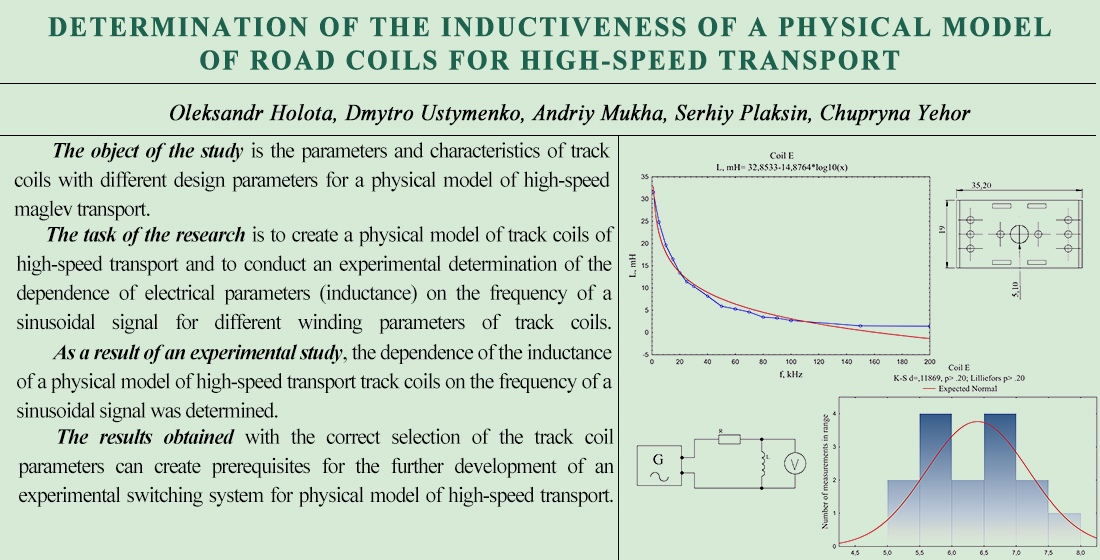
Об'єктом дослідження є параметри та характеристики шляхових котушок з різними конструктивними показниками для натурної моделі високошвидкісного магнітолевітаційного транспорту. Проблемою, яка постає в такій системі, є невчасне вмикання шляхових котушок, що приводить до збою в роботі через короткочасне зникнення тягової сили. Рішення цієї проблеми дозволить екіпажу поліпшити умови руху високошвидкісного магнітолевітаційного транспорту. Це дасть можливість виконати обґрунтований вибір параметрів шляхової котушки натурної моделі високошвидкісного транспорту, яка б мала необхідне значення індуктивності при різних режимах включення.
Необхідна частота комутації буде залежати від бажаної швидкості руху екіпажу та параметрів шляхових котушок. Важливою задачею в межах досліджень магнітолевітаційного транспорту є розробка та створення принципово нової системи керування. Така система мала б шляхову структуру з тяговими котушками раціональної форми та параметрів, які б реалізовували визначені процеси керування експериментальною установкою. Задача дослідження полягає у створенні натурної моделі шляхових котушок високошвидкісного транспорту та проведенні експериментального визначення залежності електричних параметрів (індуктивності) від значення частоти синусоїдального сигналу при різних обмоткових параметрів шляхових котушок. Для реалізації технічного рішення створена натурна модель шляхової котушки, яка враховує необхідні вимоги для дослідження. Пошук більш сприятливих технологічних рішень потребує проведення досліджень електричних процесів у колі шляхової структури натурної моделі шляхової котушки. Це дозволить обґрунтувати передумови створення, накопичення та передачі необхідної енергії до шляхових котушок в фізичних моделях, що імітуватимуть принципи руху та керування магнітолевітаційного транспорту.
В ході дослідження отримані результати шляхом застосування методів математичної статистики та виконано розробку шляхової котушки з оптимальними параметрами для натурної моделі дослідної установки високошвидкісного транспорту.
Отримані результати при правильному виборі параметрів шляхових котушок дають можливість створити передумови для подальшої розробки дослідної системи комутації натурних моделей високошвидкісного транспорту. У цьому разі резерв функціонування може визначатися в необхідному запасі ефективної роботи шляхових котушок для реалізації потрібних законів керування рухомим складом.
Посилання
- Holota, O. O., Mukha, A. M., Ustymenko, D. V., Plaksin, S. V. (2024). Investigation of Processes in the Traction Capacitor Circuit of the Model of High-Speed Magnetolevitation Transport. Science and Transport Progress, 1 (105), 30–41. https://doi.org/10.15802/stp2024/301521
- Dong, F., Hao, L., Park, D., Iwasa, Y., Huang, Z. (2023). On the future sustainable ultra-high-speed maglev: An energy-economical superconducting linear thrusting system. Energy Conversion and Management, 291, 117247. https://doi.org/10.1016/j.enconman.2023.117247
- Leferink, F. B. J. (1996). Inductance calculations; experimental investigations. Proceedings of Symposium on Electromagnetic Compatibility, 235–240. https://doi.org/10.1109/isemc.1996.561235
- de Oliveira, R. A. H., Stephan, R. M., Ferreira, A. C., Murta-Pina, J. (2020). Design and Innovative Test of a Linear Induction Motor for Urban MagLev Vehicles. IEEE Transactions on Industry Applications, 56 (6), 6949–6956. https://doi.org/10.1109/tia.2020.3023066
- Mirafzal, B., Skibinski, G. L., Tallam, R. M. (2009). Determination of Parameters in the Universal Induction Motor Model. IEEE Transactions on Industry Applications, 45 (1), 142–151. https://doi.org/10.1109/tia.2008.2009481
- Wang, H., Li, J., Qu, R., Lai, J., Huang, H., Liu, H. (2018). Study on High Efficiency Permanent Magnet Linear Synchronous Motor for Maglev. IEEE Transactions on Applied Superconductivity, 28 (3), 1–5. https://doi.org/10.1109/tasc.2018.2796560
- Lv, P., Liu, L., Su, X., Lin, P., Ma, H., Xu, D., Liu, Z. (2024). Calculation of Inductance Parameters of Wound Brushless Doubly-fed Motor. https://doi.org/10.21203/rs.3.rs-4640959/v1
- Wang, H., Zhong, X., Shen, G. (2013). Analysis and experimental study on the MAGLEV vehicle-guideway interaction based on the full-state feedback theory. Journal of Vibration and Control, 21 (2), 408–416. https://doi.org/10.1177/1077546313488431
- Huang, H., Li, H., Sun, Y., Hu, X. (2024). Development and Challenges of Maglev Transportation. Railway Transport and Engineering – A Comprehensive Guide. https://doi.org/10.5772/intechopen.1007211
- Stephan, R. M., Deng, Z. (2023). Past, present and future of Superconducting Magnetic Levitation (SML). Modern Transportation Systems and Technologies, 9 (1), 5–19. https://doi.org/10.17816/transsyst2023915-19
##submission.downloads##
Опубліковано
Як цитувати
Номер
Розділ
Ліцензія
Авторське право (c) 2025 Oleksandr Holota, Dmytro Ustymenko, Andriy Mukha, Serhiy Plaksin, Yehor Chupryna

Ця робота ліцензується відповідно до Creative Commons Attribution 4.0 International License.
Закріплення та умови передачі авторських прав (ідентифікація авторства) здійснюється у Ліцензійному договорі. Зокрема, автори залишають за собою право на авторство свого рукопису та передають журналу право першої публікації цієї роботи на умовах ліцензії Creative Commons CC BY. При цьому вони мають право укладати самостійно додаткові угоди, що стосуються неексклюзивного поширення роботи у тому вигляді, в якому вона була опублікована цим журналом, але за умови збереження посилання на першу публікацію статті в цьому журналі.