Encapsulation of polyphenols in baked goods: a strategy for enhancing stability and antioxidant activity
DOI:
https://doi.org/10.15587/2706-5448.2025.332998Keywords:
encapsulation, polyphenols, thermal stability, oxidative stress, biopolymer carriers, sodium alginateAbstract
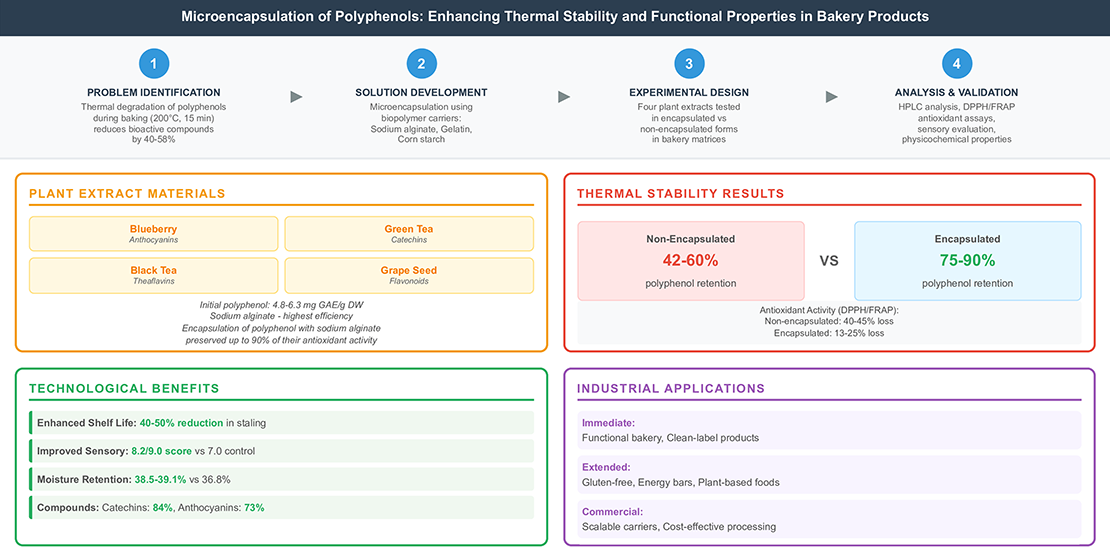
The object of this study was polyphenol-rich extracts obtained from black tea, grape seeds, green tea, and blueberries, incorporated into bakery matrices in both encapsulated and non-encapsulated forms. The research addressed the critical problem of thermal degradation of polyphenolic compounds during baking, which drastically reduces their antioxidant capacity and limits their application as functional ingredients in food systems. Experimental results demonstrated that microencapsulation using food-grade biopolymeric carriers – especially sodium alginate – significantly enhanced the thermal stability and retention of polyphenols during high-temperature processing. Non-encapsulated samples retained only 42–60% of their initial polyphenol content post-baking, while encapsulated forms preserved up to 90%, showing a clear technological advantage. Antioxidant activity, assessed via DPPH and FRAP assays, decreased by up to 45% in non-encapsulated products, whereas encapsulated variants maintained 75–90% of their original activity. HPLC analysis confirmed that encapsulation reduced the thermal degradation of individual compounds such as catechins, flavanones, and anthocyanins. These protective effects are attributed to the formation of a stabilizing polymeric matrix that shields bioactives from oxidation, limits interactions with gluten and starch, and ensures more uniform retention within the food matrix. Sensory analysis further demonstrated that the addition of encapsulated polyphenols enhanced aroma, texture, crumb softness, and color, especially in samples enriched with grape seed and green tea extracts. These findings confirm the practical feasibility of polyphenol encapsulation in commercial bakery workflows for producing clean-label, antioxidant-enriched functional baked goods with improved nutritional and technological properties and extended shelf life.
References
- Czajkowska-González, Y. A., Alvarez-Parrilla, E., del Rocío Martínez-Ruiz, N., Vázquez-Flores, A. A., Gaytán-Martínez, M., de la Rosa, L. A. (2021). Addition of phenolic compounds to bread: antioxidant benefits and impact on food structure and sensory characteristics. Food Production, Processing and Nutrition, 3 (1). https://doi.org/10.1186/s43014-021-00068-8
- Shahidi, F., Ambigaipalan, P. (2015). Phenolics and polyphenolics in foods, beverages and spices: Antioxidant activity and health effects – A review. Journal of Functional Foods, 18, 820–897. https://doi.org/10.1016/j.jff.2015.06.018
- Scalbert, A., Manach, C., Morand, C., Rémésy, C., Jiménez, L. (2005). Dietary Polyphenols and the Prevention of Diseases. Critical Reviews in Food Science and Nutrition, 45 (4), 287–306. https://doi.org/10.1080/1040869059096
- Rathod, N. B., Elabed, N., Punia, S., Ozogul, F., Kim, S.-K., Rocha, J. M. (2023). Recent Developments in Polyphenol Applications on Human Health: A Review with Current Knowledge. Plants, 12 (6), 1217. https://doi.org/10.3390/plants12061217
- Rana, A., Samtiya, M., Dhewa, T., Mishra, V., Aluko, R. E. (2022). Health benefits of polyphenols: A concise review. Journal of Food Biochemistry, 46 (10). https://doi.org/10.1111/jfbc.14264
- Briguglio, G., Costa, C., Pollicino, M., Giambò, F., Catania, S., Fenga, C. (2020). Polyphenols in cancer prevention: New insights (Review). International Journal of Functional Nutrition, 1 (2). https://doi.org/10.3892/ijfn.2020.9
- Somerville, V., Bringans, C., Braakhuis, A. (2017). Polyphenols and Performance: A Systematic Review and Meta-Analysis. Sports Medicine, 47 (8), 1589–1599. https://doi.org/10.1007/s40279-017-0675-5
- Cao, G., Zuo, J., Wu, B., Wu, Y. (2024). Polyphenol supplementation boosts aerobic endurance in athletes: systematic review. Frontiers in Physiology, 15. https://doi.org/10.3389/fphys.2024.1369174
- Abdel-Aal, E.-S. M., Rabalski, I. (2022). Changes in Phenolic Acids and Antioxidant Properties during Baking of Bread and Muffin Made from Blends of Hairless Canary Seed, Wheat, and Corn. Antioxidants, 11 (6), 1059. https://doi.org/10.3390/antiox11061059
- Tolve, R., Bianchi, F., Lomuscio, E., Sportiello, L., Simonato, B. (2022). Current Advantages in the Application of Microencapsulation in Functional Bread Development. Foods, 12 (1), 96. https://doi.org/10.3390/foods12010096
- Gil, J. V., Esteban-Muñoz, A., Fernández-Espinar, M. T. (2021). Changes in the Polyphenolic Profile and Antioxidant Activity of Wheat Bread after Incorporating Quinoa Flour. Antioxidants, 11 (1), 33. https://doi.org/10.3390/antiox11010033
- Lachowicz, S., Świeca, M., Pejcz, E. (2021). Biological activity, phytochemical parameters, and potential bioaccessibility of wheat bread enriched with powder and microcapsules made from Saskatoon berry. Food Chemistry, 338, 128026. https://doi.org/10.1016/j.foodchem.2020.128026
- Granato, D., Barba, F. J., Bursać Kovačević, D., Lorenzo, J. M., Cruz, A. G., Putnik, P. (2020). Functional Foods: Product Development, Technological Trends, Efficacy Testing, and Safety. Annual Review of Food Science and Technology, 11 (1), 93–118. https://doi.org/10.1146/annurev-food-032519-051708
- Pasrija, D., Ezhilarasi, P. N., Indrani, D., Anandharamakrishnan, C. (2015). Microencapsulation of green tea polyphenols and its effect on incorporated bread quality. LWT – Food Science and Technology, 64 (1), 289–296. https://doi.org/10.1016/j.lwt.2015.05.054
- Chen, L., Gnanaraj, C., Arulselvan, P., El-Seedi, H., Teng, H. (2019). A review on advanced microencapsulation technology to enhance bioavailability of phenolic compounds: Based on its activity in the treatment of Type 2 Diabetes. Trends in Food Science & Technology, 85, 149–162. https://doi.org/10.1016/j.tifs.2018.11.026
- Akbarbaglu, Z., Peighambardoust, S. H., Sarabandi, K., Jafari, S. M. (2021). Spray drying encapsulation of bioactive compounds within protein-based carriers; different options and applications. Food Chemistry, 359, 129965. https://doi.org/10.1016/j.foodchem.2021.129965
- Alu’datt, M. H., Alrosan, M., Gammoh, S., Tranchant, C. C., Alhamad, M. N., Rababah, T. et al. (2022). Encapsulation-based technologies for bioactive compounds and their application in the food industry: A roadmap for food-derived functional and health-promoting ingredients. Food Bioscience, 50, 101971. https://doi.org/10.1016/j.fbio.2022.101971
- Dahiya, D., Terpou, A., Dasenaki, M., Nigam, P. S. (2023). Current status and future prospects of bioactive molecules delivered through sustainable encapsulation techniques for food fortification. Sustainable Food Technology, 1 (4), 500–510. https://doi.org/10.1039/d3fb00015j
- Qazi, H. J., Ye, A., Acevedo-Fani, A., Singh, H. (2024). Delivery of encapsulated bioactive compounds within food matrices to the digestive tract: recent trends and future perspectives. Critical Reviews in Food Science and Nutrition, 65 (15), 2921–2942. https://doi.org/10.1080/10408398.2024.2353366
- Bińkowska, W., Szpicer, A., Wojtasik-Kalinowska, I., Półtorak, A. (2024). Innovative Methods of Encapsulation and Enrichment of Cereal-Based Pasta Products with Biofunctional Compounds. Applied Sciences, 14 (4), 1442. https://doi.org/10.3390/app14041442
- Colantuono, A., Ferracane, R., Vitaglione, P. (2018). Potential bioaccessibility and functionality of polyphenols and cynaropicrin from breads enriched with artichoke stem. Food Chemistry, 245, 838–844. https://doi.org/10.1016/j.foodchem.2017.11.099
- Kamali Rousta, L., Bodbodak, S., Nejatian, M., Ghandehari Yazdi, A. P., Rafiee, Z., Xiao, J., Jafari, S. M. (2021). Use of encapsulation technology to enrich and fortify bakery, pasta, and cereal-based products. Trends in Food Science & Technology, 118, 688–710. https://doi.org/10.1016/j.tifs.2021.10.029
- Martirosyan, D. M., Singh, J. (2015). A new definition of functional food by FFC: what makes a new definition unique? Functional Foods in Health and Disease, 5 (6), 209–223. https://doi.org/10.31989/ffhd.v5i6.183
- ISO 14502-1:2005. Determination of substances characteristic of green and black tea – Part 1: Content of total polyphenols in tea – Colorimetric method using Folin-Ciocalteu reagent (2005). International Organization for Standardization (ISO). Available at: https://www.iso.org/standard/31356.html
- Lee, J., Durst, R., Wrolstad, R. E. (2006). AOAC 2005.02: Total monomeric anthocyanin pigment content of fruit juices, beverages, natural colorants, and wines. Official Methods of Analysis of AOAC International. AOAC International, 37–39. Available at: https://www.researchgate.net/publication/260264533_AOAC_200502_Total_Monomeric_Anthocyanin_Pigment_Content_of_Fruit_Juices_Beverages_Natural_Colorants_and_Wines-_pH_Differential_Method
- Brand-Williams, W., Cuvelier, M. E., Berset, C. (1995). Use of a free radical method to evaluate antioxidant activity. LWT – Food Science and Technology, 28 (1), 25–30. https://doi.org/10.1016/s0023-6438(95)80008-5
- Benzie, I. F. F., Strain, J. J. (1996). The Ferric Reducing Ability of Plasma (FRAP) as a Measure of “Antioxidant Power”: The FRAP Assay. Analytical Biochemistry, 239 (1), 70–76. https://doi.org/10.1006/abio.1996.0292
- ISO 14502-2:2005. Determination of substances characteristic of green and black tea – Part 2: Content of catechins in green tea – Method using high-performance liquid chromatography (2005). International Organization for Standardization (ISO). Available at: https://www.iso.org/standard/31357.html
- ISO 8586:2023. Sensory analysis – Selection and training of sensory assessors (2023). International Organization for Standardization (ISO). Available at: https://www.iso.org/standard/76667.html
- ISO 712-1:2024. Cereals and cereal products – Determination of moisture content – Part 1: Reference method (2024). International Organization for Standardization (ISO). Available at: https://www.iso.org/standard/85395.html
Downloads
Published
How to Cite
Issue
Section
License
Copyright (c) 2025 Sofiia Chernenko

This work is licensed under a Creative Commons Attribution 4.0 International License.
The consolidation and conditions for the transfer of copyright (identification of authorship) is carried out in the License Agreement. In particular, the authors reserve the right to the authorship of their manuscript and transfer the first publication of this work to the journal under the terms of the Creative Commons CC BY license. At the same time, they have the right to conclude on their own additional agreements concerning the non-exclusive distribution of the work in the form in which it was published by this journal, but provided that the link to the first publication of the article in this journal is preserved.





