Інкапсуляція поліфенолів у хлібобулочних виробах: стратегія підвищення стабільності та антиоксидантної активності
DOI:
https://doi.org/10.15587/2706-5448.2025.332998Ключові слова:
інкапсуляція, поліфеноли, термічна стабільність, окислювальний стрес, біополімерні носії, альгінат натріюАнотація
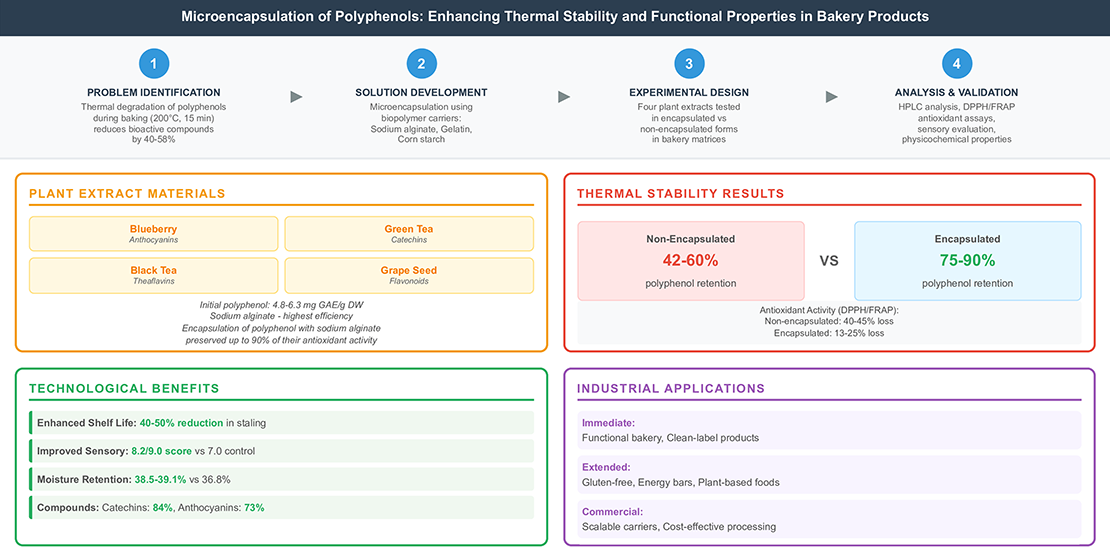
Об'єктом цього дослідження були екстракти, багаті на поліфеноли, отримані з чорного чаю, виноградних кісточок, зеленого чаю та чорниці, включені до складу хлібобулочних виробів як в інкапсульованій, так і в неінкапсульованій формі. Дослідження було присвячене критичній проблемі термічного розкладу поліфенольних сполук під час випікання, що різко знижує їх антиоксидантну здатність і обмежує їх застосування як функціональних інгредієнтів у харчових системах. Результати експерименту продемонстрували, що мікрокапсулювання з використанням харчових біополімерних носіїв, особливо альгінату натрію, значно підвищило термічну стабільність і збереження поліфенолів під час високотемпературної обробки. Некапсульовані зразки зберегли лише 42–60% від початкового вмісту поліфенолів після випікання, тоді як капсульовані форми зберегли до 90%, продемонструвавши очевидну технологічну перевагу. Антиоксидантна активність, оцінена за допомогою тестів DPPH і FRAP, знизилася на 45% у неінкапсульованих продуктах, тоді як інкапсульовані варіанти зберегли 75–90% своєї початкової активності. Аналіз HPLC підтвердив, що інкапсуляція зменшила термічну деградацію окремих сполук, таких як катехіни, флаванони та антоціани. Ці захисні ефекти пояснюються утворенням стабілізуючої полімерної матриці, яка захищає біоактивні речовини від окислення, обмежує взаємодію з глютеном і крохмалем та забезпечує більш рівномірне утримання в матриці харчового продукту. Сенсорний аналіз також продемонстрував, що додавання інкапсульованих поліфенолів покращило аромат, текстуру, м'якість м'якушки та колір, особливо в зразках, збагачених екстрактами виноградних кісточок і зеленого чаю. Ці результати підтверджують практичну доцільність інкапсуляції поліфенолів у комерційних хлібопекарських технологічних процесах для виробництва функціональних хлібобулочних виробів з чистим складом, збагачених антиоксидантами, з поліпшеними поживними та технологічними властивостями та подовженим терміном зберігання.
Посилання
- Czajkowska-González, Y. A., Alvarez-Parrilla, E., del Rocío Martínez-Ruiz, N., Vázquez-Flores, A. A., Gaytán-Martínez, M., de la Rosa, L. A. (2021). Addition of phenolic compounds to bread: antioxidant benefits and impact on food structure and sensory characteristics. Food Production, Processing and Nutrition, 3 (1). https://doi.org/10.1186/s43014-021-00068-8
- Shahidi, F., Ambigaipalan, P. (2015). Phenolics and polyphenolics in foods, beverages and spices: Antioxidant activity and health effects – A review. Journal of Functional Foods, 18, 820–897. https://doi.org/10.1016/j.jff.2015.06.018
- Scalbert, A., Manach, C., Morand, C., Rémésy, C., Jiménez, L. (2005). Dietary Polyphenols and the Prevention of Diseases. Critical Reviews in Food Science and Nutrition, 45 (4), 287–306. https://doi.org/10.1080/1040869059096
- Rathod, N. B., Elabed, N., Punia, S., Ozogul, F., Kim, S.-K., Rocha, J. M. (2023). Recent Developments in Polyphenol Applications on Human Health: A Review with Current Knowledge. Plants, 12 (6), 1217. https://doi.org/10.3390/plants12061217
- Rana, A., Samtiya, M., Dhewa, T., Mishra, V., Aluko, R. E. (2022). Health benefits of polyphenols: A concise review. Journal of Food Biochemistry, 46 (10). https://doi.org/10.1111/jfbc.14264
- Briguglio, G., Costa, C., Pollicino, M., Giambò, F., Catania, S., Fenga, C. (2020). Polyphenols in cancer prevention: New insights (Review). International Journal of Functional Nutrition, 1 (2). https://doi.org/10.3892/ijfn.2020.9
- Somerville, V., Bringans, C., Braakhuis, A. (2017). Polyphenols and Performance: A Systematic Review and Meta-Analysis. Sports Medicine, 47 (8), 1589–1599. https://doi.org/10.1007/s40279-017-0675-5
- Cao, G., Zuo, J., Wu, B., Wu, Y. (2024). Polyphenol supplementation boosts aerobic endurance in athletes: systematic review. Frontiers in Physiology, 15. https://doi.org/10.3389/fphys.2024.1369174
- Abdel-Aal, E.-S. M., Rabalski, I. (2022). Changes in Phenolic Acids and Antioxidant Properties during Baking of Bread and Muffin Made from Blends of Hairless Canary Seed, Wheat, and Corn. Antioxidants, 11 (6), 1059. https://doi.org/10.3390/antiox11061059
- Tolve, R., Bianchi, F., Lomuscio, E., Sportiello, L., Simonato, B. (2022). Current Advantages in the Application of Microencapsulation in Functional Bread Development. Foods, 12 (1), 96. https://doi.org/10.3390/foods12010096
- Gil, J. V., Esteban-Muñoz, A., Fernández-Espinar, M. T. (2021). Changes in the Polyphenolic Profile and Antioxidant Activity of Wheat Bread after Incorporating Quinoa Flour. Antioxidants, 11 (1), 33. https://doi.org/10.3390/antiox11010033
- Lachowicz, S., Świeca, M., Pejcz, E. (2021). Biological activity, phytochemical parameters, and potential bioaccessibility of wheat bread enriched with powder and microcapsules made from Saskatoon berry. Food Chemistry, 338, 128026. https://doi.org/10.1016/j.foodchem.2020.128026
- Granato, D., Barba, F. J., Bursać Kovačević, D., Lorenzo, J. M., Cruz, A. G., Putnik, P. (2020). Functional Foods: Product Development, Technological Trends, Efficacy Testing, and Safety. Annual Review of Food Science and Technology, 11 (1), 93–118. https://doi.org/10.1146/annurev-food-032519-051708
- Pasrija, D., Ezhilarasi, P. N., Indrani, D., Anandharamakrishnan, C. (2015). Microencapsulation of green tea polyphenols and its effect on incorporated bread quality. LWT – Food Science and Technology, 64 (1), 289–296. https://doi.org/10.1016/j.lwt.2015.05.054
- Chen, L., Gnanaraj, C., Arulselvan, P., El-Seedi, H., Teng, H. (2019). A review on advanced microencapsulation technology to enhance bioavailability of phenolic compounds: Based on its activity in the treatment of Type 2 Diabetes. Trends in Food Science & Technology, 85, 149–162. https://doi.org/10.1016/j.tifs.2018.11.026
- Akbarbaglu, Z., Peighambardoust, S. H., Sarabandi, K., Jafari, S. M. (2021). Spray drying encapsulation of bioactive compounds within protein-based carriers; different options and applications. Food Chemistry, 359, 129965. https://doi.org/10.1016/j.foodchem.2021.129965
- Alu’datt, M. H., Alrosan, M., Gammoh, S., Tranchant, C. C., Alhamad, M. N., Rababah, T. et al. (2022). Encapsulation-based technologies for bioactive compounds and their application in the food industry: A roadmap for food-derived functional and health-promoting ingredients. Food Bioscience, 50, 101971. https://doi.org/10.1016/j.fbio.2022.101971
- Dahiya, D., Terpou, A., Dasenaki, M., Nigam, P. S. (2023). Current status and future prospects of bioactive molecules delivered through sustainable encapsulation techniques for food fortification. Sustainable Food Technology, 1 (4), 500–510. https://doi.org/10.1039/d3fb00015j
- Qazi, H. J., Ye, A., Acevedo-Fani, A., Singh, H. (2024). Delivery of encapsulated bioactive compounds within food matrices to the digestive tract: recent trends and future perspectives. Critical Reviews in Food Science and Nutrition, 65 (15), 2921–2942. https://doi.org/10.1080/10408398.2024.2353366
- Bińkowska, W., Szpicer, A., Wojtasik-Kalinowska, I., Półtorak, A. (2024). Innovative Methods of Encapsulation and Enrichment of Cereal-Based Pasta Products with Biofunctional Compounds. Applied Sciences, 14 (4), 1442. https://doi.org/10.3390/app14041442
- Colantuono, A., Ferracane, R., Vitaglione, P. (2018). Potential bioaccessibility and functionality of polyphenols and cynaropicrin from breads enriched with artichoke stem. Food Chemistry, 245, 838–844. https://doi.org/10.1016/j.foodchem.2017.11.099
- Kamali Rousta, L., Bodbodak, S., Nejatian, M., Ghandehari Yazdi, A. P., Rafiee, Z., Xiao, J., Jafari, S. M. (2021). Use of encapsulation technology to enrich and fortify bakery, pasta, and cereal-based products. Trends in Food Science & Technology, 118, 688–710. https://doi.org/10.1016/j.tifs.2021.10.029
- Martirosyan, D. M., Singh, J. (2015). A new definition of functional food by FFC: what makes a new definition unique? Functional Foods in Health and Disease, 5 (6), 209–223. https://doi.org/10.31989/ffhd.v5i6.183
- ISO 14502-1:2005. Determination of substances characteristic of green and black tea – Part 1: Content of total polyphenols in tea – Colorimetric method using Folin-Ciocalteu reagent (2005). International Organization for Standardization (ISO). Available at: https://www.iso.org/standard/31356.html
- Lee, J., Durst, R., Wrolstad, R. E. (2006). AOAC 2005.02: Total monomeric anthocyanin pigment content of fruit juices, beverages, natural colorants, and wines. Official Methods of Analysis of AOAC International. AOAC International, 37–39. Available at: https://www.researchgate.net/publication/260264533_AOAC_200502_Total_Monomeric_Anthocyanin_Pigment_Content_of_Fruit_Juices_Beverages_Natural_Colorants_and_Wines-_pH_Differential_Method
- Brand-Williams, W., Cuvelier, M. E., Berset, C. (1995). Use of a free radical method to evaluate antioxidant activity. LWT – Food Science and Technology, 28 (1), 25–30. https://doi.org/10.1016/s0023-6438(95)80008-5
- Benzie, I. F. F., Strain, J. J. (1996). The Ferric Reducing Ability of Plasma (FRAP) as a Measure of “Antioxidant Power”: The FRAP Assay. Analytical Biochemistry, 239 (1), 70–76. https://doi.org/10.1006/abio.1996.0292
- ISO 14502-2:2005. Determination of substances characteristic of green and black tea – Part 2: Content of catechins in green tea – Method using high-performance liquid chromatography (2005). International Organization for Standardization (ISO). Available at: https://www.iso.org/standard/31357.html
- ISO 8586:2023. Sensory analysis – Selection and training of sensory assessors (2023). International Organization for Standardization (ISO). Available at: https://www.iso.org/standard/76667.html
- ISO 712-1:2024. Cereals and cereal products – Determination of moisture content – Part 1: Reference method (2024). International Organization for Standardization (ISO). Available at: https://www.iso.org/standard/85395.html
##submission.downloads##
Опубліковано
Як цитувати
Номер
Розділ
Ліцензія
Авторське право (c) 2025 Sofiia Chernenko

Ця робота ліцензується відповідно до Creative Commons Attribution 4.0 International License.
Закріплення та умови передачі авторських прав (ідентифікація авторства) здійснюється у Ліцензійному договорі. Зокрема, автори залишають за собою право на авторство свого рукопису та передають журналу право першої публікації цієї роботи на умовах ліцензії Creative Commons CC BY. При цьому вони мають право укладати самостійно додаткові угоди, що стосуються неексклюзивного поширення роботи у тому вигляді, в якому вона була опублікована цим журналом, але за умови збереження посилання на першу публікацію статті в цьому журналі.