Biochemical variability of vegetable juice powders: a key factor in modulating the physicochemical properties and safety profile of vegan fermented sausages
DOI:
https://doi.org/10.15587/2706-5448.2025.334830Keywords:
meat analogues, natural curing, ethnic cuisine, organic ingredients, future foodsAbstract
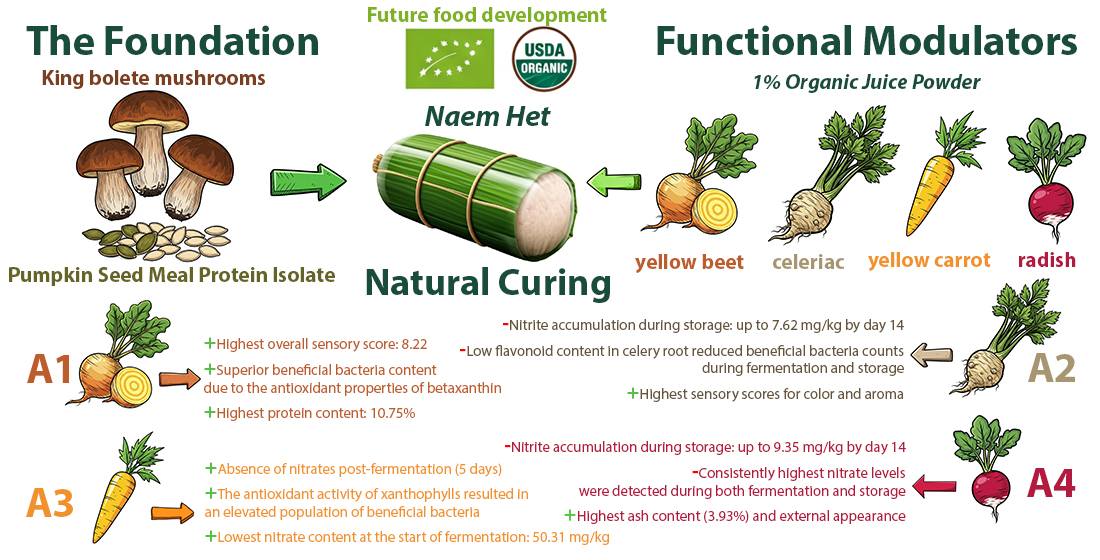
This research focuses on developing Thai mushroom vegan sausages (Naem Het) with improved quality and safety profiles by incorporating pumpkin seed protein isolate (PSMPI) and vegetable juice powders (yellow beet, celeriac, yellow carrot, radish) as functional ingredients. Their effects on sensory and microbiological parameters, nutritional value, and stability were evaluated. The growing demand for plant-based meat analogues necessitates the development of high-quality fermented products. A key challenge remains the achievement of desirable characteristics without synthetic additives; therefore, the use of vegetable juices as natural nitrite precursors in mushroom-based systems is a promising but under-researched area. Five formulations (A0 and 4 experimental ones) were analyzed for their chemical composition, microbiological parameters (aerobic mesophilic bacteria, lactic acid bacteria, coliforms, pH, ), and sensory properties during fermentation and 14 days of storage. It was found that PSMPI significantly increased the protein content (from 8.50% in A0 to 10.75% in A1) and improved the texture. The vegetable powders effectively served as sources of , modulating microbial activity. Based on a comprehensive evaluation, the samples with beetroot (A1) and carrot (A3) were identified as the best. They exhibited superior sensory profiles compared to the control A0 (7.87), receiving the highest overall scores on a 9-point scale – 8.22 (A1) and 8.12 (A3) – and demonstrated optimal microbiological stability (pH 4.49–4.51, LAB ≈ 8.3–8.5 log10 CFU / g). This comprehensive positive effect was attributed to the high content of pigments with antioxidant properties in these vegetables, which facilitated a controlled fermentation. In contrast, in the samples with celery and radish, a significantly lower pigment content impaired the bacterial reduction of their extremely high initial content (270–290 mg / kg), leading to a unique dynamic and maximal accumulation of .Thus, this research confirms that the judicious selection of vegetable juice powder is an effective tool for creating high-quality, safe, and sensorially appealing vegan fermented products.
References
- The State of Food Security and Nutrition in the World 2024: Financing to end hunger, food insecurity and malnutrition in all its forms (2024). FAO. https://doi.org/10.4060/cd1254en
- Climate change 2023: Synthesis report (2023). Contribution of Working Groups I, II and III to the Sixth Assessment Report of the Intergovernmental Panel on Climate Change. Available at: https://www.ipcc.ch/report/ar6/syr/
- Drangert, J.-O. (2024). City Residents Play a Pivotal Role in Managing Global Food Security While Improving Human Health and Minimizing Environmental Footprints. Nutrients, 16 (23), 4176. https://doi.org/10.3390/nu16234176
- Samad, H. A., Kumar Eshwaran, V., Muquit, S. P., Sharma, L., Arumugam, H., Kant, L. et al. (2025). Sustainable Livestock Solutions: Addressing Carbon Footprint Challenges from Indian and Global Perspectives. Sustainability, 17 (5), 2105. https://doi.org/10.3390/su17052105
- Gupta, A., Keast, R., Liem, D. G., Jadhav, S. R., Mahato, D. K., Gamlath, S. (2025). Barista-Quality Plant-Based Milk for Coffee: A Comprehensive Review of Sensory and Physicochemical Characteristics. Beverages, 11 (1), 24. https://doi.org/10.3390/beverages11010024
- Vasylenko, O., Pasichnyi, V., Holovko, T., Lapytska, N., Golovko, M., Xuanxuan, Q., Yanghe, L. (2023). Nanosized Chitosan and Plasma-Activated Water: Improving the Microbiological and Physicochemical Properties of Vetch (Vicia sativa L.) Bean Sprouts. 2023 IEEE 13th International Conference Nanomaterials: Applications & Properties (NAP), IMT10-1-IMT10-7. https://doi.org/10.1109/nap59739.2023.10310729
- Runhaar, H. (2025). Governing towards sustainable food systems: new connections for more diversity. International Journal of Agricultural Sustainability, 23 (1). https://doi.org/10.1080/14735903.2025.2475254
- Golovko, N., Golovko, T., Gelikh, A. (2015). Investigation of amino acid structure of proteins of freshwater bivalve mussels from the genus anodonta of the northern Ukraine. Eastern-European Journal of Enterprise Technologies, 5 (11 (77)), 10–16. https://doi.org/10.15587/1729-4061.2015.51072
- Sarmento, T. C., Ferreira, R. dos S., Franco, O. L. (2024). Plant-Based Diet and Sports Performance. ACS Omega, 9 (49), 47939–47950. https://doi.org/10.1021/acsomega.4c07560
- Tian, X., Tian, Y., Meng, S., Zhao, J., Shao, L., Li, Y., Wang, W. (2025). A rethinking of nitrate, nitrite, and nitric oxide for food preservation and human health. Food Science and Human Wellness. https://doi.org/10.26599/fshw.2024.9250434
- Membrino, V., Di Paolo, A., Di Crescenzo, T., Cecati, M., Alia, S., Vignini, A. (2025). Effects of Animal-Based and Plant-Based Nitrates and Nitrites on Human Health: Beyond Nitric Oxide Production. Biomolecules, 15 (2), 236. https://doi.org/10.3390/biom15020236
- Knez, E., Hałasa, R., Turecka, K., Ośko, J., Kadac-Czapska, K., Waleron, K., Grembecka, M. (2024). Microbiological Safety and Health Properties of Marketed Fermented Root Vegetables. Applied Sciences, 15 (1), 121. https://doi.org/10.3390/app15010121
- Andrade, B. F., Carmo, L. R. do, Tanaka, M. S., Torres Filho, R. de A., Ramos, A. de L. S., Ramos, E. M. (2025). Evaluation of Nonthermal Technologies to Reduce or Replace Nitrite in Meat Products. Food Technology and Biotechnology, 63 (1), 94–108. https://doi.org/10.17113/ftb.63.01.25.8744
- Helikh, A., Filon, A. (2025). Study of the amino acid profile of alternative proteins (Helix pomatia, Lissachatina fulica, Helix aspersa) and their potential application in a healthy diet: optimization of a modern brandade recipe. Technology Audit and Production Reserves, 2 (3 (82)), 71–79. https://doi.org/10.15587/2706-5448.2025.326896
- Liu, Y., Helikh, A., Filon, A., Duan, Z. (2023). Sausage technology for food sustainability: recipe, color, nutrition, structure. Eastern-European Journal of Enterprise Technologies, 4 (11 (124)), 47–58. https://doi.org/10.15587/1729-4061.2023.286323
- Onwezen, M. C., Nassar, G., Bouma, J. A. (2025). Change Meat Resistance: Systematic Literature Review on Consumer Resistance to the Alternative Protein Transition. Annual Review of Food Science and Technology, 16 (1), 127–146. https://doi.org/10.1146/annurev-food-111523-121744
- Baig, M. A., Ajayi, F. F., Hamdi, M., Baba, W., Brishti, F. H., Khalid, N. et al. (2024). Recent Research Advances in Meat Analogues: A Comprehensive Review on Production, Protein Sources, Quality Attributes, Analytical Techniques Used, and Consumer Perception. Food Reviews International, 41 (1), 236–267. https://doi.org/10.1080/87559129.2024.2396855
- Pasichnyi, V., Marynin, A., Moroz, E., Geredchuk, A. (2015). Development of combined protein-fat emulsions for sausage and semifinished products with poultry meat. Eastern-European Journal of Enterprise Technologies, 1 (6 (73)), 32–38. https://doi.org/10.15587/1729-4061.2015.36232
- Samad, A., Kim, S.-H., Kim, C.-J., Lee, E.-Y., Kumari, S., Hossain, M. J., Alam, A. N., Muazzam, A., Hwang, Y.-H., Joo, S.-T. (2025). From Farms to Labs: The New Trend of Sustainable Meat Alternatives. Food Science of Animal Resources, 45 (1), 13–30. https://doi.org/10.5851/kosfa.2024.e105
- Ali, A., Bharali, P. (2025). The rise of plant-based meat alternatives: Challenges and perspectives. Food Bioscience, 68, 106640. https://doi.org/10.1016/j.fbio.2025.106640
- Liu, Y., Helikh, A. O., Filon, A. M., Tang, X.-X., Duan, Z.-H., Ren, A.-Q. (2024). Beetroot (Beta vulgaris L. var. conditiva Alef.) pretreated by freeze-thaw: influence of drying methods on the quality characteristics. CyTA – Journal of Food, 22 (1), 1–12. https://doi.org/10.1080/19476337.2023.2295421
- Gao, D., Helikh, A., Filon, A., Duan, Z., Vasylenko, O. (2022). Effect of pH-shifting treatment on the gel properties of pumpkin seed protein isolate. Journal of Chemistry and Technologies, 30 (2), 198–204. https://doi.org/10.15421/jchemtech.v30i2.241145
- Official methods of analysis of AOAC International (2022). AOAC International.
- Salfinger, Y., Tortorello, M. L. (Eds.) (2015). Compendium of methods for the microbiological examinations of foods. Washington: American Public Health Association. https://doi.org/10.2105/mbef.0222
- ISO 15214 Microbiology of food and animal feeding stuffs – Horizontal method for the enumeration of mesophilic lactic acid bacteria – Colony-count technique at 30 degrees C (1998). International Organization for Standardization. Available at: https://www.iso.org/standard/26853.html
- Lawless, H. T., Heymann, H. (2010). Sensory evaluation of food: Principles and practices. Springer Science & Business Media. https://doi.org/10.1007/978-1-4419-6488-5
- Pasakornrawong, P. (1908). Mae Khrua Hua Pa.
- Prymenko, V., Sefikhanova, K., Helikh, A., Golovko, M., Vasylenko, O. (2022). Choice justification of dairy raw materials according to indicators of their structure for obtaining selenium-protein dietary supplements. Journal of Chemistry and Technologies, 30 (1), 79–87. https://doi.org/10.15421/jchemtech.v30i1.241139
- Alasi, S. O., Sanusi, M. S., Sunmonu, M. O., Odewole, M. M., Adepoju, A. L. (2024). Exploring recent developments in novel technologies and AI integration for plant-based protein functionality: A review. Journal of Agriculture and Food Research, 15, 101036. https://doi.org/10.1016/j.jafr.2024.101036
Downloads
Published
How to Cite
Issue
Section
License
Copyright (c) 2025 Anna Helikh, Andrii Filon

This work is licensed under a Creative Commons Attribution 4.0 International License.
The consolidation and conditions for the transfer of copyright (identification of authorship) is carried out in the License Agreement. In particular, the authors reserve the right to the authorship of their manuscript and transfer the first publication of this work to the journal under the terms of the Creative Commons CC BY license. At the same time, they have the right to conclude on their own additional agreements concerning the non-exclusive distribution of the work in the form in which it was published by this journal, but provided that the link to the first publication of the article in this journal is preserved.





