Біохімічна варіативність порошків з овочевих соків: ключовий фактор модуляції фізико-хімічних властивостей та профілю безпеки веганських ферментованих ковбасок
DOI:
https://doi.org/10.15587/2706-5448.2025.334830Ключові слова:
м’ясні аналоги, натуральне курування, етнічна кухня, органічні інгредієнти, їжа майбутньогоАнотація
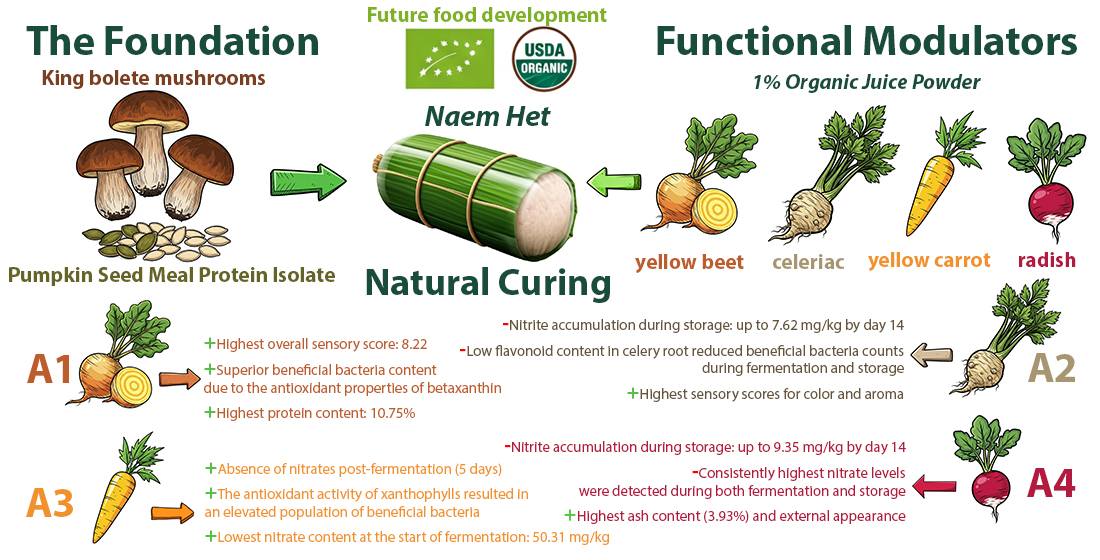
Це дослідження зосереджено на розробці тайських грибних веганських ковбасок (Naem Het) з покращеними характеристиками якості та безпеки шляхом використання ізоляту білка насіння гарбуза (PSMPI) та порошків з овочевих соків (жовтого буряка, селери, жовтої моркви, редиски) як функціональних інгредієнтів. Оцінювали їхній вплив на сенсорні, мікробіологічні показники, харчову цінність та стабільність. Зростання попиту на рослинні аналоги м'яса потребує створення якісних ферментованих продуктів. Ключовим викликом залишається досягнення бажаних характеристик без синтетичних добавок, тому використання овочевих соків як натуральних прекурсорів нітритів у грибних системах є перспективним, але малодослідженим напрямом. Проаналізовано п’ять рецептур (А0 і 4 дослідні) за хімічним складом, мікробіологічними показниками (АМБ, МКБ, коліформи, pH, ) та сенсорними властивостями протягом ферментації й 14 діб зберігання. Встановлено, що PSMPI значно підвищив вміст білка (з 8.50% у А0 до 10.75% у А1) та покращив текстуру. Овочеві порошки ефективно слугували джерелами , модулюючи мікробіологічну активність. За сукупністю показників, зразки з буряком (А1) та морквою (А3) визнано найкращими. Вони продемонстрували кращі сенсорні профілі порівняно з контролем А0 (7.87), отримавши найвищі загальні оцінки за 9-бальною шкалою – 8.22 (А1) та 8.12 (А3), та оптимальну мікробіологічну стабільність (pH 4.49–4.51, МКБ ≈ 8.3–8.5 log10 КУО / г). Такий комплексний позитивний ефект пояснюється високим вмістом у цих овочах пігментів з антиоксидантними властивостями, що сприяло контрольованій ферментації. Натомість у зразках із селерою та редискою значно нижчий вміст пігментів послабив бактеріальну редукцію їхнього надзвичайно високого початкового вмісту (270–290 мг / кг), що й спричинило унікальну динаміку та максимальне накопичення . Отже, дослідження підтверджує, що правильний вибір порошку овочевого соку є ефективним інструментом для створення якісних, безпечних та сенсорно привабливих веганських ферментованих продуктів.
Посилання
- The State of Food Security and Nutrition in the World 2024: Financing to end hunger, food insecurity and malnutrition in all its forms (2024). FAO. https://doi.org/10.4060/cd1254en
- Climate change 2023: Synthesis report (2023). Contribution of Working Groups I, II and III to the Sixth Assessment Report of the Intergovernmental Panel on Climate Change. Available at: https://www.ipcc.ch/report/ar6/syr/
- Drangert, J.-O. (2024). City Residents Play a Pivotal Role in Managing Global Food Security While Improving Human Health and Minimizing Environmental Footprints. Nutrients, 16 (23), 4176. https://doi.org/10.3390/nu16234176
- Samad, H. A., Kumar Eshwaran, V., Muquit, S. P., Sharma, L., Arumugam, H., Kant, L. et al. (2025). Sustainable Livestock Solutions: Addressing Carbon Footprint Challenges from Indian and Global Perspectives. Sustainability, 17 (5), 2105. https://doi.org/10.3390/su17052105
- Gupta, A., Keast, R., Liem, D. G., Jadhav, S. R., Mahato, D. K., Gamlath, S. (2025). Barista-Quality Plant-Based Milk for Coffee: A Comprehensive Review of Sensory and Physicochemical Characteristics. Beverages, 11 (1), 24. https://doi.org/10.3390/beverages11010024
- Vasylenko, O., Pasichnyi, V., Holovko, T., Lapytska, N., Golovko, M., Xuanxuan, Q., Yanghe, L. (2023). Nanosized Chitosan and Plasma-Activated Water: Improving the Microbiological and Physicochemical Properties of Vetch (Vicia sativa L.) Bean Sprouts. 2023 IEEE 13th International Conference Nanomaterials: Applications & Properties (NAP), IMT10-1-IMT10-7. https://doi.org/10.1109/nap59739.2023.10310729
- Runhaar, H. (2025). Governing towards sustainable food systems: new connections for more diversity. International Journal of Agricultural Sustainability, 23 (1). https://doi.org/10.1080/14735903.2025.2475254
- Golovko, N., Golovko, T., Gelikh, A. (2015). Investigation of amino acid structure of proteins of freshwater bivalve mussels from the genus anodonta of the northern Ukraine. Eastern-European Journal of Enterprise Technologies, 5 (11 (77)), 10–16. https://doi.org/10.15587/1729-4061.2015.51072
- Sarmento, T. C., Ferreira, R. dos S., Franco, O. L. (2024). Plant-Based Diet and Sports Performance. ACS Omega, 9 (49), 47939–47950. https://doi.org/10.1021/acsomega.4c07560
- Tian, X., Tian, Y., Meng, S., Zhao, J., Shao, L., Li, Y., Wang, W. (2025). A rethinking of nitrate, nitrite, and nitric oxide for food preservation and human health. Food Science and Human Wellness. https://doi.org/10.26599/fshw.2024.9250434
- Membrino, V., Di Paolo, A., Di Crescenzo, T., Cecati, M., Alia, S., Vignini, A. (2025). Effects of Animal-Based and Plant-Based Nitrates and Nitrites on Human Health: Beyond Nitric Oxide Production. Biomolecules, 15 (2), 236. https://doi.org/10.3390/biom15020236
- Knez, E., Hałasa, R., Turecka, K., Ośko, J., Kadac-Czapska, K., Waleron, K., Grembecka, M. (2024). Microbiological Safety and Health Properties of Marketed Fermented Root Vegetables. Applied Sciences, 15 (1), 121. https://doi.org/10.3390/app15010121
- Andrade, B. F., Carmo, L. R. do, Tanaka, M. S., Torres Filho, R. de A., Ramos, A. de L. S., Ramos, E. M. (2025). Evaluation of Nonthermal Technologies to Reduce or Replace Nitrite in Meat Products. Food Technology and Biotechnology, 63 (1), 94–108. https://doi.org/10.17113/ftb.63.01.25.8744
- Helikh, A., Filon, A. (2025). Study of the amino acid profile of alternative proteins (Helix pomatia, Lissachatina fulica, Helix aspersa) and their potential application in a healthy diet: optimization of a modern brandade recipe. Technology Audit and Production Reserves, 2 (3 (82)), 71–79. https://doi.org/10.15587/2706-5448.2025.326896
- Liu, Y., Helikh, A., Filon, A., Duan, Z. (2023). Sausage technology for food sustainability: recipe, color, nutrition, structure. Eastern-European Journal of Enterprise Technologies, 4 (11 (124)), 47–58. https://doi.org/10.15587/1729-4061.2023.286323
- Onwezen, M. C., Nassar, G., Bouma, J. A. (2025). Change Meat Resistance: Systematic Literature Review on Consumer Resistance to the Alternative Protein Transition. Annual Review of Food Science and Technology, 16 (1), 127–146. https://doi.org/10.1146/annurev-food-111523-121744
- Baig, M. A., Ajayi, F. F., Hamdi, M., Baba, W., Brishti, F. H., Khalid, N. et al. (2024). Recent Research Advances in Meat Analogues: A Comprehensive Review on Production, Protein Sources, Quality Attributes, Analytical Techniques Used, and Consumer Perception. Food Reviews International, 41 (1), 236–267. https://doi.org/10.1080/87559129.2024.2396855
- Pasichnyi, V., Marynin, A., Moroz, E., Geredchuk, A. (2015). Development of combined protein-fat emulsions for sausage and semifinished products with poultry meat. Eastern-European Journal of Enterprise Technologies, 1 (6 (73)), 32–38. https://doi.org/10.15587/1729-4061.2015.36232
- Samad, A., Kim, S.-H., Kim, C.-J., Lee, E.-Y., Kumari, S., Hossain, M. J., Alam, A. N., Muazzam, A., Hwang, Y.-H., Joo, S.-T. (2025). From Farms to Labs: The New Trend of Sustainable Meat Alternatives. Food Science of Animal Resources, 45 (1), 13–30. https://doi.org/10.5851/kosfa.2024.e105
- Ali, A., Bharali, P. (2025). The rise of plant-based meat alternatives: Challenges and perspectives. Food Bioscience, 68, 106640. https://doi.org/10.1016/j.fbio.2025.106640
- Liu, Y., Helikh, A. O., Filon, A. M., Tang, X.-X., Duan, Z.-H., Ren, A.-Q. (2024). Beetroot (Beta vulgaris L. var. conditiva Alef.) pretreated by freeze-thaw: influence of drying methods on the quality characteristics. CyTA – Journal of Food, 22 (1), 1–12. https://doi.org/10.1080/19476337.2023.2295421
- Gao, D., Helikh, A., Filon, A., Duan, Z., Vasylenko, O. (2022). Effect of pH-shifting treatment on the gel properties of pumpkin seed protein isolate. Journal of Chemistry and Technologies, 30 (2), 198–204. https://doi.org/10.15421/jchemtech.v30i2.241145
- Official methods of analysis of AOAC International (2022). AOAC International.
- Salfinger, Y., Tortorello, M. L. (Eds.) (2015). Compendium of methods for the microbiological examinations of foods. Washington: American Public Health Association. https://doi.org/10.2105/mbef.0222
- ISO 15214 Microbiology of food and animal feeding stuffs – Horizontal method for the enumeration of mesophilic lactic acid bacteria – Colony-count technique at 30 degrees C (1998). International Organization for Standardization. Available at: https://www.iso.org/standard/26853.html
- Lawless, H. T., Heymann, H. (2010). Sensory evaluation of food: Principles and practices. Springer Science & Business Media. https://doi.org/10.1007/978-1-4419-6488-5
- Pasakornrawong, P. (1908). Mae Khrua Hua Pa.
- Prymenko, V., Sefikhanova, K., Helikh, A., Golovko, M., Vasylenko, O. (2022). Choice justification of dairy raw materials according to indicators of their structure for obtaining selenium-protein dietary supplements. Journal of Chemistry and Technologies, 30 (1), 79–87. https://doi.org/10.15421/jchemtech.v30i1.241139
- Alasi, S. O., Sanusi, M. S., Sunmonu, M. O., Odewole, M. M., Adepoju, A. L. (2024). Exploring recent developments in novel technologies and AI integration for plant-based protein functionality: A review. Journal of Agriculture and Food Research, 15, 101036. https://doi.org/10.1016/j.jafr.2024.101036
##submission.downloads##
Опубліковано
Як цитувати
Номер
Розділ
Ліцензія
Авторське право (c) 2025 Anna Helikh, Andrii Filon

Ця робота ліцензується відповідно до Creative Commons Attribution 4.0 International License.
Закріплення та умови передачі авторських прав (ідентифікація авторства) здійснюється у Ліцензійному договорі. Зокрема, автори залишають за собою право на авторство свого рукопису та передають журналу право першої публікації цієї роботи на умовах ліцензії Creative Commons CC BY. При цьому вони мають право укладати самостійно додаткові угоди, що стосуються неексклюзивного поширення роботи у тому вигляді, в якому вона була опублікована цим журналом, але за умови збереження посилання на першу публікацію статті в цьому журналі.