Analysis of sinusoidal transformation model of dark tone digital images
DOI:
https://doi.org/10.15587/2706-5448.2025.334896Keywords:
image, modeling, sinusoid, simulator, gradation, optics, density, contrast, sensitivity, qualityAbstract
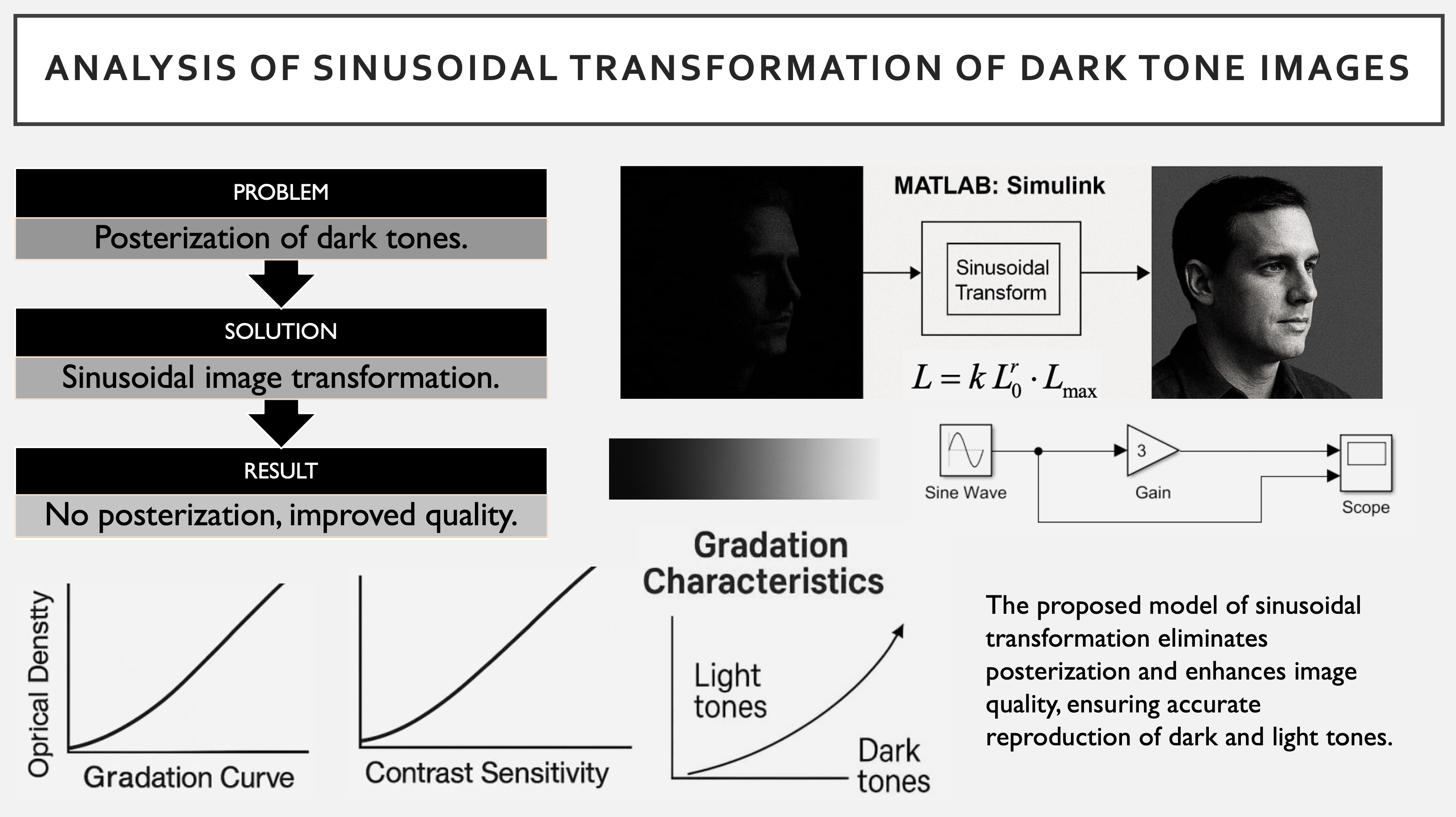
The object of the study is the technological process of sinusoidal transformation of dark tones into a digital image, used at the stage of preparation for printing. One of the most problematic areas is posterization, which occurs with traditional power-law gamma transformation, creating noticeable bands on the image that distort its quality and limit the capabilities of the operator, technologist, and printer.
The study employed mathematical modeling and quantization of gradation characteristics to eliminate these shortcomings. A mathematical model of sinusoidal transformation was developed, describing the brightness of the image in the range of 0 ≤ L ≤ 255 levels. A structural scheme of the simulator model was also created in MATLAB: Simulink, allowing for the calculation and plotting of gradation characteristics, optical density, and contrast sensitivity for different transformation frequencies.
As a result of the simulation, it was found that the sinusoidal transformation has significantly smaller initial quantization shifts (0.5–2 units) and first step lengths (1–2 levels) compared to the traditional gamma transformation (11–31 units and 10–15 levels, respectively). This eliminates posterization. The contrast sensitivity of the sinusoidal transformation increases up to 2.2, exceeding the constant value of 1 in the linear scale, which ensures improved tone perception. Thus, the proposed method demonstrates higher efficiency in reproducing images in both dark and light areas.
The results obtained demonstrate the absence of posterization in the sinusoidal transformation of dark tones. This is due to the proposed approach having several features, including a steeper gradation characteristic at the beginning of the range, which eliminates posterization of dark tones without losses in highlights. This ensures the ability to obtain high-quality images with improved gradation characteristics.
Compared to similar known methods, this provides advantages in the form of improved image quality and elimination of posterization, which is crucial for the quality preparation of images for printing. The results of the research and simulation modeling can be used to select optimal reproduction characteristics, ensuring improved perception of the printed image by the human visual system. This allows achieving high print quality without losses in detail and contrast, which is a significant advantage in the printing industry.
References
- Baranovskyi, I. V., Yakhymovych, Yu. P. (1998). Polihrafichna pererobka obrazotvorchoi informatsii. Kyiv-Lviv: IZMN, 400.
- Lotoshynska, N. D., Ivakhiv, O. V. (2014). Teoriia koloru ta koloroutvorennia. Lviv: Vydavnytstvo Lvivska politekhnika, 204.
- O’Quinn, D. (2003). Print publishing: A Hayden shop manual. Indianapolis: Hayden Books, 595.
- Malina, W., Ablaneyko, S., Pawlak, W. (2002). Podstawy cufrowego przetwarzania obrazow. Warsawa: Akademicka Oficyna Wydawnicza EXIT, 132.
- Hunko, S. M. (2010). Osnovy polihrafii (dodrukarski protsesy). Lviv: Ukrainska akademiia drukarstva, 160.
- Pashulia, P. L. (2011). Standartyzatsiia, metrolohiia, vidpovidnist, yakist u polihrafii. Lviv: Ukrainska akademiia drukarstva, 408.
- Gonzalez, R. C., Woods, R. E. (2018). Digital image processing. Pearson, 1022.
- Durnyak, B., Lutskiv, M., Shepita, P., Hunko, D., Savina, N. (2021). Formation of linear characteristics of normalized raster transformation for rhombic elements. Intelligent Information Technologies & System of Information Security, CEUR Workshop Proceedings, 2853, 127–133.
- Lutskiv, M. M. (2012). Tsyfrovi tekhnolohii drukarstva. Lviv: Ukrainska akademiia drukarstva, 488.
- Buchynski, L. (2005). Skanery i skanowanie. Warszawa: Wydawnictwo MIKOMA, 88.
- Vovk, S. M., Hnatushchenko, V. V., Bondarenko, M. V. (2016). Metody obrobky zobrazhen ta kompiuternyi zir. Dnipropetrovsk: Lira, 148.
- Lutskiv, M. M., Serdiuk, Yu. Yu. (2023). Synusoidalne peretvorennia tsyfrovykh zobrazhen. Kompiuterni tekhnolohii drukarstva, 1 (48), 45–54.
- Havrysh, B. M., Durniak, B. V., Tymchenko, O. V., Yushchyk, O. V. (2016). Vidtvorennia zobrazhen rastrovymy skanuiuchymy prystroiamy. Lviv: NVLPT UAD, 180.
- Martyniuk, V. T. (2009). Osnovy dodrukarskoi pidhotovky obrazotvorchoi informatsii: Kn. 2: Osnovy opratsiuvannia obrazotvorchoi informatsii. Kyiv: Universytet “Ukraina”, 291.
- Vorobel, R. A. (2012). Loharyfmichna obrobka zobrazhen. Kyiv: Naukova dumka, 232.
Downloads
Published
How to Cite
Issue
Section
License
Copyright (c) 2025 Mykola Lutskiv, Yura Serdyuk

This work is licensed under a Creative Commons Attribution 4.0 International License.
The consolidation and conditions for the transfer of copyright (identification of authorship) is carried out in the License Agreement. In particular, the authors reserve the right to the authorship of their manuscript and transfer the first publication of this work to the journal under the terms of the Creative Commons CC BY license. At the same time, they have the right to conclude on their own additional agreements concerning the non-exclusive distribution of the work in the form in which it was published by this journal, but provided that the link to the first publication of the article in this journal is preserved.