Formation of an adaptive model of entrepreneurial risk management as an element of enterprise crisis management
DOI:
https://doi.org/10.15587/2706-5448.2025.339131Keywords:
entrepreneurial risk, risk management, crisis management, uncertainty management, risk minimization toolsAbstract
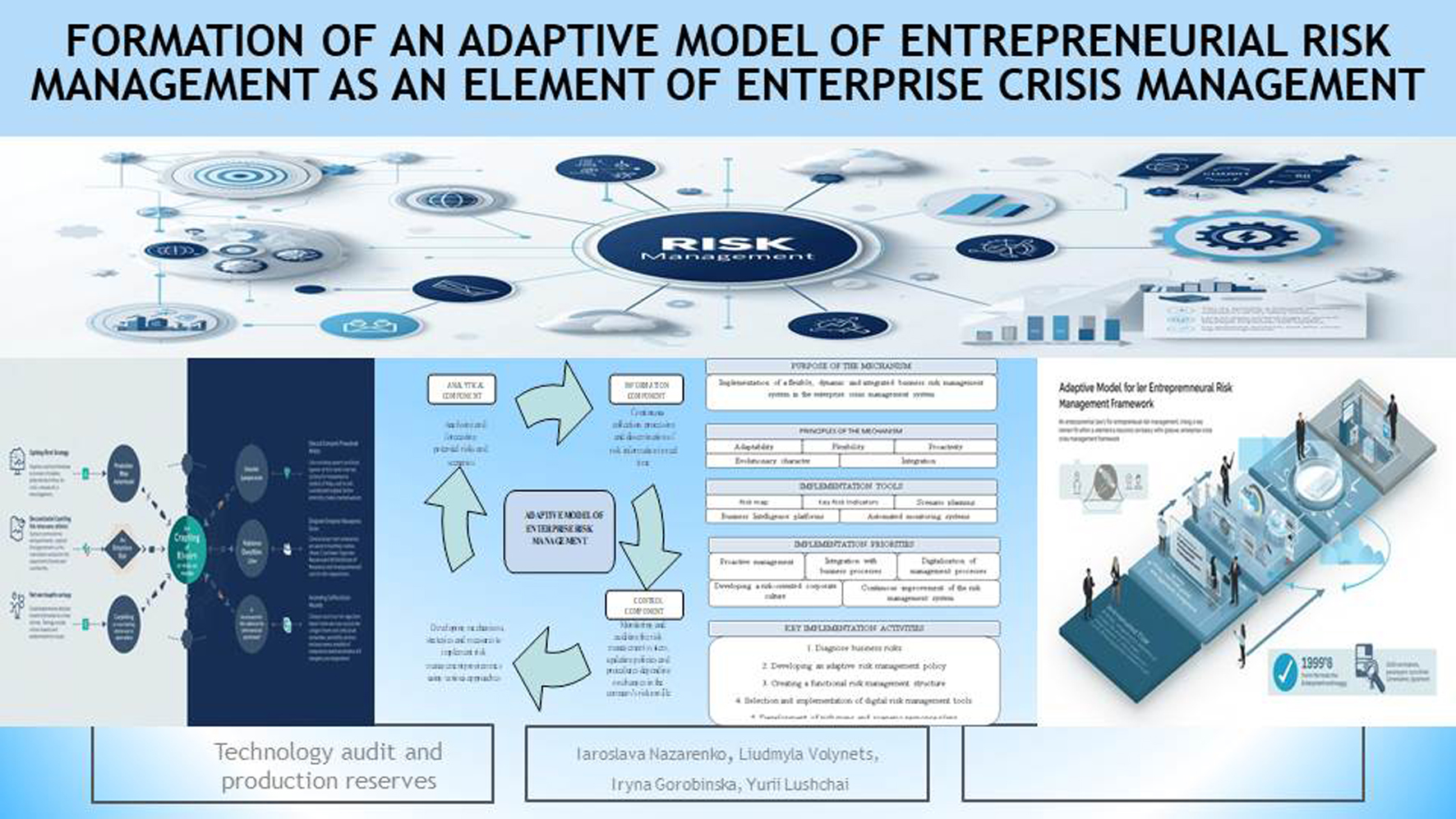
The object of the research is the processes of business risk management as a key element of enterprise crisis management. Particular attention is paid to the study and formation of an adaptive model of business risk management as a key tool for crisis management. The emphasis is placed on its ability to respond to changes in the external and internal environment dynamically, ensuring strategic flexibility, enterprise risk resilience and effective functioning in conditions of uncertainty. Therefore, it is essential to establish a systematic approach for identifying, analysing, evaluating, and mitigating these risks. An adaptive model for business risk management enables a company to not only reduce the effects of adverse events but also to enhance resilience, recovery capacity, strategic flexibility, and competitiveness. The proposed mechanism for implementing the adaptive model consists of six consecutive stages: diagnostics, planning, institutionalization, digitalization, staff training, and continuous improvement. This approach facilitates a gradual transformation of the management system in response to changes in the external environment. The key priorities for implementation are as follows: proactivity, flexibility, integration, digitalization, the development of a risk-oriented culture, and continuous improvement. Successfully implementing these priorities is critical for the effective functioning of the entire risk management system. This article outlines a set of measures that can be adopted to put the adaptive model into practice. These measures address organizational, institutional, informational technology, and personnel aspects, ensuring an interdisciplinary approach and consistency in management decisions. The proposed model can serve as a foundation for developing a customized risk management strategy for enterprises operating in an unstable economy. The work highlights the importance of integrating the enterprise risk management system across all departments and structural units to enable quick responses to changes in both the external and internal environments, thereby enhancing the enterprise's crisis resilience. The presented results are of practical importance for enterprises in all sectors of the economy. The results of the study can serve as an analytical basis for further scientific developments and implementation of effective models of crisis management of business risks.
References
- Hisrich, R. D., Ramadani, V. (2016). Entrepreneurial Risk Management. Effective Entrepreneurial Management. Cham: Springer, 55–73. https://doi.org/10.1007/978-3-319-50467-4_4
- Aryati, T., Khomsiyah, K., Harahap, C. D. (2023). Enterprise risk management: A bibliometric analysis of research Trends. Decision Science Letters, 12 (3), 561–570. https://doi.org/10.5267/j.dsl.2023.4.007
- Vesković, N. (2014). Aspects of entrepreneurial risk. Proceedings of the 1st International Scientific Conference – FINIZ 2014, 115–117. https://doi.org/10.15308/finiz-2014-115-117
- Risk as the foundation for crisis management and crisis communication (2023). SAGE Publications, Inc., 21–39. Available at: https://uk.sagepub.com/sites/default/files/upm-assets/120144_book_item_120144.pdf
- Alshebami, A. S. (2025). Crisis Management and Customer Adaptation: Pathways to Adaptive Capacity and Resilience in Micro- and Small-Sized Enterprises. Sustainability, 17 (9), 3759. https://doi.org/10.3390/su17093759
- Skomra, W. (2017). Risk Management as Part of Crisis Management Tasks. Foundations of Management, 9 (1), 245–256. https://doi.org/10.1515/fman-2017-0019
- Brear, A. S. (2021). Entrepreneurial and SME Resilience During Crisis Episodes. Cases on Small Business Economics and Development During Economic Crises. IGI Global Scientific Publishing, 52–79. https://doi.org/10.4018/978-1-7998-7657-1.ch003
- Kotov, B. (2023). Justification of the Mechanism of Risk Protection of Business Structures. Economics: Time Realities, 3 (67), 89–98. https://doi.org/10.15276/etr.03.2023.10
- Myroshnychenko, G. (2024). Strategies for risk management in enterprise structures. Scientific Papers of Donetsk National Technical University. Series: Economic, 2 (30), 4–10. https://doi.org/10.31474/1680-0044-2024-2(30)-4-10
- Perederii, T. (2024). Features of the current practice of anti-crisis management of sustainable development in trade enterprises of Ukraine. Actual Problems of Economics, 1 (278), 146–158. https://doi.org/10.32752/1993-6788-2024-1-278-146-158
- Korobka, S. V. (2024). Osoblyvosti upravlinnia biznes-ryzykamy malykh pidpryiemstv v umovakh viiny. LNUVM BT. https://doi.org/10.32718/monohraf.2024.5
- Kopylyuk, O., Muzychka, O. (2022). Organizational and Financial Mechanism of Anti-Crisis Management of Business Entities. University Scientific Notes, 1-2 (85-86), 8–16. https://doi.org/10.37491/unz.85-86.1
- Bromiley, P., McShane, M., Nair, A., Rustambekov, E. (2015). Enterprise Risk Management: Review, Critique, and Research Directions. Long Range Planning, 48 (4), 265–276. https://doi.org/10.1016/j.lrp.2014.07.005
- Khalina, V., Kolmakova, O., Ustilovska, A. (2023). Economic security of ukrainian companies through the prism of the modern phenomenon of their adaptation. Economy and Society, 58. https://doi.org/10.32782/2524-0072/2023-58-94
- Kukhtyk, T. V., Obraztsova, N. O. (2012). Stymuliuvannia innovatsiino-investytsiinoi diialnosti malykh pidpryiemstv shliakhom uprovadzhennia systemy upravlinnia ryzykamy. Efektyvna ekonomika, 12. Available at: http://www.economy.nayka.com.ua/?op=1&z=1687
- Varaksіna, O., Рobidennа, V., Hrebenyk, R. (2023). Risk management in the context of economic security of the enterprise. Economy and Society, 56. https://doi.org/10.32782/2524-0072/2023-56-47
- Kostiuk, M. S. (2024). Risk management strategy development in business activities. Efektyvna Ekonomika, 8. https://doi.org/10.32702/2307-2105.2024.8.94
- Nazarenko, I., Bazyliuk, A., Nazarenko, M., Gorobinska, I., Nakonechna, S.; Slavinska, O., Danchuk, V., Kunytska, O., Hulchak, O. (Eds.) (2025). Directions of Financial Support for Post-war Recovery and Sustainable Development of Smart Cities in Ukraine. Intelligent Transport Systems: Ecology, Safety, Quality, Comfort. ITSESQC 2024. Lecture Notes in Networks and Systems. Cham: Springer, 362–373. https://doi.org/10.1007/978-3-031-87379-9_33
- Hutsaliuk, O., Antonenko, N., Nazarenko, I., Boiko, N., Karlova, I., Babych, L.; El Khoury, R. (Ed.) (2024). Cognitive Model Building to Improve the Efficiency of Enterprise Liquid Cash Management. Technology-Driven Business Innovation: Unleashing the Digital Advantage. Studies in Systems, Decision and Control. Cham Springer, 199–209. https://doi.org/10.1007/978-3-031-62656-2_18
- Vorkut, T., Volynets, L. (2025). Devising a method for strategic-oriented evaluation of the activities of logistics personnel taking into account the effect of risk and uncertainty factors. Eastern-European Journal of Enterprise Technologies, 3 (3 (135)), 57–66. https://doi.org/10.15587/1729-4061.2025.329994
- Levchenko, I., Dmytriiev, I., Babailov, V., Kyrchata, I., Britchenko, I., Vorkut, T. et al.; Levchenko, I., Dmytriiev, I. (Eds.) (2025). Strategic-oriented management of the transport industry: logistics approaches, innovative solutions and management models. Kharkiv: TECHNOLOGY CENTER PC, 116. https://doi.org/10.15587/978-617-8360-14-6
- Volynets, L. M.; Chobitok, V. I. (Ed.) (2025). Metodolohichni platformy doslidzhennia efektyvnosti stratehichno-oriientovanoho upravlinnia v orhanizatsiiakh i orhanizatsiinykh merezhakh v umovakh hlobalizatsii. Transformation of socio-economic systems in the context of globalization. Kharkiv: Vyd-vo Ivanchenka I. S., 8–23. https://doi.org/10.35668/978-617-8332-75-4
Downloads
Published
How to Cite
Issue
Section
License
Copyright (c) 2025 Iaroslava Nazarenko, Lyudmyla Volynets, Iryna Gorobinska, Yurii Lushchai

This work is licensed under a Creative Commons Attribution 4.0 International License.
The consolidation and conditions for the transfer of copyright (identification of authorship) is carried out in the License Agreement. In particular, the authors reserve the right to the authorship of their manuscript and transfer the first publication of this work to the journal under the terms of the Creative Commons CC BY license. At the same time, they have the right to conclude on their own additional agreements concerning the non-exclusive distribution of the work in the form in which it was published by this journal, but provided that the link to the first publication of the article in this journal is preserved.





