Modeling combined and separated sequencing legs in Point Merge: impact on capacity, vertical profile, and continuous descent
DOI:
https://doi.org/10.15587/2706-5448.2025.339717Keywords:
Point Merge, sequencing legs, continuous descent, capacity, separation intervalAbstract
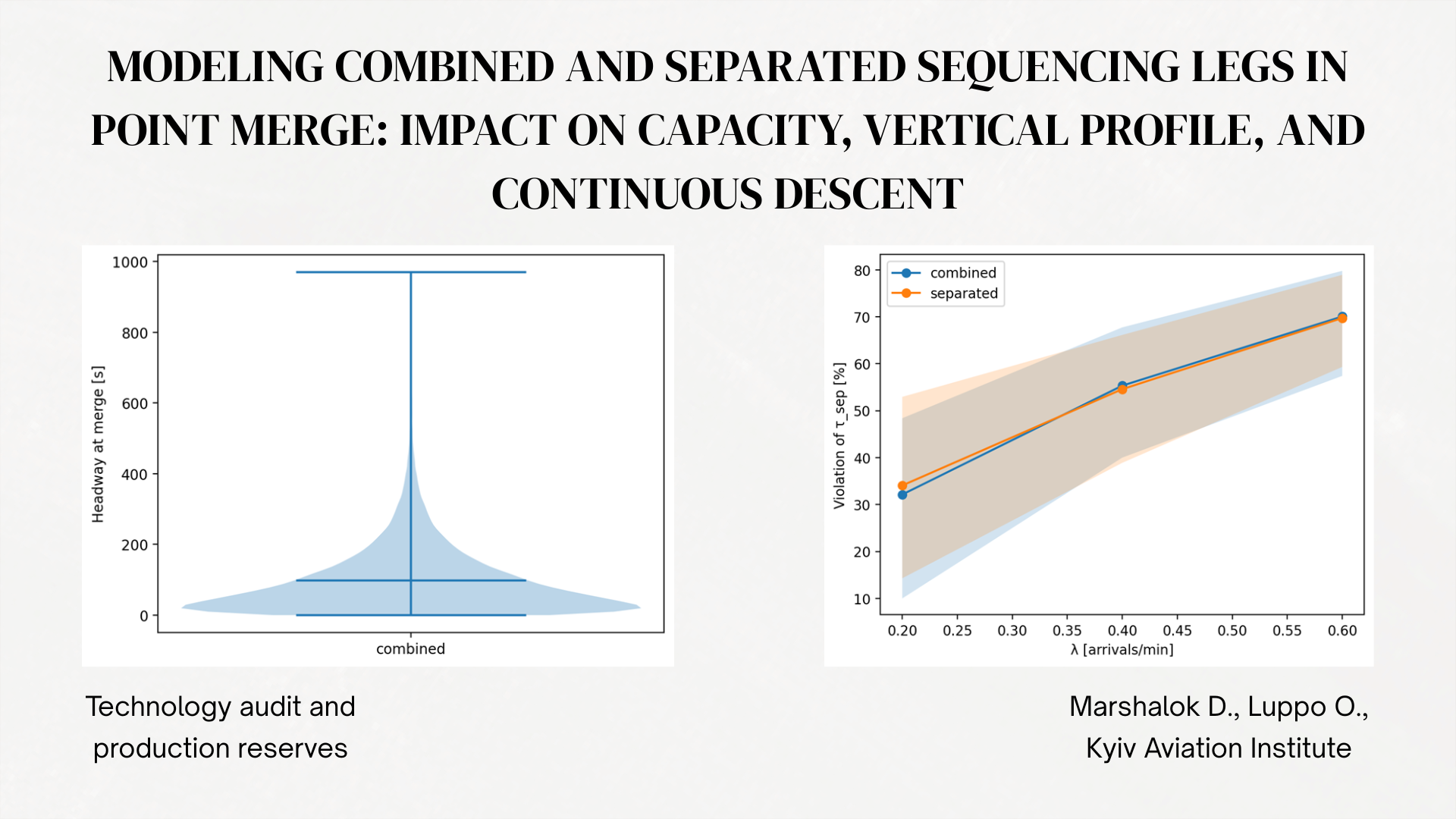
The object of research is the process of arrival sequencing in terminal maneuvering areas under the Point Merge concept. One problematic aspect is ensuring stable time-based intervals and maintaining continuous-descent profiles under peak demand and wind perturbations, as well as the lack of simple rules for choosing between combined and separated sequencing legs and for switching between them. The study used analytical modelling of arc geometry and direct-to-merge rules; parameterization of procedures and target intervals; probabilistic models of demand and ground-speed variation; Monte Carlo simulations using open traffic, weather and Aeronautical Information Services sources; statistical analysis; construction of a proxy controllability index; a hysteresis-based switching rule; and sensitivity analysis. It was proposed to obtain a reproducible framework for designing and comparing combined and separated sequencing legs with unified metrics. This follows from combining transparent geometry parameterization with a simple hysteresis-based switching rule that avoids frequent back-and-forth configuration changes. As a result, medians are practically identical on identical geometry, while differences appear in the tails: separated legs reduce the probability of long loops and extreme low-altitude horizontal segments. Compared with static alternatives, hysteresis-based switching under peak demand reduces separation-interval violations by up to ≈17.5 percentage points and shortens median low-altitude horizontal time by ≈4–9 s, at the cost of ≈0.57 NM of added median distance, providing better operational support without heavy optimizers. Limitations include a single case, environmental inference via extra distance, and a proxy controllability index. Future work will include human-in-the-loop experiments and coupling with detailed aircraft-performance models.
References
- Procedures for Air Navigation Services – Air Traffic Management (PANS-ATM). Doc 4444 (2016) Montreal: ICAO. Available at: http://library.caanepal.gov.np:8080/bitstream/123456789/401/1/4444_cons_en.pdf
- Annex 11 to the Convention on International Civil Aviation: Air Traffic Services (2018). Montreal: ICAO. Available at: https://ffac.ch/wp-content/uploads/2020/10/ICAO-Annex-11-Air-Traffic-Services.pdf
- Point Merge: Integration of arrival flows to a merge point. Operational Services and Environment Definition (OSED). Version 2.0 (2010). Brussels: EUROCONTROL. Available at: https://www.eurocontrol.int/sites/default/files/library/003_Point_Merge_OSED_V2.0.pdf
- Continuous Descent Operations (CDO) Manual. Doc 9931 (2010). Montreal: ICAO. Available at: https://applications.icao.int/tools/ATMiKIT/story_content/external_files/102600063919931_en.pdf
- Favennec, B., Hoffman, E., Trzmiel, A., Vergne, F., Zeghal, K. (2009). The Point Merge Arrival Flow Integration Technique: Towards More Complex Environments and Advanced Continuous Descent. 9th AIAA Aviation Technology, Integration, and Operations Conference (ATIO). https://doi.org/10.2514/6.2009-6921
- Point Merge implementation: A quick guide. Ed. 1.51 (2024). Brussels: EUROCONTROL. Available at: https://www.eurocontrol.int/sites/default/files/2024-12/eurocontrol-point-merge-guide-v1-51.pdf
- Favennec, B., Trzmiel, A., Zeghal, K. (2018). How the geometry of arrival routes can influence sequencing? 2018 Aviation Technology, Integration, and Operations Conference. https://doi.org/10.2514/6.2018-4000
- Ivanescu, D., Shaw, C., Tamvaclis, C., Kettunen, T. (2009). Models of Air Traffic Merging Techniques: Evaluating Performance of Point Merge. 9th AIAA Aviation Technology, Integration, and Operations Conference (ATIO). https://doi.org/10.2514/6.2009-7013
- Hardell, H., Otero, E., Polishchuk, T., Smetanová, L. (2025). Optimizing air traffic management through point merge procedures: Minimizing delays and environmental impact in arrival operations. Journal of Air Transport Management, 123, 102706. https://doi.org/10.1016/j.jairtraman.2024.102706
- Oren, A., Sahin, O. (2021). The flight efficiency analysis on the Multi-Arrival Route Point Merge System. The Aeronautical Journal, 126 (1299), 755–767. https://doi.org/10.1017/aer.2021.105
- Dönmez, K., Çetek, C., Kaya, O. (2021). Aircraft Sequencing and Scheduling in Parallel-Point Merge Systems for Multiple Parallel Runways. Transportation Research Record: Journal of the Transportation Research Board, 2676 (3), 108–124. https://doi.org/10.1177/03611981211049410
- Kharchenko, V. P., Butsyk, I. M., Alieksieiev, O. M. (2009). Methods of making the right decision Manager at Air Traffic Service. Proceedings of National Aviation University, 40 (3). https://doi.org/10.18372/2306-1472.40.1757
- OpenSky REST API. OpenSky Network. Available at: https://openskynetwork.github.io/opensky-api/rest.html Last accessed: 07.10.2025
- Data API. NWS Aviation Weather Center. Available at: https://aviationweather.gov/data/api/ Last accessed: 07.10.2025
- EIDW(DUBLIN) New Runway 10L/28R AIP IRELAND Updates (2022). AirNav Ireland (AIS). Available at: https://www.iaa.ie/docs/default-source/publications/ei_sup_2022_020_en.pdf?sfvrsn=88d612f3_2
- European AIS Database. EUROCONTROL. Available at: https://www.eurocontrol.int/service/european-ais-database Last accessed: 07.10.2025
Downloads
Published
How to Cite
Issue
Section
License
Copyright (c) 2025 Daniil Marshalok, Oleksandr Luppo

This work is licensed under a Creative Commons Attribution 4.0 International License.
The consolidation and conditions for the transfer of copyright (identification of authorship) is carried out in the License Agreement. In particular, the authors reserve the right to the authorship of their manuscript and transfer the first publication of this work to the journal under the terms of the Creative Commons CC BY license. At the same time, they have the right to conclude on their own additional agreements concerning the non-exclusive distribution of the work in the form in which it was published by this journal, but provided that the link to the first publication of the article in this journal is preserved.





