Assessment of the content of flavonoids in green buckwheat flour
DOI:
https://doi.org/10.15587/2706-5448.2025.341092Keywords:
green buckwheat, green buckwheat flour, flavonoids, rutin, quercetin, functional nutritionAbstract
The object of research is green buckwheat flour (GBF) from various brands, including Ecorod, Ecoorganic, Ms. Tally, Ecosmak, and Ahimsa, which is considered a promising raw material for functional food production. One of the main challenges in studying GBF is the insufficient amount of data on the quantitative content of individual flavonoid compounds, particularly quercetin and rutin, as well as the lack of systematic comparison of these indicators between different manufacturers. This limits the possibilities for the targeted use of GBF as a source of biologically active substances for the development of products with enhanced antioxidant activity.
The study applied absorption spectrophotometry based on the formation of chelate complexes with aluminum chloride (AlCl₃), which allowed the determination of total flavonoid content and subsequent calculation of quercetin and rutin equivalents. This approach enables a quantitative assessment of the bioactive potential of the raw materials under study and reveals variability depending on the brand.
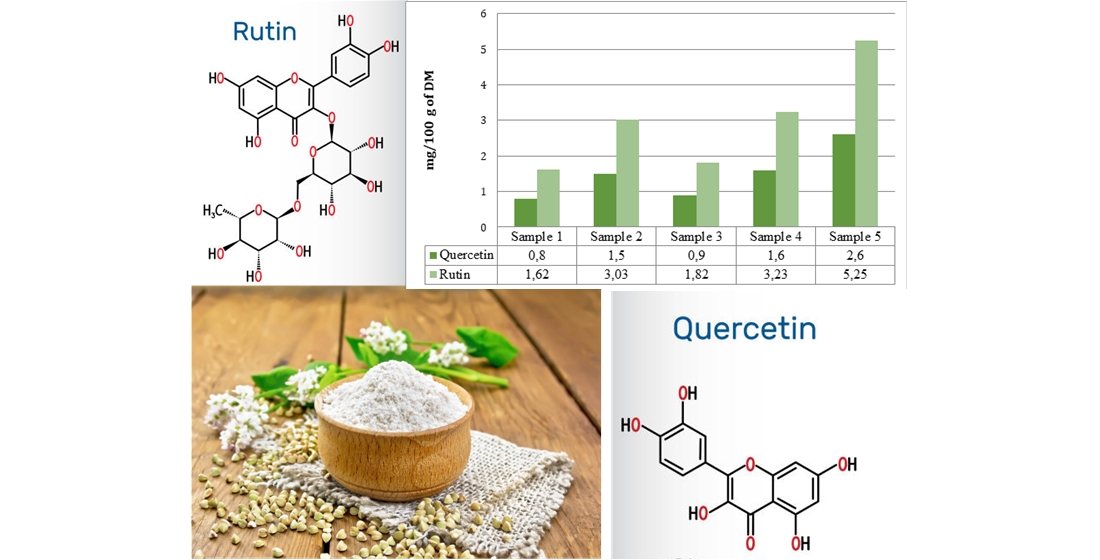
The obtained results indicate a significant concentration of flavonoids in GBF: quercetin content ranged from 0.8 to 2.6 mg/100 g dry matter (DM), and rutin content ranged from 1.62 to 5.25 mg/100 g DM. This can be explained by the fact that green buckwheat, unlike heat-treated grain, preserves natural enzyme activity and its phytochemical complex, with flavonoids playing a leading role.
The applied approach provides a more reasonable evaluation of the functional value of green buckwheat grain and flour, which is of direct practical importance for the food industry. The results confirm the potential of GBF as a gluten-free ingredient for functional food products aimed at reducing oxidative stress and preventing chronic non-communicable diseases.
References
- Tungmunnithum, D., Thongboonyou, A., Pholboon, A., Yangsabai, A. (2018). Flavonoids and Other Phenolic Compounds from Medicinal Plants for Pharmaceutical and Medical Aspects: An Overview. Medicines, 5 (3), 93. https://doi.org/10.3390/medicines5030093
- Kuljarusnont, S., Iwakami, S., Iwashina, T., Tungmunnithum, D. (2024). Flavonoids and Other Phenolic Compounds for Physiological Roles, Plant Species Delimitation, and Medical Benefits: A Promising View. Molecules, 29 (22), 5351. https://doi.org/10.3390/molecules29225351
- Rice-Evans, C. A., Miller, N. J., Paganga, G. (1996). Structure-antioxidant activity relationships of flavonoids and phenolic acids. Free Radical Biology and Medicine, 20 (7), 933–956. https://doi.org/10.1016/0891-5849(95)02227-9
- Kumar, S., Pandey, A. K. (2013). Chemistry and Biological Activities of Flavonoids: An Overview. The Scientific World Journal, 2013 (1). https://doi.org/10.1155/2013/162750
- Kim, Y. W., Kang, H. E., Lee, M. G., Hwang, S. J., Kim, S. C., Lee, C. H. et al. (2009). Liquiritigenin, a flavonoid aglycone from licorice, has a choleretic effect and the ability to induce hepatic transporters and phase-II enzymes. American Journal of Physiology-Gastrointestinal and Liver Physiology, 296 (2), 372–381. https://doi.org/10.1152/ajpgi.90524.2008
- Sebastian, R. S., Goldman, J. D., Moshfegh, A. J. (2023). Dietary intake and sources of flavonoids by adults in the U.S. What We Eat in America, NHANES 2017–2018. Food Surveys Research Group Dietary Data Brief, 49. Available at: https://www.ncbi.nlm.nih.gov/books/NBK603802
- Schoenlechner, R., Bender, D. (2020). Pseudocereals for global food production. Cereal Foods World, 65 (2). https://doi.org/10.1094/CFW-65-2-0014
- Skřivan, P., Chrpová, D., Klitschová, B., Švec, I., Sluková, M. (2023). Buckwheat Flour (Fagopyrum esculentum Moench) – A Contemporary View on the Problems of Its Production for Human Nutrition. Foods, 12 (16), 3055. https://doi.org/10.3390/foods12163055
- Dębski, H., Wiczkowski, W., Szawara-Nowak, D., Horbowicz, M. (2021). Elicitation with Sodium Silicate and Iron Chelate Affects the Contents of Phenolic Compounds and Minerals in Buckwheat Sprouts. Polish Journal of Food and Nutrition Sciences, 71 (1), 21–28. https://doi.org/10.31883/pjfns/131061
- Jha, R., Zhang, K., He, Y., Mendler-Drienyovszki, N., Magyar-Tábori, K., Quinet, M. et al. (2024). Global nutritional challenges and opportunities: Buckwheat, a potential bridge between nutrient deficiency and food security. Trends in Food Science & Technology, 145, 104365. https://doi.org/10.1016/j.tifs.2024.104365
- Kreft, I., Germ, M., Golob, A., Vombergar, B., Bonafaccia, F., Luthar, Z. (2022). Impact of Rutin and Other Phenolic Substances on the Digestibility of Buckwheat Grain Metabolites. International Journal of Molecular Sciences, 23 (7), 3923. https://doi.org/10.3390/ijms23073923
- Mirza, M. A., Mahmood, S., Hilles, A. R., Ali, A., Khan, M. Z., Zaidi, S. A. A. et al. (2023). Quercetin as a therapeutic product: Evaluation of its pharmacological action and clinical applications – a review. Pharmaceuticals, 16 (11), 1631. https://doi.org/10.3390/ph16111631
- Semwal, R., Joshi, S. K., Semwal, R. B., Semwal, D. K. (2021). Health benefits and limitations of rutin – a natural flavonoid with high nutraceutical value. Phytochemistry Letters, 46, 119–128. https://doi.org/10.1016/j.phytol.2021.10.006
- Yang, H., Wang, C., Zhang, L., Lv, J., Ni, H. (2019). Rutin alleviates hypoxia/reoxygenation-induced injury in myocardial cells by up-regulating SIRT1 expression. Chemico-Biological Interactions, 297, 44–49. https://doi.org/10.1016/j.cbi.2018.10.016
- Ganeshpurkar, A., Saluja, A. K. (2017). The Pharmacological Potential of Rutin. Saudi Pharmaceutical Journal, 25 (2), 149–164. https://doi.org/10.1016/j.jsps.2016.04.025
- Patel, K., Patel, D. K. (2019). The beneficial role of rutin, a naturally occurring flavonoid in health promotion and disease prevention: A systematic review and update. Bioactive Food as Dietary Interventions for Arthritis and Related Inflammatory Diseases, 457–479. https://doi.org/10.1016/b978-0-12-813820-5.00026-x
- Singh, S., Singh, D. K., Meena, A., Dubey, V., Masood, N., Luqman, S. (2019). Rutin protects t‑butyl hydroperoxide-induced oxidative impairment via modulating the Nrf2 and iNOS activity. Phytomedicine, 55, 92–104. https://doi.org/10.1016/j.phymed.2018.07.009
- Pedriali, C. A., Fernandes, A. U., Bernusso, L. de C., Polakiewicz, B. (2008). The synthesis of a water-soluble derivative of rutin as an antiradical agent. Química Nova, 31 (8), 2147–2151. https://doi.org/10.1590/s0100-40422008000800039
- Giménez-Bastida, J. A., Zieliński, H. (2015). Buckwheat as a Functional Food and Its Effects on Health. Journal of Agricultural and Food Chemistry, 63 (36), 7896–7913. https://doi.org/10.1021/acs.jafc.5b02498
- Pivec, T., Kargl, R., Maver, U., Bračič, M., Elschner, T., Žagar, E., Gradišnik, L., Stana Kleinschek, K. (2019). Chemical Structure–Antioxidant Activity Relationship of Water–Based Enzymatic Polymerized Rutin and Its Wound Healing Potential. Polymers, 11 (10), 1566. https://doi.org/10.3390/polym11101566
- Ge, X., Jing, L., Zhao, K., Su, C., Zhang, B., Zhang, Q., Han, L., Yu, X., Li, W. (2021). The phenolic compounds profile, quantitative analysis and antioxidant activity of four naked barley grains with different color. Food Chemistry, 335, 127655. https://doi.org/10.1016/j.foodchem.2020.127655
- Kreft, I., Germ, M., Golob, A., Vombergar, B., Bonafaccia, F., Luthar, Z. (2022). Impact of Rutin and Other Phenolic Substances on the Digestibility of Buckwheat Grain Metabolites. International Journal of Molecular Sciences, 23 (7), 3923. https://doi.org/10.3390/ijms23073923
- Luthar, Z., Germ, M., Likar, M., Golob, A., Vogel-Mikuš, K., Pongrac, P., Kušar, A., Pravst, I., Kreft, I. (2020). Breeding Buckwheat for Increased Levels of Rutin, Quercetin and Other Bioactive Compounds with Potential Antiviral Effects. Plants, 9 (12), 1638. https://doi.org/10.3390/plants9121638
- Kreft, I., Golob, A., Vombergar, B., Germ, M. (2023). Tartary Buckwheat Grain as a Source of Bioactive Compounds in Husked Groats. Plants, 12 (5), 1122. https://doi.org/10.3390/plants12051122
- Li, D., Li, X., Ding, X., Park, K.-H. (2008). A process for preventing enzymatic degradation of rutin in Tartary buckwheat (Fagopyrum tataricum Gaertn) flour. Food Science and Biotechnology, 17, 118–122. Available at: https://www.researchgate.net/publication/282054353_A_process_for_preventing_enzymatic_degradation_of_rutin_in_tartary_buckwheat_Fagopyrum_tataricum_Gaertn_flour
- Jiang, P., Burczynski, F., Campbell, C., Pierce, G., Austria, J. A., Briggs, C. J. (2007). Rutin and flavonoid contents in three buckwheat species Fagopyrum esculentum, F. tataricum, and F. homotropicum and their protective effects against lipid peroxidation. Food Research International, 40 (3), 356–364. https://doi.org/10.1016/j.foodres.2006.10.009
- Ma, H., Bian, Z., Wang, S. (2020). Effects of Different Treatments on the Germination, Enzyme Activity, and Nutrient Content of Buckwheat. Food Science and Technology Research, 26 (3), 319–328. https://doi.org/10.3136/fstr.26.319
- Živković, A., Polak, T., Cigić, B., Požrl, T. (2021). Germinated Buckwheat: Effects of Dehulling on Phenolics Profile and Antioxidant Activity of Buckwheat Seeds. Foods, 10 (4), 740. https://doi.org/10.3390/foods10040740
- Gao, Y., Xia, W., Shao, P., Wu, W., Chen, H., Fang, X. et al. (2022). Impact of thermal processing on dietary flavonoids. Current Opinion in Food Science, 48, 100915. https://doi.org/10.1016/j.cofs.2022.100915
- Lesjak, M., Beara, I., Simin, N., Pintać, D., Majkić, T., Bekvalac, K. et al. (2018). Antioxidant and anti-inflammatory activities of quercetin and its derivatives. Journal of Functional Foods, 40, 68–75. https://doi.org/10.1016/j.jff.2017.10.047
- Boots, A. W., Haenen, G. R. M. M., Bast, A. (2008). Health effects of quercetin: From antioxidant to nutraceutical. European Journal of Pharmacology, 585 (2–3), 325–337. https://doi.org/10.1016/j.ejphar.2008.03.008
Downloads
Published
How to Cite
Issue
Section
License
Copyright (c) 2025 Olha Sereda, Yevheniia Demydova, Olena Koshel, Valeriia Ponomarenko, Oleksandr Voronin, Inha Kuznietsova, Liudmyla Zaichuk

This work is licensed under a Creative Commons Attribution 4.0 International License.
The consolidation and conditions for the transfer of copyright (identification of authorship) is carried out in the License Agreement. In particular, the authors reserve the right to the authorship of their manuscript and transfer the first publication of this work to the journal under the terms of the Creative Commons CC BY license. At the same time, they have the right to conclude on their own additional agreements concerning the non-exclusive distribution of the work in the form in which it was published by this journal, but provided that the link to the first publication of the article in this journal is preserved.





