Комплексне формування шкіряного напівфабрикату з використанням ензимів
DOI:
https://doi.org/10.15587/2706-5448.2025.344270Ключові слова:
ензимна пластифікація, ензими протеолітичної та гідролітичної дії, шкіряний напівфабрикат, фізико-хімічні властивостіАнотація
Об’єктом дослідження є процес комплексного формування еластичної шкіри з використанням ензимів протеолітичної та гідролітичної дії.
Одним з найбільш проблемних місць є зниження еластичності шкіряного напівфабрикату на стадії його зневоднювання. Ензимне оброблення підвищує рухливість мікрофібрилярної структури напівфабрикату внаслідок руйнування фізичних міжмолекулярних зв’язків.
В ході дослідження використовувалися ензим протеолітичної дії на стадії м’якшення голини та ензими гідролітичної дії для оброблення дубленого хромового напівфабрикату.
Отримано напівфабрикат, який характеризується збільшенням пористості у порівнянні з вихідним напівфабрикатом. Показник пористості напівфабрикату підвищується на 22% у випадку застосування ензимної обробки на стадії м’якшення та на 67% при повторному обробленні ензимами дубленого напівфабрикату. Це пов'язано з тим, що запропоноване ензимне оброблення сприяє видаленню глікозаміногліканів з дерми на стадії м’якшення. У подальшому використання ензимів після дублення напівфабрикату сприяє руйнуванню зв’язків вуглеводів з макромолекулами колагену, що забезпечує підвищення його фізико-хімічних властивостей. Особливість цього ефекту можна пояснити наявністю у ензимів активного центру, що утворює з вуглеводами та макромолекулами колагену ензимно-вуглеводнево-колагенові комплекси. Всередині утворених комплексів відбувається руйнування існуючих зв’язків і відокремлення вуглеводів від колагену дерми.
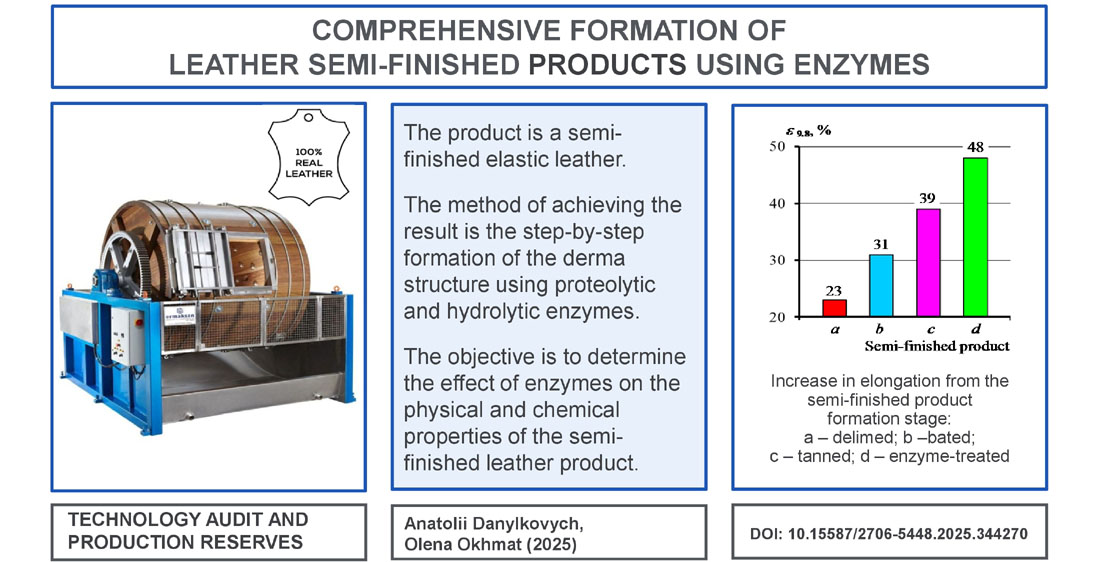
Завдяки цьому забезпечується можливість отримання шкіряного напівфабрикату, який характеризується підвищенням межі міцності та подовження при 9.8 МПа відповідно на 8.4 та 23.0% і ці показники досягають 20.7 МПа та 48.0% у порівнянні з показниками дубленого напівфабрикату.
Посилання
- de Castro Bizerra, V., Sales, M. B., Fernandes Melo, R. L., Andrade do Nascimento, J. G., Junior, J. B. et al. (2024). Opportunities for cleaner leather processing based on protease enzyme: Current evidence from an advanced bibliometric analysis. Renewable and Sustainable Energy Reviews, 191, 114162. https://doi.org/10.1016/j.rser.2023.114162
- Atamanova, A. A., Kolesnyk, T. O., Andreieva, O. A. (2020). Modern research on the properties and use of enzymes. Visnyk Khmelnytskoho Natsionalnoho Universytetu, 5 (267), 257–263. Available at: https://journals.khnu.km.ua/vestnik/?p=4652
- Wanyonyi, W. C., Mulaa, F. J.; Mamo, G., Mattiasson, B. (Eds.) (2019). Alkaliphilic Enzymes and Their Application in Novel Leather Processing Technology for Next-Generation Tanneries. Alkaliphiles in Biotechnology. Advances in Biochemical Engineering/Biotechnology. Cham: Springer, 195–220. https://doi.org/10.1007/10_2019_95
- Ma, J., Hou, X., Gao, D., Lv, B., Zhang, J. (2014). Greener approach to efficient leather soaking process: role of enzymes and their synergistic effect. Journal of Cleaner Production, 78, 226–232. https://doi.org/10.1016/j.jclepro.2014.04.058
- Khambhaty, Y. (2020). Applications of enzymes in leather processing. Environmental Chemistry Letters, 18 (3), 747–769. https://doi.org/10.1007/s10311-020-00971-5
- Dettmer, A., Schacker dos Anjos, P., Gutterres, M. (2013). Enzymes in the Leather Industry, A Special Review Paper. JALCA, 108, 146–158. Available at: https://journals.uc.edu/index.php/JALCA/article/view/3464
- Kolesnyk, T. O., Andreieva, O. A. (2020). Research of the process soaking of leather raw material in the presence of enzyme preparations. Visnyk Khmelnytskoho natsionalnoho universytetu, 2 (283), 251–254. Available at: https://journals.khnu.km.ua/vestnik/?p=1199
- Simion, D., Gaidău, C., Păun, G., Berechet, D. (2023). Applications of Enzymes as Ecologic Alternatives in the Leather Industry. Leather and Footwear Journal, 23 (2), 107–114. https://doi.org/10.24264/lfj.23.2.4
- Edmonds, R. (2008). Proteolytic depilation of lambskins. [Doctoral dissertation, Massey University]. Available at: https://mro.massey.ac.nz/bitstream/10179/892/1/Edmonds%20RL%202008%20as%20amended.pdf
- Afsar, A., Cetinkaya, F. (2008). Studies on the degreasing of skin by using enzyme in liming process. Indian Journal of Chemical Technology, 15 (5), 507–510. Available at: https://scispace.com/papers/studies-on-the-degreasing-of-skin-by-using-enzyme-in-liming-1ibihp0yhw
- Lyu, B., Cheng, K., Ma, J., Hou, X., Gao, D., Gao, H. et al. (2017). A cleaning and efficient approach to improve wet-blue sheepleather quality by enzymatic degreasing. Journal of Cleaner Production, 148, 701–708. https://doi.org/10.1016/j.jclepro.2017.01.170
- Briki, S., Hamdi, O., Landoulsi, A. (2016). Enzymatic dehairing of goat skins using alkaline protease from Bacillus sp. SB12. Protein Expression and Purification, 121, 9–16. https://doi.org/10.1016/j.pep.2015.12.021
- Skyba, M. Y. (2025). Clean technologies in tannery. Technologies and Engineering, 5 (22), 110–122. https://doi.org/10.30857/2786-5371.2024.5.11
- Choudhary, R. B., Jana, A. K., Jha, M. K. (2004). Enzyme technology applications in leather processing. Indian Journal of chemical technology, 11 (5), 659–671. Available at: https://scispace.com/papers/enzyme-technology-applications-in-leather-processing-ugvgeo7n3m
- Zhang, Y., Liu, H., Tang, K., Liu, J., Li, X. (2021). Effect of different ions in assisting protease to open the collagen fiber bundles in leather making. Journal of Cleaner Production, 293, 126017. https://doi.org/10.1016/j.jclepro.2021.126017
- Širvaitytė, J., Valeika, V., Beleška, K., Valeikienė, V. (2006). Bating of pelts after deliming with peracetic acid. Proceedings of the Estonian Academy of Sciences. Chemistry, 55 (2), 93–100. https://doi.org/10.3176/chem.2006.2.06
- Harkavenko, S. S., Statsenko, D. V., Zlotenko, B. M. (2016). Vykorystannia enzymiv u shkiriano-vzuttievomu vyrobnytstvi. Kyiv: KNUTD, 16–18.
- Kopytina, I., Andreyeva, O., Mokrousova, O., Okhmat, O. (2022). Enzymes and approaches to their application in the leather production. Herald of Khmelnytskyi National University. Technical Sciences, 313 (5), 227–232. https://doi.org/10.31891/2307-5732-2022-313-5-227-232
- Danylkovych, A. H., Lishchuk, V. I., Strembulevych, L. V. (2015). Suchasne vyrobnytstvo khutra. Kyiv: Fenik, 320. Available at: https://er.knutd.edu.ua/handle/123456789/1754
- Souza, F. R. de, Gutterres, M. (2012). Application of enzymes in leather processing: a comparison between chemical and coenzymatic processes. Brazilian Journal of Chemical Engineering, 29 (3), 473–482. https://doi.org/10.1590/s0104-66322012000300004
- Biškauskaitė, R., Valeika, V. (2023). Wet Blue Enzymatic Treatment and Its Effect on Leather Properties and Post-Tanning Processes. Materials, 16 (6), 2301. https://doi.org/10.3390/ma16062301
- Lasoń-Rydel, M., Sieczyńska, K., Gendaszewska, D., Ławińska, K., Olejnik, T. P. (2024). Use of enzymatic processes in the tanning of leather materials. AUTEX Research Journal, 24 (1). https://doi.org/10.1515/aut-2023-0012
- Biškauskaitė-Ulinskė, R., Valeika, V. (2025). Effect of Enzyme on Chromed Leather Dyeing With Acidic Dyes. Journal of Engineering, 2025 (1). https://doi.org/10.1155/je/8884546
- Danylkovych, A. H. (2006). Praktykum z khimii i tekhnolohii shkiry ta khutra. Kyiv: Feniks, 340.
- Danylkovych, A. H. (2016). Osnovni materialy i tekhnolohii vyrobnytstva shkiry. Kyiv: KNUTD, 175. Available at: https://er.knutd.edu.ua/bitstream/123456789/18043/1/20210713_301.pdf
- Mokrousova, E., Dzyazko, Y., Volfkovich, Y., Nikolskaya, N. (2016). Hierarchical structure of the derma affected by chemical treatment and filling with bentonite: Diagnostics with a method of standard contact porosimetry. Nanophysics, Nanophotonics, Surface Studies, and Applications: Selected Proceedings of the 3rd International Conference Nanotechnology and Nanomaterials (NANO2015). Cham: Springer International Publishing, 277–290. https://link.springer.com/chapter/10.1007/978-3-319-30737-4_23
- Pervaia, N. V. (2019). Assessment of the capability of leather for footwear upper to keep the shape after molding. Bulletin of the Kyiv National University of Technologies and Design. Technical Science Series, 3 (134), 62–72. https://doi.org/10.30857/1813-6796.2019.3.6
##submission.downloads##
Опубліковано
Як цитувати
Номер
Розділ
Ліцензія
Авторське право (c) 2025 Аnatolii Danylkovych, Olena Okhmat

Ця робота ліцензується відповідно до Creative Commons Attribution 4.0 International License.
Закріплення та умови передачі авторських прав (ідентифікація авторства) здійснюється у Ліцензійному договорі. Зокрема, автори залишають за собою право на авторство свого рукопису та передають журналу право першої публікації цієї роботи на умовах ліцензії Creative Commons CC BY. При цьому вони мають право укладати самостійно додаткові угоди, що стосуються неексклюзивного поширення роботи у тому вигляді, в якому вона була опублікована цим журналом, але за умови збереження посилання на першу публікацію статті в цьому журналі.