Determination of the largest Lyapunov exponent of chaos in the dynamics of hazardous parameters of a gas environment for the rapid ignition detection
DOI:
https://doi.org/10.15587/2706-5448.2025.345030Keywords:
largest Lyapunov exponent, operational detection of ignition, dangerous parameters of the gas environment, premisesAbstract
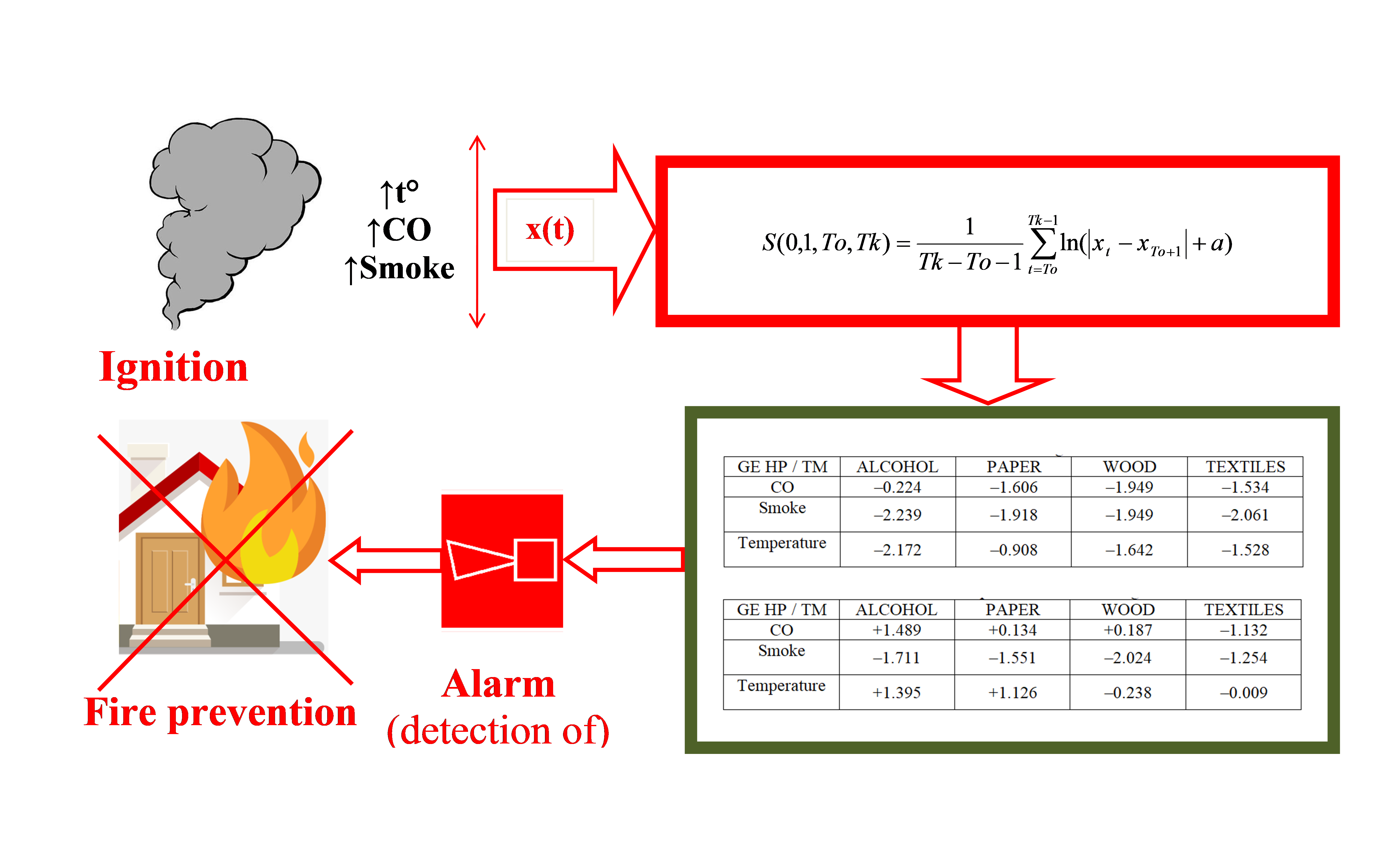
The object of research is the largest Lyapunov exponent of the dynamics of hazardous gas environment parameters in premises at intervals of reliable absence and presence of ignition of materials in premises. The problem is to determine and develop a strategy for using the largest Lyapunov exponent on a one-dimensional sample of real contaminated measurements of hazardous gas environment parameters in premises for the prompt detection of material ignitions. An experimental verification of the determination of the largest Lyapunov exponent of the dynamics of the main hazardous gas environment parameters during ignition of materials in a laboratory chamber at intervals of reliable absence and occurrence of ignition was performed. It was established that during ignition of materials, the values of the largest Lyapunov exponent indicate a decrease in stability and a transition to chaos in the dynamics of temperature and carbon monoxide concentration for all the test materials under study. This indicates a loss of the degree of “order” in the dynamics of temperature and carbon monoxide concentration. At the same time, the value of the largest Lyapunov exponent of the dynamics of the specific optical density of smoke does not change significantly and remains stable with some decrease in stability during ignition of the material. It was found that the use of such a parameter for detecting the ignition of materials has significant advantages in the case of using the dynamics of temperature and carbon monoxide concentration of the gas environment of the premises. The results obtained are useful from a theoretical point of view for determining the largest Lyapunov exponent for a one-dimensional sample of real contaminated measurements for an arbitrary dangerous parameter of the gas environment at an arbitrary observation interval. The practical significance lies in the possibility of further improving existing fire protection systems of objects in order to prevent fires.
References
- Otrosh, Y., Rybka, Y., Danilin, O., Zhuravskyi, M. (2019). Assessment of the technical state and the possibility of its control for the further safe operation of building structures of mining facilities. E3S Web of Conferences, 123, 01012. https://doi.org/10.1051/e3sconf/201912301012
- Semko, A., Beskrovnaya, M., Vinogradov, S., Hritsina, I., Yagudina, N. (2014). The usage of high speed impulse liquid jets for putting out gas blowouts. Journal of Theoretical and Applied Mechanics, 3, 655–664.
- Vasyukov, A., Loboichenko, V., Bushtec, S. (2016). Identification of bottled natural waters by using direct conductometry. Ecology, Environment and Conservation, 22 (3), 1171–1176.
- Pospelov, B., Andronov, V., Rybka, E., Meleshchenko, R., Borodych, P. (2018). Studying the recurrent diagrams of carbon monoxide concentration at early ignitions in premises. Eastern-European Journal of Enterprise Technologies, 3 (9 (93)), 34–40. https://doi.org/10.15587/1729-4061.2018.133127
- Pospelov, B., Andronov, V., Rybka, E., Skliarov, S. (2017). Design of fire detectors capable of self-adjusting by ignition. Eastern-European Journal of Enterprise Technologies, 4 (9 (88)), 53–59. https://doi.org/10.15587/1729-4061.2017.108448
- Cencini, M., Cecconi, F., Vulpiani, A. (2009). Chaos. Series on Advances in Statistical Mechanics. WORLD SCIENTIFIC, 480. https://doi.org/10.1142/7351
- Dieci, L., Van Vleck, E. S. (2002). Lyapunov Spectral Intervals: Theory and Computation. SIAM Journal on Numerical Analysis, 40 (2), 516–542. https://doi.org/10.1137/s0036142901392304
- Cheng, C., Sun, F., Zhou, X. (2011). One fire detection method using neural networks. Tsinghua Science and Technology, 16 (1), 31–35. https://doi.org/10.1016/s1007-0214(11)70005-0
- Ding, Q., Peng, Z., Liu, T., Tong, Q. (2014). Multi-Sensor Building Fire Alarm System with Information Fusion Technology Based on D-S Evidence Theory. Algorithms, 7 (4), 523–537. https://doi.org/10.3390/a7040523
- Pospelov, B., Rybka, E., Samoilov, M., Morozov, I., Bezuhla, Y., Butenko, T. et al. (2022). Defining the features of amplitude and phase spectra of dangerous factors of gas medium during the ignition of materials in the premises. Eastern-European Journal of Enterprise Technologies, 2 (10 (116)), 57–65. https://doi.org/10.15587/1729-4061.2022.254500
- Jiang YueZhong, J. Y., Wang GuiYan, W. G., LüLeiChang, L., Yuan SuPing, Y. S., Ma Ling, M. L. (2004). Studies on pulp-oriented cultivation techniques of poplar wood. Scientia Silvae Sinicae, 40 (1), 123–130.
- Bei, P., Liwei, C., Chang, L. (2012). An Experimental Study on the Burning Behavior of Fabric used Indoor. Procedia Engineering, 43, 257–261. https://doi.org/10.1016/j.proeng.2012.08.044
- Peng, X., Liu, S., Lu, G. (2005). Experimental analysis on heat release rate of materials. Journal of Chongqing University, 28, 122–125.
- Pospelov, B., Rybka, E., Savchenko, A., Dashkovska, O., Harbuz, S., Naden, E. et al. (2022). Peculiarities of amplitude spectra of the third order for the early detection of indoor fires. Eastern-European Journal of Enterprise Technologies, 5 (10 (119)), 49–56. https://doi.org/10.15587/1729-4061.2022.265781
- Pospelov, B., Andronov, V., Rybka, E., Chubko, L., Bezuhla, Y., Gordiichuk, S. et al. (2023). Revealing the peculiarities of average bicoherence of frequencies in the spectra of dangerous parameters of the gas environment during fire. Eastern-European Journal of Enterprise Technologies, 1 (10 (121)), 46–54. https://doi.org/10.15587/1729-4061.2023.272949
- Pospelov, B., Rybka, E., Polkovnychenko, D., Myskovets, I., Bezuhla, Y., Butenko, T. et al. (2023). Comparison of bicoherence on the ensemble of realizations and a selective evaluation of the bispectrum of the dynamics of dangerous parameters of the gas medium during fire. Eastern-European Journal of Enterprise Technologies, 2 (10 (122)), 14–21. https://doi.org/10.15587/1729-4061.2023.276779
- Sadkovyi, V., Pospelov, B., Rybka, E., Kreminskyi, B., Yashchenko, O., Bezuhla, Y. et al. (2022). Development of a method for assessing the reliability of fire detection in premises. Eastern-European Journal of Enterprise Technologies, 3 (10 (117)), 56–62. https://doi.org/10.15587/1729-4061.2022.259493
- Pospelov, B., Andronov, V., Rybka, E., Bezuhla, Y., Liashevska, O., Butenko, T. et al. (2022). Empirical cumulative distribution function of the characteristic sign of the gas environment during fire. Eastern-European Journal of Enterprise Technologies, 4 (10 (118)), 60–66. https://doi.org/10.15587/1729-4061.2022.263194
- Heskestad, G., Newman, J. S. (1992). Fire detection using cross-correlations of sensor signals. Fire Safety Journal, 18 (4), 355–374. https://doi.org/10.1016/0379-7112(92)90024-7
- Gottuk, D. T., Wright, M. T., Wong, J. T., Pham, H. V., Rose-Pehrson, S. L. (2002). Prototype early warning fire detection system: test series 4 results. Available at: https://apps.dtic.mil/sti/citations/ADA399480
- Nakamura, T. (2022). Nonlinear systems and Lyapunov spectrum. Available at: https://sites.google.com/view/lyapunov-spectrum/home
- Prat-Guitart, N., Nugent, C., Mullen, E., Mitchell, F. J. G., Hawthorne, D., Belcher, C. M., Yearsley, J. M. (2019). Peat Fires in Ireland. Coal and Peat Fires: A Global Perspective. Elsevier, 451–482. https://doi.org/10.1016/b978-0-12-849885-9.00020-2
- Fonollosa, J., Solórzano, A., Marco, S. (2018). Chemical Sensor Systems and Associated Algorithms for Fire Detection: A Review. Sensors, 18 (2), 553. https://doi.org/10.3390/s18020553
- Liu, C., Zhang, C., Mu, Y., Liu, J., Zhang, Y. (2017). Emission of volatile organic compounds from domestic coal stove with the actual alternation of flaming and smoldering combustion processes. Environmental Pollution, 221, 385–391. https://doi.org/10.1016/j.envpol.2016.11.089
- Quintiere, J. G. (2016). Principles of Fire Behavior. CRC Press, 437. https://doi.org/10.1201/9781315369655
- Gann, R. G., Bryner, N. P. (2008). Chapter 2 Combustion Products and Their Effects on Life Safety. Fire Protection Handbook. National Fire Protection Assoc, 11–34.
- Stec, A. A. (2017). Fire toxicity – The elephant in the room? Fire Safety Journal, 91, 79–90. https://doi.org/10.1016/j.firesaf.2017.05.003
- McKenna, S. T., Birtles, R., Dickens, K., Walker, R. G., Spearpoint, M. J., Stec, A. A., Hull, T. R. (2018). Flame retardants in UK furniture increase smoke toxicity more than they reduce fire growth rate. Chemosphere, 196, 429–439. https://doi.org/10.1016/j.chemosphere.2017.12.017
- Pospelov, B., Andronov, V., Rybka, E., Popov, V., Semkiv, O. (2018). Development of the method of frequencytemporal representation of fluctuations of gaseous medium parameters at fire. Eastern-European Journal of Enterprise Technologies, 2 (10 (92)), 44–49. https://doi.org/10.15587/1729-4061.2018.125926
- Schuster, H. G., Just, W. (2005). Deterministic chaos: an introduction. John Wiley & Sons. https://doi.org/10.1002/3527604804
- Broer, H. W., Takens, F. (2011). Dynamical systems and chaos. New York: Springer, 313. https://doi.org/10.1007/978-1-4419-6870-8
- Vogel, M. (2019). Chaos in nature, 2nd edition. Contemporary Physics, 60 (3), 271–272. https://doi.org/10.1080/00107514.2019.1660722
- Vambol, S., Vambol, V., Kondratenko, O., Koloskov, V., Suchikova, Y. (2018). Substantiation of expedience of application of high-temperature utilization of used tires for liquefied methane production. Journal of Achievements in Materials and Manufacturing Engineering, 2 (87), 77–84. https://doi.org/10.5604/01.3001.0012.2830
- Winter, L., Taylor, P., Bellenger, C., Grimshaw, P., Crowther, R. G. (2023). The application of the Lyapunov Exponent to analyse human performance: A systematic review. Journal of Sports Sciences, 41 (22), 1994–2013. https://doi.org/10.1080/02640414.2024.2308441
- Dubinin, D., Cherkashyn, O., Maksymov, A., Beliuchenko, D., Hovalenkov, S., Shevchenko, S., Avetisyan, V. (2020). Investigation of the effect of carbon monoxide on people in case of fire in a building. Sigurnost, 62 (4), 347–357. https://doi.org/10.31306/s.62.4.2
- Hulse, L. M., Galea, E. R., Thompson, O. F., Wales, D. (2020). Perception and recollection of fire hazards in dwelling fires. Safety Science, 122, 104518. https://doi.org/10.1016/j.ssci.2019.104518
- Optical/Heat Multisensor Detector (2019). Discovery, 1, 4.
- Kantz, H., Schreiber, T. (2004). Nonlinear Time Series Analysis. Cambridge University Press, 396.
- Skokos, Ch. (2009). The Lyapunov Characteristic Exponents and Their Computation. Dynamics of Small Solar System Bodies and Exoplanets. Springer, 63–135. https://doi.org/10.1007/978-3-642-04458-8_2
- Wolf, A., Swift, J. B., Swinney, H. L., Vastano, J. A. (1985). Determining Lyapunov exponents from a time series. Physica D: Nonlinear Phenomena, 16 (3), 285–317. https://doi.org/10.1016/0167-2789(85)90011-9
- Rosenstein, M. T., Collins, J. J., De Luca, C. J. (1993). A practical method for calculating largest Lyapunov exponents from small data sets. Physica D: Nonlinear Phenomena, 65 (1-2), 117–134. https://doi.org/10.1016/0167-2789(93)90009-p
- Kantz, H. (1994). A robust method to estimate the maximal Lyapunov exponent of a time series. Physics Letters A, 185 (1), 77–87. https://doi.org/10.1016/0375-9601(94)90991-1
- Heilmann, О. (2023). Multifunctional Echo State Networks: Effects of Topology and Memory on the Reconstruction of Chaotic Attractors. Available at: https://elib.dlr.de/195462/1/Heilmann_Oliver_20.03.2023_fuer_SS2023.pdf
- Busse, A. M. (2004). Classification of Processes by the Lyapunov exponent, Technical Report, Universität Dortmund, Sonderforschungsbereich 475 Komplex itätsreduktion in Multivariaten Datenstrukturen. Dortmund, 70. Available at: https://hdl.handle.net/10419/22583
- De Micco, L., Antonelli, M., Crespo, M. L., Cicuttin, A. (2017). HW/SW codesign of maximum Lyapunov exponent estimator. 2017 IEEE 8th Latin American Symposium on Circuits & Systems (LASCAS). IEEE, 1–4. https://doi.org/10.1109/lascas.2017.7948066
Downloads
Published
How to Cite
Issue
Section
License
Copyright (c) 2025 Igor Tolok, Boris Pospelov, Evgenіy Rybka, Serhii Savchenko, Yurii Kozar, Olekcii Krainiukov, Konstantin Sporyshev, Larysa Maladyka, Vyacheslav Surianinov, Maksym Harifullin

This work is licensed under a Creative Commons Attribution 4.0 International License.
The consolidation and conditions for the transfer of copyright (identification of authorship) is carried out in the License Agreement. In particular, the authors reserve the right to the authorship of their manuscript and transfer the first publication of this work to the journal under the terms of the Creative Commons CC BY license. At the same time, they have the right to conclude on their own additional agreements concerning the non-exclusive distribution of the work in the form in which it was published by this journal, but provided that the link to the first publication of the article in this journal is preserved.