Determining the investment attractiveness of the biohacking and bioinnovation market based on market trends in the pharmaceutical business
DOI:
https://doi.org/10.15587/2706-5448.2026.352711Keywords:
biohacking, investment analysis, clinical trials, biotechnology IPOs, risk management, longevity economyAbstract
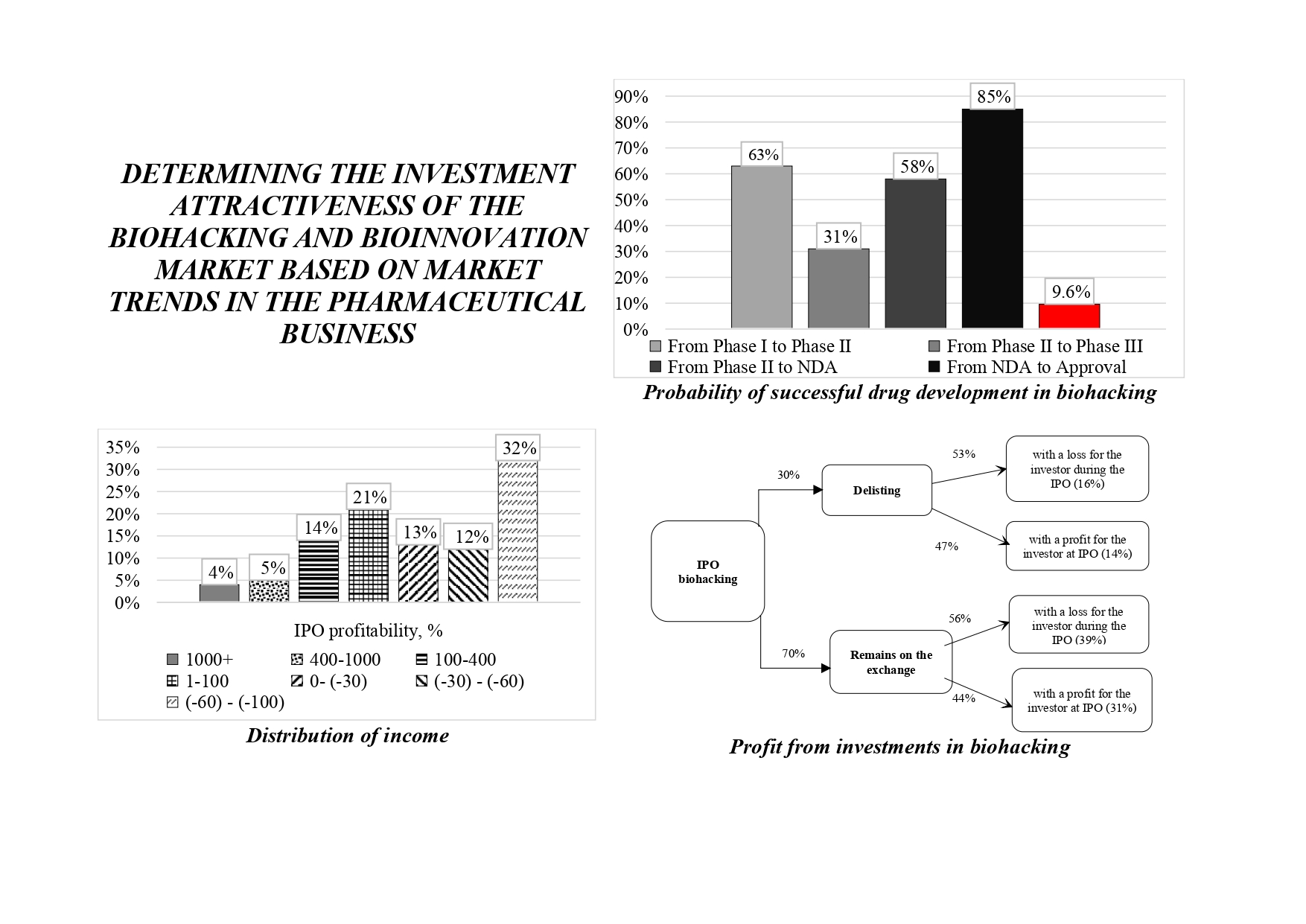
The object of the study was the process of venture investment in biohacking as a component of the pharmaceutical business, which embodies the development of the specified market. Since research requires significant capital investments, it is worth studying in detail and carefully the issues of financial investments and obtaining income from the specified processes. This work proposes a comprehensive economic analysis of the biohacking industry as a modern investment tool. The consistency of the high growth forecast with the main statistical risks inherent in biotechnology enterprises was described and analyzed. The basis for the hypothesis was the methodology for analyzing the development of the biohacking investment market. The analysis is based on the success rates of clinical trials and the development of FDA medical products from phase I to approval. The results are based on an assessment of the capital market of biotechnology companies in the world after IPOs since 2020. The results confirmed the hypothesis of rapid market growth with a compound annual rate of 19.09% from 2025 to 2034 (forecast). However, there is a rather low overall clinical success rate, about 9.06% between phase I and final drug approval, considering the highest percentage of research outflow between phases II and III (only 31% success). The best value was obtained for rare diseases (about 25.0%), the worst for oncology research (5.1%). The results indicate that most of the investments (about 56%) end in loss. As a result, it was determined that biohacking is currently a high-risk and at the same time highly productive direction, which has a radically different nature of investment. That is why investment should be based on careful, substantiated, reliable data analysis and assessment of the clinical portfolio, considering diversified risks.
References
- Takhar, J., Houston, H. R., Dholakia, N. (2022). Live very long and prosper? Transhumanist visions and ambitions in 2021 and beyond…. Journal of Marketing Management, 38 (5-6), 399–422. https://doi.org/10.1080/0267257x.2022.2069953
- Ezepchuk, Yu. V., Kolybo, D. V. (2016). Nobel laureate Ilya I. Metchnikoff (1845-1916). Life story and scientific heritage. The Ukrainian Biochemical Journal, 88 (6), 98–109. https://doi.org/10.15407/ubj88.06.098
- Metcalf, C. D., Ostler, C., Thor, P., Kheng, S., Srors, S., Sann, R. et al. (2023). Engaging multisector stakeholders to identify priorities for global health innovation, change and research: an engagement methodology and application to prosthetics service delivery in Cambodia. Disability and Rehabilitation, 46 (4), 685–696. https://doi.org/10.1080/09638288.2023.2173313
- Routhier, F., Lapierre, N., Huet-Fiola, C., Labrie, D., Rhéaume, N., Laberge, J. et al. (2025). Identifying the needs and preferences of potential users of a digital platform to facilitate outdoor leisure physical activities for people with physical or sensory disabilities. Disability and Rehabilitation, 47 (24), 6337–6346. https://doi.org/10.1080/09638288.2025.2502578
- Bialecki, J. (2020). Kolob Runs on Domo: Mormon Secrets and Transhumanist Code. Ethnos, 87 (3), 518–537. https://doi.org/10.1080/00141844.2020.1770311
- Mendz, G. L., Cook, M. (2021). Transhumanist Genetic Enhancement: Creation of a ‘New Man’ Through Technological Innovation. The New Bioethics, 27 (2), 105–126. https://doi.org/10.1080/20502877.2021.1917228
- Shalko, M., Domina, O., Korobko, I., Melnyk, D., Andriushchenko, A. (2024). The transformative impact of large language models in healthcare. Technology Audit and Production Reserves, 6 (4 (80)), 32–42. https://doi.org/10.15587/2706-5448.2024.319006
- Cohen, J. (2025). Fear of a transhumanist future: conspiracy theories and the speculative present. Journal of Contemporary Religion, 40 (2), 205–221. https://doi.org/10.1080/13537903.2025.2524246
- Simberg, D., Barenholz, Y., Roffler, S. R., Landfester, K., Kabanov, A. V., Moghimi, S. M. (2025). PEGylation technology: addressing concerns, moving forward. Drug Delivery, 32 (1). https://doi.org/10.1080/10717544.2025.2494775
- Schulte, P. A., Jacklitsch, B. L., Bhattacharya, A., Chun, H., Edwards, N., Elliott, K. C. et al. (2023). Updated assessment of occupational safety and health hazards of climate change. Journal of Occupational and Environmental Hygiene, 20 (5-6), 183–206. https://doi.org/10.1080/15459624.2023.2205468
- Yang, B., Gomes Dos Santos, A., Puri, S., Bak, A., Zhou, L. (2022). The industrial design, translation, and development strategies for long-acting peptide delivery. Expert Opinion on Drug Delivery, 19 (10), 1233–1245. https://doi.org/10.1080/17425247.2022.2098276
- Tse, T. K. C. (2025). Crafting a living tradition for a modern metropolis: a study of a Taoist education scheme in Hong Kong. British Journal of Religious Education, 1–14. https://doi.org/10.1080/01416200.2025.2488001
- Andriushchenko, K., Liezina, A., Slavkova, A., Logvinov, P., Lavruk, V., Petrukha, S., Storozhenko, A. (2024). The Impact of Energy-Efficient Technologies on the Development of the Agricultural Industry. Journal of Environmental & Earth Sciences, 7 (1), 423–437. https://doi.org/10.30564/jees.v7i1.7635
- Wilson, G. A., York, J. M. (2022). Reducing risk and increasing performance in the biotechnology industry. Journal of the International Council for Small Business, 4 (2), 184–195. https://doi.org/10.1080/26437015.2022.2073297
- Lima, V. M., Pessôa, L. A., Belk, R. W. (2022). The Promethean biohacker: on consumer biohacking as a labour of love. Journal of Marketing Management, 38 (5-6), 483–514. https://doi.org/10.1080/0267257x.2022.2070239
- Vidhata, S., Sarmah, B. (2024). Yoga and biohacking: a comprehensive overview. UGC CARE Journal, 48 (2), 30–40. Available at: https://www.researchgate.net/publication/381853205_YOGA_AND_BIOHACKING_A_COMPREHENSIVE_OVERVIEW
- Biohacking Market Size & Share Analys-is Growth Trends and Forecast (2026 – 2031). Mordor Intelligence. Available at: https://www.mordorintelligence.com/industry-reports/biohacking
- Domina, O., Andriushchenko, K., Liezina, A., Tsymbalenko, Y., Titova, O., Kyryliuk, O., Vylgin, Y. (2025). The Impact of Artificial Intelligence on the Formation of a Teacher’s Digital Twin in the Metaverse. Journal of Vasyl Stefanyk Precarpathian National University, 12 (3), 169–185. https://doi.org/10.15330/jpnu.12.3.169-185
- Andriushchenko, K., Khaletska, A., Ushenko, N., Zholnerchyk, H., Ivanets, I., Petrychuk, S., Uliganets, S. (2021). Education process digitalization and its impact on human capital of an enterprise. Journal of Management Information and Decision Sciences, 24 (5), 1–9. Available at: https://www.researchgate.net/publication/377329779_Education_process_digitalization_and_its_impact_on_human_capital_of_an_enterprise
- Feng, Q.-M., Chen, J.-W. (2024). Effects of exercise combined with cognitive dual-task training on cognitive function and sustained effects in stroke patients: a systematic review and meta-analysis. Disability and Rehabilitation, 47 (14), 3538–3547. https://doi.org/10.1080/09638288.2024.2435523
- Wang, D., Li, L. L., Lu, L. Y., Wilson, M. (2023). The Opioid Crisis, Employee Health Capital, and Corporate Information Production. European Accounting Review, 34 (2), 721–749. https://doi.org/10.1080/09638180.2023.2272622
- Carmichael, J., Ymer, L., Ponsford, J. (2025). Understanding participant experiences of cognitive behavioural therapy and health education for sleep disturbance and fatigue after acquired brain injury: a qualitative study. Disability and Rehabilitation, 47 (24), 6457–6467. https://doi.org/10.1080/09638288.2025.2484342
- Patel, A. S., Moake, T. R. (2023). Health behavior profiles: A person-centered approach to employee health. The Social Science Journal, 1–14. https://doi.org/10.1080/03623319.2023.2178441
- Liu, Y., Fuller, B., Hester, K., Chen, H. (2023). Authentic leadership and employees’ job performance: mediation effect of positive employee health. Journal of Management Analytics, 10 (3), 566–582. https://doi.org/10.1080/23270012.2023.2219993
- Andriushchenko, K., Liezina, A., Vasylchak, S., Manylich, M., Shterma, T., Petrynyak, U. (2022). Management of the Development of the Innovative Potential of the Region. TEM Journal, 11 (1), 339–347. https://doi.org/10.18421/tem111-43
- Cunningham, C., O’Donoghue, G., Cosgrave, S., Sands, T., Leacy, B., Markievicz, I. et al. (2022). Gym staff perspectives on disability inclusion: a qualitative study. Disability and Rehabilitation, 45 (3), 441–448. https://doi.org/10.1080/09638288.2022.2036826
- Haid, M., Heimerl, P., Menhofer, A., Stummer, H., Nöhammer, E. (2022). Workplace health promotion in the Austrian hospitality industry. Journal of Human Resources in Hospitality & Tourism, 21 (2), 289–314. https://doi.org/10.1080/15332845.2022.2031612
- Yatsenko, O., Nitsenko, V., Karasova, N., James, H. S., Parcell, J. L. (2017). Realization of the potential of the Ukraine–EU free trade area in agriculture. Journal of International Studies, 10 (2), 258–277. https://doi.org/10.14254/2071-8330.2017/10-2/18
- Andriushchenko, K., Kovtun, V., Cherniaieva, O., Datsii, N., Aleinikova, O., Mykolaiets, A. (2020). Transformation of the Educational Ecosystem in the Singularity Environment. International Journal of Learning, Teaching and Educational Research, 19 (9), 77–98. https://doi.org/10.26803/ijlter.19.9.5
- Yeh, K. B., Du, E., Olinger, G., Boston, D. (2022). Biotechnology and Biodefense Enterprise: An Industry Perspective on Defence Acquisition. Global Security: Health, Science and Policy, 7 (1), 37–43. https://doi.org/10.1080/23779497.2022.2102527
- Rosburg, T., Deuring, G., Ebner, G., Hauch, V., Pflueger, M. O., Stieglitz, R.-D. et al. (2022). Digitally Assisted Standard Diagnostics in Insurance Medicine (DASDIM): psychometric data in psychiatric work disability evaluations. Disability and Rehabilitation, 45 (26), 4457–4470. https://doi.org/10.1080/09638288.2022.2151655
- Kaberniuk, A. A., Oliĭnyk, O. S., Kolibo, D. V., Komisarenko, S. V. (2009). Toxin-neutralizing properties of antibodies to diphtheria toxin recombinant subunits A and B and a new method of their estimation. Ukrain'skyi Biokhimichnyi Zhurnal, 81 (3), 92–101. Available at: https://einstein.elsevierpure.com/en/publications/toxin-neutralizing-properties-of-antibodies-to-diphtheria-toxin-r-2/
- Shatursky, O. Y., Manoilov, K. Y., Gorbatiuk, O. B., Usenko, M. O., Zhukova, D. A., Vovk, A.I., Kobzar, O.L., Trikash, I.O., Borisova, T.A., Kolibo, D.V., Komisarenko, S.V. (2021). The geometry of diphtheria toxoid CRM197 channel assessed by thiazolium salts and nonelectrolytes. Biophysical Journal, 120 (12), 2577–2591. https://doi.org/10.1016/j.bpj.2021.04.028
- Liezina, A., Lavruk, A., Matviienko, H., Ivanets, I., Tseluiko, O., Kuchai, O. (2023). Impact of econometric modeling and perspectives of economic security of the cross-industry complex. Acta Innovations, 47, 73–83. https://doi.org/10.32933/actainnovations.47.7
- Clarke, L., Ridgewell, E., Dillon, M. P. (2022). Identifying and linking prosthetic outcomes to the ICF framework: a step to inform the benefits measured in prosthetic health economic evaluations. Disability and Rehabilitation, 45 (6), 1103–1113. https://doi.org/10.1080/09638288.2022.2049902
- Liezina, A., Andriushchenko, K., Domina, O., Titova, O., Petukhova, H. (2024). Regional clustering of FEC enterprises to strengthen the country’s economic security. Technology Audit and Production Reserves, 6 (4 (80)), 51–61. https://doi.org/10.15587/2706-5448.2024.320341
- Patrick, R. (2024). Balancing progress and responsibility: Ethical considerations in biotechnology. Journal of Biochemistry and Biotechnology, 7 (1), 190. Available at: https://www.alliedacademies.org/journal-biochemistry-biotechnology/
- Kovtun, V., Andriushchenko, K., Horbova, N., Lavruk, O., Yelyzaveta Muzychka, Y. (2020). Features of the Management Process of Ambidextrous Companies. TEM Journal, 9 (1), 221–226. https://doi.org/10.18421/tem91-31
- Andriushchenko, K., Liezina, A., Lavruk, V., Sliusareva, L., Rudevska, V. (2022). Intelligent enterprise capital control based on Markov chain. Acta Innovations, 45, 18–30. https://doi.org/10.32933/actainnovations.45.2
- Yatsenko, O. M., Nitsenko, V. S., Mardani, A., Tananaiko, T. S. (2018). The impact of global risks on the world trade and economic environment. Financial and Credit Activity Problems of Theory and Practice, 4 (27), 435–444. https://doi.org/10.18371/fcaptp.v4i27.154279
- Cekerevac, Z., Dvorak, Z., Prigoda, L., Cekerevac, P. (2018). Hacking, Protection and the Consequences of Hacking. Communications, 20 (2), 83–87. https://doi.org/10.26552/com.c.2018.2.83-87
- Lorrimar, V. (2025). What are ‘biohackers’ hacking? Identifying motivations and meaning-making frameworks. Medical Humanities. https://doi.org/10.1136/medhum-2025-013261
- Bennett, G., Gilman, N., Stavrianakis, A., Rabinow, P. (2009). From synthetic biology to biohacking: are we prepared? Nature Biotechnology, 27 (12), 1109–1111. https://doi.org/10.1038/nbt1209-1109
- Delfanti, A. (2013). Forbidden, Public, enclosed, open science. Biohackers: The Politics of Open Science. London: Pluto Press, 25–68. Available at: https://monoskop.org/images/8/8d/Delfanti_Alessandro_Biohackers_The_Politics_of_Open_Science_2013.pdf
- Pokataiev, P., Liezina, A., Petukhova, H., Andriushchenko, A. (2022). The role of biotechnology in the development of the bioeconomy. Acta Innovations, 46, 19–34. https://doi.org/10.32933/actainnovations.46.2
- Souza, D. de O., Rosales-Flores, R. A., Magalhães, A. P. N. de, Pereira-Abagaro, C., Cruz, S. Â. F. da S., Ericson, S. (2024). Risks, demands, and health damages faced by nursing workers in confronting Covid-19. Theoretical Issues in Ergonomics Science, 26 (2), 217–228. https://doi.org/10.1080/1463922x.2024.2405681
- Giordano, S. (2017). New Democratic Sciences, Ethics, and Proper Publics. Science, Technology, & Human Values, 43 (3), 401–430. https://doi.org/10.1177/0162243917723078
- Boettcher, K., Terkowsky, C., Schade, M., Brandner, D., Grünendahl, S., Pasaliu, B. (2023). Developing a real-world scenario to foster learning and working 4.0 – on using a digital twin of a jet pump experiment in process engineering laboratory education. European Journal of Engineering Education, 48 (5), 949–971. https://doi.org/10.1080/03043797.2023.2182184
- Landrain, T., Meyer, M., Perez, A. M., Sussan, R. (2013). Do-it-yourself biology: challenges and promises for an open science and technology movement. Systems and Synthetic Biology, 7 (3), 115–126. https://doi.org/10.1007/s11693-013-9116-4
- Pokataіev, P., Teteruk, K., Andriushchenko, A. (2023). A Biotechnological Business Incubator as an Instrument of Innovation Entrepreneurship. Recent Trends in Business and Entrepreneurial Ventures, 37–60. https://doi.org/10.52305/KZZV1105
- Andriushchenko, K., Riepina, I., Buriachenko, A., Kyryliuk, O. (2025). Determining the capabilities of artificial intelligence on the development of cryptotrading and blockchain technology. Technology Audit and Production Reserves, 3 (4 (83)), 42–52. https://doi.org/10.15587/2706-5448.2025.330463
- Redchuk, T. A., Korotkevich, N. V., Kaberniuk, A. A., Oliinyk, E. S., Labyntsev, A. Yu., Romaniuk, S. I. Kolibo, D. V., Busol, V. A., Komisarenko, S. V. (2010). Statistical analysis of the distribution of the antibody levels to Mycobacterium bovis antigenes for bovine tuberculosis diagnostics. Cytology and Genetics, 44 (5), 280–285. https://doi.org/10.3103/s009545271005004x
- Ferrari, A., Coenen, C., Grunwald, A. (2012). Visions and Ethics in Current Discourse on Human Enhancement. NanoEthics, 6 (3), 215–229. https://doi.org/10.1007/s11569-012-0155-1
- Chen, J., Pan, L., Lu, Y., Zhang, T., Xu, D., Yan, S., Ouyang, Z. (2023). Evolution of global scientific collaboration in mRNA vaccine research: Insights from bibliometric and social network analysis (2010~2023). Human Vaccines & Immunotherapeutics, 19 (3). https://doi.org/10.1080/21645515.2023.2276624
- Targeted protection with a chlorhexidine and alcohol-free alternative (2025). British Dental Journal, 239 (10), 735–735. https://doi.org/10.1038/s41415-025-9410-z
- Increase vigilance against cyberattacks (2022). Nature Biotechnology, 40 (8), 1155–1155. https://doi.org/10.1038/s41587-022-01446-4
- Zaidan, E., Ibrahim, I. A. (2024). AI Governance in a Complex and Rapidly Changing Regulatory Landscape: A Global Perspective. Humanities and Social Sciences Communications, 11 (1). https://doi.org/10.1057/s41599-024-03560-x
- Andriushchenko, K., Buriachenko, A., Liezina, A., Lavruk, O., Korzhenivska, N., Slavina, N. (2024). The impact of labor resources on the economic security of an enterprise in the sustainable development concept. Technology Audit and Production Reserves, 6 (4 (80)), 21–31. https://doi.org/10.15587/2706-5448.2024.318702
- Li, C., Zhou, J. (2022). Invention traits and alliance formation for high-tech startups. Technology Analysis & Strategic Management, 36 (10), 2462–2475. https://doi.org/10.1080/09537325.2022.2147819
- Dinda, G., Rahman, Z. (2025). Global Trends in Biotechnology Innovation: A Patent-Based Analysis. Science & Technology Libraries, 1–18. https://doi.org/10.1080/0194262x.2025.2530406
- Biobanking Funding & Investment Trends (2025). Grand View Research. Available at: https://www.grandviewresearch.com/market-trends/biobanking-funding-investment-trends
- Andriushchenko, K., Datsii, O., Lavruk, O., Dmytrenko, R., Kutashev, I., Vіnіchenko, I. et al. (2021). Development of а matrix of food industry capacity for making management decisions in the formation of sustainable development of agroecosystems. Eastern-European Journal of Enterprise Technologies, 2 (13 (110)), 16–27. https://doi.org/10.15587/1729-4061.2021.227805
- Raišienė, A. G., Yatsenko, O., Nitsenko, V., Karasova, N., Vojtovicova, A. (2019). Global dominants of Chinese trade policy development: Opportunities and threats for cooperation with Ukraine. Journal of International Studies, 12 (1), 193–207. https://doi.org/10.14254/2071-8330.2019/12-1/13
- Hwang, S.-E., Jang, Y.-A., Lim, K.-M., Jung, J.-W., Lee, J. H. (2025). New drug accessibility and budgetary impact in South Korea: policy challenges and implications. Expert Review of Pharmacoeconomics & Outcomes Research, 25 (5), 813–821. https://doi.org/10.1080/14737167.2025.2487468
- Deng, G., Fiaschetti, M., Mazzarisi, P., Medda, F. (2025). Optimizing investment period length and strategies for later stage venture capital staged financing portfolio. The European Journal of Finance, 31 (12), 1576–1598. https://doi.org/10.1080/1351847x.2025.2532548
- Sanger, N., Panesar, B., Dennis, M., Rosic, T., Rodrigues, M., Lovell, E., Yang, S. et al. (2022). The Inclusion of Patients’ Reported Outcomes to Inform Treatment Effectiveness Measures in Opioid Use Disorder. A Systematic Review. Patient Related Outcome Measures, 13, 113–130. https://doi.org/10.2147/prom.s297699
- Searson, P. C., Banks, W. A. (2026). Strategies for blood–brain barrier rejuvenation and repair. Nature Reviews Drug Discovery. https://doi.org/10.1038/s41573-025-01364-5
- Avouac, J., Barzel, A., Caiati, D., Davis, R. S., Gottschalk, S., Grieshaber-Bouyer, R. et al. (2026). Roads and detours for CAR T cell therapy in autoimmune diseases. Nature Reviews Drug Discovery. https://doi.org/10.1038/s41573-025-01349-4
- Coyle, J. T., Paul, S. M. (2026). Novel drug treatments for schizophrenia. Nature Reviews Drug Discovery. https://doi.org/10.1038/s41573-025-01335-w
- Haikarainen, T., Virtanen, A. T., Cravatt, B. F., Silvennoinen, O. (2026). Pharmacological targeting of the JAK–STAT pathway: new concepts and emerging indications. Nature Reviews Drug Discovery. https://doi.org/10.1038/s41573-025-01336-9
- Harutyunyan, A. (2024). IPO Activity In Global Healthcare & Life Sciences. Available at: https://dealforma.com/ipo-activity-in-global-healthcare-life-sciences/
Downloads
Published
How to Cite
Issue
Section
License
Copyright (c) 2026 Anhelina Andriushchenko, Anastasiia Liezina, Denis Kolybo, Ganna Gurina, Kostiantyn Havrysh, Nataliya Mazur, Oksana Kushnir, Oksana Kyryliuk

This work is licensed under a Creative Commons Attribution 4.0 International License.
The consolidation and conditions for the transfer of copyright (identification of authorship) is carried out in the License Agreement. In particular, the authors reserve the right to the authorship of their manuscript and transfer the first publication of this work to the journal under the terms of the Creative Commons CC BY license. At the same time, they have the right to conclude on their own additional agreements concerning the non-exclusive distribution of the work in the form in which it was published by this journal, but provided that the link to the first publication of the article in this journal is preserved.