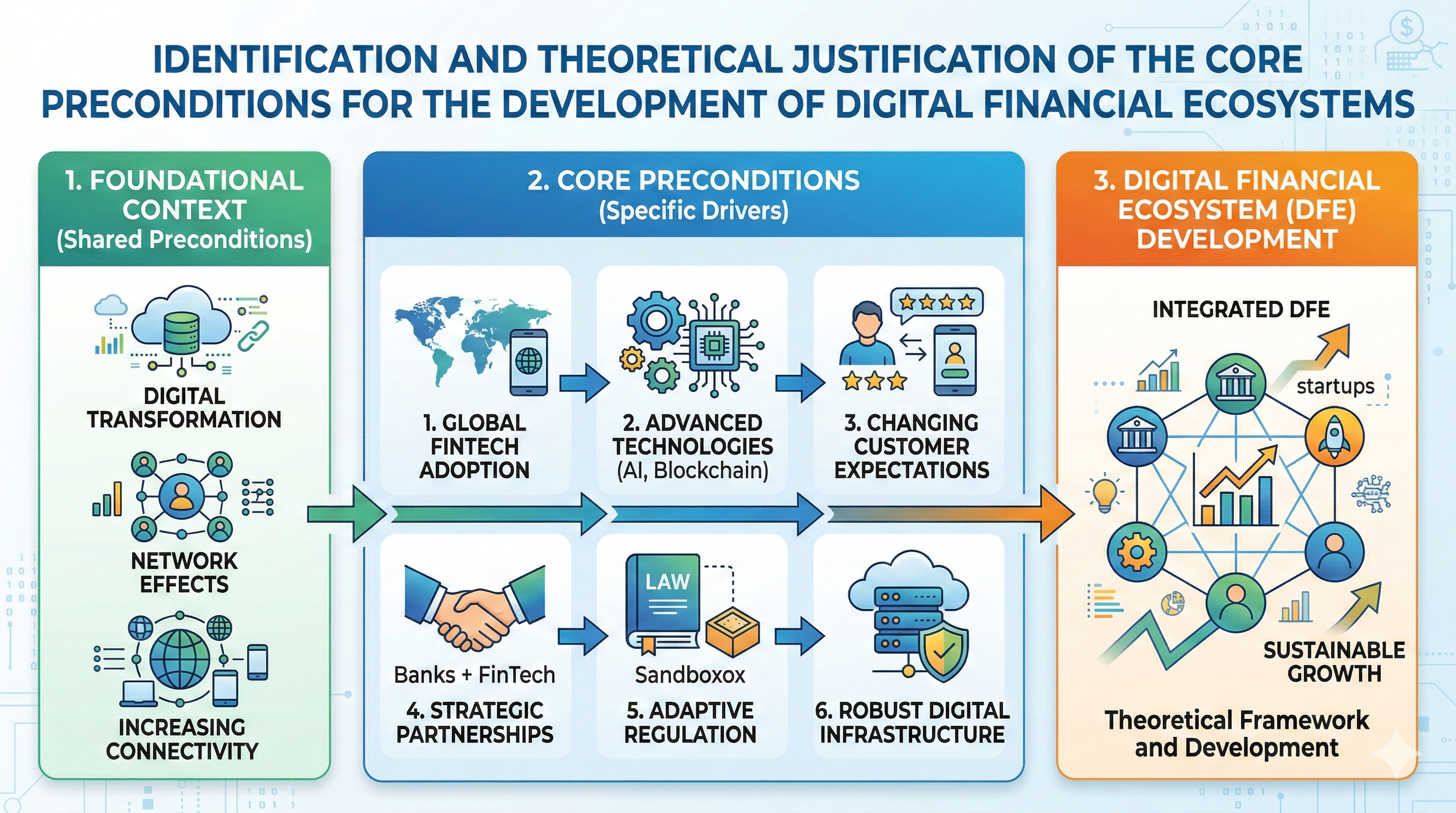
Identification and theoretical justification of the core preconditions for the development of digital financial ecosystems
DOI:
https://doi.org/10.15587/2706-5448.2026.352882Keywords:
digital financial ecosystems, financial architecture, financial technologies, hybrid financial architectureAbstract
The object of research is the process of forming digital financial ecosystems in the context of the transformation of the global financial architecture. The problem is the gaps in the forming digital financial ecosystems during the transformation of the global financial architecture under the influence of technological innovations. This is due to the introduction of blockchain technologies, smart contracts, intelligent agents (based on the introduction of artificial intelligence systems), multi-protocol financial technologies, the lack of unified standards and regulatory norms. A systems approach, structural-functional, comparative and institutional analysis, as well as trend analysis methods serve as the methodological basis of this research, implemented on the basis of statistical data from the Statista database and McKinsey & Company reports. Based on the generalization of quantitative and comparative assessments, the main trends in the transformation of the global financial architecture have been identified and analyzed. Institutional changes in the financial market based on the introduction of decentralized financial technologies (DeFi) and the implementation of the ISO 20022 regulatory standard are systematized. Key barriers to the transformation of modern financial architecture are identified, and directions for overcoming them are highlighted based on the development of hybrid financial solutions, international unification of standards and regulatory norms. The concept of forming a hybrid financial architecture (CeDeFi) and digital financial ecosystems is substantiated, which combines the advantages of decentralization and innovation with the reliability of the traditional financial system. The practical significance of research lies in the possibility of using its results to form effective strategies for the development of digital financial ecosystems, improve regulatory policy and make management decisions by financial institutions and fintech companies.
References
- Goudjil, L., Cherbal, S., Chaabna, S., Bensalem, I., Mashaleh, A., Gawanmeh, A. (2025). Application of Blockchain in the Development of Central Bank Digital Currencies. 2025 International Conference on New Trends in Computing Sciences (ICTCS). Amman: IEEE, 499–504. https://doi.org/10.1109/ictcs65341.2025.10989459
- Durigan Junior, C. A., de Mesquita Spinola, M., Gonçalves, R. F., Laurindo, F. J. B. (2024). Central Bank Digital Currency: The advent of its IT governance in the financial markets. arXiv. https://doi.org/10.48550/arXiv.2407.07898
- Allen, S., Čapkun, S., Eyal, I., Fanti, G., Ford, B., Grimmelmann, J. et al. (2020). Design Choices for Central Bank Digital Currency: Policy and Technical Considerations. National Bureau of Economic Research. https://doi.org/10.3386/w27634
- Buldas, A., Draheim, D., Gault, M., Laanoja, R., Nagumo, T., Saarepera, M. et al. (2022). An Ultra-Scalable Blockchain Platform for Universal Asset Tokenization: Design and Implementation. https://doi.org/10.36227/techrxiv.19673640.v1
- Wang, Z., Yu, L., Zhou, L. (2024). Navigating the Blockchain-Driven Transformation in Industry 4.0: Opportunities and Challenges for Economic and Management Innovations. Journal of the Knowledge Economy, 16 (1), 3507–3549. https://doi.org/10.1007/s13132-024-02007-7
- Wen, H., Li, S., Lau, R. S. M., Zhang, J. (2025). Stablecoins and the Emerging Hybrid Monetary Ecosystems. arXiv. https://doi.org/10.48550/arXiv.2505.10997
- Wang, H., Chen, K., Xu, D. (2016). A maturity model for blockchain adoption. Financial Innovation, 2 (1). https://doi.org/10.1186/s40854-016-0031-z
- Tian, Y., Adriaens, P., Minchin, R. E., Chang, C., Lu, Z., Qi, C. (2021). Asset Tokenization: A blockchain Solution to Financing Infrastructure in Emerging Markets and Developing Economies. SSRN Electronic Journal. https://doi.org/10.2139/ssrn.3837703
- Tian, Y., Minchin, R. E., Chung, K., Woo, J., Adriaens, P. (2022). Towards Inclusive and Sustainable Infrastructure Development through Blockchain-enabled Asset Tokenization: An Exploratory Case Study. IOP Conference Series: Materials Science and Engineering, 1218 (1), 012040. https://doi.org/10.1088/1757-899x/1218/1/012040
- Zetzsche, D. A., Arner, D. W., Buckley, R. P. (2020). Decentralized Finance. Journal of Financial Regulation, 6 (2), 172–203. https://doi.org/10.1093/jfr/fjaa010
- Soana, G., de Arruda, T. (2024). Central Bank Digital Currencies and financial integrity: finding a new trade-off between privacy and traceability within a changing financial architecture. Journal of Banking Regulation, 25 (4), 467–486. https://doi.org/10.1057/s41261-024-00241-2
- Mancini Griffoli, T., Martinez Peria, M., Agur, I., Ari, A., Kiff, J., Popescu, A. et al. (2018). Casting Light on Central Bank Digital Currencies. Staff Discussion Notes, 18 (8), 1. https://doi.org/10.5089/9781484384572.006
- Lavayssière, X. (2025). Legal Structures of Tokenised Assets. European Journal of Risk Regulation, 1–13. https://doi.org/10.1017/err.2024.88
- Zhang, Y., Gong, B., Zhou, P. (2024). Centralized use of decentralized technology: Tokenization of currencies and assets. Structural Change and Economic Dynamics, 71, 15–25. https://doi.org/10.1016/j.strueco.2024.06.006
- Kayani, U., Hasan, F. (2024). Unveiling Cryptocurrency Impact on Financial Markets and Traditional Banking Systems: Lessons for Sustainable Blockchain and Interdisciplinary Collaborations. Journal of Risk and Financial Management, 17 (2), 58. https://doi.org/10.3390/jrfm17020058
- Mohamed, H. (2021). Decentralizing Finance via Cryptocurrencies and Tokenization of Assets and Peer-to-Peer Platforms. International Journal of Islamic Economics, 3 (1), 1–16. https://doi.org/10.32332/ijie.v3i1.3128
- Harvey, C. R., Ramachandran, A., Santoro, J. (2021). DeFi and the Future of Finance. SSRN Electronic Journal. https://doi.org/10.2139/ssrn.3711777
- Schär, F. (2021). Decentralized Finance: On Blockchain – and Smart Contract-Based Financial Markets. Review, 103 (2). https://doi.org/10.20955/r.103.153-74
- Olatoye, F. O., Elufioye, O. A., Okoye, C. C., Nwankwo, E. E., Oladapo, J. O. (2024). Blockchain in asset management: An extensive review of opportunities and challenges. International Journal of Science and Research Archive, 11 (1), 2111–2119. https://doi.org/10.30574/ijsra.2024.11.1.0280
- Statista. Available at: https://www.statista.com/
- ForkLog. Available at:https://forklog.com/
- Rooz, Y. (2024). How tokenization is transforming finance and investment. World Economic Forum. Available at: https://www.weforum.org/stories/2024/12/tokenization-blockchain-assets-finance
- Banerjee, A., Sevillano, J., Higginson, M. (2024). From ripples to waves: The transformational power of tokenizing assets. McKinsey & Company. Available at: https://www.mckinsey.com/industries/financial-services/our-insights/from-ripples-to-waves-the-transformational-power-of-tokenizing-assets
- Higginson, M., Spanz, G. (2025). The stable door opens: How tokenized cash enables next gen payments. McKinsey & Company. Available at: https://www.mckinsey.com/industries/financial-services/our-insights/the-stable-door-opens-how-tokenized-cash-enables-next-gen-payments
- Standard Chartered: tokenization market to reach $30.1 trillion by 2034; trade finance will be significant (2024). Ledger Insight. Available at: https://www.ledgerinsights.com/standard-chartered-tokenization-market-to-reach-30-1-trillion-by-2034-trade-finance-will-be-significant/
- The next-generation monetary and financial system (2025). Bank for International Settlements. Available at: https://www.bis.org/publ/arpdf/ar2025e3.htm
- Markets in Crypto-Assets Regulation (MiCA). European Securities and Markets Authority. Available at: https://www.esma.europa.eu/esmas-activities/digital-finance-and-innovation/markets-crypto-assets-regulation-mica
- SEC and CFTC Staff Issue Joint Statement on Trading of Certain Spot Crypto Asset Products (2025). U.S. Securities and Exchange Commission. Available at: https://www.sec.gov/newsroom/press-releases/2025-110-sec-cftc-staff-issue-joint-statement-trading-certain-spot-crypto-asset-products
Downloads
Published
How to Cite
Issue
Section
License
Copyright (c) 2026 Oleksandr Manoylenko, Svitlana Kuznetsova

This work is licensed under a Creative Commons Attribution 4.0 International License.
The consolidation and conditions for the transfer of copyright (identification of authorship) is carried out in the License Agreement. In particular, the authors reserve the right to the authorship of their manuscript and transfer the first publication of this work to the journal under the terms of the Creative Commons CC BY license. At the same time, they have the right to conclude on their own additional agreements concerning the non-exclusive distribution of the work in the form in which it was published by this journal, but provided that the link to the first publication of the article in this journal is preserved.