Evaluation of the behavior and distribution of mercury and associated heavy metals in contaminated soils from an abandoned mercury complex in the Azzaba region (Northeast Algeria)
DOI:
https://doi.org/10.15587/2706-5448.2026.352998Keywords:
mercury district, toxic elements, physicochemical properties, soil, mobility, accumulationAbstract
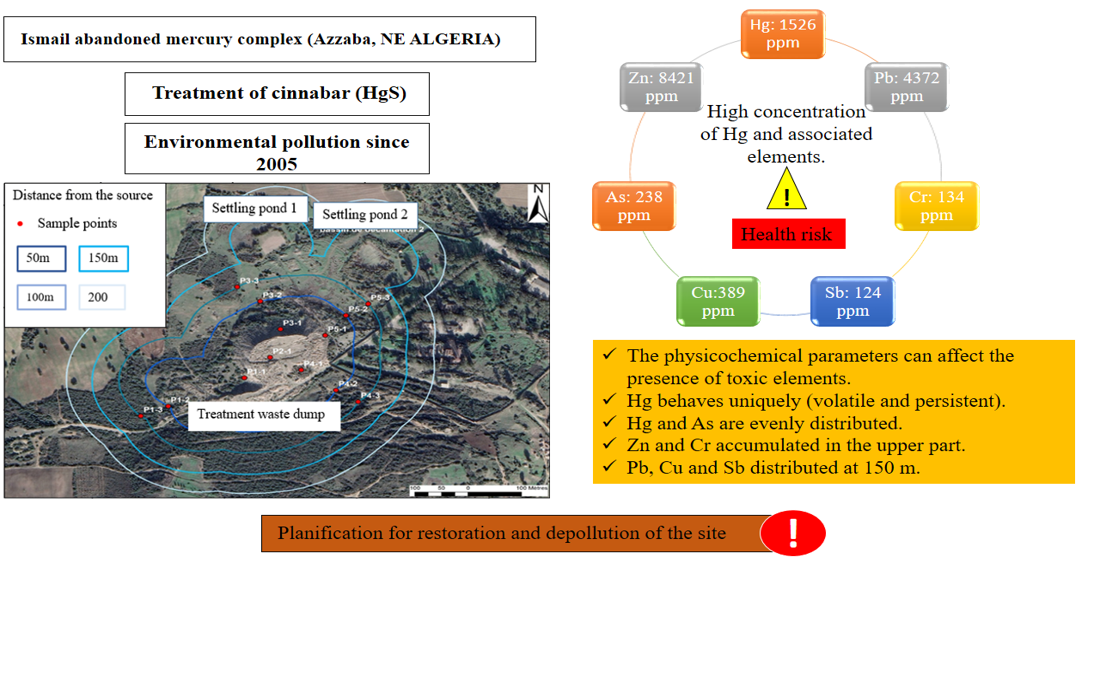
This research is about the mercury and toxic metals pollution caused by the mining processes of cinnabar deposits at Ismail abandoned mercury complex in Algeria. This complex has caused many health and environmental problems in Azzaba area. The effect has continued to date with the presence of toxic elements even after almost 20 years since the site closed. Planning for remediation was never considered. However, this study aims to characterize the soil, by mercury and associated metals concentrations and physicochemical parameters. Also, to evaluate the behavior and distribution of toxic elements in samples based on the physicochemical parameters of the environment. The results show that all samples have a high level of toxic metals (Hg, Zn, Pb, As, Cr, Cu, and Sb) with averages in ppm, respectively (1526, 8421, 4372, 238, 134, 389, 124), these concentrations exceed standards, which increase the environmental risks. The statistical results show a correlation between pH–(Zn, Pb, Cr), Ec–(Pb, Cr and Cu), CEC–(Zn, Cu and As), OM–Zn and CaCO3–(Zn, Pb, Cr, Cu and Sb) indicate that physicochemical parameters can affect the behavior and the mobility of metals. Except for Hg, which behaves in a particular way. In addition, according to ANOVA tests, Hg and As are evenly distributed throughout the study area. Unlike other metals, Pb, Cu and Sb to move to the surrounding soil or accumulate at a distance of 150 m while Zn and Cr accumulate in the upper part of the waste dump. This research investigates how toxic elements disperse or accumulate, make an assumption about their geochemical origin, and analyses their interactions with different soil characteristics. In addition, it contributes to the assessment of environmental risks and provides a relevant scientific support for planning appropriate decontamination and site restoration strategies.
References
- Kahangwa, C. A., Nahonyo, C. L., Sangu, G., Nassary, E. K. (2021). Assessing phytoremediation potentials of selected plant species in restoration of environments contaminated by heavy metals in gold mining areas of Tanzania. Heliyon, 7 (9), e07979. https://doi.org/10.1016/j.heliyon.2021.e07979
- Karaca, O., Cameselle, C., Reddy, K. R. (2017). Acid pond sediment and mine tailings contaminated with metals: physicochemical characterization and electrokinetic remediation. Environmental Earth Sciences, 76 (12). https://doi.org/10.1007/s12665-017-6736-0
- Fernández-Martínez, R., Corrochano, N., Álvarez-Quintana, J., Ordóñez, A., Álvarez, R., Rucandio, I. (2024). Assessment of the ecological risk and mobility of arsenic and heavy metals in soils and mine tailings from the Carmina mine site (Asturias, NW Spain). Environmental Geochemistry and Health, 46 (3). https://doi.org/10.1007/s10653-023-01848-6
- Bauštein, M., Száková, J., Stefanović, L., Najmanová, J., Sysalová, J., Tlustoš, P. (2024). Assessment of Mercury Uptake by Plants in Former Cinnabar Mining Areas. Minerals, 14 (12), 1211. https://doi.org/10.3390/min14121211
- Yan, J., Wang, C., Wang, Z., Yang, S., Li, P. (2019). Mercury concentration and speciation in mine wastes in Tongren mercury mining area, southwest China and environmental effects. Applied Geochemistry, 106, 112–119. https://doi.org/10.1016/j.apgeochem.2019.05.008
- Kumar, V., Umesh, M., Shanmugam, M. K., Chakraborty, P., Duhan, L., Gummadi, S. N. et al. (2023). A Retrospection on Mercury Contamination, Bioaccumulation, and Toxicity in Diverse Environments: Current Insights and Future Prospects. Sustainability, 15 (18), 13292. https://doi.org/10.3390/su151813292
- Seklaoui, M., Boutaleb, A., Benali, H., Alligui, F., Prochaska, W. (2016). Environmental assessment of mining industry solid pollution in the mercurial district of Azzaba, northeast Algeria. Environmental Monitoring and Assessment, 188 (11). https://doi.org/10.1007/s10661-016-5619-2
- Benhamza, M., Hammar, Y. (2012). Contamination by mercury of groundwater of the North Numidian zone of Azzaba, North East Algeria. Effect of inorganic mercury contamination of population. International Journal of Environment and Waste Management, 9 (3/4), 347. https://doi.org/10.1504/ijewm.2012.046397
- Benhamza, M. (2007). Contribution de la géophysique à l’étude hydrogéologique de la zone mercurielle nord numidique(AZZABA)-Détermination du degré de pollution. [Doctoral thesis]. Available at: https://biblio.univ-annaba.dz/wp-content/uploads/2014/06/BENHAMZA-Moussa.pdf
- Benhamza, M., Kherici, N., Picard-Bonnaud, F., Nezzal, A. (2008). Qualité des eaux souterraines de la zone mercurielle Nord Numédique (AZZABA), Nord Est Algérie. Evaluation de la contamination de la population par le mercure inorganique. Bulletin du Service Géologique de l'Algérie, 19 (2), 135–149. Available at: https://asjp.cerist.dz/en/article/2758
- Megueddem, M., Belmahi, H., Azzouz, M., Reggabi, M. (2004). Dosage du mercure sanguin chez des sujets professionnellement exposés. Revue Française Des Laboratoires, 2004 (363), 41–46. https://doi.org/10.1016/s0338-9898(04)80069-6
- Seklaoui, M. (2018). Etude environnementale de la pollution minière du district mercuriel d’Azzaba. [Doctoral thesis]. Available at: https://theses-algerie.com/3175702025128580/these-de-doctorat/universite-des-sciences-et-de-la-technologie-houari-boumedien---alger/etude-environnementale-de-la-pollution-mini%C3%A8re-du-district-mercuriel-d-azzaba
- Nannoni, A., Meloni, F., Benvenuti, M., Cabassi, J., Ciani, F., Costagliola, P. et al. (2022). Environmental impact of past Hg mining activities in the Monte Amiata district, Italy: A summary of recent studies. AIMS Geosciences, 8 (4), 525–551. https://doi.org/10.3934/geosci.2022029
- Moussa, B., Djamel, R., Faouzi, B. M. (2015). Hydro Geochemistry and Balance between Minerals and Solutions in the Mercurial Zone of Azzaba, Northeast of Algeria. Energy Procedia, 74, 1133–1141. https://doi.org/10.1016/j.egypro.2015.07.754
- Alligui, F., Boutaleb, A. (2010). Impact of Mercury Mine Activities on Water Resources at Azzaba-North-East of Algeria. American Journal of Environmental Sciences, 6 (4), 395–401. https://doi.org/10.3844/ajessp.2010.395.401
- Alligui, F., Boutaleb, A. (2013). Origin and Speciation of Selected Trace Elements in Groundwater: A Case Study of Azzaba District in Northeast of Algeria. Journal of Environment, 2 (6), 134–139. Available at: https://www.researchgate.net/publication/299583965_Origin_and_Speciation_of_Selected_Trace_Elements_in_Groundwater_A_Case_Study_of_Azzaba_District_in_Northeast_of_Algeria
- Walkley, A., Black, I. A. (1934). An examination of the Degtjareff method for determining soil organic matter, and a proposed modification of the chromic acid titration method. Soil Science, 37 (1), 29–38. https://doi.org/10.1097/00010694-193401000-00003
- Lamas, F., Irigaray, C., Oteo, C., Chacón, J. (2005). Selection of the most appropriate method to determine the carbonate content for engineering purposes with particular regard to marls. Engineering Geology, 81 (1), 32–41. https://doi.org/10.1016/j.enggeo.2005.07.005
- Liming to Improve Soil quality in acid soil (1999). U.S. Department of Agriculture, Natural Resources Conservation Service. Available at: https://www.nrcs.usda.gov/sites/default/files/2023-04/nrcs142p2_053252.pdf
- Ech-Charef, A., Dekayir, A., Jordán, G., Rouai, M., Chabli, A., Qarbous, A. et al. (2023). Soil heavy metal contamination in the vicinity of the abandoned Zeïda mine in the Upper Moulouya Basin, Morocco. Implications for airborne dust pollution under semi-arid climatic conditions. Journal of African Earth Sciences, 198, 104812. https://doi.org/10.1016/j.jafrearsci.2022.104812
- Badamasi, H., Dauda, A., Suleiman, A. K., Muhammad, S. E., Durumin-Iya, N. I., Abdullahi, H. U. (2024). Source Distribution and Ecological Risk Assessments of Heavy Metals from the Soils of Riruwai Mining Area, North-Western Nigeria. Indonesian Journal of Environmental Management and Sustainability, 8 (1), 25–33. https://doi.org/10.26554/ijems.2024.8.1.25-33
- Petelka, J., Abraham, J., Bockreis, A., Deikumah, J. P., Zerbe, S. (2019). Soil Heavy Metal (loid) Pollution and Phytoremediation Potential of Native Plants on a Former Gold Mine in Ghana. Water, Air, & Soil Pollution, 230 (11). https://doi.org/10.1007/s11270-019-4317-4
- Standard operating procedure for soil pH determination (2021). FAO, 23. Available at: https://openknowledge.fao.org/items/226f2913-07c3-4aaf-a94a-3147c2398aa5
- Kahoul, M., Alioua, A., Nassima, D., Ayad, W. (2014). Comportement des micromycètes du sol vis-à-vis de la pollution mercurielle dans la région d’Azzaba (Algérie). Journal of Materials and Environmental science. 5 (5), 1470–1476. Available at: https://www.jmaterenvironsci.com/Document/vol5/vol5_N5/180-JMES-762-2014-Kahoul.pdf
- Maphuhla, N. G., Lewu, F. B., Oyedeji, O. O. (2021). Accumulation of Heavy Metal Concentration and Physicochemical Parameters in Soil from Alice Landfill Site in Eastern Cape, South Africa. Research Square. https://doi.org/10.21203/rs.3.rs-621824/v1
- Badamasi, H., Hassan, U. F., Adamu, H. M. (2022). Physico-chemical Properties and Heavy metal Contamination Levels of Soils from Riruwai Mining Area, North-western Nigeria. Malaysian Journal of Applied Sciences, 7 (2), 29–43. https://doi.org/10.37231/myjas.2022.7.2.324
- He, G., Zhang, Z., Wu, X., Cui, M., Zhang, J., Huang, X. (2020). Adsorption of Heavy Metals on Soil Collected from Lixisol of Typical Karst Areas in the Presence of CaCO3 and Soil Clay and Their Competition Behavior. Sustainability, 12 (18), 7315. https://doi.org/10.3390/su12187315
- Yu, H., Li, C., Yan, J., Ma, Y., Zhou, X., Yu, W. et al. (2023). A review on adsorption characteristics and influencing mechanism of heavy metals in farmland soil. RSC Advances, 13 (6), 3505–3519. https://doi.org/10.1039/d2ra07095b
- Gruszka, D., Szopka, K., Gruss, I., Złocka, M. (2025). Is the Soil in Allotment Gardens Healthy Enough? – Relation Between Organic Matter Content and Selected Heavy Metals. Sustainability, 17 (16), 7424. https://doi.org/10.3390/su17167424
Downloads
Published
How to Cite
Issue
Section
License
Copyright (c) 2026 Rania Sbaghdi, Abdellali Bouzenzana, Hani Bouyahmed, Abdelfettah Gherib, Samir Chekchaki, Iness Braham

This work is licensed under a Creative Commons Attribution 4.0 International License.
The consolidation and conditions for the transfer of copyright (identification of authorship) is carried out in the License Agreement. In particular, the authors reserve the right to the authorship of their manuscript and transfer the first publication of this work to the journal under the terms of the Creative Commons CC BY license. At the same time, they have the right to conclude on their own additional agreements concerning the non-exclusive distribution of the work in the form in which it was published by this journal, but provided that the link to the first publication of the article in this journal is preserved.