Evaluation of technological properties and safety indicators of poultry products made using natural marinades
DOI:
https://doi.org/10.15587/2706-5448.2026.353035Keywords:
marinated meat semi-finished products, cherry juice, josta juice, marinade absorption, antioxidant activityAbstract
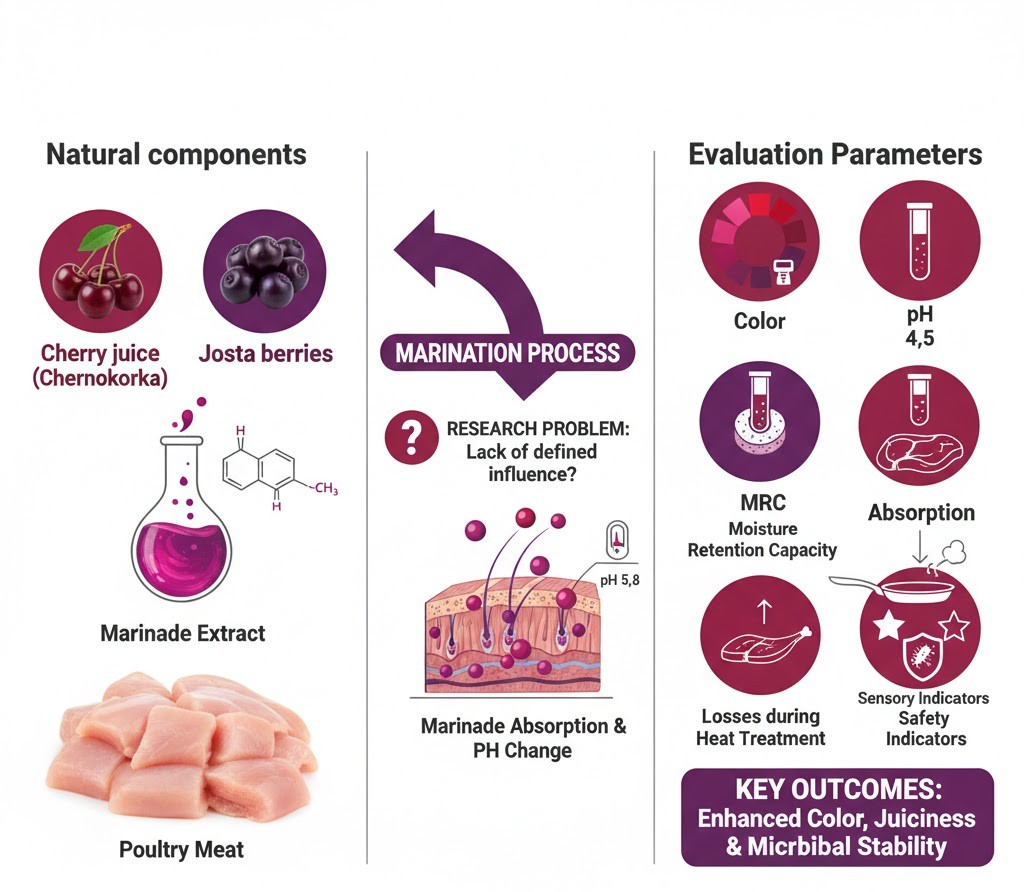
The object of research is the technology and quality parameters of marinated semi-finished poultry meat products using marinades based on cherry juice of the Chernokorka variety (Cherry tree Chernokorka) and Josta berries (Josta). The problem solved in the research is the lack of an exhaustive definition of the influence of natural marinades on the complex of indicators of natural semi-finished poultry meat products. The key evaluation parameters were: color, pH, moisture retention capacity, marinade absorption, losses during heat treatment, sensory indicators, safety indicators of finished products. The process of passive marinating (soaking) was carried out for 12 hours. For this, chicken breasts were soaked in marinade solutions No. 1 (josta berry juice: purified water: sea salt – 60:37:3) and No. 2 (cherry berry juice: purified water: sea salt – 60:37:3). As a control, samples were marinated in marinades of the company Spice Land LLC (Ukraine).
It was found that the juice of josta berries differs from cherry juice in a higher content of total phenolic compounds (327.16 versus 201.31 mg/100 ml) and a higher titrated acidity (3.5%). The antioxidant activity of josta juice is at a high level: juice polyphenols inhibit 97.41 ± 1.57% of the DPPH free radical. An increase in moisture content was determined in products marinated with cherry juice (76.21%) and josta juice (77.16%). The use of cherry and josta juice in marinades accelerates their diffusion into muscle tissue. The highest sorption capacity was found in samples treated with marinade with josta juice (1.43%), which is 1.5 times higher than the control. The use of berry juices in marinades reduces thermal losses by 2.17–2.68%.
It has been proven that the use of cherry and josta juice as bases for marinades in the technology of semi-finished poultry meat products improves the taste and aroma profile of finished products, inhibits oxidative processes in marinated semi-finished poultry meat products, and ensures their microbiological safety during storage.
References
- Figueroa, C., Ramírez, C., Núñez, H., Jaques, A., Simpson, R. (2020). Application of vacuum impregnation and CO2-laser microperforations in the potential acceleration of the pork marinating process. Innovative Food Science & Emerging Technologies, 66, 102500. https://doi.org/10.1016/j.ifset.2020.102500
- Gazda, P., Glibowski, P. (2024). Advanced Technologies in Food Processing – Development Perspective. Applied Sciences, 14 (9), 3617. https://doi.org/10.3390/app14093617
- Demir, H., Çelik, S., Sezer, Y. Ç. (2021). Effect of ultrasonication and vacuum impregnation pretreatments on the quality of beef marinated in onion juice a natural meat tenderizer. Food Science and Technology International, 28 (4), 340–352. https://doi.org/10.1177/10820132211012919
- Augustyńska-Prejsnar, A., Sokołowicz, Z., Hanus, P., Ormian, M., Kačániová, M. (2020). Quality and Safety of Marinating Breast Muscles of Hens from Organic Farming after the Laying Period with Buttermilk and Whey. Animals, 10 (12), 2393. https://doi.org/10.3390/ani10122393
- Manful, C. F., Pham, T. H., Nadeem, M., Wheeler, E., Warren, K. J. T., Vidal, N. P., Thomas, R. H. (2021). Assessing unfiltered beer-based marinades effects on ether and ester linked phosphatidylcholines and phosphatidylethanolamines in grilled beef and moose meat. Meat Science, 171, 108271. https://doi.org/10.1016/j.meatsci.2020.108271
- Ehsanur Rahman, S. M., Islam, S., Pan, J., Kong, D., Xi, Q., Du, Q. et al. (2023). Marination ingredients on meat quality and safety – a review. Food Quality and Safety, 7. https://doi.org/10.1093/fqsafe/fyad027
- Augustyńska-Prejsnar, A., Kačániová, M., Ormian, M., Topczewska, J., Sokołowicz, Z. (2023). Quality and Microbiological Safety of Poultry Meat Marinated with the Use of Apple and Lemon Juice. International Journal of Environmental Research and Public Health, 20 (5), 3850. https://doi.org/10.3390/ijerph20053850
- Latoch, A., Czarniecka-Skubina, E., Moczkowska-Wyrwisz, M. (2023). Marinades Based on Natural Ingredients as a Way to Improve the Quality and Shelf Life of Meat: A Review. Foods, 12 (19), 3638. https://doi.org/10.3390/foods12193638
- Peshuk, L., Kyrylov, Y., Shtyk, I., Сhernushenko, O. (2022). Technology of marined game semi-finished meat with an accent of elegance and functionality. Journal of Chemistry and Technologies, 30 (4), 639–651. https://doi.org/10.15421/jchemtech.v30i4.268176
- Tyshchenko, L. M., Pylypchuk, O., Adamchuk, L. O., Akulonok, O. I. (2021). Honey as a component of marinade for semi-finished meat products. Animal Science and Food Technology, 12 (2), 73–81. https://doi.org/10.31548/animal2021.02.008
- Edema, W. N., Jayarathne, G. G. N., Udayanga, D., Senevirathne, T. A. S. M., Jayasena, D. D. (2020). Effect of different marinades with bee honey and pineapple on quality attributes of smoked chicken jerky. Proceedings of the International Research Conference of Uva Wellassa University. Badulla: Uva Wellassa University, 283.
- Lopes, S. M., da Silva, D. C., Tondo, E. C. (2021). Bactericidal effect of marinades on meats against different pathogens: a review. Critical Reviews in Food Science and Nutrition, 62 (27), 7650–7658. https://doi.org/10.1080/10408398.2021.1916734
- Serdaroğlu, M., Öztürk-Kerimoğlu, B. (2023). Et Teknolojisi Et Ürünleri Üretiminde Temel Teknolojiler ve Ürün Kalitesi. Sidas, 316.
- Bhat, Z. F., Morton, J. D., Mason, S. L., Bekhit, A. E. A. (2018). Applied and Emerging Methods for Meat Tenderization: A Comparative Perspective. Comprehensive Reviews in Food Science and Food Safety, 17 (4), 841–859. https://doi.org/10.1111/1541-4337.12356
- Barekat, S., Soltanizadeh, N. (2017). Improvement of meat tenderness by simultaneous application of high-intensity ultrasonic radiation and papain treatment. Innovative Food Science & Emerging Technologies, 39, 223–229. https://doi.org/10.1016/j.ifset.2016.12.009
- Bekhit, A. E.-D. A., Suwandy, V., Carne, A., van de Ven, R., Hopkins, D. L. (2016). Effect of repeated pulsed electric field treatment on the quality of hot-boned beef loins and topsides. Meat Science, 111, 139–146. https://doi.org/10.1016/j.meatsci.2015.09.001
- Simonova, I., Tsizh, B., Drachuk, U., Halukh, B., Basarab, I., Koval, H. et al. (2024). The utilization of new types of marinades based on fruit raw material for use in the technology of semi-finished rabbit meat. Zywnosc Nauka Technologia Jakosc/Food Science Technology Quality, 31 (2), 46–66. https://doi.org/10.15193/zntj/2024/139/496
- Laczkó-Zöld, E., Komlósi, A., Ülkei, T., Fogarasi, E., Croitoru, M., Fülöp, I. et al. (2018). Extractability of polyphenols from black currant, red currant and gooseberry and their antioxidant activity. Acta Biologica Hungarica, 69 (2), 156–169. https://doi.org/10.1556/018.69.2018.2.5
- Yalpachyk, V. F., Zahorko, N. P., Kiurchev, S. V., Tarasenko, V. H., Kiurcheva, L. M., Budenko, S. F. et al. (2018). Optymizatsiia tekhnolohii zamorozhuvannia plodoovochevoi produktsii. Melitopol: Vydavnychyi budynok Melitopolskoi miskoi drukarni, 214.
- Untea, A. E., Oancea, A.-G., Vlaicu, P. A., Varzaru, I., Saracila, M. (2024). Blackcurrant (Fruits, Pomace, and Leaves) Phenolic Characterization before and after In Vitro Digestion, Free Radical Scavenger Capacity, and Antioxidant Effects on Iron-Mediated Lipid Peroxidation. Foods, 13 (10), 1514. https://doi.org/10.3390/foods13101514
- Carvalho, F., Lahlou, R. A., Silva, L. R. (2024). Phenolic Compounds from Cherries and Berries for Chronic Disease Management and Cardiovascular Risk Reduction. Nutrients, 16 (11), 1597. https://doi.org/10.3390/nu16111597
- Nour, V. (2022). Effect of Sour Cherry or Plum Juice Marinades on Quality Characteristics and Oxidative Stability of Pork Loin. Foods, 11 (8), 1088. https://doi.org/10.3390/foods11081088
- Clodoveo, M. L., Crupi, P., Muraglia, M., Naeem, M. Y., Tardugno, R., Limongelli, F., Corbo, F. (2023). The main phenolic compounds responsible for the antioxidant capacity of sweet cherry (Prunus avium L.) pulp. LWT, 185, 115085. https://doi.org/10.1016/j.lwt.2023.115085
- Bozhko, N., Pasichnyi, V., Tischenko, V., Marynin, A., Shubina, Y., Strashynskyi, I. (2021). Determining the nutritional value and quality indicators of meat-containing bread made with hemp seeds flour (Cannabis sativa L.). Eastern-European Journal of Enterprise Technologies, 4 (11 (112)), 58–65. https://doi.org/10.15587/1729-4061.2021.237806
- Bozhko, N., Pasichnyi, V., Marynin, A., Tischenko, V., Strashynskyi, I., Kyselov, O. (2020). The efficiency of stabilizing the oxidative spoilage of meat-containing products with a balanced fat-acid composition. Eastern-European Journal of Enterprise Technologies, 3 (11 (105)), 38–45. https://doi.org/10.15587/1729-4061.2020.205201
- Abd-Elhalim, B. T., Mohamed, E. S., Gamar, G. M., Moawad, H. (2025). Biological activities and application of Rosmarinus officinalis extract to improve the preservation and microbial qualities of some local meat products. Scientific Reports, 15 (1). https://doi.org/10.1038/s41598-025-14247-x
- Kang, J.-Y., Lee, S.-H., Jo, A.-H., Park, E.-J., Bak, Y.-S., Kim, J.-B. (2020). Improving the accuracy of coliform detection in meat products using modified dry rehydratable film method. Food Science and Biotechnology, 29 (9), 1289–1294. https://doi.org/10.1007/s10068-020-00778-8
- Modzelewska-Kapituła, M., Tkacz, K., Nogalski, Z. (2021). The influence of muscle, ageing and thermal treatment method on the quality of cooked beef. Journal of Food Science and Technology, 59 (1), 123–132. https://doi.org/10.1007/s13197-021-04993-x
- Bulgaru, V., Gurev, A., Baerle, A., Dragancea, V., Balan, G., Cojocari, D. et al. (2024). Phytochemical, Antimicrobial, and Antioxidant Activity of Different Extracts from Frozen, Freeze-Dried, and Oven-Dried Jostaberries Grown in Moldova. Antioxidants, 13 (8), 890. https://doi.org/10.3390/antiox13080890
- Vahapoglu, B., Erskine, E., Gultekin Subasi, B., Capanoglu, E. (2021). Recent Studies on Berry Bioactives and Their Health-Promoting Roles. Molecules, 27 (1), 108. https://doi.org/10.3390/molecules27010108
- Okatan, V. (2020). Antioxidant properties and phenolic profile of the most widely appreciated cultivated berry species: A comparative study. Folia Horticulturae, 32 (1), 79–85. https://doi.org/10.2478/fhort-2020-0008
- Unal, K., Alagöz, E., Çelik, İ., Sarıçoban, C. (2021). Marination with citric acid, lemon, and grapefruit affects the sensory, textural, and microstructure characteristics of poultry meat. British Poultry Science, 63 (1), 31–38. https://doi.org/10.1080/00071668.2021.1963674
- Dilek, N. M., Babaoğlu, A. S., Unal, K., Ozbek, C., Pırlak, L., Karakaya, M. (2023). Marination with aronia, grape and hawthorn vinegars affects the technological, textural, microstructural and sensory properties of spent chicken meat. British Poultry Science, 64 (3), 357–363. https://doi.org/10.1080/00071668.2022.2163616
- Komoltri, P., Pakdeechanuan, P. (2012). Effects of marinating ingredients on physicochemical, microstructural and sensory properties of golek chicken. International Food Research Journal, 19, 1449–1455.
- Mohd Azmi, S., Kumar, P., Sharma, N., Sazili, A., Lee, S.-J., Ismail-Fitry, M. (2023). Application of Plant Proteases in Meat Tenderization: Recent Trends and Future Prospects. Foods, 12 (6), 1336. https://doi.org/10.3390/foods12061336
- Pylypchuk, O., Tyshchenko, L., Israelian, V., Mushtruk, N. (2022). Influence of parameters of marinating meat semi-finished products on the quality of the finished product. Animal Science and Food Technology, 13 (2), 44–52. https://doi.org/10.31548/animal.13(2).2022.44-52
- Al‐Dalali, S., Li, C., Xu, B. (2021). Evaluation of the effect of marination in different seasoning recipes on the flavor profile of roasted beef meat via chemical and sensory analysis. Journal of Food Biochemistry, 46 (6). https://doi.org/10.1111/jfbc.13962
- Simonova, I., Halukh, B., Drachuk, U., Basarab, I. (2023). Improvement of poultry meat marinated semi-finished product technology. Scientific Messenger of LNU of Veterinary Medicine and Biotechnologies, 25 (99), 61–68. https://doi.org/10.32718/nvlvet-f9911
- Borodai, A. B., Sutkovych, T. Yu., Heredchuk, A. M., Levchenko, Yu. V. (2024). Improvement pre-treatment technology of meat for the preparation in restaurants. Scientific Messenger of LNU of Veterinary Medicine and Biotechnologies, 26 (101), 84–90. https://doi.org/10.32718/nvlvet-f10113
- Das, A., Hashem, M. A., Azad, M. A. K., Rahman, M. M. (2022). Marinating broiler meat in cooking oil for short-term storage. Meat Research, 2 (3). https://doi.org/10.55002/mr.2.3.22
- Gök, V., Bor, Y. (2016). Effect of Marination with Fruit and Vegetable Juice on the Some Quality Characteristics of Turkey Breast Meat. Revista Brasileira de Ciência Avícola, 18 (3), 481–488. https://doi.org/10.1590/1806-9061-2016-0225
- Kadıoğlu, P., Karakaya, M., Unal, K., Babaoğlu, A. S. (2019). Technological and textural properties of spent chicken breast, drumstick and thigh meats as affected by marinating with pineapple fruit juice. British Poultry Science, 60 (4), 381–387. https://doi.org/10.1080/00071668.2019.1621990
- Barbanti, D., Pasquini, M. (2005). Influence of cooking conditions on cooking loss and tenderness of raw and marinated chicken breast meat. LWT – Food Science and Technology, 38 (8), 895–901. https://doi.org/10.1016/j.lwt.2004.08.017
- Filipović, I., Ćurčić, B., Filipović, V., Nićetin, M., Filipović, J., Knežević, V. (2016). The Effects of Technological Parameters on Chicken Meat Osmotic Dehydration Process Efficiency. Journal of Food Processing and Preservation, 41 (1), e13116. https://doi.org/10.1111/jfpp.13116
- Peshuk, L. V., Prykhodko, D. Yu., Shtyk, I. I. (2024). Vplyv kavovoho marynadu na optymizatsiiu yakisnykh pokaznykiv miasnykh napivfabrykativ iz dychyny. Tavriiskyi naukovyi visnyk. Seriia: Tekhnichni nauky, 5, 131–139.
- Klementaviciute, J., Zavistanaviciute, P., Klupsaite, D., Rocha, J. M., Gruzauskas, R., Viskelis, P. et al. (2024). Valorization of Dairy and Fruit/Berry Industry By-Products to Sustainable Marinades for Broilers’ Wooden Breast Meat Quality Improvement. Foods, 13 (9), 1367. https://doi.org/10.3390/foods13091367
- Bozhko, N., Pasichnyi, V., Tischenko, V., Marynin, A., Vasylyshyn, K.; Gubsky, S., Stabnikova, O., Stabnikov, V., Paredes-López, O. (Eds.) (2025). Antioxidants from Wild Plants in Meat and Meat Products. Wild Edible Plants. Boca Raton: CRC Press, 243–267. https://doi.org/10.1201/9781003486794-9
- Pasichniy, V., Tischenko, V., Bozhko, N., Koval, O., Marynin, A. (2022). Use of bioactive properties of plant extracts to increase the storage stability of mechanically separated turkey meat. Ukrainian Food Journal, 11 (4), 616–628. https://doi.org/10.24263/2304-974x-2022-11-4-10
- Rupasinghe, R. A., Alahakoon, A. U., Alakolanga, A. W., Jayasena, D. D., Jo, C. (2022). Oxidative Stability of Vacuum-Packed Chicken Wings Marinated with Fruit Juices during Frozen Storage. Food Science of Animal Resources, 42 (1), 61–72. https://doi.org/10.5851/kosfa.2021.e62
- Mani-López, E., García, H. S., López-Malo, A. (2012). Organic acids as antimicrobials to control Salmonella in meat and poultry products. Food Research International, 45 (2), 713–721. https://doi.org/10.1016/j.foodres.2011.04.043
- Meneses, R., Teixeira, P. (2022). Marination as a Hurdle to Microbial Pathogens and Spoilers in Poultry Meat Products: A Brief Review. Applied Sciences, 12 (22), 11774. https://doi.org/10.3390/app122211774
Downloads
Published
How to Cite
Issue
Section
License
Copyright (c) 2026 Vasyl Tischenko, Svitlana Huba, Nataliia Bozhko

This work is licensed under a Creative Commons Attribution 4.0 International License.
The consolidation and conditions for the transfer of copyright (identification of authorship) is carried out in the License Agreement. In particular, the authors reserve the right to the authorship of their manuscript and transfer the first publication of this work to the journal under the terms of the Creative Commons CC BY license. At the same time, they have the right to conclude on their own additional agreements concerning the non-exclusive distribution of the work in the form in which it was published by this journal, but provided that the link to the first publication of the article in this journal is preserved.