Modeling of sustainable development of the healthcare system on the basis of synergy of effective public administration and digital accounting and analytics
DOI:
https://doi.org/10.15587/2706-5448.2026.356922Keywords:
e-health, accessibility, sustainability, digital development, public institutions, driver of modernization, correlation-regression modelAbstract
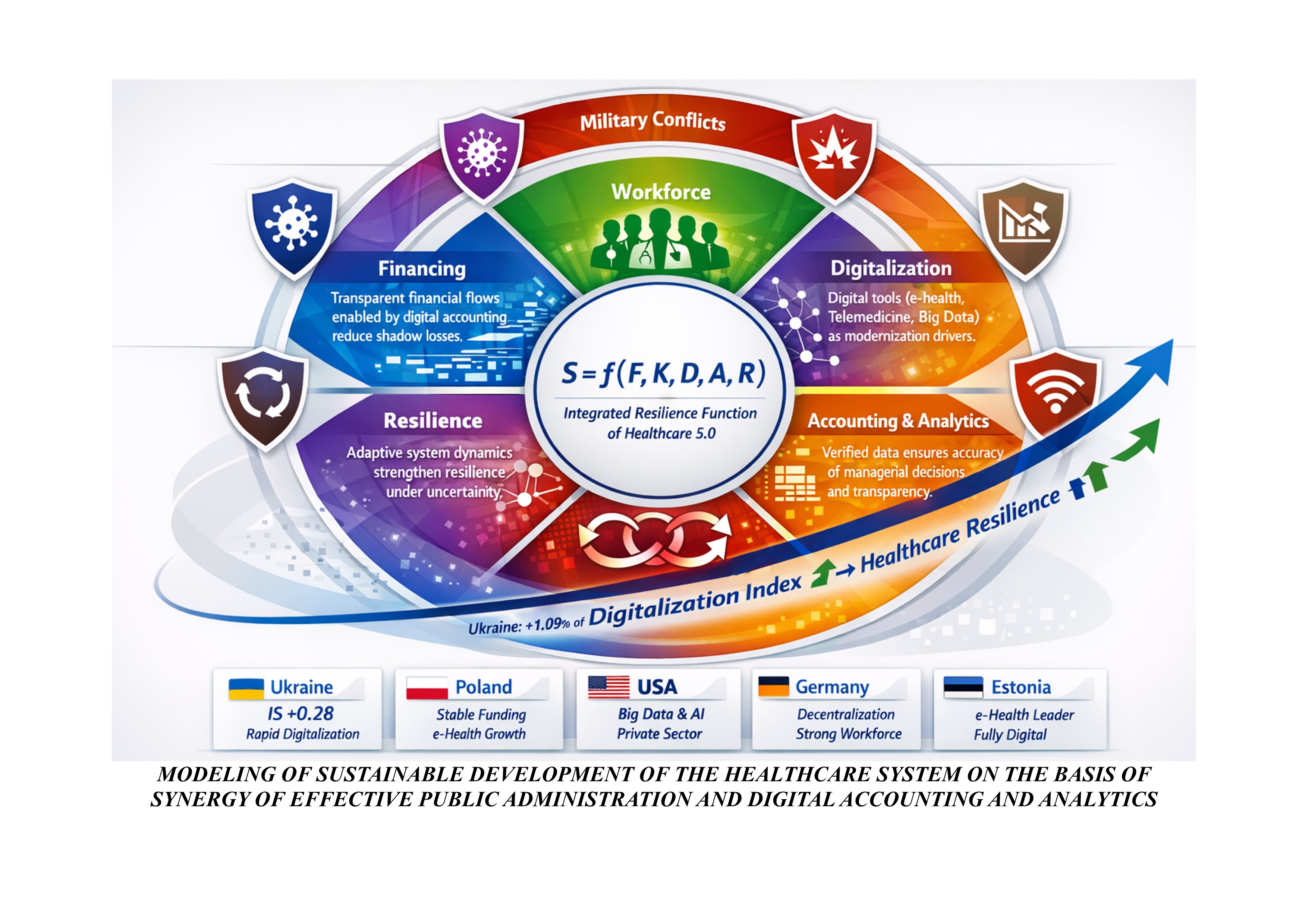
The object of research is the public administration system in the healthcare sector and its transformational changes under the influence of digitalization. Currently, new challenges for the healthcare system are emerging in the global world. These include global pandemics, active hostilities, migration shifts and processes, economic instability, and digital transformation. That is why ensuring the sustainability of the healthcare system is a critically important aspect of creating appropriate conditions for the social well-being of the population. The paper examines the system of management decisions in the medical field, which is considered as a multi-component dynamic structure that must adaptively respond to the challenges of the external environment and conditions of uncertainty. The paper substantiates a conceptual model of health care system sustainability based on the synergy of public administration and accounting and analytical support. The model is based on the concept of adaptive system dynamics and feedback, which allows mathematically determining the level of management actions on the level of sustainability of the healthcare system. The results of the analysis among five countries (Ukraine, Poland, USA, Germany and Estonia) are presented according to the indicators: healthcare spending in GDP, human resources and level of digitalization. Methodologies used: correlation-regression analysis, index method, comparative analysis. The results obtained showed a high level of causality and correlation between digital tools and economic performance, considering data verification by accounting and analytical support (Pearson coefficient rxy > 0.85 for leading countries), which confirm the relevance of their implementation. The obtained data of the integrated index of health system sustainability (IS for Ukraine increased by 0.28) confirm that the introduction of public management tools in health care allows for a transition to its proactive management.
References
- Digdowiseiso, K. (2024). Fiscal decentralization and social stability in selected developing countries: the role of institutional quality. Cogent Social Sciences, 10 (1). https://doi.org/10.1080/23311886.2024.2432070
- Strietholt, M. (2026). Money, liberty and nonpublic sources of social stability. Review of Social Economy, 1–41. https://doi.org/10.1080/00346764.2025.2612022
- Chauhan, S., Gupta, P., Goyal, S. (2022). The role of innovation type and country context in diffusion of innovative technologies in organisations – a meta-analytic review. Behaviour & Information Technology, 42 (11), 1845–1873. https://doi.org/10.1080/0144929x.2022.2100826
- Kovtun, V., Andriushchenko, K., Horbova, N., Lavruk, O., Yelyzaveta Muzychka, Y. (2020). Features of the Management Process of Ambidextrous Companies. TEM Journal, 9 (1), 221–226. https://doi.org/10.18421/tem91-31
- Turyasiima, M., Niwampeire, P., Ssendyona, M., Akot, B., Acheng, M., Katongole, S. et al. (2025). Enhancing Diagnostic and Patient Safety in Healthcare Systems: Key Insights from the World Patient Safety Day 2024 Commemoration in Uganda. Drug, Healthcare and Patient Safety, 17, 135–143. https://doi.org/10.2147/dhps.s520743
- James, T. S. (2025). Democracy, public administration, and democratic backsliding. Policy Studies, 1–26. https://doi.org/10.1080/01442872.2025.2521170
- Yatsenko, O. M., Nitsenko, V. S., Mardani, A., Tananaiko, T. S. (2018). The impact of global risks on the world trade and economic environment. Financial and Credit Activity Problems of Theory and Practice, 4 (27), 435–444. https://doi.org/10.18371/fcaptp.v4i27.154279
- Liu, W., James, T. S., Man, C. (2022). Governance and public administration in China. Policy Studies, 43 (3), 387–402. https://doi.org/10.1080/01442872.2022.2054091
- Andriushchenko, K., Liezina, A., Vasylchak, S., Manylich, M., Shterma, T., Petrynyak, U. (2022). Management of the Development of the Innovative Potential of the Region. TEM Journal, 11 (1), 339–347. https://doi.org/10.18421/tem111-43
- Equils, O., Bakaj, A., Wilson-Mifsud, B., Chatterjee, A. (2023). Restoring Trust: The Need for Precision Medicine in Infectious Diseases, Public Health and Vaccines. Human Vaccines & Immunotherapeutics, 19 (2). https://doi.org/10.1080/21645515.2023.2234787
- Lei, K. C., Loi, C. I., Cen, Z., Li, J., Liang, Z., Hu, H. et al. (2023). Adopting an electronic medication administration system in long-term care facilities: a key stakeholder interview study in Macao. Informatics for Health and Social Care, 48 (3), 252–266. https://doi.org/10.1080/17538157.2023.2165084
- Andriushchenko, K., Kovtun, V., Cherniaieva, O., Datsii, N., Aleinikova, O., Mykolaiets, A. (2020). Transformation of the Educational Ecosystem in the Singularity Environment. International Journal of Learning, Teaching and Educational Research, 19 (9), 77–98. https://doi.org/10.26803/ijlter.19.9.5
- Katz, E., Chikwenhere, Y., Essien, E., Olirus Owilli, A., Westerhaus, M. (2023). Rethinking global health from south and north: A social medicine approach to global health education. Global Public Health, 18 (1). https://doi.org/10.1080/17441692.2023.2191685
- Senghor, A. S., Mbaye, M. S., Diop, R., Tosam, M. J., Kabou, P., Niang, A., Okoye, G. (2023). Towards a transactional medicine approach to combating global emerging pathogens: the case of COVID-19. Global Public Health, 18 (1). https://doi.org/10.1080/17441692.2023.2272710
- Andriushchenko, K., Tepliuk, M., Boniar, S., Ushenko, N., Liezina, A. (2019). Influence of cost drivers on value-oriented management of investment activity of companies. Investment Management and Financial Innovations, 16 (3), 353–364. https://doi.org/10.21511/imfi.16(3).2019.31
- Kraitzman, A. P., Genauer, J. (2023). The impact of security issues on government evaluation: evidence from the Arab World. Democratization, 30 (4), 693–714. https://doi.org/10.1080/13510347.2023.2177639
- Jambi, L., Almutairi, F., Alotaibi, A., Alshaya, A., Alharbi, O., Alqahtani, A. et al. (2025). The Impact of the COVID-19 Pandemic on a Nuclear Medicine Department in Riyadh, Saudi Arabia. Journal of Multidisciplinary Healthcare, 18, 6431–6444. https://doi.org/10.2147/jmdh.s523104
- Yatsenko, O., Nitsenko, V., Tananaiko, T., Szetela, B., Kobylianska, A. (2019). Trade and economic integration dominants in North America countries’ interaction. Journal of International Studies, 12 (3), 277–293. https://doi.org/10.14254/2071-8330.2019/12-3/22
- Rockholt, M. M., Addae, G., Chee, A., Chin, W., Cuff, G., Wang, J. et al. (2023). Implementing Telemedicine During the COVID-19 Pandemic: Disparities in Utilization in an Urban Pain Medicine Practice. Journal of Pain Research, 16, 2763–2775. https://doi.org/10.2147/jpr.s415415
- Mekonen, Z. T., Fenta, T., Nadeem, S., Cho, D. (2024). Global Health Commodities Supply Chain in the Era of COVID-19 Pandemic: Challenges, Impacts, and Prospects: A Systematic Review. Journal of Multidisciplinary Healthcare, 17, 1523–1539. https://doi.org/10.2147/jmdh.s448654
- Andriushchenko, K., Datsii, O., Aleinikova, O., Mohamed Abdulla, A., Mohammed Ali, A. (2019). Improvement of the water resources management system at the territorial level. Problems and Perspectives in Management, 17 (3), 421–437. https://doi.org/10.21511/ppm.17(3).2019.34
- Ortiz-Prado, E., Izquierdo-Condoy, J. S., Vasconez-Gonzalez, J., López-Cortés, A., Salazar-Santoliva, C., Vargas Michay, A. R. et al. (2025). From pandemic onset to present: five years of insights into ARDS caused by COVID-19. Expert Review of Respiratory Medicine, 19 (8), 843–862. https://doi.org/10.1080/17476348.2025.2507207
- Polishchuk, Y., Kornyliuk, A., Lavreniuk, V., Horbov, V., Ivashchenko, A., Tepliuk, M. (2024). Running a business during wartime: Voice of Ukrainian displaced business. Problems and Perspectives in Management, 22 (3), 287–302. https://doi.org/10.21511/ppm.22(3).2024.23
- Andriushchenko, K., Lavruk, V., Uliganets, S., Kovtun, V., Matviienko, H. (2019). Reputation Risk Management Companies Based on Competence Approach. TEM Journal, 8 (2), 516–524. https://doi.org/10.18421/tem82-27
- Jung, H.-J., Kim, D.-I., Choi, S.-J., Park, J.-K., Lee, J.-M. (2025). Effectiveness and Safety of Korean Medicine in Treating Female Infertility: A Prospective Multicenter Observational Study. International Journal of Women’s Health, 17, 1771–1787. https://doi.org/10.2147/ijwh.s520044
- Pokataiev, P., Liezina, A., Petukhova, H., Andriushchenko, A. (2022). The role of biotechnology in the development of the bioeconomy. Acta Innovations, 46, 19–34. https://doi.org/10.32933/actainnovations.46.2
- Schmalhofer, C., Otte im Kampe, E., Eheberg, D., Sandhu, H., Maier, M., Perschke, A. et al. (2025). Economic evaluation of oral Nirmatrelvir/ritonavir versus best supportive care in patients at high risk for progression to severe COVID-19 in Germany: a cost-effectiveness analysis. Journal of Medical Economics, 28 (1), 1226–1240. https://doi.org/10.1080/13696998.2025.2536974
- Agostino, M., Mammone, M., Ruberto, S. (2024). Pandemic and Infodemic: The Role of Social Media in Disinformation Relating to COVID-19 in Italy. Forum for Social Economics, 54 (4), 499–529. https://doi.org/10.1080/07360932.2024.2405588
- Tepliuk, M., Polishchuk, Y., Fomenko, B., Bortnik, A., Domina, O., Matsola, S. (2024). An entropic perspective on business relocation in the context of sustainable development. Financial and Credit Activity Problems of Theory and Practice, 1 (54), 421–439. https://doi.org/10.55643/fcaptp.1.54.2024.4248
- Andriushchenko, A., Liezina, A., Kolybo, D., Gurina, G., Havrysh, K., Mazur, N. et al. (2026). Determining the investment attractiveness of the biohacking and bioinnovation market based on market trends in the pharmaceutical business. Technology Audit and Production Reserves, 1 (4 (87)), 21–33. https://doi.org/10.15587/2706-5448.2026.352711
- Triadafilopoulos, T., Taylor, Z. (2023). The domestic politics of selective permeability: disaggregating the Canadian migration state. Journal of Ethnic and Migration Studies, 50 (3), 702–725. https://doi.org/10.1080/1369183x.2023.2269785
- Buriachenko, A., Zakhozhay, K., Liezina, A., Lysak, V. (2022). Sustainability and security of public budget of the Visegrad Group countries. Acta Innovations, 42, 71–88. https://doi.org/10.32933/actainnovations.42.6
- Hirata, R., Tago, M., Shikino, K., Watari, T., Takahashi, H., Sasaki, Y., Shimizu, T. (2024). Standardizing Generalist Definitions to Improve Evidence in General Medicine: Addressing Diverse Interpretations and Lack of Consistency. International Journal of General Medicine, 17, 2939–2943. https://doi.org/10.2147/ijgm.s468755
- Andriushchenko, K., Liezina, A., Lavruk, V., Sliusareva, L., Rudevska, V. (2022). Intelligent enterprise capital control based on Markov chain. Acta Innovations, 45, 18–30. https://doi.org/10.32933/actainnovations.45.2
- Kermani, F., Reandi, S. T. A. (2023). Exploring the Funding Challenges Faced by Small NGOs: Perspectives from an Organization with Practical Experience of Working in Rural Malawi. Research and Reports in Tropical Medicine, 14, 99–110. https://doi.org/10.2147/rrtm.s424075
- Hallal, H., Hoteit, M., Hallit, S., Hallal, M. (2025). Perceptions, attitudes and experiences of hospital pharmacists working in the private sector regarding drug shortage in Lebanon: a national cross-sectional study. Journal of Pharmaceutical Policy and Practice, 18 (1). https://doi.org/10.1080/20523211.2025.2464786
- Huerta, A., Huerta, J. (2024). Navigating the nexus of personalized medicine and healthcare management: Advancing paediatric pain management modalities in sickle cell disease through thematic analysis for ages 1–12. International Journal of Healthcare Management, 19 (1), 145–155. https://doi.org/10.1080/20479700.2024.2413797
- Andriushchenko, K., Datsii, O., Lavruk, O., Dmytrenko, R., Kutashev, I., Vіnіchenko, I. et al. (2021). Development of а matrix of food industry capacity for making management decisions in the formation of sustainable development of agroecosystems. Eastern-European Journal of Enterprise Technologies, 2 (13 (110)), 16–27. https://doi.org/10.15587/1729-4061.2021.227805
- Tago, M., Hirata, R., Shikino, K., Watari, T., Takahashi, H., Nishi, T. et al. (2025). A Classification Method for General Medicine Physicians to Advance Field Research in Japan. International Journal of General Medicine, 18, 5033–5038. https://doi.org/10.2147/ijgm.s540846
- Tseng, C.-Y., Li, J., Lin, L.-H., Wang, K., White III, C. C., Wang, B. (2023). Deep reinforcement learning approach for dynamic capacity planning in decentralised regenerative medicine supply chains. International Journal of Production Research, 63 (2), 555–570. https://doi.org/10.1080/00207543.2023.2262043
- Shalko, M., Domina, O., Korobko, I., Melnyk, D., Andriushchenko, A. (2024). The transformative impact of large language models in healthcare. Technology Audit and Production Reserves, 6 (4 (80)), 32–42. https://doi.org/10.15587/2706-5448.2024.319006
- Kommalur, A., Ramalingam, D., Manjunath, N., Venkatesh, P., Bidaremane Junjappa, S. et al. (2026). Successful perinatal management of a large placental chorio-angioma: a case report demonstrating the effectiveness of a public–private partnership model. Paediatrics and International Child Health, 1–7. https://doi.org/10.1080/20469047.2025.2609525
- Sahithya, V., Sivanantham, P., Anandraj, J., Parameswaran, S., Sekhar Kar, S. (2024). Economic cost of hemodialysis and peritoneal dialysis under public–private partnership in a public tertiary care centre of Puducherry, India. Expert Review of Pharmacoeconomics & Outcomes Research, 25 (3), 415–421. https://doi.org/10.1080/14737167.2024.2439515
- Domina, O., Andriushchenko, K., Liezina, A., Tsymbalenko, Y., Titova, O., Kyryliuk, O., Vylgin, Y. (2025). The Impact of Artificial Intelligence on the Formation of a Teacher’s Digital Twin in the Metaverse. Journal of Vasyl Stefanyk Precarpathian National University, 12 (3), 169–185. https://doi.org/10.15330/jpnu.12.3.169-185
- Nauenberg, E., Yurga, E. (2023). Public–private partnership alternative for a national pharmacare program in Canada. Journal of Pharmaceutical Policy and Practice, 16 (1). https://doi.org/10.1186/s40545-023-00526-3
- Zainal, H., Xiaohui, X., Thumboo, J., Kok Yong, F. (2023). Digital competencies for Singapore’s national medical school curriculum: a qualitative study. Medical Education Online, 28 (1). https://doi.org/10.1080/10872981.2023.2211820
- Pokataiev, P., Teteruk, K., Andriushchenko, A. (2023). A biotechnological rolebusiness incubator as an instrument of innovation entrepreneurship. Recent Trends in Business and Entrepreneurial Ventures. Available at: https://novapublishers.com/shop/recent-trends-in-business-and-entrepreneurial-ventures/
- Anaya, J.-M., Herrán, M., Pino, L. E. (2025). Challenges and opportunities for precision medicine in developing nations. Expert Review of Precision Medicine and Drug Development, 10 (1), 1–15. https://doi.org/10.1080/23808993.2025.2505796
- Kohler, J. C., Castro-Arteaga, M., Panjwani, S., Mukanga, D., Lumpkin, M. M., Fundafunda, B. et al. (2025). Understanding the regulatory-procurement interface for medicines in Africa via publicly available information on standards, implementation, and enforcement in five countries. Journal of Pharmaceutical Policy and Practice, 18 (1). https://doi.org/10.1080/20523211.2024.2436898
- Global Health Expenditure Database. Available at: https://apps.who.int/nha/database/
- The Digital Economy and Society Index (DESI). Available at: https://digital-strategy.ec.europa.eu/en/policies/desi
- Liezina, A., Lavruk, A., Matviienko, H., Ivanets, I., Tseluiko, O., Kuchai, O. (2023). Impact of econometric modeling and perspectives of economic security of the cross-industry complex. Acta Innovations, 47, 73–83. https://doi.org/10.32933/actainnovations.47.7
- Williamson, J., Hasan, S. S., Gc, V. S. (2025). Economic and developmental impacts of FDA designations: a systematic review and meta-analysis. Expert Review of Pharmacoeconomics & Outcomes Research, 25 (7), 1051–1061. https://doi.org/10.1080/14737167.2025.2507426
- Wu, J., Ma, Y., Wang, J., Xiao, M. (2024). The Application of ChatGPT in Medicine: A Scoping Review and Bibliometric Analysis. Journal of Multidisciplinary Healthcare, 17, 1681–1692. https://doi.org/10.2147/jmdh.s463128
- Andriushchenko, K., Khaletska, A., Ushenko, N., Zholnerchyk, H., Ivanets, I., Petrychuk, S. Uliganets, S. (2021). Education process digitalization and its impact on human capital of an enterprise. Journal of Management Information and Decision Sciences, 24 (5), 1–9. Available at: https://www.abacademies.org/articles/Education-process-digitalization-and-its-impact-on-human-capital-of-an-enterprise-1532-5806-24-5-271.pdf
- Alemu, A. B., Ibrahim, N. A., Argaw, K. W. (2023). Magnitude of Medicine Wastage and Perceived Contributing Factors Among Public Health Facilities in Dire-Dawa City Administration, in Mid COVID-19 Pandemic in Ethiopia: Retrospective, Cross-Sectional Study. Integrated Pharmacy Research and Practice, 12, 61–75. https://doi.org/10.2147/iprp.s395102
Downloads
Published
How to Cite
Issue
Section
License
Copyright (c) 2026 Oksana Kyryliuk, Alexandr Lavruk, Oksana Domina, Yana Tsymbalenko, Igor Dzemishkevych, Daryna Melnyk, Igor Korobko, Zinoviy Nadyuk, Oleksandr Datsii, Rostyslav Kostyk

This work is licensed under a Creative Commons Attribution 4.0 International License.
The consolidation and conditions for the transfer of copyright (identification of authorship) is carried out in the License Agreement. In particular, the authors reserve the right to the authorship of their manuscript and transfer the first publication of this work to the journal under the terms of the Creative Commons CC BY license. At the same time, they have the right to conclude on their own additional agreements concerning the non-exclusive distribution of the work in the form in which it was published by this journal, but provided that the link to the first publication of the article in this journal is preserved.