Моделювання сталого розвитку системи охорони здоров’я на засадах синергії ефективного публічного управління та цифрового обліково-аналітичного забезпечення
DOI:
https://doi.org/10.15587/2706-5448.2026.356922Ключові слова:
e-health, безбарʼєрність, стійкість, цифровий розвиток, публічні інституції, драйвер модернізації, кореляційно-регресійна модельАнотація
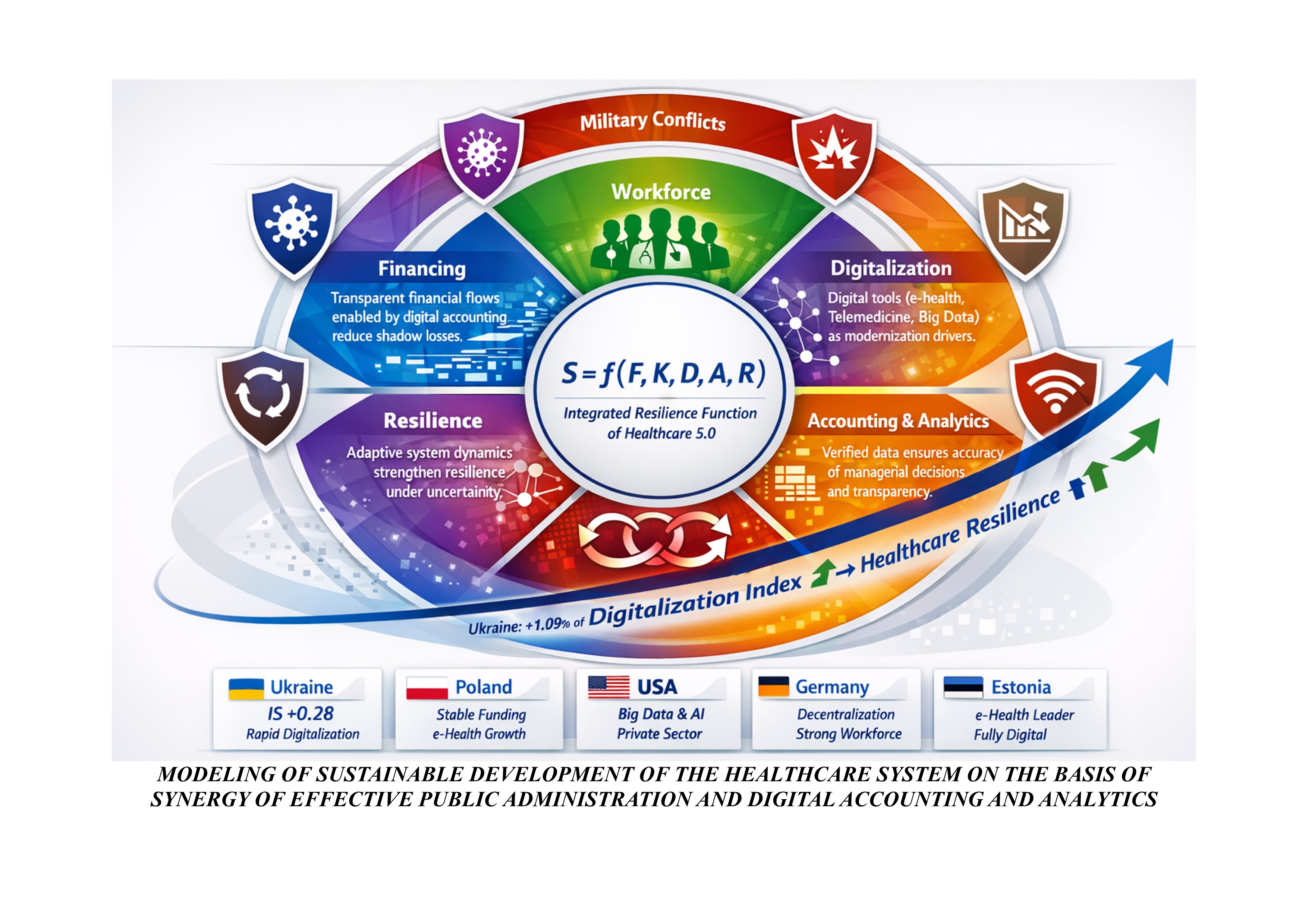
Об’єктом дослідження є система публічного управління в сфері охорони здоров’я та її трансформаційні зміни під впливом в умовах цифровізації. Наразі в глобальному світовому просторі виникають все нові виклики для системи охорони здоров’я. До таких варто віднести всесвітні пандемії, активні бойові дії, міграційні зрушення та процеси, економічна нестабільність та цифрова трансформація. Саме тому забезпечення стійкості системи охорони здоров’я є критично важливим аспектом створення належних умов соціального добробуту населення. В роботі розглянуто систему управлінських рішень у медичній сфері, що розглядається як багатокомпонентна динамічна структура, яка має адаптивно реагувати на виклики зовнішнього оточення та умови невизначеності. В роботі обґрунтовано концептуальну модель стійкості системи охорони здоров’я на основі синергії публічного управління та обліково – аналітичного забезпечення. Модель ґрунтується на концепції адаптивної системної динаміки та зворотному зв’язку впливу, що дозволяє математично визначити рівень управлінських дій на рівень стійкості системи охорони здоров’я. Представлено результати аналізу серед п’яти країн (Україна, Польща, США, Німеччина та Естонія) за показниками: витрати на охорону здоров’я в ВВП, кадрове забезпечення та рівень цифровізації. Використані методології – кореляційно-регресійний аналіз, індексний метод, компаративний аналіз. Отримані результати засвідчили високий рівень причинно-наслідкових зав’язків та кореляційної залежності між цифровими інструментами та економічною результативністю з врахуванням верифікації даних за обліково-аналітичним забезпеченням (коефіцієнт Пірсона rxy>0,85 для країн лідерів), які підтверджують доречність їх імплементації. Отримані дані інтегрованого індексу стійкості системи охорони здоров’я (ІS зокрема для України зросли на 0,28) підтверджують, що впровадження інструментів публічного управління в охорону здоров’я дозволяє перейти до її проактивного управління
Посилання
- Digdowiseiso, K. (2024). Fiscal decentralization and social stability in selected developing countries: the role of institutional quality. Cogent Social Sciences, 10 (1). https://doi.org/10.1080/23311886.2024.2432070
- Strietholt, M. (2026). Money, liberty and nonpublic sources of social stability. Review of Social Economy, 1–41. https://doi.org/10.1080/00346764.2025.2612022
- Chauhan, S., Gupta, P., Goyal, S. (2022). The role of innovation type and country context in diffusion of innovative technologies in organisations – a meta-analytic review. Behaviour & Information Technology, 42 (11), 1845–1873. https://doi.org/10.1080/0144929x.2022.2100826
- Kovtun, V., Andriushchenko, K., Horbova, N., Lavruk, O., Yelyzaveta Muzychka, Y. (2020). Features of the Management Process of Ambidextrous Companies. TEM Journal, 9 (1), 221–226. https://doi.org/10.18421/tem91-31
- Turyasiima, M., Niwampeire, P., Ssendyona, M., Akot, B., Acheng, M., Katongole, S. et al. (2025). Enhancing Diagnostic and Patient Safety in Healthcare Systems: Key Insights from the World Patient Safety Day 2024 Commemoration in Uganda. Drug, Healthcare and Patient Safety, 17, 135–143. https://doi.org/10.2147/dhps.s520743
- James, T. S. (2025). Democracy, public administration, and democratic backsliding. Policy Studies, 1–26. https://doi.org/10.1080/01442872.2025.2521170
- Yatsenko, O. M., Nitsenko, V. S., Mardani, A., Tananaiko, T. S. (2018). The impact of global risks on the world trade and economic environment. Financial and Credit Activity Problems of Theory and Practice, 4 (27), 435–444. https://doi.org/10.18371/fcaptp.v4i27.154279
- Liu, W., James, T. S., Man, C. (2022). Governance and public administration in China. Policy Studies, 43 (3), 387–402. https://doi.org/10.1080/01442872.2022.2054091
- Andriushchenko, K., Liezina, A., Vasylchak, S., Manylich, M., Shterma, T., Petrynyak, U. (2022). Management of the Development of the Innovative Potential of the Region. TEM Journal, 11 (1), 339–347. https://doi.org/10.18421/tem111-43
- Equils, O., Bakaj, A., Wilson-Mifsud, B., Chatterjee, A. (2023). Restoring Trust: The Need for Precision Medicine in Infectious Diseases, Public Health and Vaccines. Human Vaccines & Immunotherapeutics, 19 (2). https://doi.org/10.1080/21645515.2023.2234787
- Lei, K. C., Loi, C. I., Cen, Z., Li, J., Liang, Z., Hu, H. et al. (2023). Adopting an electronic medication administration system in long-term care facilities: a key stakeholder interview study in Macao. Informatics for Health and Social Care, 48 (3), 252–266. https://doi.org/10.1080/17538157.2023.2165084
- Andriushchenko, K., Kovtun, V., Cherniaieva, O., Datsii, N., Aleinikova, O., Mykolaiets, A. (2020). Transformation of the Educational Ecosystem in the Singularity Environment. International Journal of Learning, Teaching and Educational Research, 19 (9), 77–98. https://doi.org/10.26803/ijlter.19.9.5
- Katz, E., Chikwenhere, Y., Essien, E., Olirus Owilli, A., Westerhaus, M. (2023). Rethinking global health from south and north: A social medicine approach to global health education. Global Public Health, 18 (1). https://doi.org/10.1080/17441692.2023.2191685
- Senghor, A. S., Mbaye, M. S., Diop, R., Tosam, M. J., Kabou, P., Niang, A., Okoye, G. (2023). Towards a transactional medicine approach to combating global emerging pathogens: the case of COVID-19. Global Public Health, 18 (1). https://doi.org/10.1080/17441692.2023.2272710
- Andriushchenko, K., Tepliuk, M., Boniar, S., Ushenko, N., Liezina, A. (2019). Influence of cost drivers on value-oriented management of investment activity of companies. Investment Management and Financial Innovations, 16 (3), 353–364. https://doi.org/10.21511/imfi.16(3).2019.31
- Kraitzman, A. P., Genauer, J. (2023). The impact of security issues on government evaluation: evidence from the Arab World. Democratization, 30 (4), 693–714. https://doi.org/10.1080/13510347.2023.2177639
- Jambi, L., Almutairi, F., Alotaibi, A., Alshaya, A., Alharbi, O., Alqahtani, A. et al. (2025). The Impact of the COVID-19 Pandemic on a Nuclear Medicine Department in Riyadh, Saudi Arabia. Journal of Multidisciplinary Healthcare, 18, 6431–6444. https://doi.org/10.2147/jmdh.s523104
- Yatsenko, O., Nitsenko, V., Tananaiko, T., Szetela, B., Kobylianska, A. (2019). Trade and economic integration dominants in North America countries’ interaction. Journal of International Studies, 12 (3), 277–293. https://doi.org/10.14254/2071-8330.2019/12-3/22
- Rockholt, M. M., Addae, G., Chee, A., Chin, W., Cuff, G., Wang, J. et al. (2023). Implementing Telemedicine During the COVID-19 Pandemic: Disparities in Utilization in an Urban Pain Medicine Practice. Journal of Pain Research, 16, 2763–2775. https://doi.org/10.2147/jpr.s415415
- Mekonen, Z. T., Fenta, T., Nadeem, S., Cho, D. (2024). Global Health Commodities Supply Chain in the Era of COVID-19 Pandemic: Challenges, Impacts, and Prospects: A Systematic Review. Journal of Multidisciplinary Healthcare, 17, 1523–1539. https://doi.org/10.2147/jmdh.s448654
- Andriushchenko, K., Datsii, O., Aleinikova, O., Mohamed Abdulla, A., Mohammed Ali, A. (2019). Improvement of the water resources management system at the territorial level. Problems and Perspectives in Management, 17 (3), 421–437. https://doi.org/10.21511/ppm.17(3).2019.34
- Ortiz-Prado, E., Izquierdo-Condoy, J. S., Vasconez-Gonzalez, J., López-Cortés, A., Salazar-Santoliva, C., Vargas Michay, A. R. et al. (2025). From pandemic onset to present: five years of insights into ARDS caused by COVID-19. Expert Review of Respiratory Medicine, 19 (8), 843–862. https://doi.org/10.1080/17476348.2025.2507207
- Polishchuk, Y., Kornyliuk, A., Lavreniuk, V., Horbov, V., Ivashchenko, A., Tepliuk, M. (2024). Running a business during wartime: Voice of Ukrainian displaced business. Problems and Perspectives in Management, 22 (3), 287–302. https://doi.org/10.21511/ppm.22(3).2024.23
- Andriushchenko, K., Lavruk, V., Uliganets, S., Kovtun, V., Matviienko, H. (2019). Reputation Risk Management Companies Based on Competence Approach. TEM Journal, 8 (2), 516–524. https://doi.org/10.18421/tem82-27
- Jung, H.-J., Kim, D.-I., Choi, S.-J., Park, J.-K., Lee, J.-M. (2025). Effectiveness and Safety of Korean Medicine in Treating Female Infertility: A Prospective Multicenter Observational Study. International Journal of Women’s Health, 17, 1771–1787. https://doi.org/10.2147/ijwh.s520044
- Pokataiev, P., Liezina, A., Petukhova, H., Andriushchenko, A. (2022). The role of biotechnology in the development of the bioeconomy. Acta Innovations, 46, 19–34. https://doi.org/10.32933/actainnovations.46.2
- Schmalhofer, C., Otte im Kampe, E., Eheberg, D., Sandhu, H., Maier, M., Perschke, A. et al. (2025). Economic evaluation of oral Nirmatrelvir/ritonavir versus best supportive care in patients at high risk for progression to severe COVID-19 in Germany: a cost-effectiveness analysis. Journal of Medical Economics, 28 (1), 1226–1240. https://doi.org/10.1080/13696998.2025.2536974
- Agostino, M., Mammone, M., Ruberto, S. (2024). Pandemic and Infodemic: The Role of Social Media in Disinformation Relating to COVID-19 in Italy. Forum for Social Economics, 54 (4), 499–529. https://doi.org/10.1080/07360932.2024.2405588
- Tepliuk, M., Polishchuk, Y., Fomenko, B., Bortnik, A., Domina, O., Matsola, S. (2024). An entropic perspective on business relocation in the context of sustainable development. Financial and Credit Activity Problems of Theory and Practice, 1 (54), 421–439. https://doi.org/10.55643/fcaptp.1.54.2024.4248
- Andriushchenko, A., Liezina, A., Kolybo, D., Gurina, G., Havrysh, K., Mazur, N. et al. (2026). Determining the investment attractiveness of the biohacking and bioinnovation market based on market trends in the pharmaceutical business. Technology Audit and Production Reserves, 1 (4 (87)), 21–33. https://doi.org/10.15587/2706-5448.2026.352711
- Triadafilopoulos, T., Taylor, Z. (2023). The domestic politics of selective permeability: disaggregating the Canadian migration state. Journal of Ethnic and Migration Studies, 50 (3), 702–725. https://doi.org/10.1080/1369183x.2023.2269785
- Buriachenko, A., Zakhozhay, K., Liezina, A., Lysak, V. (2022). Sustainability and security of public budget of the Visegrad Group countries. Acta Innovations, 42, 71–88. https://doi.org/10.32933/actainnovations.42.6
- Hirata, R., Tago, M., Shikino, K., Watari, T., Takahashi, H., Sasaki, Y., Shimizu, T. (2024). Standardizing Generalist Definitions to Improve Evidence in General Medicine: Addressing Diverse Interpretations and Lack of Consistency. International Journal of General Medicine, 17, 2939–2943. https://doi.org/10.2147/ijgm.s468755
- Andriushchenko, K., Liezina, A., Lavruk, V., Sliusareva, L., Rudevska, V. (2022). Intelligent enterprise capital control based on Markov chain. Acta Innovations, 45, 18–30. https://doi.org/10.32933/actainnovations.45.2
- Kermani, F., Reandi, S. T. A. (2023). Exploring the Funding Challenges Faced by Small NGOs: Perspectives from an Organization with Practical Experience of Working in Rural Malawi. Research and Reports in Tropical Medicine, 14, 99–110. https://doi.org/10.2147/rrtm.s424075
- Hallal, H., Hoteit, M., Hallit, S., Hallal, M. (2025). Perceptions, attitudes and experiences of hospital pharmacists working in the private sector regarding drug shortage in Lebanon: a national cross-sectional study. Journal of Pharmaceutical Policy and Practice, 18 (1). https://doi.org/10.1080/20523211.2025.2464786
- Huerta, A., Huerta, J. (2024). Navigating the nexus of personalized medicine and healthcare management: Advancing paediatric pain management modalities in sickle cell disease through thematic analysis for ages 1–12. International Journal of Healthcare Management, 19 (1), 145–155. https://doi.org/10.1080/20479700.2024.2413797
- Andriushchenko, K., Datsii, O., Lavruk, O., Dmytrenko, R., Kutashev, I., Vіnіchenko, I. et al. (2021). Development of а matrix of food industry capacity for making management decisions in the formation of sustainable development of agroecosystems. Eastern-European Journal of Enterprise Technologies, 2 (13 (110)), 16–27. https://doi.org/10.15587/1729-4061.2021.227805
- Tago, M., Hirata, R., Shikino, K., Watari, T., Takahashi, H., Nishi, T. et al. (2025). A Classification Method for General Medicine Physicians to Advance Field Research in Japan. International Journal of General Medicine, 18, 5033–5038. https://doi.org/10.2147/ijgm.s540846
- Tseng, C.-Y., Li, J., Lin, L.-H., Wang, K., White III, C. C., Wang, B. (2023). Deep reinforcement learning approach for dynamic capacity planning in decentralised regenerative medicine supply chains. International Journal of Production Research, 63 (2), 555–570. https://doi.org/10.1080/00207543.2023.2262043
- Shalko, M., Domina, O., Korobko, I., Melnyk, D., Andriushchenko, A. (2024). The transformative impact of large language models in healthcare. Technology Audit and Production Reserves, 6 (4 (80)), 32–42. https://doi.org/10.15587/2706-5448.2024.319006
- Kommalur, A., Ramalingam, D., Manjunath, N., Venkatesh, P., Bidaremane Junjappa, S. et al. (2026). Successful perinatal management of a large placental chorio-angioma: a case report demonstrating the effectiveness of a public–private partnership model. Paediatrics and International Child Health, 1–7. https://doi.org/10.1080/20469047.2025.2609525
- Sahithya, V., Sivanantham, P., Anandraj, J., Parameswaran, S., Sekhar Kar, S. (2024). Economic cost of hemodialysis and peritoneal dialysis under public–private partnership in a public tertiary care centre of Puducherry, India. Expert Review of Pharmacoeconomics & Outcomes Research, 25 (3), 415–421. https://doi.org/10.1080/14737167.2024.2439515
- Domina, O., Andriushchenko, K., Liezina, A., Tsymbalenko, Y., Titova, O., Kyryliuk, O., Vylgin, Y. (2025). The Impact of Artificial Intelligence on the Formation of a Teacher’s Digital Twin in the Metaverse. Journal of Vasyl Stefanyk Precarpathian National University, 12 (3), 169–185. https://doi.org/10.15330/jpnu.12.3.169-185
- Nauenberg, E., Yurga, E. (2023). Public–private partnership alternative for a national pharmacare program in Canada. Journal of Pharmaceutical Policy and Practice, 16 (1). https://doi.org/10.1186/s40545-023-00526-3
- Zainal, H., Xiaohui, X., Thumboo, J., Kok Yong, F. (2023). Digital competencies for Singapore’s national medical school curriculum: a qualitative study. Medical Education Online, 28 (1). https://doi.org/10.1080/10872981.2023.2211820
- Pokataiev, P., Teteruk, K., Andriushchenko, A. (2023). A biotechnological rolebusiness incubator as an instrument of innovation entrepreneurship. Recent Trends in Business and Entrepreneurial Ventures. Available at: https://novapublishers.com/shop/recent-trends-in-business-and-entrepreneurial-ventures/
- Anaya, J.-M., Herrán, M., Pino, L. E. (2025). Challenges and opportunities for precision medicine in developing nations. Expert Review of Precision Medicine and Drug Development, 10 (1), 1–15. https://doi.org/10.1080/23808993.2025.2505796
- Kohler, J. C., Castro-Arteaga, M., Panjwani, S., Mukanga, D., Lumpkin, M. M., Fundafunda, B. et al. (2025). Understanding the regulatory-procurement interface for medicines in Africa via publicly available information on standards, implementation, and enforcement in five countries. Journal of Pharmaceutical Policy and Practice, 18 (1). https://doi.org/10.1080/20523211.2024.2436898
- Global Health Expenditure Database. Available at: https://apps.who.int/nha/database/
- The Digital Economy and Society Index (DESI). Available at: https://digital-strategy.ec.europa.eu/en/policies/desi
- Liezina, A., Lavruk, A., Matviienko, H., Ivanets, I., Tseluiko, O., Kuchai, O. (2023). Impact of econometric modeling and perspectives of economic security of the cross-industry complex. Acta Innovations, 47, 73–83. https://doi.org/10.32933/actainnovations.47.7
- Williamson, J., Hasan, S. S., Gc, V. S. (2025). Economic and developmental impacts of FDA designations: a systematic review and meta-analysis. Expert Review of Pharmacoeconomics & Outcomes Research, 25 (7), 1051–1061. https://doi.org/10.1080/14737167.2025.2507426
- Wu, J., Ma, Y., Wang, J., Xiao, M. (2024). The Application of ChatGPT in Medicine: A Scoping Review and Bibliometric Analysis. Journal of Multidisciplinary Healthcare, 17, 1681–1692. https://doi.org/10.2147/jmdh.s463128
- Andriushchenko, K., Khaletska, A., Ushenko, N., Zholnerchyk, H., Ivanets, I., Petrychuk, S. Uliganets, S. (2021). Education process digitalization and its impact on human capital of an enterprise. Journal of Management Information and Decision Sciences, 24 (5), 1–9. Available at: https://www.abacademies.org/articles/Education-process-digitalization-and-its-impact-on-human-capital-of-an-enterprise-1532-5806-24-5-271.pdf
- Alemu, A. B., Ibrahim, N. A., Argaw, K. W. (2023). Magnitude of Medicine Wastage and Perceived Contributing Factors Among Public Health Facilities in Dire-Dawa City Administration, in Mid COVID-19 Pandemic in Ethiopia: Retrospective, Cross-Sectional Study. Integrated Pharmacy Research and Practice, 12, 61–75. https://doi.org/10.2147/iprp.s395102
##submission.downloads##
Опубліковано
Як цитувати
Номер
Розділ
Ліцензія
Авторське право (c) 2026 Oksana Kyryliuk, Alexandr Lavruk, Oksana Domina, Yana Tsymbalenko, Igor Dzemishkevych, Daryna Melnyk, Igor Korobko, Zinoviy Nadyuk, Oleksandr Datsii, Rostyslav Kostyk

Ця робота ліцензується відповідно до Creative Commons Attribution 4.0 International License.
Закріплення та умови передачі авторських прав (ідентифікація авторства) здійснюється у Ліцензійному договорі. Зокрема, автори залишають за собою право на авторство свого рукопису та передають журналу право першої публікації цієї роботи на умовах ліцензії Creative Commons CC BY. При цьому вони мають право укладати самостійно додаткові угоди, що стосуються неексклюзивного поширення роботи у тому вигляді, в якому вона була опублікована цим журналом, але за умови збереження посилання на першу публікацію статті в цьому журналі.