Assessment of the technological efficiency and possibility of in-situ regeneration of a heterogeneous catalyst in the composition of proppant for hydraulic fracture of oil formations
DOI:
https://doi.org/10.15587/2706-5448.2026.358340Keywords:
hard-to-recover hydrocarbons, hydraulic fracturing, proppant, in-situ oil catalysis, zeolite, chromium carbonate, production enhancementAbstract
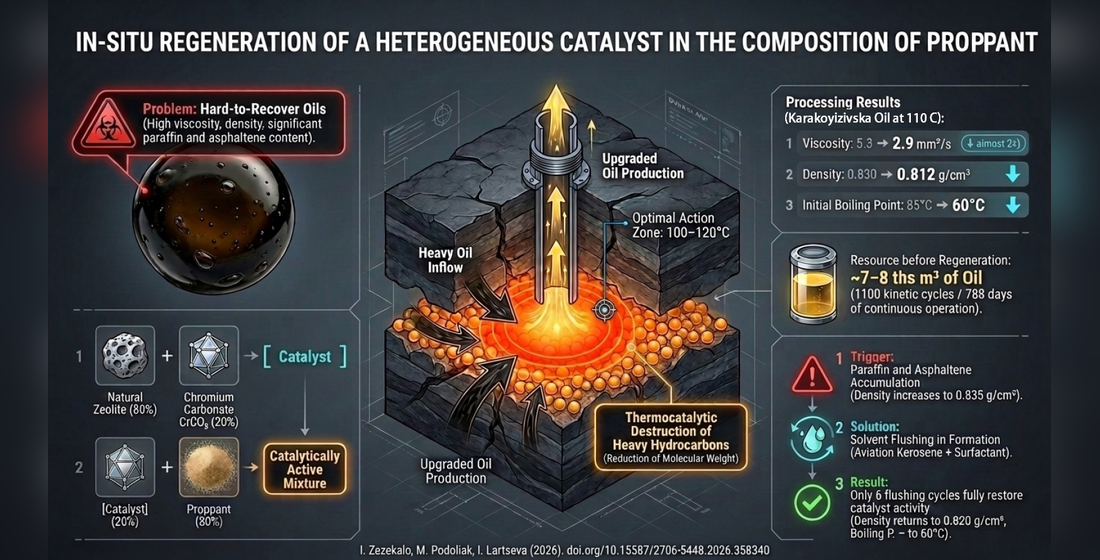
The object of this research is the process of in-situ catalytic upgrading of crude oil in a post-hydraulic fracturing environment using catalytically active proppant. The subject of research is the mechanism and conditions of in-situ catalysis of crude oil, as well as the efficiency and regeneration of the “zeolite + CrCO3” heterogeneous catalyst introduced into a proppant mixture during hydraulic fracturing.
The research addressed the problem of improving the recovery of crude oils with high density, viscosity and a significant content of asphaltene-resin-paraffinic substances through in-situ catalysis using a heterogeneous catalyst injected into the formation together with proppant during hydraulic fracturing. The work aims to describe the technology for preparing catalytically active granules, justify the catalyst’s operating cycle, investigate its regenerative capacity within the formation, and propose a regeneration technology.
The research analysed previous experiments aimed at determining the efficiency of the “zeolite + CrCO₃” heterogeneous catalyst and proposed a method for its preparation in the form of granules for subsequent addition to the proppant at a concentration of 20%. It was determined that one tonne of catalytically active granules provides catalytic treatment of approximately 7–8 thousand m³ of crude oil until regeneration is required. Laboratory studies of catalyst regeneration on a filtration unit in dynamic mode were conducted, which showed that six cycles of washing with a solvent based on aviation kerosene with the addition of a surfactant are sufficient. The paper also describes a technology for washing the catalyst after a decline in well performance.
The obtained results can be effectively used in the design and implementation of hydraulic fracturing for oil extraction within a temperature range of 100–120°C. The proposed technology enables a significant increase in well production rates and the efficiency of field operations.
References
- Dong, X., Liu, H., Chen, Z., Wu, K., Lu, N., Zhang, Q. (2019). Enhanced oil recovery techniques for heavy oil and oilsands reservoirs after steam injection. Applied Energy, 239, 1190–1211. https://doi.org/10.1016/j.apenergy.2019.01.244
- Katende, A., O’Connell, L., Rich, A., Rutqvist, J., Radonjic, M. (2021). A comprehensive review of proppant embedment in shale reservoirs: Experimentation, modeling and future prospects. Journal of Natural Gas Science and Engineering, 95, 104143. https://doi.org/10.1016/j.jngse.2021.104143
- Moroz, L., Zhekalo, A., Hryhorash, B. (2023). Study of problems and prospects for increasing hydrocarbon production using hydraulic fracturing. Prospecting and Development of Oil and Gas Fields, (3), 68–78. https://doi.org/10.69628/pdogf/3.2023.68
- Zezekalo, I., Kovalenko, V., Lartseva, I., Dubyna, O. (2021). Application of in-plastic catalysis for extraction of hard-to-recover hydrocarbons. Technology Audit and Production Reserves, 6 (3 (62)), 6–10. https://doi.org/10.15587/2706-5448.2021.247262
- Egan, C. J., Langlois, G. E., White, R. J. (1962). Selective Hydrocracking of C9- to C12-Alkylcyclohexanes on Acidic Catalysts. Evidence for the Paring Reaction. Journal of the American Chemical Society, 84 (7), 1204–1212. https://doi.org/10.1021/ja00866a028
- Podoliak, M., Zezekalo, I. (2025). Conducting research on in-reservoir catalytic destruction of oil. Bulletin of the National Technical University “KhPI”. Series: Chemistry, Chemical Technology and Ecology, 2 (14), 62–71. https://doi.org/10.20998/2079-0821.2025.02.10
- Mandari, V., Devarai, S. K. (2021). Biodiesel Production Using Homogeneous, Heterogeneous, and Enzyme Catalysts via Transesterification and Esterification Reactions: a Critical Review. BioEnergy Research, 15 (2), 935–961. https://doi.org/10.1007/s12155-021-10333-w
- Carrasco Saavedra, A., Timoshev, V., Hauck, M., Hassan Nejad, M., Dang, T. T., Vu, X. H. et al. (2022). Binder Selection to Modify Hydrocarbon Cracking Properties of Zeolite-Containing Composites. ACS Omega, 7 (19), 16430–16441. https://doi.org/10.1021/acsomega.2c00446
- Zimin, O., Zezekalo, I. (2024). Methodology and features of research of filtration properties of compacted deep-seated rocks. Bulletin of the National Technical University “KhPI”. Series: Chemistry, Chemical Technology and Ecology, 1 (11), 17–24. https://doi.org/10.20998/2079-0821.2024.01.03
- Kurovets, I. M., Hrytsyk, I. I., Prykhodko, O. A., Kucher, Z. I., Kurovets, S. S. (2025). Geothermobaric criteria for oil-and-gas bearing in the Dnieper-Donets Graben. Geofizicheskiy Zhurnal, 47 (2). https://doi.org/10.24028/gj.v47i2.322468
Downloads
Published
How to Cite
Issue
Section
License
Copyright (c) 2026 Ivan Zezekalo, Mykola Podoliak, Iryna Lartseva

This work is licensed under a Creative Commons Attribution 4.0 International License.
The consolidation and conditions for the transfer of copyright (identification of authorship) is carried out in the License Agreement. In particular, the authors reserve the right to the authorship of their manuscript and transfer the first publication of this work to the journal under the terms of the Creative Commons CC BY license. At the same time, they have the right to conclude on their own additional agreements concerning the non-exclusive distribution of the work in the form in which it was published by this journal, but provided that the link to the first publication of the article in this journal is preserved.