Development of a simulation model and testing methodology for frequency control systems of an induction drives using Sinamics G220 and Digital Twin technology
DOI:
https://doi.org/10.15587/2706-5448.2026.360983Keywords:
control system, Sinamics G220 frequency converter, induction drive, simulation model, Digital TwinAbstract
The object of research is information processes of control in Sinamics G220 frequency converters with an induction drive. The research problem lies in the need to develop simulation models of components of control systems for technological objects, as well as to design methodology and implement procedures for their testing based on Digital Twin technology.
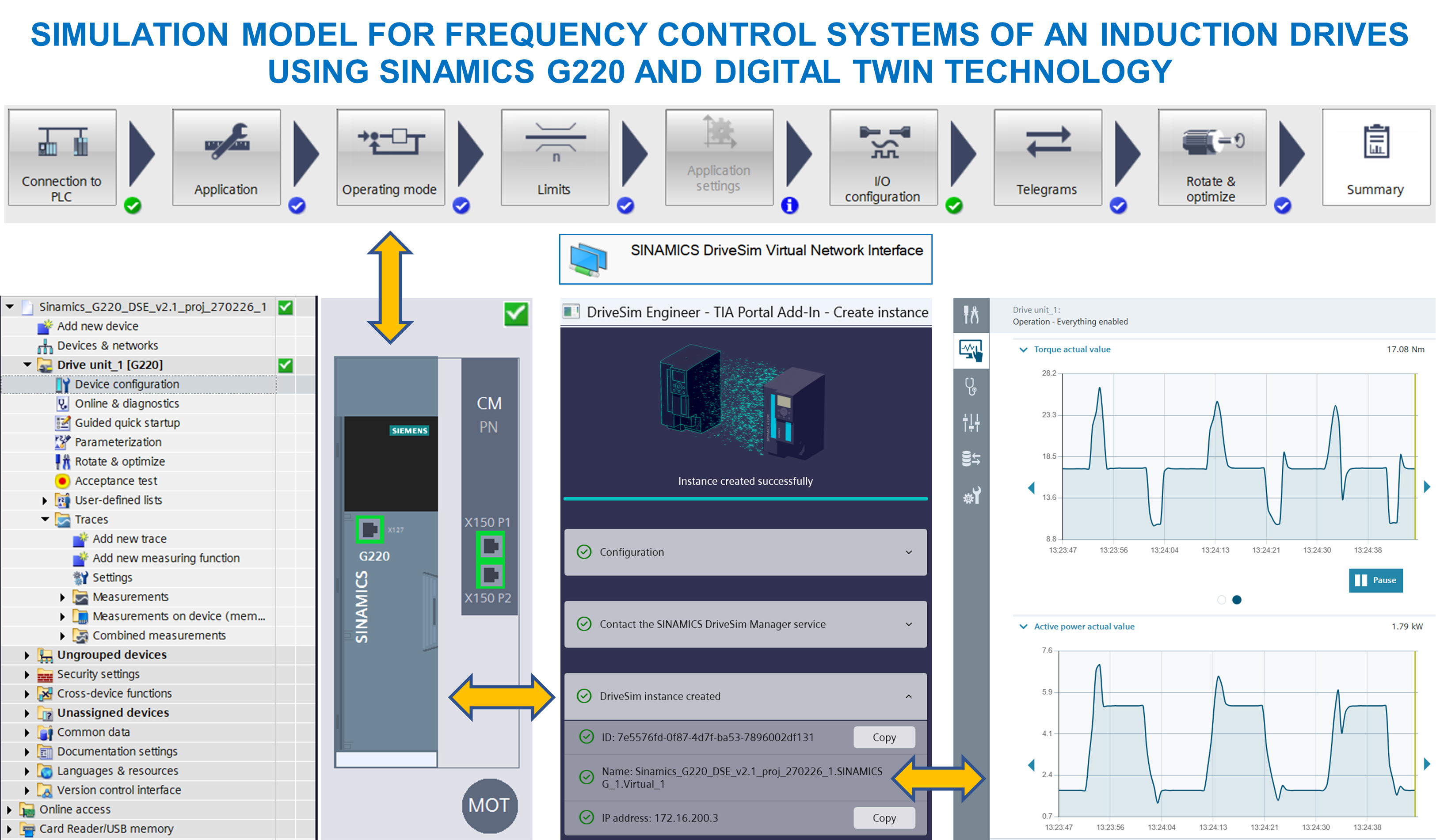
A functional scheme of a Sinamics G220 simulation model with an integrated induction drive has been developed in the TIA Portal environment. A project of a frequency control system for a 5.5 kW induction drive has been developed through parameterization, and setup of the communication environment based on Simatic S7 tools. Procedures for parameterization and Digital Twin generation were applied to create a virtual Sinamics G220 with an integrated induction drive.
The functionality of the operating modes of the Digital Twin has been defined and implemented, involving the application of the following variable parameters of rotational speed and mechanical load:
– Speed setpoint (1000 rpm and 2950 rpm with a period of 20 s);
– Ramp Function Generator (1.0 s “Up” and 1.0 s “Down”);
– Constant load torque (0.95 and 0.75 p. u.).
A procedure for setting the “Speed setpoint” via virtual digital inputs has been implemented for the operating modes “Setpoint channel”, “Fixed setpoint”, and “Binary”, providing 16 predefined “Speed setpoints”.
Testing of the Digital Twin was carried out using the built-in WEB server for two parameter sets with switched “Speed setpoints” and variable mechanical load “Constant load torque”. The testing results confirmed the adequacy of the simulation model’s response to changes in input parameters and operating modes of the Digital Twin of the Sinamics G220.
The obtained results are of practical significance for the commissioning of frequency control systems for induction drives using Sinamics G220.
References
- Andrei, A., Nicolescu, F.-A., Pupăză, C., Coman, C.-G., Ghionea, I. G. (2025). Applicability of Virtual Commissioning Concepts in Industrial Robotics as a Solution for Compatibility Issues Between Virtual Simulation and Logic Control Software. Applied Sciences, 15 (4), 2033. https://doi.org/10.3390/app15042033
- Correia, A. d. J. C., Silva, L. S., de Araújo, J. L., Contador, J. C., Contador, J. L., Magalhães, G. H. D. et al. (2026). Implementation of Integrated Control Systems Projects in Companies Focused on Industry 4.0: Opportunities and Challenges in Brazil. Technologies, 14 (2), 78. https://doi.org/10.3390/technologies14020078
- Amaya-Pinos, M., Urgiles, A., Apolo, D., Vicuña, J. A., Loja, J., Lopez, L. (2025). System Design Navigation for an Explorer Robot with System Continuous Track Type Traction. Automation, 6 (2), 18. https://doi.org/10.3390/automation6020018
- Lehner, D., Zhang, J., Pfeiffer, J., Sint, S., Splettstößer, A.-K., Wimmer, M., Wortmann, A. (2025). Model-driven engineering for digital twins: a systematic mapping study. Software and Systems Modeling, 24 (5), 1339–1377. https://doi.org/10.1007/s10270-025-01264-7
- Bhoi, S. K., Chakraborty, S., Hosseinabadi, F., Frikha, M. A., Martin, G. E., Sorniotti, A., Hegazy, O. (2025). Overview of Digital Twin Development in Power Electronics. IEEE Open Journal of Power Electronics, 6, 1737–1758. https://doi.org/10.1109/ojpel.2025.3615238
- Perisic, A., Perisic, B. (2025). Digital Twinning Future Trends Evaluation Framework: A Digital Twins Approach. Electronics, 15 (1), 90. https://doi.org/10.3390/electronics15010090
- Heluany, J. B., Gkioulos, V. (2023). A review on digital twins for power generation and distribution. International Journal of Information Security, 23 (2), 1171–1195. https://doi.org/10.1007/s10207-023-00784-x
- Aghazadeh Ardebili, A., Zappatore, M., Ramadan, A. I. H. A., Longo, A., Ficarella, A. (2024). Digital Twins of smart energy systems: a systematic literature review on enablers, design, management and computational challenges. Energy Informatics, 7 (1). https://doi.org/10.1186/s42162-024-00385-5
- Xin, P., Isleem, H. F., Khishe, M. (2025). A digital twin approach for sustainable construction: predictive optimization of concrete strength using industry 4.0 principles. Scientific Reports, 16 (1). https://doi.org/10.1038/s41598-025-32276-4
- Buri, Z., T. Kiss, J. (2025). Digitalisation in the Context of Industry 4.0 and Industry 5.0: A Bibliometric Literature Review and Visualisation. Applied System Innovation, 8 (5), 137. https://doi.org/10.3390/asi8050137
- Bysko, S., Bysko, S., Blachowicz, T. (2025). Virtual Commissioning and Digital Twins for Energy-Aware Industrial Electric Drive Systems. Energies, 18 (20), 5375. https://doi.org/10.3390/en18205375
- Lukman, G. F., Lee, C. (2025). Towards Digital Twin Modeling and Applications for Permanent Magnet Synchronous Motors. Energies, 18 (4), 956. https://doi.org/10.3390/en18040956
- Ionescu, D., Filipescu, A., Simion, G., Filipescu, A. (2025). Internet of Things-Cloud Control of a Robotic Cell Based on Inverse Kinematics, Hardware-in-the-Loop, Digital Twin, and Industry 4.0/5.0. Sensors, 25 (6), 1821. https://doi.org/10.3390/s25061821
- Zamikhovskyі, L., Nykolaychuk, M., Levytskyi, I. (2025). Development of a simulation model of a WEB-oriented servo drive frequency control system based on “Digital Twins” technology. Technology Audit and Production Reserves, 6 (2 (86)), 76–90. https://doi.org/10.15587/2706-5448.2025.345825
- Beran, L., Diblik, M. (2016). Indirect torque measurement using industrial vector control frequency converter. 2016 17th International Carpathian Control Conference (ICCC), 48–53. https://doi.org/10.1109/carpathiancc.2016.7501065
- Fuentes-Sanchez, J., Hernandez-Perez, J., Rangel-Magdaleno, J. D. J., Rosales-Nunez, S., Morales-Caporal, R. (2026). Induction Machine Digital Model Implementation for Fault Injection Analysis. Processes, 14 (3), 456. https://doi.org/10.3390/pr14030456
- Bohačík, A., Fujdiak, R. (2024). The Problem of Integrating Digital Twins into Electro-Energetic Control Systems. Smart Cities, 7 (5), 2702–2740. https://doi.org/10.3390/smartcities7050105
- Zharkymbekova, M., Mustafin, M., Almuratova, N., Chezhimbayeva, K., Sakitzhanov, M., Domalatov, Y. (2025). Evaluation of the efficiency of energy characteristics of an asynchronous motor using frequency conversion with pulse-width modulation. Eastern-European Journal of Enterprise Technologies, 4 (8 (136)), 16–25. https://doi.org/10.15587/1729-4061.2025.337918
- Polat, A. O., Erden, B. C., Kul, S., Nasiroglu, F. (2024). Light Electric Vehicle Performance with Digital Twin Technology: A Comparison of Motor Types. Arabian Journal for Science and Engineering, 49 (5), 7209–7222. https://doi.org/10.1007/s13369-023-08668-x
- Kopp, L., Molan, J.-N., Oppold, B., Steidle, L., Kley, M. (2025). Digital Twin of a Frequency Converter of an Asynchronous Machine for a Real Time Prediction in Stationary Operating Points Utilizing Machine Learning Methods. Procedia Computer Science, 270, 144–153. https://doi.org/10.1016/j.procs.2025.09.133
- Sharida, A., Kamal, N. F., Alnuweiri, H., Bayhan, S., Abu-Rub, H. (2023). Digital-Twin-Based Diagnosis and Tolerant Control of T-Type Three-Level Rectifiers. IEEE Open Journal of the Industrial Electronics Society, 4, 230–241. https://doi.org/10.1109/ojies.2023.3290169
- Asad, M., Sanchez-Fernandez, J. A. (2024). Enhancing Frequency Regulation Support through Several Synthetic Inertial Approaches for WDPS. Electronics, 13 (5), 852. https://doi.org/10.3390/electronics13050852
- Diz, S. d. L., López, R. M., Sánchez, F. J. R., Llerena, E. D., Peña, E. J. B. (2023). A real-time digital twin approach on three-phase power converters applied to condition monitoring. Applied Energy, 334, 120606. https://doi.org/10.1016/j.apenergy.2022.120606
- Ebadpour, M., Jamshidi, M., Talla, J., Hashemi-Dezaki, H., Peroutka, Z. (2023). Digital Twin Model of Electric Drives Empowered by EKF. Sensors, 23 (4), 2006. https://doi.org/10.3390/s23042006
- Mencou, S., Yakhlef, M. B., Tazi, E. B. (2025). Advanced control of induction motors (2019–2025): A comprehensive review of strategies, algorithms and sensorless techniques. E-Prime – Advances in Electrical Engineering, Electronics and Energy, 14, 101098. https://doi.org/10.1016/j.prime.2025.101098
- Ferkl, J., Novotny, L., Beudaert, X., Franco, O., Kolar, P., (2023). Simulation of feedforward control techniques to improve machines feed drives tracking performance. MM Science Journal, 2023 (4), 6999–7005. https://doi.org/10.17973/mmsj.2023_11_2023122
- Christ, L., Milloch, E., Boshoff, M., Hypki, A., Kuhlenkötter, B. (2023). Implementation of Digital Twin and Real Production System to Address Actual and Future Challenges in Assembly Technology. Automation, 4 (4), 345–358. https://doi.org/10.3390/automation4040020
- Malarczyk, M., Zychlewicz, M., Stanislawski, R., Kaminski, M. (2022). Speed Control Based on State Vector Applied for Electrical Drive with Elastic Connection. Automation, 3 (3), 337–363. https://doi.org/10.3390/automation3030018
- Hedayati Kia, S., Dunai, L., Antonino-Daviu, J. A., Razik, H. (2025). Real-Time Digital Twins for Intelligent Fault Diagnosis and Condition-Based Monitoring of Electrical Machines. Energies, 18 (17), 4637. https://doi.org/10.3390/en18174637
- Nykolaychuk, M., Zamikhovskyi, L., Levitskyi, I., Kopei, V., Ropyak, L. (2026). Development of a Simulation Model of a PID Controller Based on Simatic S7 Hardware-Software Tools and “Digital Twin” Technology. Automation, 7 (3), 74. https://doi.org/10.3390/automation7030074
- Catalog ST 70: Products for Totally Integrated Automation (2025). Siemens. Availale at: https://support.industry.siemens.com/cs/attachments/109744167/simatic-st70-complete-english-2025_1.pdf
- SINAMICS G220 converter (2025). Siemens. Available at: https://support.industry.siemens.com/cs/document/109986511/sinamics-g220-converter?dti=0&lc=en-US
- SIMOTICS GP, SD, XP, DP low-voltage motors: Catalogue D 81.1. Type series 1FP1, 1LE1, 1LE5, 1MB1 and 1PC1. Power range 0.09 to 500 kW (2018). Siemens. Available at: https://cache.industry.siemens.com/dl/files/197/109749197/att_955119/v1/simotics-gp-sd-xp-dp-catalogue-d-81-1-en-2018.pdf
- DriveSim Engineer: Function manual (2025). Siemens. Available at: https://cache.industry.siemens.com/dl/files/560/109997560/att_1349832/v1/DriveSim_Engineer_fct_man_1025_en-US.pdf
- Totally Integrated Automation (TIA). Siemens. Available at: https://docs.tia.siemens.cloud/
- SINAMICS Startdrive V20 and related updates (2026). Siemens. Available at: https://support.industry.siemens.com/cs/document/109963692/sinamics-startdrive-v20-and-related-updates?dti=0&lc=en-UA
- SINAMICS G220 converter: Operating instructions (2025). Siemens. Available at: https://support.industry.siemens.com/dl/files/511/109986511/att_1349918/v1/G220_op_instr_1125_en-US.pdf
- Zamikhovskyi, L., Nykolaychuk, M., Levytskyi, I. (2025). Extending the functionality of topologies of Web-oriented control systems for technological objects based on “Open User Communication”. Eastern-European Journal of Enterprise Technologies, 6 (2 (138)), 94–115. https://doi.org/10.15587/1729-4061.2025.348728
- Zamikhovskyi, L., Nykolaychuk, M., Levytskyi, I. (2024). Organizing the automated system of dispatch control over pump units at water pumping stations. Eastern-European Journal of Enterprise Technologies, 5 (2 (131)), 61–75. https://doi.org/10.15587/1729-4061.2024.313531
- Speed control of a SINAMICS G220 with SIMATIC S7-1500 via PROFINET (2024). Siemens. Available at: https://support.industry.siemens.com/cs/document/109955055/speed-control-of-a-sinamics-g220-with-simatic-s7-1500-via-profinet
- SINAMICS G220 converters: List manual (2025). Siemens. Available at: https://support.industry.siemens.com/cs/document/109825375
- Motion control drives: SINAMICS converters for single-axis drives – SINAMICS G220 built-in and wall-mounted units. Catalog D 36.1 (2025). Siemens. Available at: https://siemens.com/d36-1
- Nazarenko, I. V., Nikolaychuk, M. Ya., Ferenets, V. D., Sukhanov, D. Ye. (2014). Construction and modeling of unified control systems of actuating mechanisms for objects of gas-transport system. Eastern-European Journal of Enterprise Technologies, 1 (2 (67)), 41–48. https://doi.org/10.15587/1729-4061.2014.21204
- Gbadebo, A., Altumi, F., Liang, C., Pham, D. T. (2026). Digital Twin with Model Predictive Control for Screw Unfastening by Robots. Automation, 7 (1), 20. https://doi.org/10.3390/automation7010020
- Zamikhovskіy, L., Levytskyi, I., Nykolaychuk, M. (2021). Designing a system that removes metallic inclusions from bulk raw materials on the belt conveyor. Eastern-European Journal of Enterprise Technologies, 3 (2 (111)), 79–87. https://doi.org/10.15587/1729-4061.2021.234235
- Zamikhovskyi, L., Zamikhovska, O., Ivanyuk, N., Mirzoieva, O., Nykolaychuk, M. (2025). Development of an anti-surge protection system for gas pumping units based on hardware and software vibration monitoring tools. Eastern-European Journal of Enterprise Technologies, 4 (2 (136)), 117–132. https://doi.org/10.15587/1729-4061.2025.337736
- Fujita, T., Xi, T., Ikeda, R., Kehne, S., Fey, M., Brecher, C. (2022). Identification of a Practical Digital Twin for Simulation of Machine Tools. International Journal of Automation Technology, 16 (3), 261–268. https://doi.org/10.20965/ijat.2022.p0261
- DriveSim Engineer: Restrictions V2.1 (2025). Siemens. Available at: https://support.industry.siemens.com/cs/mdm/109997560?c=194276245515&lc=en-WW
- SIMATIC Target: Calling Simulink® models (2024). Siemens. Available at: https://cache.industry.siemens.com/dl/files/830/109482830/att_1299002/v2/109482830_SIMATIC_Target_DOC_V13_en.pdf
Downloads
Published
How to Cite
Issue
Section
License
Copyright (c) 2026 Leonid Zamikhovskyі, Mykola Nykolaychuk, Ivan Levytskyi

This work is licensed under a Creative Commons Attribution 4.0 International License.
The consolidation and conditions for the transfer of copyright (identification of authorship) is carried out in the License Agreement. In particular, the authors reserve the right to the authorship of their manuscript and transfer the first publication of this work to the journal under the terms of the Creative Commons CC BY license. At the same time, they have the right to conclude on their own additional agreements concerning the non-exclusive distribution of the work in the form in which it was published by this journal, but provided that the link to the first publication of the article in this journal is preserved.





