Розроблення імітаційної моделі та методики тестування систем частотного керування асинхронним приводом на базі Sinamics G220 і технології «Digital Twin»
DOI:
https://doi.org/10.15587/2706-5448.2026.360983Ключові слова:
система керування, частотний перетворювач Sinamics G220, асинхронний привод, імітаційна модель, Digital TwinАнотація
Об’єктом дослідження є інформаційні процеси керування в частотних перетворювачах Sinamics G220 з асинхронним приводом. Проблематика дослідження полягає у необхідності створення імітаційних моделей компонентів систем керування технологічними об’єктами, розробленні методик та реалізації процедур для їх тестування на базі технології «Digital Twin».
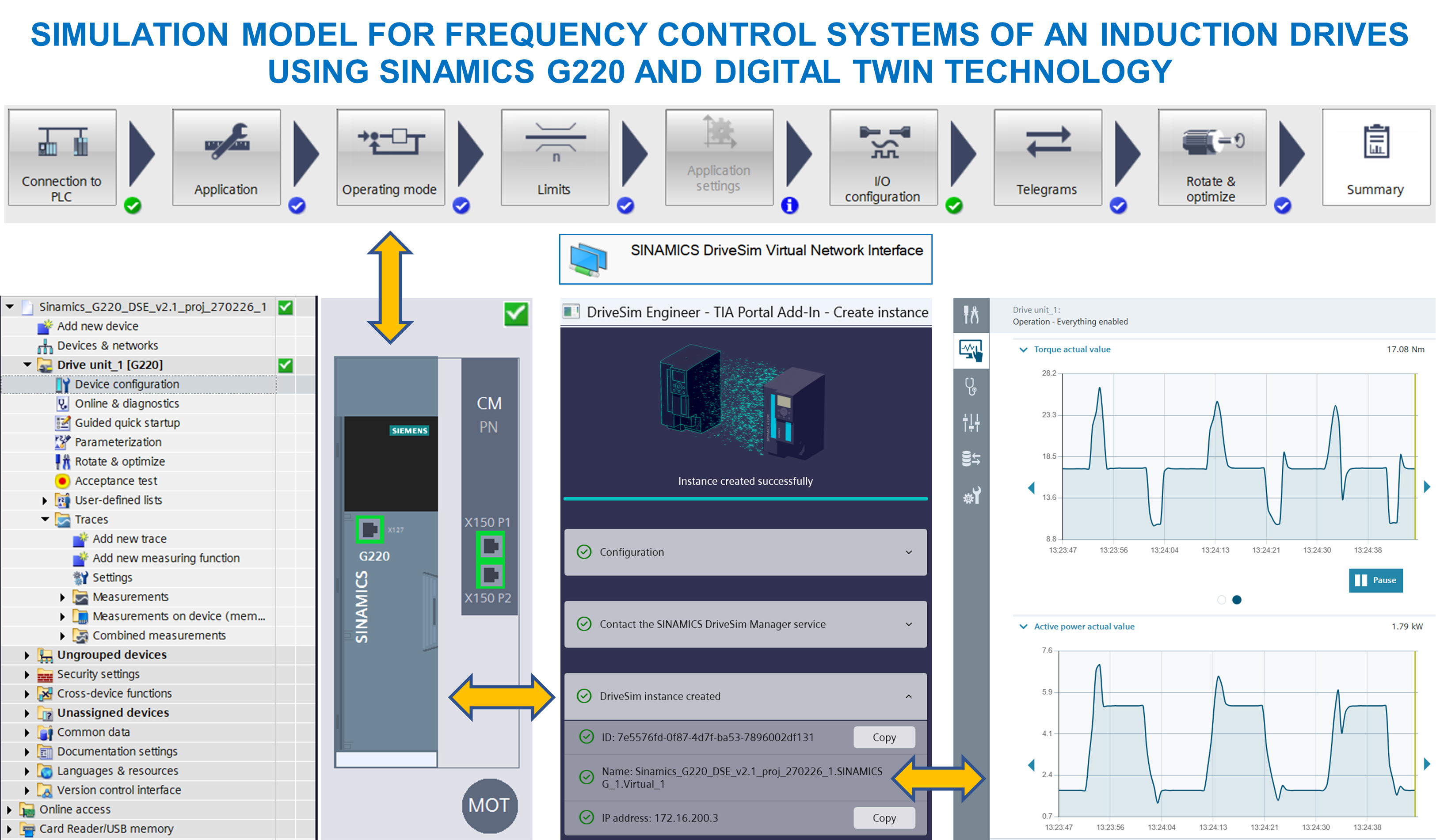
Розроблено функціональну схему імітаційної моделі Sinamics G220 з інтегрованим асинхронним приводом в середовищі TIA Portal на базі технології «Digital Twin». Розроблено проєкт системи частотного керування асинхронним приводом потужністю 5.5 kW шляхом параметрування та налагодження комунікаційного середовища на базі обладнання Simatic S7. Для створення віртуального Sinamics G220 з інтегрованим асинхронним приводом застосовано процедури параметрування та генерування «Digital Twin».
Визначено та реалізовано функціональність режимів роботи «Digital Twin» Sinamics G220 з асинхронним приводом, що полягає у застосовані наступних змінних параметрів швидкості обертів і механічного навантаження:
– «Speed setpoint» (1000 rpm та 2950 rpm з періодом 20 s);
– «Rump-Function-Generator» (1.0 s «Up» p. u. та 1.0 s «Down»);
– «Constant load torque» (0.95 та 0.75 p. u.).
Реалізовано процедуру задання «Speed setpoint» через віртуальні digital inputs (DI) для режимів роботи «Setpoint channel», «Fixed setpoint», «Binary», що забезпечує 16 попередньо визначених «Speed setpoint».
Тестування «Digital Twin» виконано засобами вбудованого WEB-сервера для двох наборів параметрів з комутованою «Speed setpoint» і змінним механічним навантаженням «Constant load torque». За результатами тестування підтверджено адекватність реакції імітаційної моделі на зміну вхідних параметрів і режимів роботи «Digital Twin» Sinamics G220.
Отримані результати мають практичне значення при вводі в експлуатацію систем частотного керування асинхронним приводом на базі обладнання SINAMICS G220.
Посилання
- Andrei, A., Nicolescu, F.-A., Pupăză, C., Coman, C.-G., Ghionea, I. G. (2025). Applicability of Virtual Commissioning Concepts in Industrial Robotics as a Solution for Compatibility Issues Between Virtual Simulation and Logic Control Software. Applied Sciences, 15 (4), 2033. https://doi.org/10.3390/app15042033
- Correia, A. d. J. C., Silva, L. S., de Araújo, J. L., Contador, J. C., Contador, J. L., Magalhães, G. H. D. et al. (2026). Implementation of Integrated Control Systems Projects in Companies Focused on Industry 4.0: Opportunities and Challenges in Brazil. Technologies, 14 (2), 78. https://doi.org/10.3390/technologies14020078
- Amaya-Pinos, M., Urgiles, A., Apolo, D., Vicuña, J. A., Loja, J., Lopez, L. (2025). System Design Navigation for an Explorer Robot with System Continuous Track Type Traction. Automation, 6 (2), 18. https://doi.org/10.3390/automation6020018
- Lehner, D., Zhang, J., Pfeiffer, J., Sint, S., Splettstößer, A.-K., Wimmer, M., Wortmann, A. (2025). Model-driven engineering for digital twins: a systematic mapping study. Software and Systems Modeling, 24 (5), 1339–1377. https://doi.org/10.1007/s10270-025-01264-7
- Bhoi, S. K., Chakraborty, S., Hosseinabadi, F., Frikha, M. A., Martin, G. E., Sorniotti, A., Hegazy, O. (2025). Overview of Digital Twin Development in Power Electronics. IEEE Open Journal of Power Electronics, 6, 1737–1758. https://doi.org/10.1109/ojpel.2025.3615238
- Perisic, A., Perisic, B. (2025). Digital Twinning Future Trends Evaluation Framework: A Digital Twins Approach. Electronics, 15 (1), 90. https://doi.org/10.3390/electronics15010090
- Heluany, J. B., Gkioulos, V. (2023). A review on digital twins for power generation and distribution. International Journal of Information Security, 23 (2), 1171–1195. https://doi.org/10.1007/s10207-023-00784-x
- Aghazadeh Ardebili, A., Zappatore, M., Ramadan, A. I. H. A., Longo, A., Ficarella, A. (2024). Digital Twins of smart energy systems: a systematic literature review on enablers, design, management and computational challenges. Energy Informatics, 7 (1). https://doi.org/10.1186/s42162-024-00385-5
- Xin, P., Isleem, H. F., Khishe, M. (2025). A digital twin approach for sustainable construction: predictive optimization of concrete strength using industry 4.0 principles. Scientific Reports, 16 (1). https://doi.org/10.1038/s41598-025-32276-4
- Buri, Z., T. Kiss, J. (2025). Digitalisation in the Context of Industry 4.0 and Industry 5.0: A Bibliometric Literature Review and Visualisation. Applied System Innovation, 8 (5), 137. https://doi.org/10.3390/asi8050137
- Bysko, S., Bysko, S., Blachowicz, T. (2025). Virtual Commissioning and Digital Twins for Energy-Aware Industrial Electric Drive Systems. Energies, 18 (20), 5375. https://doi.org/10.3390/en18205375
- Lukman, G. F., Lee, C. (2025). Towards Digital Twin Modeling and Applications for Permanent Magnet Synchronous Motors. Energies, 18 (4), 956. https://doi.org/10.3390/en18040956
- Ionescu, D., Filipescu, A., Simion, G., Filipescu, A. (2025). Internet of Things-Cloud Control of a Robotic Cell Based on Inverse Kinematics, Hardware-in-the-Loop, Digital Twin, and Industry 4.0/5.0. Sensors, 25 (6), 1821. https://doi.org/10.3390/s25061821
- Zamikhovskyі, L., Nykolaychuk, M., Levytskyi, I. (2025). Development of a simulation model of a WEB-oriented servo drive frequency control system based on “Digital Twins” technology. Technology Audit and Production Reserves, 6 (2 (86)), 76–90. https://doi.org/10.15587/2706-5448.2025.345825
- Beran, L., Diblik, M. (2016). Indirect torque measurement using industrial vector control frequency converter. 2016 17th International Carpathian Control Conference (ICCC), 48–53. https://doi.org/10.1109/carpathiancc.2016.7501065
- Fuentes-Sanchez, J., Hernandez-Perez, J., Rangel-Magdaleno, J. D. J., Rosales-Nunez, S., Morales-Caporal, R. (2026). Induction Machine Digital Model Implementation for Fault Injection Analysis. Processes, 14 (3), 456. https://doi.org/10.3390/pr14030456
- Bohačík, A., Fujdiak, R. (2024). The Problem of Integrating Digital Twins into Electro-Energetic Control Systems. Smart Cities, 7 (5), 2702–2740. https://doi.org/10.3390/smartcities7050105
- Zharkymbekova, M., Mustafin, M., Almuratova, N., Chezhimbayeva, K., Sakitzhanov, M., Domalatov, Y. (2025). Evaluation of the efficiency of energy characteristics of an asynchronous motor using frequency conversion with pulse-width modulation. Eastern-European Journal of Enterprise Technologies, 4 (8 (136)), 16–25. https://doi.org/10.15587/1729-4061.2025.337918
- Polat, A. O., Erden, B. C., Kul, S., Nasiroglu, F. (2024). Light Electric Vehicle Performance with Digital Twin Technology: A Comparison of Motor Types. Arabian Journal for Science and Engineering, 49 (5), 7209–7222. https://doi.org/10.1007/s13369-023-08668-x
- Kopp, L., Molan, J.-N., Oppold, B., Steidle, L., Kley, M. (2025). Digital Twin of a Frequency Converter of an Asynchronous Machine for a Real Time Prediction in Stationary Operating Points Utilizing Machine Learning Methods. Procedia Computer Science, 270, 144–153. https://doi.org/10.1016/j.procs.2025.09.133
- Sharida, A., Kamal, N. F., Alnuweiri, H., Bayhan, S., Abu-Rub, H. (2023). Digital-Twin-Based Diagnosis and Tolerant Control of T-Type Three-Level Rectifiers. IEEE Open Journal of the Industrial Electronics Society, 4, 230–241. https://doi.org/10.1109/ojies.2023.3290169
- Asad, M., Sanchez-Fernandez, J. A. (2024). Enhancing Frequency Regulation Support through Several Synthetic Inertial Approaches for WDPS. Electronics, 13 (5), 852. https://doi.org/10.3390/electronics13050852
- Diz, S. d. L., López, R. M., Sánchez, F. J. R., Llerena, E. D., Peña, E. J. B. (2023). A real-time digital twin approach on three-phase power converters applied to condition monitoring. Applied Energy, 334, 120606. https://doi.org/10.1016/j.apenergy.2022.120606
- Ebadpour, M., Jamshidi, M., Talla, J., Hashemi-Dezaki, H., Peroutka, Z. (2023). Digital Twin Model of Electric Drives Empowered by EKF. Sensors, 23 (4), 2006. https://doi.org/10.3390/s23042006
- Mencou, S., Yakhlef, M. B., Tazi, E. B. (2025). Advanced control of induction motors (2019–2025): A comprehensive review of strategies, algorithms and sensorless techniques. E-Prime – Advances in Electrical Engineering, Electronics and Energy, 14, 101098. https://doi.org/10.1016/j.prime.2025.101098
- Ferkl, J., Novotny, L., Beudaert, X., Franco, O., Kolar, P., (2023). Simulation of feedforward control techniques to improve machines feed drives tracking performance. MM Science Journal, 2023 (4), 6999–7005. https://doi.org/10.17973/mmsj.2023_11_2023122
- Christ, L., Milloch, E., Boshoff, M., Hypki, A., Kuhlenkötter, B. (2023). Implementation of Digital Twin and Real Production System to Address Actual and Future Challenges in Assembly Technology. Automation, 4 (4), 345–358. https://doi.org/10.3390/automation4040020
- Malarczyk, M., Zychlewicz, M., Stanislawski, R., Kaminski, M. (2022). Speed Control Based on State Vector Applied for Electrical Drive with Elastic Connection. Automation, 3 (3), 337–363. https://doi.org/10.3390/automation3030018
- Hedayati Kia, S., Dunai, L., Antonino-Daviu, J. A., Razik, H. (2025). Real-Time Digital Twins for Intelligent Fault Diagnosis and Condition-Based Monitoring of Electrical Machines. Energies, 18 (17), 4637. https://doi.org/10.3390/en18174637
- Nykolaychuk, M., Zamikhovskyi, L., Levitskyi, I., Kopei, V., Ropyak, L. (2026). Development of a Simulation Model of a PID Controller Based on Simatic S7 Hardware-Software Tools and “Digital Twin” Technology. Automation, 7 (3), 74. https://doi.org/10.3390/automation7030074
- Catalog ST 70: Products for Totally Integrated Automation (2025). Siemens. Availale at: https://support.industry.siemens.com/cs/attachments/109744167/simatic-st70-complete-english-2025_1.pdf
- SINAMICS G220 converter (2025). Siemens. Available at: https://support.industry.siemens.com/cs/document/109986511/sinamics-g220-converter?dti=0&lc=en-US
- SIMOTICS GP, SD, XP, DP low-voltage motors: Catalogue D 81.1. Type series 1FP1, 1LE1, 1LE5, 1MB1 and 1PC1. Power range 0.09 to 500 kW (2018). Siemens. Available at: https://cache.industry.siemens.com/dl/files/197/109749197/att_955119/v1/simotics-gp-sd-xp-dp-catalogue-d-81-1-en-2018.pdf
- DriveSim Engineer: Function manual (2025). Siemens. Available at: https://cache.industry.siemens.com/dl/files/560/109997560/att_1349832/v1/DriveSim_Engineer_fct_man_1025_en-US.pdf
- Totally Integrated Automation (TIA). Siemens. Available at: https://docs.tia.siemens.cloud/
- SINAMICS Startdrive V20 and related updates (2026). Siemens. Available at: https://support.industry.siemens.com/cs/document/109963692/sinamics-startdrive-v20-and-related-updates?dti=0&lc=en-UA
- SINAMICS G220 converter: Operating instructions (2025). Siemens. Available at: https://support.industry.siemens.com/dl/files/511/109986511/att_1349918/v1/G220_op_instr_1125_en-US.pdf
- Zamikhovskyi, L., Nykolaychuk, M., Levytskyi, I. (2025). Extending the functionality of topologies of Web-oriented control systems for technological objects based on “Open User Communication”. Eastern-European Journal of Enterprise Technologies, 6 (2 (138)), 94–115. https://doi.org/10.15587/1729-4061.2025.348728
- Zamikhovskyi, L., Nykolaychuk, M., Levytskyi, I. (2024). Organizing the automated system of dispatch control over pump units at water pumping stations. Eastern-European Journal of Enterprise Technologies, 5 (2 (131)), 61–75. https://doi.org/10.15587/1729-4061.2024.313531
- Speed control of a SINAMICS G220 with SIMATIC S7-1500 via PROFINET (2024). Siemens. Available at: https://support.industry.siemens.com/cs/document/109955055/speed-control-of-a-sinamics-g220-with-simatic-s7-1500-via-profinet
- SINAMICS G220 converters: List manual (2025). Siemens. Available at: https://support.industry.siemens.com/cs/document/109825375
- Motion control drives: SINAMICS converters for single-axis drives – SINAMICS G220 built-in and wall-mounted units. Catalog D 36.1 (2025). Siemens. Available at: https://siemens.com/d36-1
- Nazarenko, I. V., Nikolaychuk, M. Ya., Ferenets, V. D., Sukhanov, D. Ye. (2014). Construction and modeling of unified control systems of actuating mechanisms for objects of gas-transport system. Eastern-European Journal of Enterprise Technologies, 1 (2 (67)), 41–48. https://doi.org/10.15587/1729-4061.2014.21204
- Gbadebo, A., Altumi, F., Liang, C., Pham, D. T. (2026). Digital Twin with Model Predictive Control for Screw Unfastening by Robots. Automation, 7 (1), 20. https://doi.org/10.3390/automation7010020
- Zamikhovskіy, L., Levytskyi, I., Nykolaychuk, M. (2021). Designing a system that removes metallic inclusions from bulk raw materials on the belt conveyor. Eastern-European Journal of Enterprise Technologies, 3 (2 (111)), 79–87. https://doi.org/10.15587/1729-4061.2021.234235
- Zamikhovskyi, L., Zamikhovska, O., Ivanyuk, N., Mirzoieva, O., Nykolaychuk, M. (2025). Development of an anti-surge protection system for gas pumping units based on hardware and software vibration monitoring tools. Eastern-European Journal of Enterprise Technologies, 4 (2 (136)), 117–132. https://doi.org/10.15587/1729-4061.2025.337736
- Fujita, T., Xi, T., Ikeda, R., Kehne, S., Fey, M., Brecher, C. (2022). Identification of a Practical Digital Twin for Simulation of Machine Tools. International Journal of Automation Technology, 16 (3), 261–268. https://doi.org/10.20965/ijat.2022.p0261
- DriveSim Engineer: Restrictions V2.1 (2025). Siemens. Available at: https://support.industry.siemens.com/cs/mdm/109997560?c=194276245515&lc=en-WW
- SIMATIC Target: Calling Simulink® models (2024). Siemens. Available at: https://cache.industry.siemens.com/dl/files/830/109482830/att_1299002/v2/109482830_SIMATIC_Target_DOC_V13_en.pdf
##submission.downloads##
Опубліковано
Як цитувати
Номер
Розділ
Ліцензія
Авторське право (c) 2026 Leonid Zamikhovskyі, Mykola Nykolaychuk, Ivan Levytskyi

Ця робота ліцензується відповідно до Creative Commons Attribution 4.0 International License.
Закріплення та умови передачі авторських прав (ідентифікація авторства) здійснюється у Ліцензійному договорі. Зокрема, автори залишають за собою право на авторство свого рукопису та передають журналу право першої публікації цієї роботи на умовах ліцензії Creative Commons CC BY. При цьому вони мають право укладати самостійно додаткові угоди, що стосуються неексклюзивного поширення роботи у тому вигляді, в якому вона була опублікована цим журналом, але за умови збереження посилання на першу публікацію статті в цьому журналі.