Features of CSR development in various sectors of the economy: case study from Ukraine based on the analytical-hierarchical method
DOI:
https://doi.org/10.15587/2706-5448.2026.361128Keywords:
CSR of enterprises, market environment, working environment, environment, society, analytical-hierarchical methodAbstract
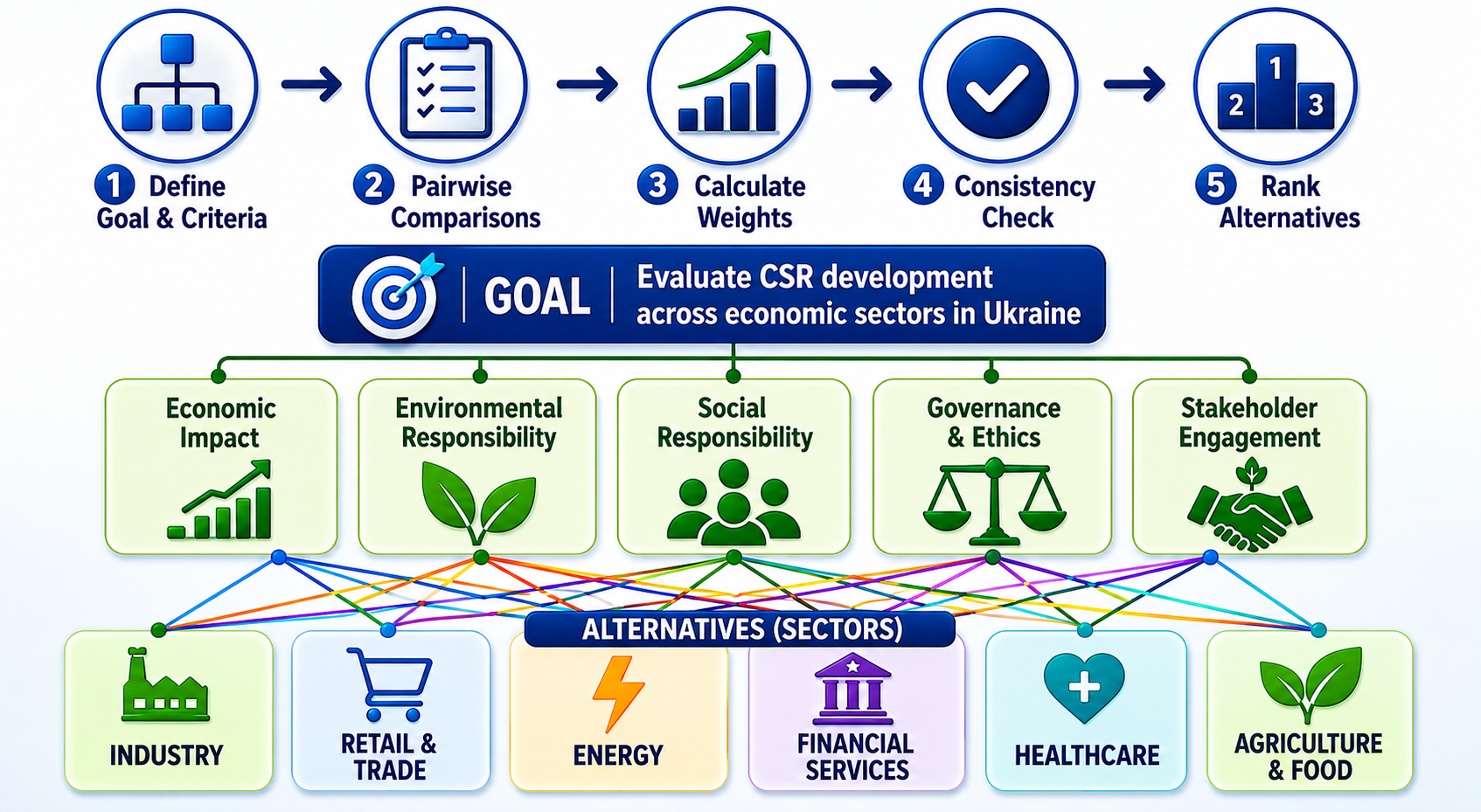
The object of research is the level of development of corporate social responsibility (CSR) in various sectors of the economy. The conducted research solves the problem of the lack of a comprehensive assessment of the level of development of CSR in various sectors of the economy. The research method is the construction of an analytical hierarchical model (AHP) for assessing CSR, taking into account economic, social and environmental aspects. The empirical basis of the research is an expert survey of specialists in the field of management and CSR. The research results were processed using the Expert Choice software. The data show that for enterprises in the IT (0.316) and energy (0.323) industries, the most important aspect of CSR is the working environment (0.383). The latter can be explained by the high level of digital culture, the significant importance of human capital and environmental responsibility. Enterprises of the light, food and machine-building industries received lower weight coefficients (0.104; 0.11 and 0.146, respectively), which is due to the low level of investment in employees, lower interest in environmental initiatives or low participation in social projects. In general, the AHP analysis shows that CSR in Ukraine is formed at the expense of social, labor and public aspects, while the market and financial and economic blocks play a less significant role. The applied structured multi-aspect approach to expert assessment will allow to form priorities of components and elements of CSR in different sectors of the economy. The results can be used by enterprises of different sectors of the economy to form corporate social responsibility policies. The use of the AHP model allows to structure the decision-making process, reduce the level of uncertainty and increase the validity of resource allocation regarding corporate social responsibility.
References
- Carroll, A. B. (1991). The pyramid of corporate social responsibility: Toward the moral management of organizational stakeholders. Business Horizons, 34 (4), 39–48. https://doi.org/10.1016/0007-6813(91)90005-g
- Mosad, M. S. T., Szegedi, K. (2025). Mapping the academic discourse on CSR disclosure in family firms. Discover Sustainability, 7 (1). https://doi.org/10.1007/s43621-025-02342-y
- Peng, Y., Zhang, Z. (2026). The roles of lean and corporate social responsibility in acquisitions. Omega, 141, 103483. https://doi.org/10.1016/j.omega.2025.103483
- Ta, H. T. T., Le, O. T. T., Can, D. H. (2025). Stakeholder pressure on the level of corporate social responsibility disclosure: Evidence from Vietnam. Multidisciplinary Science Journal, 8 (2), 2026029. https://doi.org/10.31893/multiscience.2026029
- He, L.-Y., Wang, Y. (2026). Is CSR a leading indicator of corporate restructuring performance? Evidence from explainable machine learning. Journal of Management Science and Engineering, 11 (1), 20–36. https://doi.org/10.1016/j.jmse.2025.12.001
- Yin, C., Salmador, M. P., Li, D. (2026). The impact of corporate social responsibility on executive remuneration: A comparative analysis of family and non-family firms. International Entrepreneurship and Management Journal, 22 (1). https://doi.org/10.1007/s11365-025-01147-9
- Rodrigues, M., Mendes, L. (2018). Mapping of the literature on social responsibility in the mining industry: A systematic literature review. Journal of Cleaner Production, 181, 88–101. https://doi.org/10.1016/j.jclepro.2018.01.163
- Willness, C. R., Grygoryeva, A. (2026). A systematic review of negative reactions to corporate social responsibility. Human Resource Management Review, 36 (2), 101130. https://doi.org/10.1016/j.hrmr.2025.101130
- Téllez-Bedoya, C., Almanza-Junco, C., Herrera, J. (2026). Analytic Hierarchy Process-Based Framework for Corporate Social Responsibility Decision-Making in Peacebuilding Contexts. Sustainability, 18 (4), 2151. https://doi.org/10.3390/su18042151
- Kirzhetska, M. S., Kirzhetskyy, Y. I., Zelenko, N. M., Zelenko, V. A., Klos, L. Y., Shkoliar, M. V., Gnylianska, L. Y. (2023). Activity-based costing: a practical model of cost calculation in psychiatric hospitals. Wiadomości Lekarskie, 76 (12), 2679–2686. https://doi.org/10.36740/wlek202312118
- Moskvyak, Y., Kucher, A., Kniaz, S., Heorhiadi, N., Fedorchak, O. (2025). Construction of a model for forecasting the rationality of financial decisions under the conditions of financial markets digitalization. Eastern-European Journal of Enterprise Technologies, 2 (13 (134)), 38–50. https://doi.org/10.15587/1729-4061.2025.325518
- Kharchuk, V., Oleksiv, I. (2023). The Intellectual Structure of Sustainable Leadership Studies: Bibliometric Analysis. Advances in Intelligent Systems, Computer Science and Digital Economics IV. Cham: Springer, 430–442. https://doi.org/10.1007/978-3-031-24475-9_37
- Oleksiv, I., Lema, H., Vankovych, L., Chapran, S. (2025). Analysis of the Relationship Between CSR Elements Applying Isomorphic Distances. Advances in Computer Science for Engineering and Education VII. 417–426. https://doi.org/10.1007/978-3-031-84228-3_36
- Lema, H., Lisovych, T., Oleksiv, I., Kharchuk, V., Shulyar, R., Lema, O. (2025). Influence of External and Internal Factors on Company Activity in War Conditions Applying Expert Integral Evaluation System: A Case Study from Ukraine. Advances in Computer Science for Engineering and Education VII. Cham: Springer, 427–437. https://doi.org/10.1007/978-3-031-84228-3_37
- Kuzmin, O. Y., Oleksiv, I. B., Mykhailyak, G. V. (2014). Integral evaluation of company employees' competence system. Actual Problems of Economics, 5 (155), 506–513.
- Chapran, S. (2021). Analysis of methodological approaches to the construction of dynamic systems of investment in information development. Technology Audit and Production Reserves, 6 (4 (62)), 12–16. https://doi.org/10.15587/2706-5448.2021.248312
- Saaty, T. L. (1980). The analytic hierarchy process: Planning, priority setting, resource allocation. McGraw-Hill, 287.
- Directive (EU) 2022/2464 of the European Parliament and of the Council of 14 December 2022 amending Regulation (EU) No 537/2014, Directive 2004/109/EC, Directive 2006/43/EC and Directive 2013/34/EU, as regards corporate sustainability reporting (Text with EEA relevance) (2022). European Parliament and Council of the European Union. Available at: https://eur-lex.europa.eu/legal-content/EN/TXT/?uri=CELEX%3A32022L2464&qid=1681303503520
- Corporate responsibility (2025). EPAM Systems. Available at: https://www.epam.com/about/who-we-are/corporate-responsibility
- Corporate social responsibility report 2024 (2024). SoftServe. Available at: https://www.softserveinc.com/files/csr/softserve-corporate-social-responsibility-report-2024.pdf
- Sustainability in action report (2024). DTEK. Available at: https://dtek.com/content/upload/Sustainability_in_Action_report.pdf
Downloads
Published
How to Cite
Issue
Section
License
Copyright (c) 2026 Halyna Lema, Ihor Oleksiv, Viktoriya Kharchuk, Roksolana Vilhutska, Liliia Mykhailyshyn

This work is licensed under a Creative Commons Attribution 4.0 International License.
The consolidation and conditions for the transfer of copyright (identification of authorship) is carried out in the License Agreement. In particular, the authors reserve the right to the authorship of their manuscript and transfer the first publication of this work to the journal under the terms of the Creative Commons CC BY license. At the same time, they have the right to conclude on their own additional agreements concerning the non-exclusive distribution of the work in the form in which it was published by this journal, but provided that the link to the first publication of the article in this journal is preserved.