Improvement of the method of functional representation of the shape of a three-dimensional object
DOI:
https://doi.org/10.15587/2706-5448.2026.361358Keywords:
3D modeling, functional representation, Transformer, Fourier transform, calibration of the action orbit of the similarity group, quality assessment of the functional representationAbstract
The object of research is the process of creating a three-dimensional computer model of an aerodynamic product.
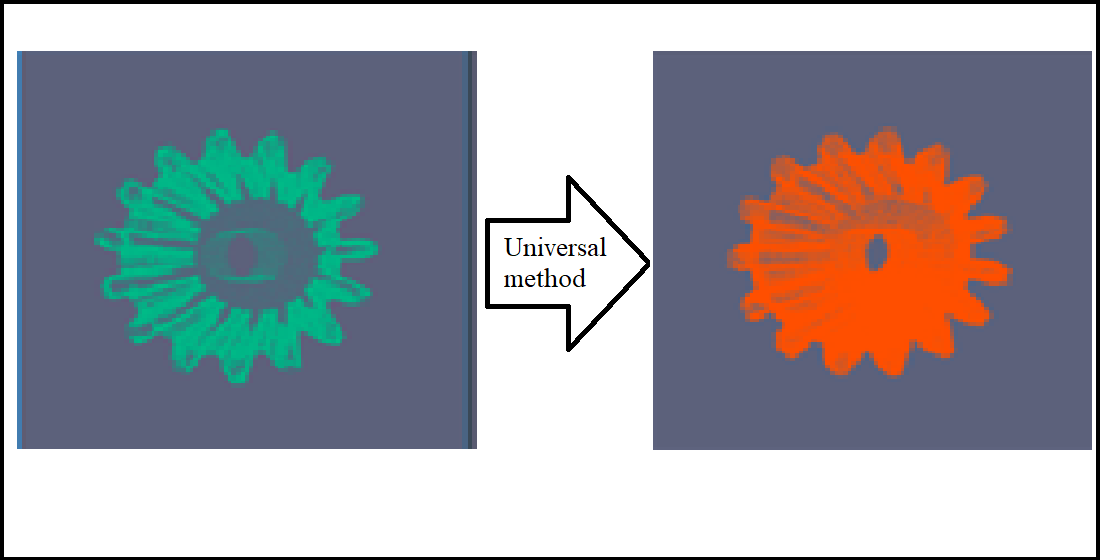
The research is devoted to solving the problem of combining a Transformer class model and a method of representing figures through a Fourier series. Such a combination is possible provided that a universal method of representing multidimensional data of different types is used. The results of the combination can improve the solution of the problem of creating a 3D model that meets the specified environmental requirements with sufficiently high accuracy. However, the issues of applying a universal method of representing multidimensional data remain largely unexplored.
A universal method of representing mathematical descriptions of a 3D object and the physical environment that affects the characteristics of this object has been improved. A new method of calibrating the action orbit of the similarity group of figures by displacement has been developed. A method of applying the Fourier transform for figures that form multiple-valued functions after the second phase of the transformation has been improved. A quantitative quality assessment of the functional representation of a figure based on the Hausdorff distance has been developed. A method for eliminating the existing shortcomings of this distance has also been developed.
An experimental verification of the obtained research results has been carried out. It has been established that the use of the proposed improvements ensures the invariance of the functional representation with respect to spatial characteristics of 99.9%. The largest root mean square deviation is 0.000008 absolute units of the Hausdorff distance.
The obtained results provide a universal method for representing any three-dimensional objects. Unlike most existing methods, the improved method allows to operate on 3D models as points in the Hilbert functional space. This possibility allows to significantly simplify the use of modern machine learning models of the Transformer class for solving scientific and applied problems of mathematical physics.
References
- Ruksov, Y., Moroz, B. (2025). Functional representation of 3D objects as a method of data generalization in generative machine learning models. Computer-Integrated Technologies: Education, Science, Production, 60, 269–282. https://doi.org/10.36910/6775-2524-0560-2025-60-29
- Islam, S., Elmekki, H., Elsebai, A., Bentahar, J., Drawel, N., Rjoub, G., Pedrycz, W. (2024). A comprehensive survey on applications of transformers for deep learning tasks. Expert Systems with Applications, 241, 122666. https://doi.org/10.1016/j.eswa.2023.122666
- Sun, Y., Wang, Y., Liu, Z., Siegel, J. E., Sarma, S. E. (2020). PointGrow: Autoregressively Learned Point Cloud Generation with Self-Attention. 2020 IEEE Winter Conference on Applications of Computer Vision (WACV). Snowmass, 61–70. https://doi.org/10.1109/wacv45572.2020.9093430
- Nash, C., Ganin, Y., Eslami, S. M. A., Battaglia, P. (2020). PolyGen: An Autoregressive Generative Model of 3D Meshes. Proceedings of the 37th International Conference on Machine Learning, in Proceedings of Machine Learning Research, 119, 7220–7229. https://doi.org/10.48550/arXiv.2002.10880
- Siddiqui, Y., Alliegro, A., Artemov, A., Tommasi, T., Sirigatti, D., Rosov, V. et al. (2024). MeshGPT: Generating Triangle Meshes with Decoder-Only Transformers. 2024 IEEE/CVF Conference on Computer Vision and Pattern Recognition (CVPR). Seattle, 19615–19625. https://doi.org/10.1109/cvpr52733.2024.01855
- Ibing, M., Kobsik, G., Kobbelt, L. (2023). Octree Transformer: Autoregressive 3D Shape Generation on Hierarchically Structured Sequences. 2023 IEEE/CVF Conference on Computer Vision and Pattern Recognition Workshops (CVPRW). Vancouver, 2698–2707. https://doi.org/10.1109/cvprw59228.2023.00270
- Zhang, J., Xiong, F., Wang, G., Xu, M. (2025). G3PT: Unleash the Power of Autoregressive Modeling in 3D Generation via Cross-Scale Querying Transformer. Proceedings of the Thirty-Fourth International Joint Conference on Artificial Intelligence, 2350–2358. https://doi.org/10.24963/ijcai.2025/262
- Jiang, J., Li, G., Jiang, Y., Zhang, L., Deng, X. (2023). TransCFD: A transformer-based decoder for flow field prediction. Engineering Applications of Artificial Intelligence, 123, 106340. https://doi.org/10.1016/j.engappai.2023.106340
- Sun, J., Ovsjanikov, M., Guibas, L. (2009). A Concise and Provably Informative Multi‐Scale Signature Based on Heat Diffusion. Computer Graphics Forum, 28 (5), 1383–1392. https://doi.org/10.1111/j.1467-8659.2009.01515.x
- Aubry, M., Schlickewei, U., Cremers, D. (2011). The wave kernel signature: A quantum mechanical approach to shape analysis. 2011 IEEE International Conference on Computer Vision Workshops (ICCV Workshops). Barcelona, 1626–1633. https://doi.org/10.1109/iccvw.2011.6130444
- Zarpalas, D., Daras, P., Tzovaras, D., Strintzis, M. G. (2005). 3D shape descriptors based on Fourier transforms. Proceedings of the 6th International Workshop on Image Analysis for Multimedia Interactive Services (WIAMIS '05). Montreux. Available at: https://www.researchgate.net/publication/267697186_3D_Shape_Descriptors_Based_on_Fourier_Transforms/citations
- Li, H., Hartley, R., Narayanan, P. J., Nayar, S. K., Shum, H. Y. (Eds.) (2006). New 3D Fourier Descriptors for Genus-Zero Mesh Objects. Computer Vision – ACCV 2006. Springer, Berlin, Heidelberg, 734–743. https://doi.org/10.1007/11612032_74
- Vranic, D., Saupe, D. (2001). 3D Shape Descriptor Based on 3D Fourier Transform. Proceedings of ECMCS- 2001, the 3rd EURASIP Conference on Digital Signal Processing for Multimedia Communications and Services. Budapest, 271–274. Available at: https://www.uni-konstanz.de/mmsp/pubsys/publishedFiles/VrSa01.pdf
- Frejlichowski, D.; Heyden, A., Kahl, F. (Eds.) (2011). A Three-Dimensional Shape Description Algorithm Based on Polar-Fourier Transform for 3D Model Retrieval. Image Analysis. Berlin, Heidelberg: Springer, 457–466. https://doi.org/10.1007/978-3-642-21227-7_43
- Zhou, Q., Jacobson, A. (2016). Thingi10K: A Dataset of 10,000 3D-Printing Models. arXiv:1605.04797. https://doi.org/10.48550/arXiv.1605.04797
- Ruksov, Y. (2026). Functional representation materials. GitLab. Available at: https://gitlab.com/science6682645/func-repr-materials Last accessed: 03.02.2026
- Chen, M., Radford, A., Child, R., Wu, J., Jun, H., Dhariwal, P. et al. (2020). Generative Pretraining from Pixels. International Conference on Machine Learning, PMLR, 119, 1691–1703. Available at: https://proceedings.mlr.press/v119/chen20s.html
- Sendov, B. (1990). Hausdorff Distance. Hausdorff Approximations. Springer, 23–48. https://doi.org/10.1007/978-94-009-0673-0_2
Downloads
Published
How to Cite
Issue
Section
License
Copyright (c) 2026 Yevhenii Ruksov, Borys Moroz, Maksym Ievlanov, Dmytro Moroz

This work is licensed under a Creative Commons Attribution 4.0 International License.
The consolidation and conditions for the transfer of copyright (identification of authorship) is carried out in the License Agreement. In particular, the authors reserve the right to the authorship of their manuscript and transfer the first publication of this work to the journal under the terms of the Creative Commons CC BY license. At the same time, they have the right to conclude on their own additional agreements concerning the non-exclusive distribution of the work in the form in which it was published by this journal, but provided that the link to the first publication of the article in this journal is preserved.





