Development of regression technology for assessing the state of semi-Markov systems under conditions of a small sample of initial data
DOI:
https://doi.org/10.15587/2706-5448.2026.363099Keywords:
semi-Markov systems, regression polynomial, small sample, artificial orthogonalization, representative subdesignAbstract
The object of research is to assess the state of semi-Markov systems in conditions of a small sample of initial data.
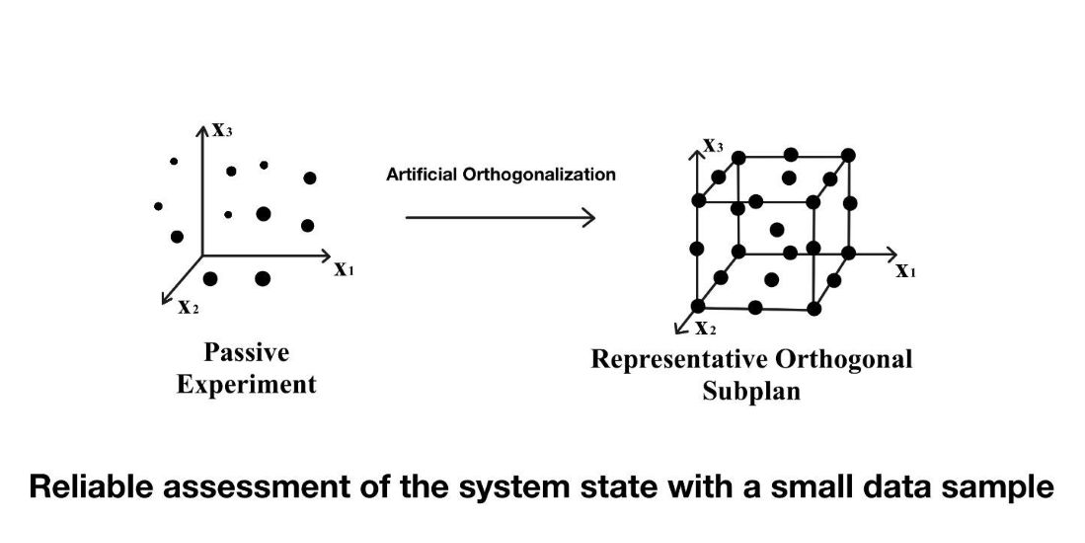
This paper addresses the problem of assessing the state of a multi-element multifactorial stochastic object under conditions of a small sample of fuzzy initial data. Known methods for solving similar problems are ineffective in practical conditions of a small sample of initial data. A real possibility for identifying the relationship between explanatory and explained variables lies in the use of artificial orthogonalization of the results of a passive experiment. In this case, a full factorial experiment design is constructed, the most important property of which is orthogonality. This makes it possible to independently evaluate all the coefficients of the regression equation, which determine the degree of influence of factors and all their interactions on the value of the explained variable. This is achieved through the development of a technology for artificial orthogonalization of a passive experiment and a method for processing the resulting full factorial experiment design. The resulting heterogeneity of the full design is mitigated by finding a truncated representative orthogonal subdesign. The research resulted in a method that enables the calculation of all coefficients of the full regression equation with a small sample of initial data. This method provides a more accurate solution to the problem compared to known methods. The universality of the method lies in the fact that it is implemented in the same way for any set of objective functions. The ability of this method to overcome the computational complexity arising from the large dimensionality of relevant problems allows it to be applied in a wide range of practical areas. The proposed methodology is illustrated step by step by solving an example.
References
- Myśliwiec, P., Kubit, A. (2025). Integrated multiobjective optimization of RFSSW parameters for AA2024-T3 using ANOVA machine learning and NSGA II. Scientific Reports, 15 (1). https://doi.org/10.1038/s41598-025-21941-3
- Kamalov, F., Sulieman, H., Alzaatreh, A., Emarly, M., Chamlal, H., Safaraliev, M. (2025). Mathematical Methods in Feature Selection: A Review. Mathematics, 13 (6), 996. https://doi.org/10.3390/math13060996
- Herren, A., Hahn, P. R. (2022). Statistical Aspects of SHAP: Functional ANOVA for Model Interpretation. arXiv:2208.09970v2. https://doi.org/10.48550/arXiv.2208.09970
- Puliyanda, A., Li, Z., Prasad, V. (2022). Real-time monitoring of reaction mechanisms from spectroscopic data using hidden semi-Markov models for mode identification. Journal of Process Control, 117, 188–205. https://doi.org/10.1016/j.jprocont.2022.07.011
- Tian, X., Wei, G., Wang, J. (2022). Target Location Method Based on Compressed Sensing in Hidden Semi Markov Model. Electronics, 11 (11), 1715. https://doi.org/10.3390/electronics11111715
- Liao, Y., Xiang, Y., Wang, M. (2020). Health Assessment and Prognostics Based on Higher Order Hidden Semi-Markov Models. arXiv:2002.05272. https://doi.org/10.48550/arXiv.2002.05272
- Leemis, L. M. (2023). Statistical Modeling: Regression, Survival Analysis, and Time Series Analysis. Open Educational Resource. https://doi.org/10.21220/SQQ8-A372
- Jarantow, S. W., Pisors, E. D., Chiu, M. L. (2023). Introduction to the Use of Linear and Nonlinear Regression Analysis in Quantitative Biological Assays. Current Protocols, 3 (6). https://doi.org/10.1002/cpz1.801
- Pallavi, Joshi, S., Singh, D., Kaur, M., Lee, H.-N. (2022). Comprehensive Review of Orthogonal Regression and Its Applications in Different Domains. Archives of Computational Methods in Engineering, 29 (6), 4027–4047. https://doi.org/10.1007/s11831-022-09728-5
- Gauss, C. F. (1823). Theoria combinations observationum erroribns minimis obnoxial. H. Dieterich. Available at: https://archive.org/details/bub_gb_ZQ8OAAAAQAAJ/mode/2up
- Janković, A., Chaudhary, G., Goia, F. (2025). Optimization through classical design of experiments (DOE): An investigation on the performance of different factorial designs for multi-objective optimization of complex systems. Journal of Building Engineering, 102, 111931. https://doi.org/10.1016/j.jobe.2025.111931
- Hastie, T., Tibshirani, R., Tibshirani, R. (2020). Best Subset, Forward Stepwise or Lasso? Analysis and Recommendations Based on Extensive Comparisons. Statistical Science, 35 (4), 579–592. https://doi.org/10.1214/19-sts733
- Cheng, J., Sun, J., Yao, K., Xu, M., Cao, Y. (2022). A variable selection method based on mutual information and variance inflation factor. Spectrochimica Acta Part A: Molecular and Biomolecular Spectroscopy, 268, 120652. https://doi.org/10.1016/j.saa.2021.120652
- Kullback, S., Leibler, R. (1951). On information and sufficiency. The annals of Mathematical Statistics, 1, 79–86. Available at: https://www.jstor.org/stable/2236703
- Deldossi, L., Tommasi, C. (2021). Optimal design subsampling from Big Datasets. Journal of Quality Technology, 54 (1), 93–101. https://doi.org/10.1080/00224065.2021.1889418
- Nguyen, N.-K., Stylianou, S., Pham, T.-D., Phuong Vuong, M. (2023). Designs for Screening Experiments with Quantitative Factors. Novel Aspects of Gas Chromatography and Chemometrics. IntechOpen https://doi.org/10.5772/intechopen.106805
- Kuhn, H. W. (1955). The Hungarian method for the assignment problem. Naval Research Logistics Quarterly, 2 (1-2), 83–97. https://doi.org/10.1002/nav.3800020109
Downloads
Published
How to Cite
Issue
Section
License
Copyright (c) 2026 Lev Raskin, Oksana Sira, Larysa Sukhomlyn, Vitalii Vlasenko, Ihor Pryshchepa

This work is licensed under a Creative Commons Attribution 4.0 International License.
The consolidation and conditions for the transfer of copyright (identification of authorship) is carried out in the License Agreement. In particular, the authors reserve the right to the authorship of their manuscript and transfer the first publication of this work to the journal under the terms of the Creative Commons CC BY license. At the same time, they have the right to conclude on their own additional agreements concerning the non-exclusive distribution of the work in the form in which it was published by this journal, but provided that the link to the first publication of the article in this journal is preserved.