Розробка дегідратованого білкового продукту харчування для військовослужбовців
DOI:
https://doi.org/10.15587/2706-5448.2025.326182Ключові слова:
дегідратований харчовий продукт, раціон, НАССР, люпинове борошно, м'ясо-рослинний продукт, військовослужбовці, білокАнотація
Об'єктом дослідження є процес розробки дегідратованого білкового харчового продукту, збагаченого люпиновим борошном, призначеного для харчування військовослужбовців у екстремальних умовах. Використання люпинового борошна є перспективним у технологіях виробництва дегідратованих продуктів. Воно містить більше білка, ніж інші бобові культури, і має менш виражений вплив на органолептичні показники якості готових виробів.
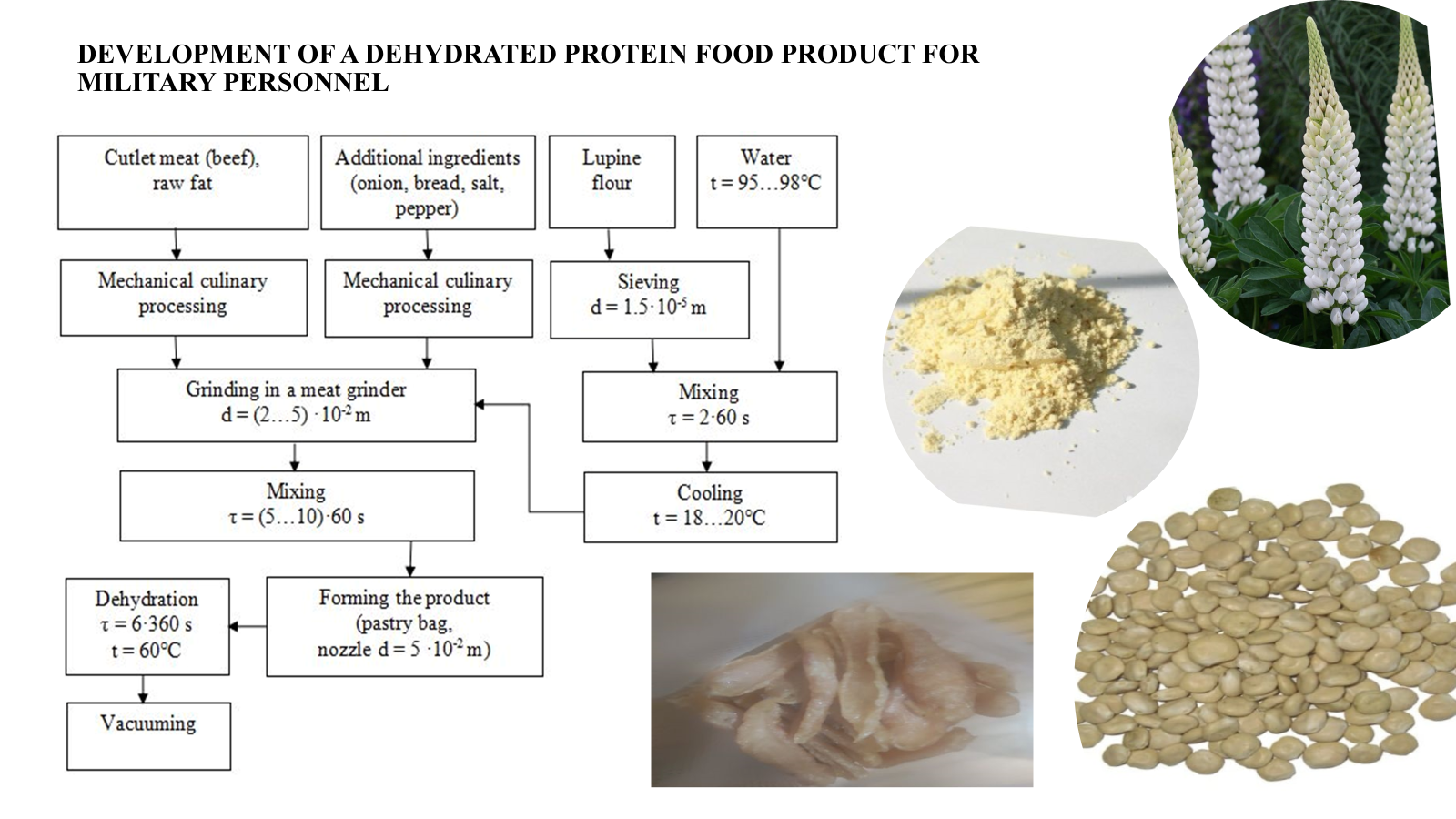
Експериментально доведено, що білий харчовий люпин є збагачувачем білка, який дозволяє отримати комбінований м'ясо-рослинний продукт, збалансований за хімічним складом. Середній вміст білка у люпиновому борошні становить 36–40 % до сухих речовин, що у 3 рази вище, ніж у пшеничному борошні першого сорту і на 2,2 % вище, ніж у соєвому борошні. Розроблено рецептуру м'ясо-рослинного білкового фаршу з 10 % заміною м’яса яловичини. Встановлено, що зі збільшенням вмісту люпинового борошна у фарші вміст білка зростає до 10,3 %. З’ясовано, що м'ясо-рослинний білковий фарш дослідного зразка за смаком, запахом, кольором, консистенцією відповідає контролю, але є кращим за соковитістю та має високу оцінку. Визначено мікроструктуру розробленого м'ясо-рослинного білкового фаршу. Складено технологічну схему виробництва та проведено волонтерську апробацію виробництва дегідратованого харчового продукту в раціоні харчування військовослужбовців. Проведено гігієнічний контроль виробництва продуктів здорового харчування. Експрес-метод гігієнічного контролю якості засвідчив, що показники люмінометра знаходяться у межах норми – 1,356–1,793 RLU – чисто, що підтверджує дотримання гігієнічних норм технологічного процесу.
Розроблено технологію оздоровчого продукту для харчування військовослужбовців у екстремальних умовах. Науково обґрунтовано вплив люпинового борошна на вміст білка у технології м'ясо-рослинного білкового оздоровчого фаршу. Підтверджено можливість впровадження технології у раціон для сухих пайків, згідно Норми № 10 для військовослужбовців.
Посилання
- Hill, N., Fallowfield, J., Price, S., Wilson, D. (2011). Military nutrition: maintaining health and rebuilding injured tissue. Philosophical Transactions of the Royal Society B: Biological Sciences, 366 (1562), 231–240. https://doi.org/10.1098/rstb.2010.0213
- Karl, J. P., Margolis, L. M., Fallowfield, J. L., Child, R. B., Martin, N. M., McClung, J. P. (2021). Military nutrition research: Contemporary issues, state of the science and future directions. European Journal of Sport Science, 22 (1), 87–98. Portico. https://doi.org/10.1080/17461391.2021.1930192
- Sotelo-Díaz, I., Blanco-Lizarazo, C. M. (2019). A systematic review of the nutritional implications of military rations. Nutrition and Health, 25 (2), 153–161. https://doi.org/10.1177/0260106018820980
- Masliichuk, O. B., Simakhina, H. O. (2023). Teoretychni ta praktychni aspekty rozroblennia ratsioniv kharchuvannia dlia viiskovosluzhbovtsiv Zbroinykh Syl Ukrainy v umovakh rosiisko-ukrainskoi viiny. Ozdorovchi kharchovi produkty ta diietychni dobavky: tekhnolohii, yakist ta bezpeka. Kyiv, 132–133.
- Simakhina, G., Naumenko, N., Masliichuk, O. (2023). Functional ingredients of wild berries to include into diets for military personnel. Global science: prospects and innovations. Liverpool, 253–258.
- Lototska-Dudyk, U. B., Krupka, N. O., Breidak, O. A. et al. (2023). Kharchuvannia viiskovosluzhbovtsiv. Lviv-Vinnytsia, 76.
- Lototska-Dudyk, U. B., Krupka, N. O., Chorna, V. V. (2023). The current state and organization of military nutrition of Ukrainian Armed Forces in the conditions of Russian aggression against Ukraine. Scientific Bulletin of the Uzhhorod University. Series “Medicine”, 1 (67), 89–94. https://doi.org/10.32782/2415-8127.2023.67.16
- Dotsenko, V. F., Murzin, A. V. (2015). Do pytannia optymizatsii ratsioniv kharchuvannia viiskovosluzhbovtsiv. Ozdorovchi kharchovi produkty ta diietychni dobavky: tekhnolohii, yakist ta bezpeka. Kyiv, 32–34.
- Chorna, V. V., Krupka, N. O., Lototska-Dudyk, U. B. (2023). Current requirements for the nutrient composition of food and the state of food supply for servicemen of the Armed Forces of Ukraine. Reports of Vinnytsia National Medical University, 27 (2), 313–318. https://doi.org/10.31393/reports-vnmedical-2023-27(2)-23
- Ukrainets, A. I., Simakhina, H. O., Stetsenko, N. O., Naumenko, N. V., Kochubei-Lytvynenko, O. V. (2017). Novi produkty dlia ratsioniv viiskovosluzhbovtsiv. Kyiv: Vydavnytstvo “Stal”, 290.
- McNeill, S. H., Harris, K. B., Field, T. G., Van Elswyk, M. E. (2012). The evolution of lean beef: Identifying lean beef in today’s U.S. marketplace. Meat Science, 90 (1), 1–8. https://doi.org/10.1016/j.meatsci.2011.05.023
- Simakhina, H. O., Ukrainets, A. I. (2010). Innovatsiini tekhnolohii ta produkty: ozdorovche kharchuvannia. Kyiv, 294.
- Pasichnyi, V. M., Simakhina, H. O., Heredchuk, A. M., Zadorozhnii, V. V. (2014). Miasomistki napivfabrykaty kulinarni z miasa ptytsi pidvyshchenoi kharchovoi tsinnosti. Naukovyi visnyk Lvivskoho natsionalnoho universytetu veterynarnoi medytsyny ta biotekhnolohii im. S. Z. Gzhytskoho, 16 (2 (4)), 149–155.
- Pasichnyi, V. M., Heredchuk, A. M., Moroz, O. O., Yastreba, Yu. A. (2015). Doslidzhennia faktoriv prolonhatsii terminiv zberihannia miasnykh i miasomistkykh produktiv. Naukovi pratsi NUKhT, 21 (4), 224–230.
- Andreani, G., Sogari, G., Marti, A., Froldi, F., Dagevos, H., Martini, D. (2023). Plant-Based Meat Alternatives: Technological, Nutritional, Environmental, Market, and Social Challenges and Opportunities. Nutrients, 15 (2), 452. https://doi.org/10.3390/nu15020452
- Azizi, R., Baggio, A., Capuano, E., Pellegrini, N. (2024). Protein transition: focus on protein quality in sustainable alternative sources. Critical Reviews in Food Science and Nutrition, 1–21. https://doi.org/10.1080/10408398.2024.2365339
- Kalenik, T. K., Costa, R., Motkina, E. V., Kosenko, T. A., Skripko, O. V., Kadnikova, I. A. (2017). Technology development of protein rich concentrates for nutrition in extreme conditions using soybean and meat by-products. Acta Scientiarum Polonorum Technologia Alimentaria, 16 (3), 255–268. https://doi.org/10.17306/j.afs.0501
- Otero, D. M., da Rocha Lemos Mendes, G., da Silva Lucas, A. J., Christ-Ribeiro, A., Ribeiro, C. D. F. (2022). Exploring alternative protein sources: Evidence from patents and articles focusing on food markets. Food Chemistry, 394, 133486. https://doi.org/10.1016/j.foodchem.2022.133486
- Paska, M., Masliichuk, O. (2018). Formulation of recipes and refinement of the technology of functional meat chopped semifinished products and chops with the use of protein enrichment. Food Resources, 6 (11), 132–138. https://doi.org/10.31073/foodresources2018-11-15
- Ukrainets, A., Pasichnyi, V., Shvedyuk, D., Matsuk, Y. (2017). Investigation of proteolysis ability of functional destinated minced half-finished meat products. Scientific Messenger of LNU of Veterinary Medicine and Biotechnologies, 19 (75), 129–133. https://doi.org/10.15421/nvlvet7526
- Golovchenko, O. V., Saiko, V. F., Fartushnjak, A. T., Pruidze, G. V. (2000). Sweet white lupin seeds as a source of pectin and protein for human nutrition. Lupin, an ancient crop for the new Millenium. Auburn, 451–452.
- Pavliuchenko, O., Bondar, N., Sots'ka, Y., Lysenko, D. (2018). Fortification of pancakes with high protein lupine flour. Visnyk ahrarnoi nauky Prychornomoria, 2, 102–107.
- Paska, M., Drachuk, U., Masliichuk, O., Vovk, V. (2017). Determining the effect of lupin flour and inula on the flow of metabolic processes in the organism. Eastern-European Journal of Enterprise Technologies, 5 (11 (89)), 34–39. https://doi.org/10.15587/1729-4061.2017.110987
##submission.downloads##
Опубліковано
Як цитувати
Номер
Розділ
Ліцензія
Авторське право (c) 2025 Olia Masliichuk, Halyna Kushniruk

Ця робота ліцензується відповідно до Creative Commons Attribution 4.0 International License.
Закріплення та умови передачі авторських прав (ідентифікація авторства) здійснюється у Ліцензійному договорі. Зокрема, автори залишають за собою право на авторство свого рукопису та передають журналу право першої публікації цієї роботи на умовах ліцензії Creative Commons CC BY. При цьому вони мають право укладати самостійно додаткові угоди, що стосуються неексклюзивного поширення роботи у тому вигляді, в якому вона була опублікована цим журналом, але за умови збереження посилання на першу публікацію статті в цьому журналі.