Розробка текстильних структур з використанням технологій 3D-прототипування
DOI:
https://doi.org/10.15587/2706-5448.2025.327068Ключові слова:
3D прототипування, текстильні конструкції, адитивне виробництво, сферичні з’єднання, псевдотекстиль, гнучкість матеріалуАнотація
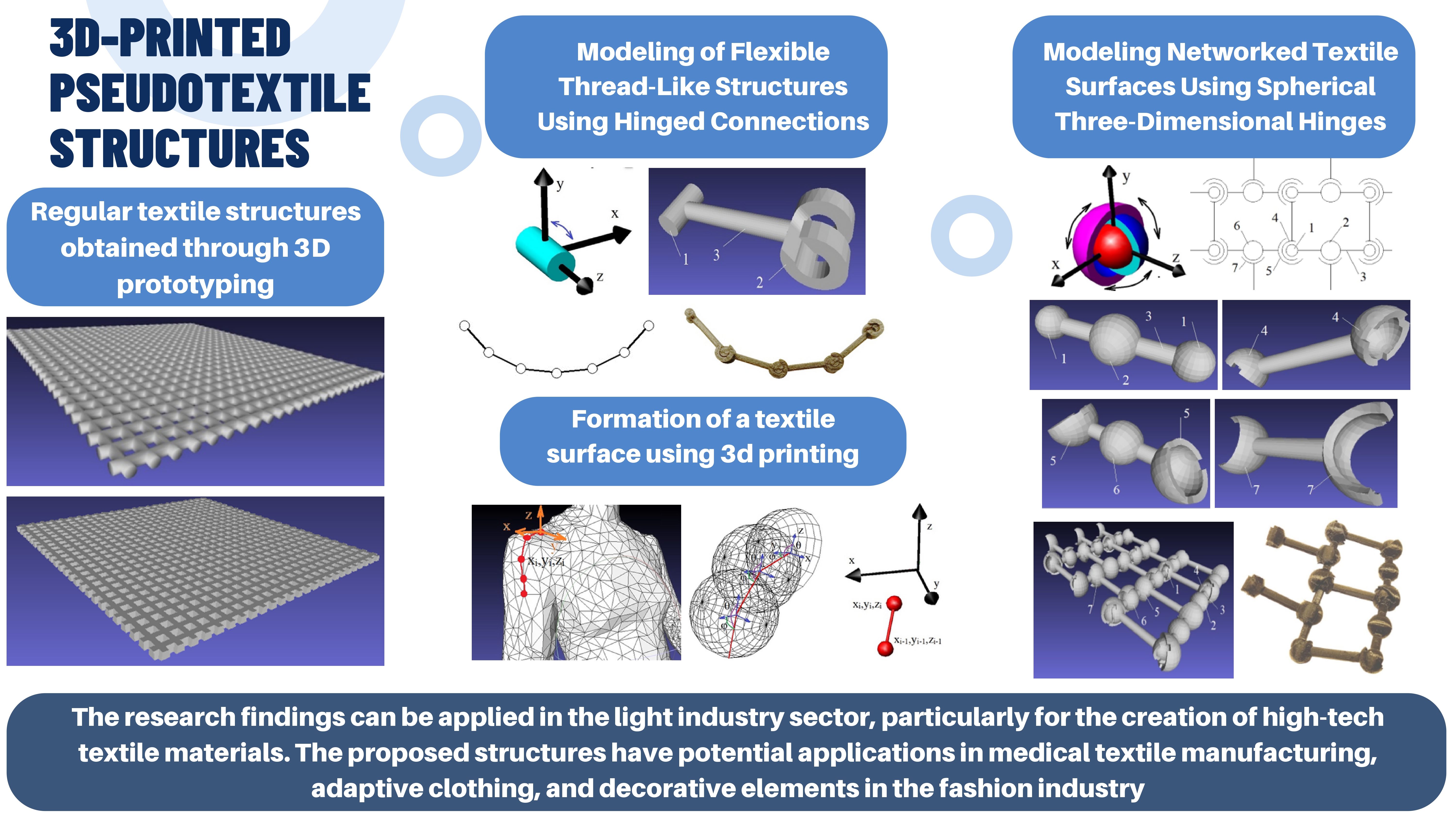
Об’єктом дослідження є псевдотекстильні сітчасті структури з тривимірними шарнірними з’єднаннями, виготовлені методами 3D-прототипування. Одним з головних завдань у сфері 3D-друку текстильних матеріалів є забезпечення їхньої гнучкості, еластичності та адаптивності до форми людського тіла. Матеріали, виготовлені традиційними методами 3D-друку, мають високу жорсткість, що обмежує їх застосування в легкій промисловості. У ході дослідження розроблено концепцію створення псевдотекстильних матеріалів на основі гнучких сітчастих структур з використанням сферичних тривимірних шарнірів. Запропонована структура дозволяє досягти необхідної гнучкості та деформаційної здатності, характерної для традиційних текстильних матеріалів. Моделювання та експериментальні зразки показали, що конструкції з тришаровими шарнірними з’єднаннями забезпечують просторову варіативність форми, а використання ексцентриситету в шарнірах дозволяє регулювати жорсткість конструкцій. Отримані результати можна пояснити використанням трирівневих сферичних шарнірних з’єднань, які забезпечують просторову рухливість окремих елементів конструкції, а також чисельним моделюванням для оптимізації розмірів елементів конструкції. Реалізовані моделі підтверджують, що механічними властивостями синтезованих структур можна керувати шляхом зміни їх геометрії. Розроблені структури можуть бути використані у виробництві одягу, де потрібна висока гнучкість матеріалу, а також у створенні адаптивних текстильних виробів медичного призначення, зокрема для компресійної терапії чи автоматизованого масажу. Крім того, такі матеріали можна використовувати в декоративному оформленні модних виробів завдяки можливості створення унікальних геометричних поверхонь.
Посилання
- Tan, Z., Lin, S., Wang, Z. (2024). Cluster Size Intelligence Prediction System for Young Women’s Clothing Using 3D Body Scan Data. Mathematics, 12 (3), 497. https://doi.org/10.3390/math12030497
- Zheng, J., Potamias, R. A., Zafeiriou, S. (2024). Design2Cloth: 3D Cloth Generation from 2D Masks. 2024 IEEE/CVF Conference on Computer Vision and Pattern Recognition (CVPR), 1748–1758. https://doi.org/10.1109/cvpr52733.2024.00172
- Nayak, R., Singh, A., Padhye, R., Wang, L. (2015). RFID in textile and clothing manufacturing: technology and challenges. Fashion and Textiles, 2 (1). https://doi.org/10.1186/s40691-015-0034-9
- Wang, W., Ho, H.-I., Guo, C., Rong, B., Grigorev, A., Song, J. et al. (2024). 4D-DRESS: A 4D Dataset of Real-World Human Clothing with Semantic Annotations. 2024 IEEE/CVF Conference on Computer Vision and Pattern Recognition (CVPR), 550–560. https://doi.org/10.1109/cvpr52733.2024.00059
- Riabchykov, M., Mytsa, V., Ryabchykova, K. (2024). Artificial Intelligence as a Tool for the Development of Professional Competencies of a Fashion Industry Specialist. Information Technology for Education, Science, and Technics. Cham: Springer, 297–310. https://doi.org/10.1007/978-3-031-71804-5_20
- Balakrishnan, H. K., Alexander, R., Guijt, R. M. (2025). 3D printing of analytical platforms: From prototyping to commercialization. 3D Printing in Analytical Chemistry, 87–100. https://doi.org/10.1016/b978-0-443-15675-5.00004-5
- Polishchuk, A., Slavinska, A., Polishchuk, O., Mytsa, V. (2023). Production of details of difficult designs of footwear and clothes with use of technologies of additive production. World Multidisciplinary Civil Engineering-Architecture-Urban Planning Symposium Wmcaus 2022, 2928, 040009. https://doi.org/10.1063/5.0172971
- Cui, T. Z., Raji, R. K., Han, J. L., Chen, Y. (2024). Application of 3D Printing Technology in Footwear Design and Manufacture – A Review of Developing Trends. Textile & Leather Review, 7, 1304–1321. https://doi.org/10.31881/tlr.2024.151
- Ochoa-V., D., Aroca, I., Lara, P., Paguay, A. (2024). Design for Six Sigma Applied for Adaptive Fashion Design with 3D Printing. Proceedings of the International Conference on Computer Science, Electronics and Industrial Engineering (CSEI 2023), 729–741. https://doi.org/10.1007/978-3-031-70981-4_48
- Vallejo, D. O., Aroca, I., Lara, P., Paguay, A. (2024). Mechanical Testing and Durability Evaluation of 3D Printed Magnetic Closures for Adaptive Fashion. Innovation and Research – Smart Technologies & Systems, 3–14. https://doi.org/10.1007/978-3-031-63437-6_1
- Manaia, J. P., Cerejo, F., Duarte, J. (2023). Revolutionising textile manufacturing: a comprehensive review on 3D and 4D printing technologies. Fashion and Textiles, 10 (1). https://doi.org/10.1186/s40691-023-00339-7
- Vuruskan, A., Ashdown, S. P. (2024). Comparison of actual and virtual pressure of athletic clothing in active poses. International Journal of Clothing Science and Technology, 37 (1), 1–21. https://doi.org/10.1108/ijcst-02-2024-0036
- Riabchykov, M., Mytsa, V., Bondarenko, M., Popova, T., Nechipor, S., Nikulina, A., Bondarenko, S. (2023). Formation of complex 3d surfaces scans for garment cad. Fibres and Textiles, 30 (3), 13–18. https://doi.org/10.15240/tul/008/2023-3-002
- Moustafa, S., Sultan, J., Wang, S., Nabil, S. (2024). Fabric-Lego: 3D-Printing Fabric-Based Lego-Compatible Designs for Assistive Wearables, Personalization, and Self-Expression. Designing Interactive Systems Conference, 209–213. https://doi.org/10.1145/3656156.3663705
- Park, S., Kim, D.-E. (2022). The application of 3D printing technology for developing a lumbar support garment for obese women. Textile Research Journal, 93 (7-8), 1712–1733. https://doi.org/10.1177/00405175221125944
- Riabchykov, M., Nazarchuk, L., Tkachuk, O., Stytsyuk, V. (2023). Creation of smart compression garment using magnetic nanotextiles. Research Journal of Textile and Apparel, 28 (4), 765–781. https://doi.org/10.1108/rjta-08-2022-0095
- Tufan Tolmaç, N., İşmal, Ö. E. (2023). A new era: 3D printing as an aesthetic language and creative tool in fashion and textile design. Research Journal of Textile and Apparel, 28 (4), 656–670. https://doi.org/10.1108/rjta-05-2022-0058
- Riabchykov, M., Mytsa, V., Tkachuk, O., Pakholiuk, O., Melnyk, D. (2024). Efficiency of Protective Textile Smart Systems Using Electronic Tags. Integrated Computer Technologies in Mechanical Engineering – 2023, 189–197. https://doi.org/10.1007/978-3-031-61415-6_16
- Zhang, M., Guo, Q., Li, Z., Zhou, Y., Zhao, S., Tong, Z. et al. (2023). Processable circularly polarized luminescence material enables flexible stereoscopic 3D imaging. Science Advances, 9 (43). https://doi.org/10.1126/sciadv.adi9944
- Dorsey, K. L., Roberts, S. F., Forman, J., Ishii, H. (2022). Analysis of DefeXtiles: a 3D printed textile towards garments and accessories. Journal of Micromechanics and Microengineering, 32 (3), 034005. https://doi.org/10.1088/1361-6439/ac4fad
- Yang, L., Meng, J., Wang, Y., Gao, X., Shi, G., Xue, T., Zhi, C. (2024). Direct ink writing-based cotton integration for enhanced mechanical and functional characteristics in 3D printed fabrics. Cellulose, 31 (4), 2685–2702. https://doi.org/10.1007/s10570-024-05742-x
- Li, S. (2024). Development and application of fused deposition molding 3D printing technology in textile and fashion design. Journal of Engineered Fibers and Fabrics, 19. https://doi.org/10.1177/15589250241266977
- Lekeckas, K., Stirbe, J., Ancutiene, K., Valusyte, R. (2023). Testing of 3D printing on textile fabrics for garments application within circular design. International Journal of Clothing Science and Technology, 35 (4), 627–647. https://doi.org/10.1108/ijcst-06-2022-0080
- He, C. (2024). Application and Development of 3D Printing Technology in Clothing Design. Applied Mathematics and Nonlinear Sciences, 9 (1). https://doi.org/10.2478/amns-2024-1199
- Wong, Y., Ho, C., Kan, C. (2024). Performance of Fused Deposition Modeling 3D Printed Fabric with Different Structures. 3D Printing and Additive Manufacturing. https://doi.org/10.1089/3dp.2023.0254
- Xiao, Y.-Q., Kan, C.-W. (2022). Review on Development and Application of 3D-Printing Technology in Textile and Fashion Design. Coatings, 12 (2), 267. https://doi.org/10.3390/coatings12020267
- Spahiu, T., Zlatev, Z., Ibrahimaj, E., Ilieva, J., Shehi, E. (2022). Drape of Composite Structures Made of Textile and 3D Printed Geometries. Machines, 10 (7), 587. https://doi.org/10.3390/machines10070587
- Sun, N., Mu, X., Zhao, K. (2024). Application of 3D Printing Technology in Customized Garment Production. Applied Mathematics and Nonlinear Sciences, 9 (1). https://doi.org/10.2478/amns-2024-1662
- Jung, J. Y., Chee, S., Sul, I. (2023). Prediction of optimal 3D printing orientation using vertically sparse voxelization and modified support structure tomography. International Journal of Clothing Science and Technology, 35 (5), 799–832. https://doi.org/10.1108/ijcst-04-2023-0041
- Wu, M., Zhi, C., Tu, L., Wang, Y., Dai, Y., Yu, L., Meng, J., He, X. (2021). Cotton-containing printing wires based on the two-dimensional braiding method for three-dimensional printing of clothing. Textile Research Journal, 92 (9-10), 1384–1393. https://doi.org/10.1177/00405175211059208
- Orlik, J., Neusius, D., Chakrabortty, A., Backes, S., Gries, T., Steiner, K. (2025). Modelling of flat pre-strain driven structures, folding to desired surface and application to 3D-printing on textiles. International Journal of Engineering Science, 208, 104201. https://doi.org/10.1016/j.ijengsci.2024.104201
- Liu, Z., Dong, F., Li, F. (2024). Numerical and experimental investigations on influence of spherical hinge mandrel on deformation characteristics of large diameter tube in small-radius NC rotary bending. The International Journal of Advanced Manufacturing Technology, 134 (11-12), 6001–6018. https://doi.org/10.1007/s00170-024-14537-0
- Guo, W., Yu, Y., Huang, M., Yang, J., Chen, W. (2024). Installation Accuracy Detection Method of Spherical Hinge Structure Based on 3D Point Cloud Registration. CICTP 2024, 3709–3719. https://doi.org/10.1061/9780784485484.353
##submission.downloads##
Опубліковано
Як цитувати
Номер
Розділ
Ліцензія
Авторське право (c) 2025 Viktoriia Mytsa, Mykola Riabchykov, Tetyana Popova, Anastasiia Nikulinа

Ця робота ліцензується відповідно до Creative Commons Attribution 4.0 International License.
Закріплення та умови передачі авторських прав (ідентифікація авторства) здійснюється у Ліцензійному договорі. Зокрема, автори залишають за собою право на авторство свого рукопису та передають журналу право першої публікації цієї роботи на умовах ліцензії Creative Commons CC BY. При цьому вони мають право укладати самостійно додаткові угоди, що стосуються неексклюзивного поширення роботи у тому вигляді, в якому вона була опублікована цим журналом, але за умови збереження посилання на першу публікацію статті в цьому журналі.