Оптимізація технологічних режимів ваграночної плавки за критерієм максимуму температури горіння
DOI:
https://doi.org/10.15587/2706-5448.2025.328992Ключові слова:
ваграночна плавка, температура горіння у вагранці, температура підігріву повітря, повнота згоряння паливаАнотація
Об'єктом дослідження була температура горіння у вагранці. Досліджувана проблема полягала в складності прогнозування температури в функції керуючих параметрів плавки.
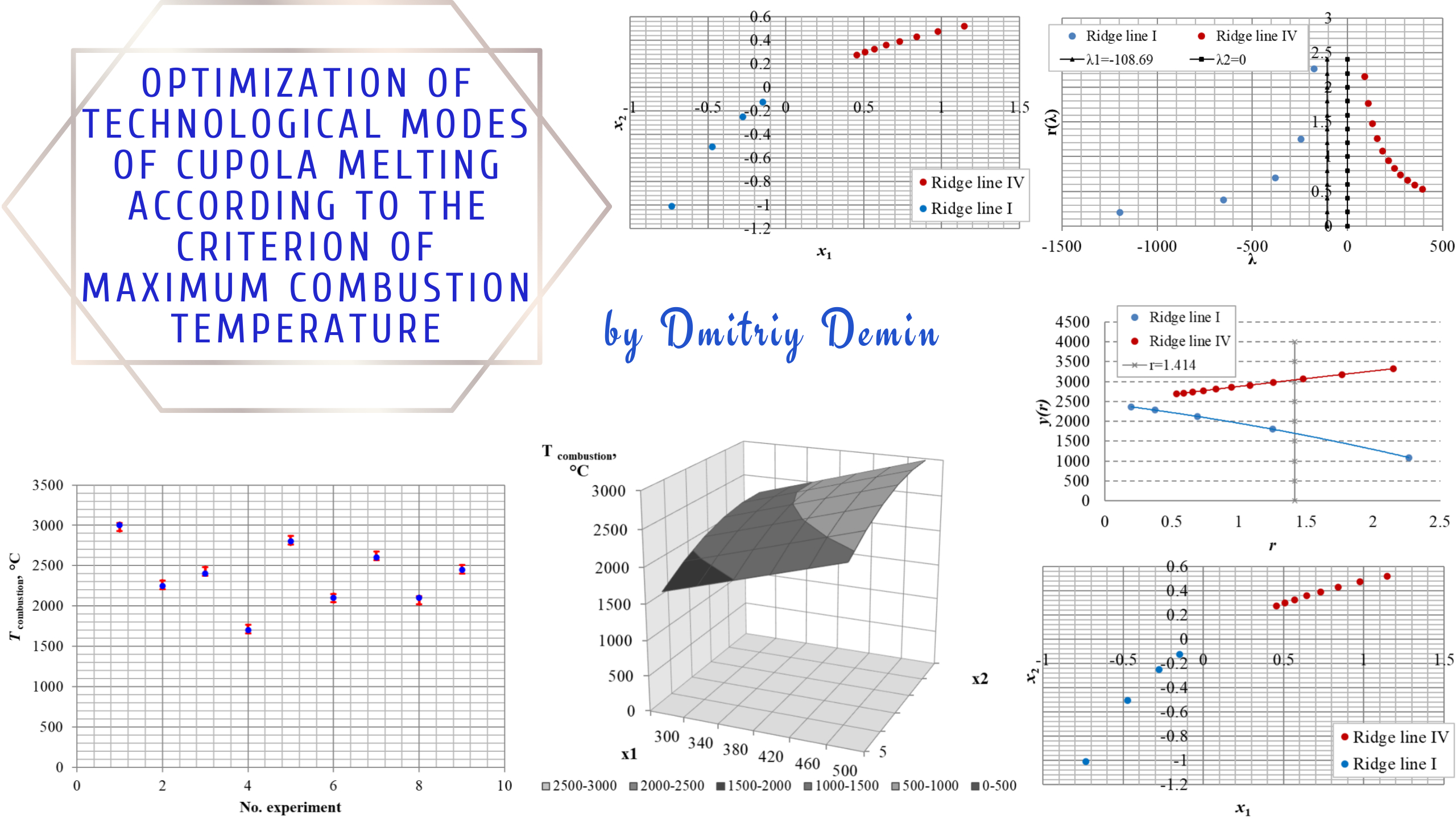
У дослідженні керуючими параметрами обрано температура підігріву повітря, що вдується в фурми, та повнота згоряння палива. Використовуючи ортогональне планування експерименту, було побудовано математичну модель у вигляді поліному другого порядку, що дозволила виявити закономірності впливу кожного керуючого чинника на результуючу величину – температуру горіння.
Отримана математична модель дозволила виявити, що обидві вхідні змінні є значущими. Однак якщо характер впливу температури підігріву повітря на температуру горіння є лінійним, то повнота згоряння впливає нелінійно. Точність моделі виявилася задовільною, бо усі експериментальні дані лягли всередину довірчих інтервалів з довірчою ймовірністю Р=0.99. Це дозволяє стверджувати про можливість використання побудованої моделі для прогнозування температури горіння в межах області планування.
Гребеневим аналізом поверхні відгуку встановлено, що теоретичне максимальне значення температури горіння на межі області планування складає близько 3000 °C. Це відповідає значенням вхідних змінних Tair≈1120 °C та η0 ≈82 %. Однак через те, що забезпечення температури підігріву повітря на рівні 1120 °C може стикатися із технічною складністю реалізації, можуть бути рекомендовані такі значення вхідних змінних: Tair=783–1060 °C, η0=71–80. Вони забезпечують температури горіння в інтервалі 2690–2980 °C, тобто значення, близькі до субоптимального, визначеного гребеневим аналізом.
Ці дані дозволяють вносити корективи у процес плавки, у тому числі використовуватись для подальшого пошуку оптимального керування плавкою. Отримані рішення можуть бути використані в чавуноливарних цехах промислових підприємств, оснащених вагранками.
Посилання
- Nwajagu, C. O., Ilochonwu, C. E. (2015). Understanding the Technology of Cupola Operation and Management Using Local Fabricated Cupola. NMS.
- Edward, K. (2008). Cupola Furnace – A Practical Treatise on the Construction and Management of Foundry Cupolas. Philadelphia.
- Olorunnishola, A. A. G., Anjorin, S. A. (2019). Development of a Statistical Model for the Effects of Air Blast Pressure, Melting Time and Fuel Consumed on Iron Melting Rate of an Erythrophleum Suave lens Charcoal-Fired Cupola Furnace. Journal of Physics: Conference Series, 1378 (4), 042026. https://doi.org/10.1088/1742-6596/1378/4/042026
- Abdelrahman, M., Kandasamy, P., Frolik, J. (2000). A methodology for the fusion of redundant sensors. Proceedings of the 2000 American Control Conference. ACC, 4, 2922–2926. https://doi.org/10.1109/acc.2000.878745
- Ochejah, Y. Y., Cyril, O., Omaone, I. F., Ogwudubi, A. F., Onakemu, O. A. (2021). Cupola Furnace Design and Fabrication for Industrial Development. International Journal of Scientific Advances, 2 (2), 102–106. https://doi.org/10.51542/ijscia.v2i2.3
- Stefanescu, D. M. (Ed.) (2017). Cast Iron Melting Furnaces. Cast Iron Science and Technology. ASM International, 121–145. https://doi.org/10.31399/asm.hb.v01a.a0006337
- PhaniShankar, C. V., Orth, S., Frolik, J., Abdelrahman, M. (2000). Fuzzy rules for automated sensor self-validation and confidence measure. Proceedings of the 2000 American Control Conference. ACC, 4, 2912–2916. https://doi.org/10.1109/acc.2000.878743
- Luis, C. J., Álvarez, L., Ugalde, M. J., Puertas, I. (2002). A technical note cupola efficiency improvement by increasing air blast temperature. Journal of Materials Processing Technology, 120 (1-3), 281–289. https://doi.org/10.1016/s0924-0136(01)01053-6
- O’Brien, W. A., Ohio, F. (1948). Pat. No. 2 443 960 USA. Control means for cupola furnaces. Serial No. 525,686 5 Claims (CI. 266–30). Available at: https://patents.google.com/patent/US2443960A/en
- Isnugroho, K., Birawidha, D. C. (2018). The production of pig iron from crushing plant waste using hot blast cupola. Alexandria Engineering Journal, 57 (1), 427–433. https://doi.org/10.1016/j.aej.2016.11.004
- Jezierski, J., Janerka, K. (2011). Selected Aspects of Metallurgical and Foundry Furnace Dust Utilization. Polish Journal of Environmental Studies, 20 (1), 101–105.
- Ristiana, R., Yunus, Ir. M. (2009). Temperature control of cupola melting. International Conference on Instrumentation, Communication, Information Technology, and Biomedical Engineering 2009, 1–5. https://doi.org/10.1109/icici-bme.2009.5417241
- Mahmoud, W. H., Abdelrahman, M., Haggard, R. L. (2004). Field programmable gate arrays implementation of automated sensor self-validation system for cupola furnaces. Computers & Industrial Engineering, 46 (3), 553–569. https://doi.org/10.1016/j.cie.2004.02.001
- Ristiana, R., Nurjaman, F., Yunus, M. (2013). Fuzzy Temperature Control for Melting Metals of Mini Cupola Furnaces. Research on Precision Instrument and Machinery, 2 (2), 30–35. Available at: https://www.academia.edu/27930776/Fuzzy_Temperature_Control_for_Melting_Metals_of_Mini_Cupola_Furnaces
- Lazzarin, R. M., Noro, M. (2015). Energy efficiency opportunities in the production process of cast iron foundries: An experience in Italy. Applied Thermal Engineering, 90, 509–520. https://doi.org/10.1016/j.applthermaleng.2015.07.028
- Demin, D., Frolova, L. (2024). Construction of a logical-probabilistic model of casting quality formation for managing technological operations in foundry production. EUREKA: Physics and Engineering, 6, 104–118. https://doi.org/10.21303/2461-4262.2024.003518
- Demin, D. (2023). Improving technology for manufacturing casting case of truck clutch release cylinder. ScienceRise, 2, 3–26. https://doi.org/10.21303/2313-8416.2023.003194
- Demin, D. (2019). Development of «whole» evaluation algorithm of the control quality of «cupola – mixer» melting duplex process. Technology Audit and Production Reserves, 3 (1 (47)), 4–24. https://doi.org/10.15587/2312-8372.2019.174449
- Demin, D. (2023). Experimental and industrial method of synthesis of optimal control of the temperature region of cupola melting. EUREKA: Physics and Engineering, 2, 68–82. https://doi.org/10.21303/2461-4262.2023.002804
- Demin, D. (2013). Adaptive modeling in problems of optimal control search termovremennoy cast iron. Eastern-European Journal of Enterprise Technologies, 6 (4 (66)), 31–37. https://doi.org/10.15587/1729-4061.2013.19453
- Demin, D., Domin, O. (2021). Adaptive technology for constructing the kinetic equations of reduction reactions under conditions of a priori uncertainty. EUREKA: Physics and Engineering, 4, 14–29. https://doi.org/10.21303/2461-4262.2021.001959
- Demin, D. (2014). Mathematical description typification in the problems of synthesis of optimal controller of foundry technological parameters. Eastern-European Journal of Enterprise Technologies, 1 (4 (67)), 43–56. https://doi.org/10.15587/1729-4061.2014.21203
- Nikolaiev, D. (2024). Construction of a cupola information profile for further modeling for the purpose of controlling melting processes. ScienceRise, 2, 3–14. https://doi.org/10.21303/2313-8416.2024.003674
- Nikolaiev, D., Selivorstov, V., Dotsenko, Y., Dzevochko, O., Pereverzieva, A., Dzevochko, A. (2025). Identification of temperature in cupola furnace based on the construction of the “slag composition – slag viscosity” model. Technology Audit and Production Reserves, 1 (1 (81)), 29–33. https://doi.org/10.15587/2706-5448.2025.322458
- Demin, D. (2020). Constructing the parametric failure function of the temperature control system of induction crucible furnaces. EUREKA: Physics and Engineering, 6, 19–32. https://doi.org/10.21303/2461-4262.2020.001489
- Stanovska, I., Duhanets, V., Prokopovych, L., Yakhin, S. (2021). Classification rule for determining the temperature regime of induction gray cast iron. EUREKA: Physics and Engineering, 1, 60–66. https://doi.org/10.21303/2461-4262.2021.001604
- Jopkiewicz, A., Podrzucki, C. (2007). Tendencies to the Improvement of the Cupola Process. Archives of foundry engineering, 13 (3), 61–70.
- Powell, W. L., Druschitz, A. P., Frost, J. (2008). Cupola Furnaces. Casting, 99–107. https://doi.org/10.31399/asm.hb.v15.a0005197
- Demin, D. (2025). Optimization of parameters of the cupola melting by the criterion of the maximum cast iron temperature. EUREKA: Physics and Engineering, 2, 158–165. https://doi.org/10.21303/2461-4262.2025.003712
- Demin, D. (2025). Determination of the heat-loaded zone of the cupola furnace and the level of the idle chargebased on the construction of an analytical description of the physical and chemical parameters of the melting. EUREKA: Physics and Engineering, 3, 00–00. https://doi.org/10.21303/2461-4262.2025.003771
- Larsen, E. D., Clark, D. E., Moore, K. L., King, P. E. (1997). Intelligent control of Cupola Melting. Available at: https://pdfs.semanticscholar.org/56c2/96af1d56d5cd963a5bcc38635142e5fa1968.pdf
- Domin, D., Lunin, D., Domina, O., Komyshan, A., Veski Saparali, K., Osadchyi, V.; Domin, D. (Ed.) (2022). The technology of scientific and practical communications: InGraph case study. Tallinn: Scientific Route OÜ, 184. https://doi.org/10.21303/978-9916-9516-9-9
- Domina, O. (2020). Selection of alternative solutions in the optimization problem of network diagrams of project implementation. Technology Audit and Production Reserves, 4 (4 (54)), 9–22. https://doi.org/10.15587/2706-5448.2020.210848
- Domina, O. (2020). Features of finding optimal solutions in network planning. EUREKA: Physics and Engineering, 6, 82–96. https://doi.org/10.21303/2461-4262.2020.001471
- Domina, O. (2021). Solution of the compromise optimization problem of network graphics on the criteria of uniform personnel loading and distribution of funds. Technology Audit and Production Reserves, 1 (4 (57)), 14–21. https://doi.org/10.15587/2706-5448.2021.225527
- Nieto-Delgado, C., Cannon, F. S., Paulsen, P. D., Furness, J. C., Voigt, R. C., Pagnotti, J. R. (2014). Bindered anthracite briquettes as fuel alternative to metallurgical coke: Full scale performance in cupola furnaces. Fuel, 121, 39–47. https://doi.org/10.1016/j.fuel.2013.12.034
##submission.downloads##
Опубліковано
Як цитувати
Номер
Розділ
Ліцензія
Авторське право (c) 2025 Dmitriy Demin

Ця робота ліцензується відповідно до Creative Commons Attribution 4.0 International License.
Закріплення та умови передачі авторських прав (ідентифікація авторства) здійснюється у Ліцензійному договорі. Зокрема, автори залишають за собою право на авторство свого рукопису та передають журналу право першої публікації цієї роботи на умовах ліцензії Creative Commons CC BY. При цьому вони мають право укладати самостійно додаткові угоди, що стосуються неексклюзивного поширення роботи у тому вигляді, в якому вона була опублікована цим журналом, але за умови збереження посилання на першу публікацію статті в цьому журналі.