Визначення оптимальних режимів роботи системи селективного каталітичного відновлення випускних газів суднових дизелів
DOI:
https://doi.org/10.15587/2706-5448.2025.340411Ключові слова:
екологічні показники, морський транспорт, очищення випускних газів, судновий дизель, система каталітичного відновленняАнотація
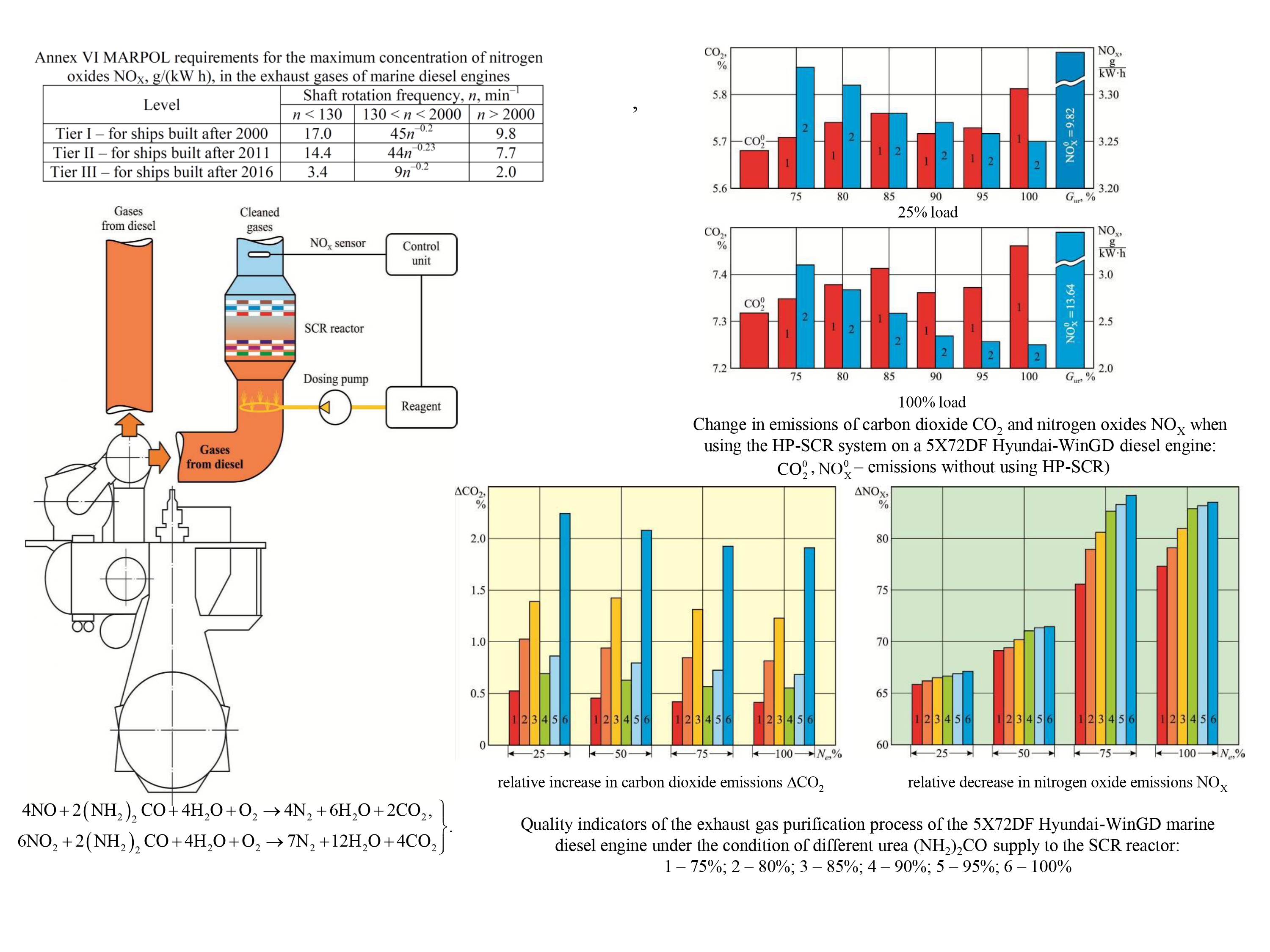
Як об’єкт дослідження процес забезпечення мінімального рівня емісії діоксиду вуглецю під час використання селективного каталітичного відновлення випускних газів від оксидів азоту. Зазначено, що системи каталітичного відновлення забезпечують найбільш ефективне очищення випускних газів від оксидів азоту. Одночасно з цим, через використання в цих системах сечовини як реагенту, збільшується емісія діоксиду вуглецю. Через це підвищується парниковий ефект та знижується енергоефективність судна. Наведені в роботі результати досліджень виконувались на судні класу Gas Carrier водотоннажністю 127645 тонн з двома головними двигунами 5X72DF Hyundai-WinGD та трьома допоміжними двигунами 6H35DF Hyundai-HiMSEN. Дизелі 5X72DF Hyundai-WinGD були обладнані системою каталітичного відновлення високого тиску, дизелі 6H35DF Hyundai-HiMSEN – системою каталітичного відновлення низького тиску. Експериментально встановлено, що серед рекомендованого діапазону подачі сечовини в систему каталітичного відновлення випускних газів існують оптимальні режимі, на яких забезпечуються мінімальне підвищення емісії діоксиду вуглецю з одночасним підтриманням високого рівню зниження емісії оксидів азоту. На цих режимах відносне збільшення емісії діоксиду вуглецю не перевищує 2.3% для обох типів дизелів. Емісія оксиду азоту для дизелів 5X72DF Hyundai-WinGD не перевищує 3.3 g/(kW × h) та не перевищує 2.4 g/(kW h) для дизелів 6H35DF Hyundai-HiMSEN, що відповідає вимогам Annex VI MARPOL. Відносне зниження емісії оксидів азоту на цих режимах складає 66.7–83.4% для дизеля 5X72DF Hyundai-WinGD та 60.8–78.3% для дизеля 6H35DF Hyundai-HiMSEN. Збіг отриманих значень для малообертового дизеля 5X72DF Hyundai-WinGD та середньообертового 6H35DF Hyundai-HiMSEN свідчить про коректність проведення досліджень та можливість імплементації їх результатів на всі типи дизелів та системи каталітичного відновлення.
Посилання
- Kolegaev, M., Brazhnik, I. (2024). Improvement of the process of preparing cargo tanks of crude oil tankers for cargo operations. Technology Audit and Production Reserves, 6 (1 (80)), 36–40. https://doi.org/10.15587/2706-5448.2024.318534
- Matieiko, O. (2024). Selection of optimal schemes for the inerting process of cargo tanks of gas carriers. Technology Audit and Production Reserves, 4 (1 (78)), 43–50. https://doi.org/10.15587/2706-5448.2024.310699
- Maryanov, D. (2021). Development of a method for maintaining the performance of drilling fluids during transportation by Platform Supply Vessel. Technology Audit and Production Reserves, 5 (2 (61)), 15–20. https://doi.org/10.15587/2706-5448.2021.239437
- Maryanov, D. (2022). Reduced energy losses during transportation of drilling fluid by Platform Supply Vessels. Technology Audit and Production Reserves, 2 (1 (64)), 42–50. https://doi.org/10.15587/2706-5448.2022.256473
- Fomin, O., Lovska, A., Kučera, P., Píštěk, V. (2021). Substantiation of Improvements for the Bearing Structure of an Open Car to Provide a Higher Security during Rail/Sea Transportation. Journal of Marine Science and Engineering, 9 (8), 873. https://doi.org/10.3390/jmse9080873
- Vladov, S., Shmelov, Y., Yakovliev, R. (2022). Optimization of Helicopters Aircraft Engine Working Process Using Neural Networks Technologies. CEUR Workshop Proceedings, 3171, 1639–1656. Available at: https://ceur-ws.org/Vol-3171/paper117.pdf
- Madey, V. (2022). Assessment of the efficiency of biofuel use in the operation of marine diesel engines. Technology Audit and Production Reserves, 2 (1 (64)), 34–41. https://doi.org/10.15587/2706-5448.2022.255959
- Budashko, V., Sandler, A., Shevchenko, V. (2022). Diagnosis of the Technical Condition of High-tech Complexes by Probabilistic Methods. TransNav, the International Journal on Marine Navigation and Safety of Sea Transportation, 16 (1), 105–111. https://doi.org/10.12716/1001.16.01.11
- Sagin, S., Sagin, A., Zablotskyi, Y., Fomin, O., Píštěk, V., Kučera, P. (2025). Method for Maintaining Technical Condition of Marine Diesel Engine Bearings. Lubricants, 13 (4), 146. https://doi.org/10.3390/lubricants13040146
- Sagin, S., Haichenia, O., Karianskyi, S., Kuropyatnyk, O., Razinkin, R., Sagin, A. et al. (2025). Improving Green Shipping by Using Alternative Fuels in Ship Diesel Engines. Journal of Marine Science and Engineering, 13 (3), 589. https://doi.org/10.3390/jmse13030589
- Sagin, S. V., Kuropyatnyk, O. A., Zablotskyi, Y. V., Gaichenia, O. V. (2022). Supplying of Marine Diesel Engine Ecological Parameters. Naše More, 69 (1), 53–61. https://doi.org/10.17818/nm/2022/1.7
- Khlopenko, M., Gritsuk, I., Sharko, O., Appazov, E. (2024). Increasing the accuracy of the vessel’s course orientation. Technology Audit and Production Reserves, 1 (2 (75)), 25–30. https://doi.org/10.15587/2706-5448.2024.298518
- Budashko, V., Shevchenko, V. (2021). Solving a task of coordinated control over a ship automated electric power system under a changing load. Eastern-European Journal of Enterprise Technologies, 2 (2 (110)), 54–70. https://doi.org/10.15587/1729-4061.2021.229033
- Ma, Z., Du, T., Duan, S., Qu, H., Wang, K., Xing, H. et al. (2023). Analysis of Exhaust Pollutants from Four-Stroke Marine Diesel Engines Based on Bench Tests. Journal of Marine Science and Engineering, 11 (2), 413. https://doi.org/10.3390/jmse11020413
- Wang, F., Zhao, J., Li, T., Guan, P., Liu, S., Wei, H. et al. (2025). Research on NOx Emissions Testing and Optimization Strategies for Diesel Engines Under Low-Load Cycles. Atmosphere, 16 (2), 190. https://doi.org/10.3390/atmos16020190
- Wang, Z., Ma, Q., Zhang, Z., Li, Z., Qin, C., Chen, J. et al. (2023). A Study on Monitoring and Supervision of Ship Nitrogen-Oxide Emissions and Fuel-Sulfur-Content Compliance. Atmosphere, 14 (1), 175. https://doi.org/10.3390/atmos14010175
- Sagin, S., Sagin, A. (2023). Development of method for managing risk factors for emergency situations when using low-sulfur content fuel in marine diesel engines. Technology Audit and Production Reserves, 5 (1 (73)), 37–43. https://doi.org/10.15587/2706-5448.2023.290198
- Kong, K.-J., Hwang, S.-C. (2024). Development and Performance Evaluation Experiment of a Device for Simultaneous Reduction of SOx and PM. Energies, 17 (13), 3337. https://doi.org/10.3390/en17133337
- Golovan, A., Gritsuk, I., Honcharuk, I. (2024). Reliable Ship Emergency Power Source: A Monte Carlo Simulation Approach to Optimize Remaining Capacity Measurement Frequency for Lead-Acid Battery Maintenance. SAE International Journal of Electrified Vehicles, 13 (2), 179–189. https://doi.org/10.4271/14-13-02-0009
- Melnyk, O., Fomin, O., Shumylo, O., Yarovenko, V., Jurkovič, M., Ocheretna, V.; Babak, V., Zaporozhets, A. (Eds.) (2025). Simulation of the Interrelationship Between Energy Efficiency and Ship Safety Based on Empirical Data and Regression Analysis. Systems, Decision and Control in Energy VII. Cham: Springer, 277–293. https://doi.org/10.1007/978-3-031-90462-2_16
- Sagin, S., Kuropyatnyk, O., Matieiko, O., Razinkin, R., Stoliaryk, T., Volkov, O. (2024). Ensuring Operational Performance and Environmental Sustainability of Marine Diesel Engines through the Use of Biodiesel Fuel. Journal of Marine Science and Engineering, 12 (8), 1440. https://doi.org/10.3390/jmse12081440
- Sagin, S. V., Karianskyi, S., Sagin, S. S., Volkov, O., Zablotskyi, Y., Fomin, O. et al. (2023). Ensuring the safety of maritime transportation of drilling fluids by platform supply-class vessel. Applied Ocean Research, 140, 103745. https://doi.org/10.1016/j.apor.2023.103745
- Sagin, S. V., Kuropyatnyk, O. A. (2018). The Use of Exhaust Gas Recirculation for Ensuring the Environmental Performance of Marine Diesel Engines. Naše More, 65 (2), 78–86. https://doi.org/10.17818/nm/2018/2.3
- International Convention for the Prevention of Pollution from Ships (MARPOL). International Maritime Organization. Available at: https://www.imo.org/en/about/Conventions/Pages/International-Convention-for-the-Prevention-of-Pollution-from-Ships-(MARPOL).aspx Last accessed: 23.09.2025
- Varbanets, R., Fomin, O., Píštěk, V., Klymenko, V., Minchev, D., Khrulev, A. et al. (2021). Acoustic Method for Estimation of Marine Low-Speed Engine Turbocharger Parameters. Journal of Marine Science and Engineering, 9 (3), 321. https://doi.org/10.3390/jmse9030321
- Vladov, S., Shmelov, Y., Yakovliev, R., Stushchankyi, Y., Havryliuk, Y. (2023). Neural Network Method for Controlling the Heli-copters Turboshaft Engines Free Turbine Speed at Flight Modes. CEUR Workshop Proceedings, 3426, 89–108. Available at: https://ceur-ws.org/Vol-3426/paper8.pdf
- Zhevzhyk, O., Potapchuk, I., Horiachkin, V., Raksha, S., Bosyi, D., Reznyk, A. (2025). Mathematical modelling of mixture formation in the combustion chamber of a diesel engine. Technology Audit and Production Reserves, 2 (1 (82)), 63–68. https://doi.org/10.15587/2706-5448.2025.326746
- Wang, W., Wang, G., Wang, Z., Lei, J., Huang, J., Nie, X. et al. (2022). Optimization of Miller Cycle, EGR, and VNT on Performance and NOx Emission of a Diesel Engine for Range Extender at High Altitude. Energies, 15 (23), 8817. https://doi.org/10.3390/en15238817
- Lee, J.-U., Hwang, S.-C., Han, S.-H. (2023). Numerical and Experimental Study on NOx Reduction According to the Load in the SCR System of a Marine Boiler. Journal of Marine Science and Engineering, 11 (4), 777. https://doi.org/10.3390/jmse11040777
- Fischer, D., Vith, W., Unger, J. L. (2024). Assessing Particulate Emissions of Novel Synthetic Fuels and Fossil Fuels under Different Operating Conditions of a Marine Engine and the Impact of a Closed-Loop Scrubber. Journal of Marine Science and Engineering, 12 (7), 1144. https://doi.org/10.3390/jmse12071144
- Wang, W., Li, Z., Ji, X., Wang, Y., Wang, X. (2024). Water Injection for Cloud Cavitation Suppression: Analysis of the Effects of Injection Parameters. Journal of Marine Science and Engineering, 12 (8), 1277. https://doi.org/10.3390/jmse12081277
- Amoresano, A., Langella, G., Iodice, P., Roscioli, S. (2023). Numerical Analysis of SO2 Absorption inside a Single Water Drop. Atmosphere, 14 (12), 1746. https://doi.org/10.3390/atmos14121746
- Ershov, M. A., Grigorieva, E. V., Abdellatief, T. M. M., Kapustin, V. M., Abdelkareem, M. A., Kamil, M. et al. (2021). Hybrid low-carbon high-octane oxygenated gasoline based on low-octane hydrocarbon fractions. Science of The Total Environment, 756, 142715. https://doi.org/10.1016/j.scitotenv.2020.142715
- Petrychenko, O., Levinskyi, M., Prytula, D., Vynohradova, A. (2023). Fuel options for the future: a comparative overview of properties and prospects. Transport Systems and Technologies, 41, 96–106. https://doi.org/10.32703/2617-9059-2023-41-8
- Zannis, T. C., Katsanis, J. S., Christopoulos, G. P., Yfantis, E. A., Papagiannakis, R. G., Pariotis, E. G. et al. (2022). Marine Exhaust Gas Treatment Systems for Compliance with the IMO 2020 Global Sulfur Cap and Tier III NOx Limits: A Review. Energies, 15 (10), 3638. https://doi.org/10.3390/en15103638
- Lee, T., Cho, J., Lee, J. (2022). Mixing Properties of Emulsified Fuel Oil from Mixing Marine Bunker-C Fuel Oil and Water. Journal of Marine Science and Engineering, 10 (11), 1610. https://doi.org/10.3390/jmse10111610
- Melnyk, O., Onishchenko, O., Onyshchenko, S., Voloshyn, A., Ocheretna, V.; Zaporozhets, A. (Ed.) (2023). Comprehensive Study and Evaluation of Ship Energy Efficiency and Environmental Safety Management Measures. Systems, Decision and Control in Energy V. Studies in Systems, Decision and Control. Cham: Springer, 481. https://doi.org/10.1007/978-3-031-35088-7_38
- Nelyubov, D. V., Fakhrutdinov, M. I., Sarkisyan, A. A., Sharin, E. A., Ershov, M. A., Makhova, U. A. et al. (2023). New Prospects of Waste Involvement in Marine Fuel Oil: Evolution of Composition and Requirements for Fuel with Sulfur Content up to 0.5%. Journal of Marine Science and Engineering, 11 (7), 1460. https://doi.org/10.3390/jmse11071460
- Senčić, T., Mrzljak, V., Blecich, P., Bonefačić, I. (2019). 2D CFD Simulation of Water Injection Strategies in a Large Marine Engine. Journal of Marine Science and Engineering, 7 (9), 296. https://doi.org/10.3390/jmse7090296
- Pelić, V., Mrakovčić, T., Medica-Viola, V., Valčić, M. (2020). Effect of Early Closing of the Inlet Valve on Fuel Consumption and Temperature in a Medium Speed Marine Diesel Engine Cylinder. Journal of Marine Science and Engineering, 8 (10), 747. https://doi.org/10.3390/jmse8100747
- Kuropyatnyk, O. A., Sagin, S. V. (2019). Exhaust Gas Recirculation as a Major Technique Designed to Reduce NOх Emissions from Marine Diesel Engines. Naše More, 66 (1), 1–9. https://doi.org/10.17818/nm/2019/1.1
- Ruban, D., Krainyk, L., Ruban, H., Shevchuk, V., Artyukh, O., Mahats, M. et al. (2025). Estimation of fuel consumption in standard driving cycles and in real bus operation. Technology Audit and Production Reserves, 2 (1 (82)), 50–56. https://doi.org/10.15587/2706-5448.2025.326476
- Kučera, O., Píštěk, V., Fomin, O., Kučera, P., Sagin, S. (2025). Measuring Device for More Precise Mistuning Identification of Integrated Bladed Discs. Symmetry, 17 (5), 717. https://doi.org/10.3390/sym17050717
- Lamas Galdo, M. I., Castro-Santos, L., Rodriguez Vidal, C. G. (2020). Numerical Analysis of NOx Reduction Using Ammonia Injection and Comparison with Water Injection. Journal of Marine Science and Engineering, 8 (2), 109. https://doi.org/10.3390/jmse8020109
- Drazdauskas, M., Lebedevas, S. (2024). Numerical Study on Optimization of Combustion Cycle Parameters and Exhaust Gas Emissions in Marine Dual-Fuel Engines by Adjusting Ammonia Injection Phases. Journal of Marine Science and Engineering, 12 (8), 1340. https://doi.org/10.3390/jmse12081340
- Petrenko, T. (2025). Study of physicochemical and geochemical aspects of enhanced oil recovery and CO₂ storage in oil reservoirs. Technology Audit and Production Reserves, 2 (1 (82)), 24–29. https://doi.org/10.15587/2706-5448.2025.325343
- Bian, J., Duan, L., Yang, Y. (2023). Simulation and Economic Investigation of CO2 Separation from Gas Turbine Exhaust Gas by Molten Carbonate Fuel Cell with Exhaust Gas Recirculation and Selective Exhaust Gas Recirculation. Energies, 16 (8), 3511. https://doi.org/10.3390/en16083511
- Sagin, S., Kuropyatnyk, O., Rusnak, D. (2025). Improvement of the process of cleaning exhaust gases of marine diesels from sulfur oxides. Technology Audit and Production Reserves, 4 (1 (84), 72–79. https://doi.org/10.15587/2706-5448.2025.337616
- Sagin, S. V., Solodovnikov, V. G. (2017). Estimation of Operational Properties of Lubricant Coolant Liquids by Optical Methods. International Journal of Applied Engineering Research, 12 (19), 8380–8391. Available at: https://www.ripublication.com/ijaer17/ijaerv12n19_51.pdf
- Sagin, S. V., Semenov, O. V. (2016). Motor Oil Viscosity Stratification in Friction Units of Marine Diesel Motors. American Journal of Applied Sciences, 13 (2), 200–208. https://doi.org/10.3844/ajassp.2016.200.208
- Zablotsky, Y. V., Sagin, S. V. (2016). Maintaining Boundary and Hydrodynamic Lubrication Modes in Operating High-pressure Fuel Injection Pumps of Marine Diesel Engines. Indian Journal of Science and Technology, 9 (20). https://doi.org/10.17485/ijst/2016/v9i20/94490
- Zablotsky, Y. V., Sagin, S. V. (2016). Enhancing Fuel Efficiency and Environmental Specifications of a Marine Diesel When using Fuel Additives. Indian Journal of Science and Technology, 9 (46). https://doi.org/10.17485/ijst/2016/v9i46/107516
- Li, M., Qiu, M., Li, Y., Tang, H., Wu, R., Yu, Z. et al. (2025). Research on Ship Carbon-Emission Monitoring Technology and Suggestions on Low-Carbon Shipping Supervision System. Atmosphere, 16 (7), 773. https://doi.org/10.3390/atmos16070773
- Petrychenko, O., Levinskyi, M., Goolak, S., Lukoševičius, V. (2025). Prospects of Solar Energy in the Context of Greening Maritime Transport. Sustainability, 17 (5), 2141. https://doi.org/10.3390/su17052141
- Goolak, S., Riabov, I., Petrychenko, O., Kyrychenko, M., Pohosov, O. (2025). The simulation model of an induction motor with consideration of instantaneous magnetic losses in steel. Advances in Mechanical Engineering, 17 (2). https://doi.org/10.1177/16878132251320236
- Kyaw Oo D’Amore, G., Biot, M., Mauro, F., Kašpar, J. (2021). Green Shipping–Multifunctional Marine Scrubbers for Emission Control: Silencing Effect. Applied Sciences, 11 (19), 9079. https://doi.org/10.3390/app11199079
- Kim, D., Lee, C. (2019). SCR Performance Evaluations in Relation to Experimental Parameters in a Marine Generator Engine. Journal of Marine Science and Engineering, 7 (3), 67. https://doi.org/10.3390/jmse7030067
- Kravchenko, O., Symonenko, R., Gerlici, J., Golovan, A., Shymanskyi, S., Gritsuk, I. et al. (2025). Research on the Use of Biogas as an Additive to Compressed Natural Gas for Supplying Vehicle Engines. Communications – Scientific Letters of the University of Zilina, 27 (3), 158–169. https://doi.org/10.26552/com.c.2025.034
- Stoliaryk, T. (2022). Analysis of the operation of marine diesel engines when using engine oils with different structural characteristics. Technology Audit and Production Reserves, 5 (1 (67)), 22–32. https://doi.org/10.15587/2706-5448.2022.265868
##submission.downloads##
Опубліковано
Як цитувати
Номер
Розділ
Ліцензія
Авторське право (c) 2025 Sergii Sagin, Oleksiy Kuropyatnyk

Ця робота ліцензується відповідно до Creative Commons Attribution 4.0 International License.
Закріплення та умови передачі авторських прав (ідентифікація авторства) здійснюється у Ліцензійному договорі. Зокрема, автори залишають за собою право на авторство свого рукопису та передають журналу право першої публікації цієї роботи на умовах ліцензії Creative Commons CC BY. При цьому вони мають право укладати самостійно додаткові угоди, що стосуються неексклюзивного поширення роботи у тому вигляді, в якому вона була опублікована цим журналом, але за умови збереження посилання на першу публікацію статті в цьому журналі.