Saproxylic rove beetles of the subfamily Aleocharinae (Coleoptera, Staphylinidae) in primeval fir forest of the Carpathian National Nature Park
DOI:
https://doi.org/10.15587/2519-8025.2025.340982Keywords:
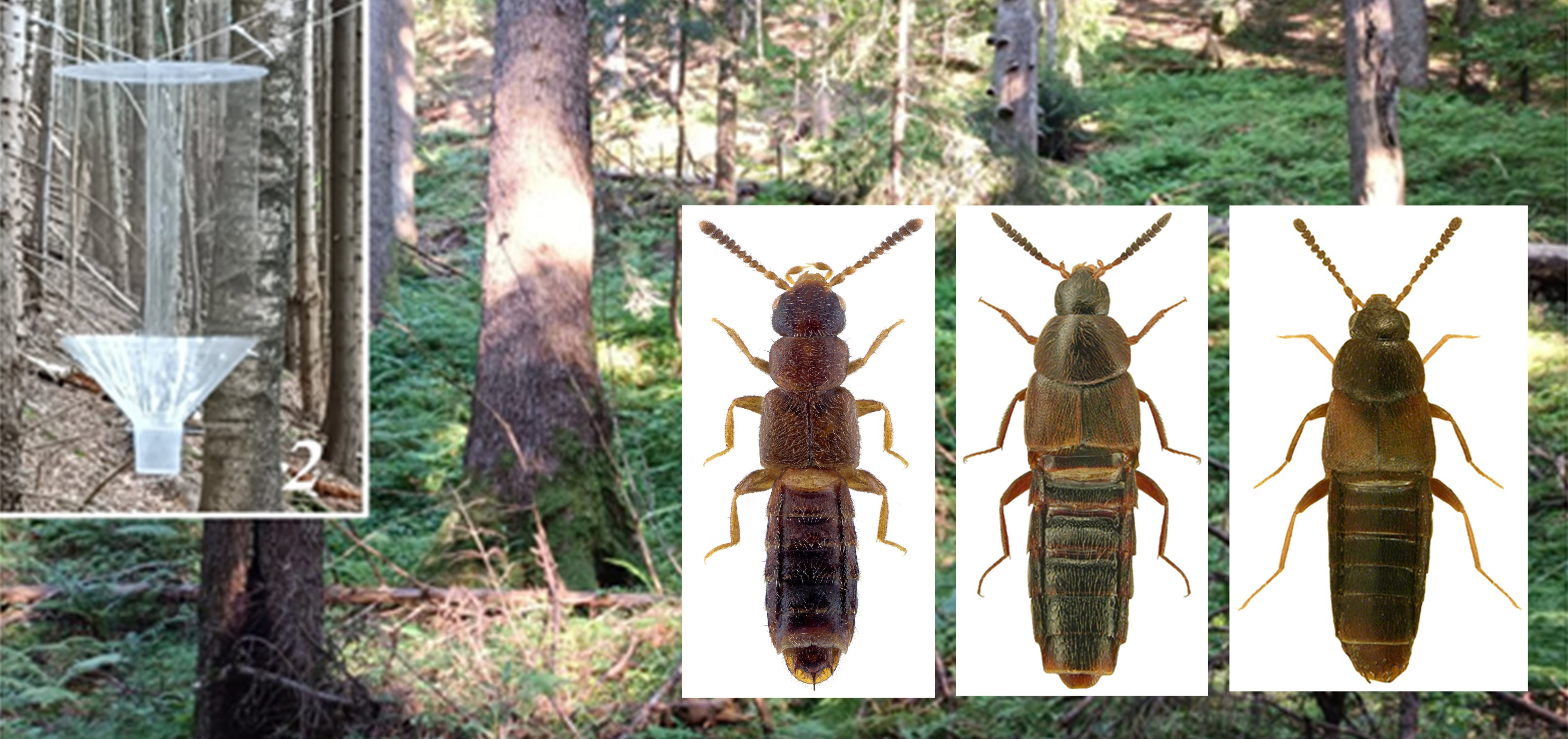
Coleoptera, Staphylinidae, Aleocharinae, saproxylic species, primeval fir forest, faunaAbstract
Saproxylic beetles are insects that depend on dead and decaying wood for at least part of their lifecycle, and play an important ecological roles in European habitats. Together with fungi, they contribute to the destruction of deadwood as well as are involved in decomposition processes and the recycling of nutrients in natural ecosystems. The subfamily Aleocharinae is one of the largest subfamilies of rove beetles.
The aim of the study is to investigate the diversity of saproxylic beetles (Coleoptera, Staphylinidae) in primeval fir forest of the Carpathian National Nature Park.
Materials and methods. The report is based on the results of observations and collections, which were conducted in coniferous forests of the Carpathian National Nature Park in 2023–2024. All traps were set up and operated yearly during the vegetation season from early April to late September.
Results. The fauna of rove beetles of the subfamily Aleocharinae accounts for 44 species, of which 23 species are obligate or facultative saproxylic. The community of rove beetles of the subfamily Aleocharinae, collected in primeval fir forest of the Carpathian National Nature Park, is characterized by a high level of faunal diversity.
Conclusions. The community of rove beetles of the subfamily Aleocharinae, collected in primeval fir forest of the Carpathian National Nature Park, is characterized by a high level of faunal diversity. The fauna of rove beetles of the subfamily Aleocharinae accounts for 44 species, of which 23 species are saproxylic. The result of our research is a section of the composition of the beetle community at a certain stage of forest succession. In the future, these data can be used by researchers to assess other territories, in particular with the aim of forming proposals for rational sustainable permanent forest use, which Ukrainian forestry is gradually moving towards
References
- Alexander, K. N. A., (2008). Tree Biology and Saproxylic Coleoptera: Issues of Definitions and conservation language. Annual Review of Ecology, Evolution, and Systematics, 10, 9–13. Available at: https://www.persee.fr/doc/revec_0249-7395_2008_sup_10_1_1455
- Nieto, A., Alexander, K. N. A. (2010). European Red List of saproxylic beetles. Luxembourg: Publications Office of the European Union, 39. Available at: https://www.cerambycoidea.com/titles/nietoalexander2010.pdf
- Newton, A. (2025). StaphBase (version Aug 2022). Catalogue of Life (Version 2025-07-10). Catalogue of Life Foundation. Amsterdam. https://doi.org/10.48580/dg9ld-3gk
- Thayer, M. K.; Beutel, R. G., Leschen, R. A. B. (Eds.) (2005). Staphylinidae. Coleoptera, Vol. I. Morphology and Systematics (Archostemata, Adephaga, Myxophaga, Polyphaga partim). Handbook of Zoology Vol. IV, Arthropoda: Insecta. Part 38. De Gruyter, Berlin, New York, 296–345. Available at: https://www.semanticscholar.org/paper/Morphology-and-systematics-(Archostemata%2C-Adephaga%2C-Beutel-Leschen/80e58a3e2ff73afa5d6d1b74f6490a2d1a72f686
- Ashe, J. S. (1984). Generic revision of the subtribe Gyrophaenina (Coleoptera: Staphylinidae: Aleocharinae) with a review of the described subgenera and major features of evolution. Quaestiones entomologicae, 20 (3), 129–349. Available at: https://www.biodiversitylibrary.org/part/204370
- Bohac, J. (1999). Staphylinid beetles as bioindicators. Agriculture, Ecosystems & Environment, 74 (1-3), 357–372. https://doi.org/10.1016/s0167-8809(99)00043-2
- Kyseliuk, O. I., Prykhodko, M. M., Yavorskyi, A. I., Abramiuk, U. M., Belei, L. M., Belmeha, V. V. et al. (2009). Karpatskyi natsionalnyi pryrodnyi park. Ivano-Frankivsk: Foliant, 672. Available at: https://www.researchgate.net/profile/Vitaliy-Nazarenko/publication/268808851_831_Bezhrebetni/links/54884d2b0cf2ef34479074db/831-Bezhrebetni.pdf
- Duelli, P., Obrist, M. K., Schmatz, D. R. (1999). Biodiversity evaluation in agricultural landscapes: above-ground insects. Agriculture, Ecosystems & Environment, 74 (1-3), 33–64. https://doi.org/10.1016/s0167-8809(99)00029-8
- Assing, V. (2009). On the taxonomy and zoogeography of some Palaearctic Aleochara species of the subgenera Xenochara Mulsant & Rey and Rheochara Mulsant & Rey (Coleoptera: Staphylinidae: Aleocharinae). Beiträge Zur Entomologie = Contributions to Entomology, 59 (1), 33–101. https://doi.org/10.21248/contrib.entomol.59.1.33-101
- Horion, A. (1967). Staphylinidae. 3. Vol. 11. Habrocerinae bis Aleocharinae (Ohne Subtribus Athetae). Faunistik der mitteleuropäischen Käfer. Überlingen-Bodensee: P.C.W. Schmidt, 419. Available at: https://fernleihe.boss.bsz-bw.de/Record/(DE-627)143153811#interlibraryloan
- Koch, K. (1989). Die Käfer Mitteleuropas. Ökologie. Band E1: Carabidae-Micropeplidae. Krefeld: Goecke & Evers, 440. Available at: https://openlibrary.org/books/OL27992161M/Die_K%C3%A4fer_Mitteleuropas_Bd._E1
- Maus, Ch., Mittmann, B., Peschke, K. (2008). Host Records of Parasitoid Aleochara Gravenhorst Species (Coleoptera, Staphylinidae) Attacking Puparia of Cyclorrhapheous Diptera. Deutsche Entomologische Zeitschrift, 45 (2), 231–254. https://doi.org/10.1002/mmnd.19980450209
- Klimaszewski, J. (2000). Diversity of the rove beetles in Canada and Alaska (Coleoptera, Staphylinidae). Mémoires de la Soiété Royale Belge d'Entomologie, 39, 3–126. Available at: https://www.naturebob.com/sites/default/files/Klimaszewski2000-Diversity-of-the-rove-beetles-of-Canada-and-Alaska.pdf
- Newton, A. F. Jr.; Wheeler, Q., Blackwell, M. (Eds.) (1984). Mycophagy in Staphylinoidea (Coleoptera). Fungus Insect Relationships: Perspectives in Ecology and Evolution. New York: Columbia University Press, 302–353. Available at: https://cup.columbia.edu/book/fungus-insect-relationships/9780231054683
- Michaud, J.-P., Majka, C. G., Privé, J.-P., Moreau, G. (2010). Natural and anthropogenic changes in the insect fauna associated with carcasses in the North American Maritime lowlands. Forensic Science International, 202 (1-3), 64–70. https://doi.org/10.1016/j.forsciint.2010.04.028
Downloads
Published
How to Cite
Issue
Section
License
Copyright (c) 2025 Yuriy Motruk, Sergiy Glotov

This work is licensed under a Creative Commons Attribution 4.0 International License.
Our journal abides by the Creative Commons Attribution 4.0 International License copyright rights and permissions for open access journals.
Authors, who are published in this journal, agree to the following conditions:
1. The authors reserve the right to authorship of the work and pass the first publication right of this work to the journal under the terms of a Creative Commons Attribution 4.0 International License, which allows others to freely distribute the published research with the obligatory reference to the authors of the original work and the first publication of the work in this journal.
2. The authors have the right to conclude separate supplement agreements that relate to non-exclusive work distribution in the form in which it has been published by the journal (for example, to upload the work to the online storage of the journal or publish it as part of a monograph), provided that the reference to the first publication of the work in this journal is included.
3. Authors have the right to store the final accepted version of the article in an institutional, thematic, or any other repository to ensure visibility and accessibility.


