Development of the cream composition with Georgian thermal water and herb extracts
DOI:
https://doi.org/10.15587/2519-4852.2023.295494Keywords:
Georgian hot springs, cream base, dermato-cosmetic cream, Borjomi, Sulori, herb extractsAbstract
Thermal mineral waters contain a certain amount of mineral substances. They are widely used around the world to develop pharmaceuticals and cosmetics. Georgia is rich in thermal mineral water and plant resources, but Georgian mineral waters and medicinal plant raw materials have not been used together in any of the dermato-cosmetic products produced in Georgia.
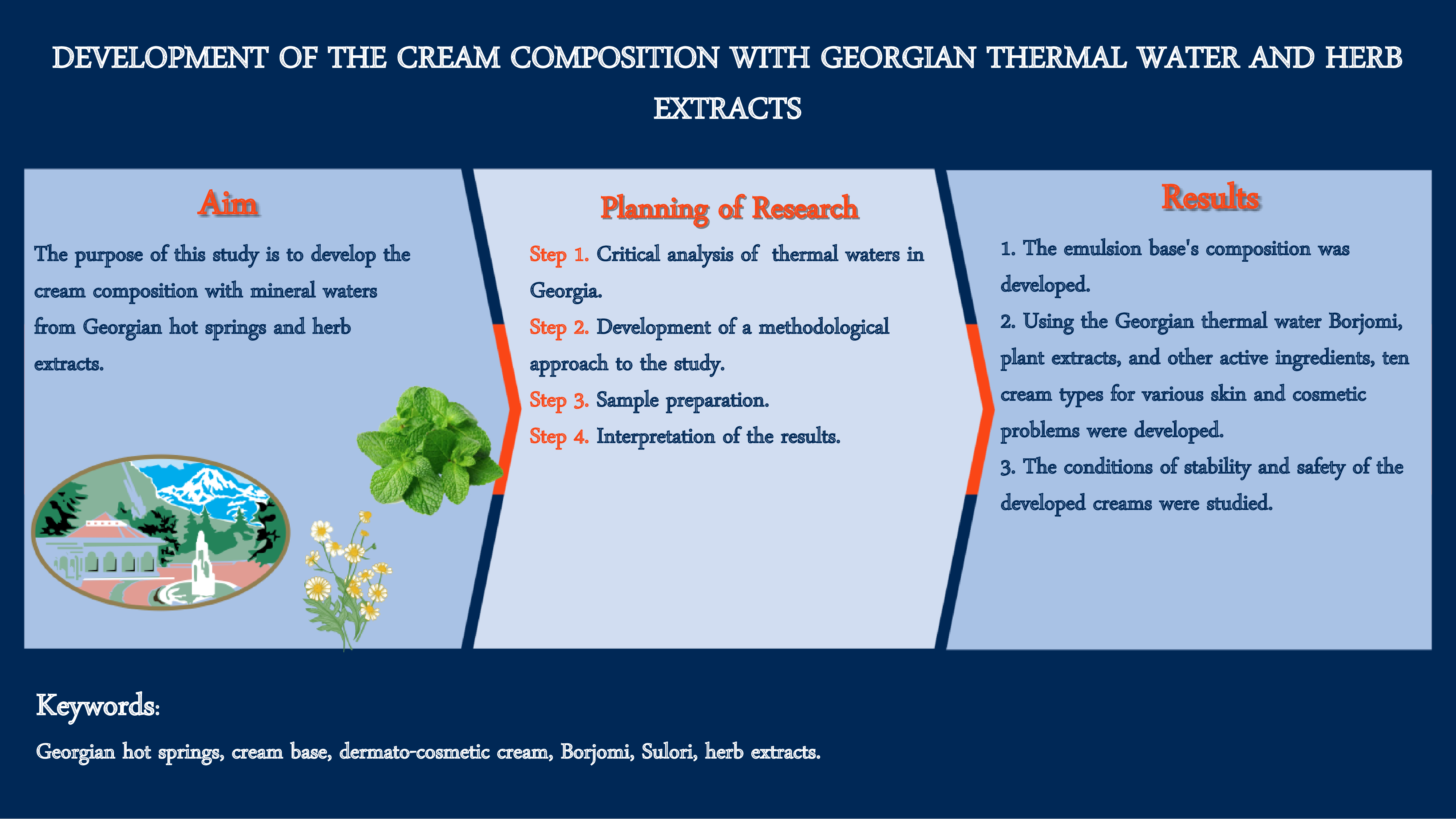
The aim of this work is to develop the cream composition with mineral waters from Georgian hot springs and herb extracts.
Material and methods. The objects of the study were Georgian thermal waters and herb extracts. Thermal waters of various degrees of mineralization were used: Sulori (mineralization - 182,6 mg/L), Tskaltubo (mineralization - 0,8 g/L) and Borjomi (mineralization - 5-7 g/L). For the study, the main methods for developing dosage forms, experimental and technological studies, physical, physico-chemical, biopharmaceutical and other methods were used.
Research results. Based on preliminary tests, preference was given to highly mineralized water “Borjomi” and its dilutions. This allowed us to develop a general strategy for creating a formula for creams containing thermal mineral water and herb extracts. The experiments were conducted with different dilutions of Borjomi. A model system suitable for mineral waters of any degree of mineralization was developed. Preliminary tests determined the ratio of the main components, with the use of which ten versions of cream were developed, and their physicochemical properties, sterility and toxicological safety were studied.
Conclusions. The critical analysis of thermal waters of Georgia was carried out and the more mineralized thermal water of Borjomi was used in the model systems. A methodological approach to the development of this type of medical and cosmetic creams for the use of selected thermal waters and plant raw materials was substantiated. The cream formulation was developed using Georgian thermal water and plant extracts. The conditions of their stability and safety were studied
References
- Kapanadze, N., Melikidze, G. I., Janelidze, P. (2010). Estimation of Zugdidi and Tbilisi thermal water deposits. Research workshop on Exploration and Exploitation of Groundwater and Thermal Water Systems in Georgia, 5–12. Available at: https://www.researchgate.net/publication/273304197_Research_workshop_on_Exploration_and_Exploitation_of_Groundwater_and_Thermal_Water_Systems_in_Georgia_estimation_of_Zugdidi_and_Tbilisi_thermal_water_deposits
- Law of Georgia on water (1997). Parliament of Georgia No. 936. 25.11.1997. Available at: https://matsne.gov.ge/en/document/view/33448?publication=19
- Figueiredo, A. C., Rodrigues, M., Mourelle, M. L., Araujo, A. R. T. S. (2023). Thermal Spring Waters as an Active Ingredient in Cosmetic Formulations. Cosmetics, 10 (1), 27. https://doi.org/10.3390/cosmetics10010027
- RTS Araujo, A. (2017). Thermal Cosmetics as Therapeutic Adjuvant for Dermatological Disorders. Global Journal of Pharmacy & Pharmaceutical Sciences, 3 (5), 118–120. https://doi.org/10.19080/gjpps.2017.03.555622
- Cacciapuoti, S., Luciano, M., Megna, M., Annunziata, M., Napolitano, M., Patruno, C. et al. (2020). The Role of Thermal Water in Chronic Skin Diseases Management: A Review of the Literature. Journal of Clinical Medicine, 9 (9), 3047. https://doi.org/10.3390/jcm9093047
- Guerrero, D., Garrigue, E. (2017). Eau thermale d’Avène et dermatite atopique: Avène’s thermal water and atopic dermatitis. Annales de Dermatologie et de Vénéréologie, 144, S27–S34. https://doi.org/10.1016/s0151-9638(17)31040-2
- Evseeva, S. B., Sysuev, B. B. (2016). The raw mineral salts use in cosmetics formulations: assortment, mineral raw materials characteristics and cosmetics formulation technology. Pharmacy & Pharmacology, 4 (2 (15)), 4–25. https://doi.org/10.19163/2307-9266-2016-4-2(15)-4-25
- Saakashvili N., Tarkhan-mouravi I., Tabidze I., Kutateladze N. (2011) Georgian balneology and balneotherapy. Tbilisi: Sakartvelos matsne, 159. Available at: https://dspace.nplg.gov.ge/bitstream/1234/9679/1/Sakurorto_Terapia.pdf
- Bejanidze, I., Petrov, O., Kharebava, T., Pohrebennyk, V., Davitadze, N., Didmanidze, N. (2020). Study of the Healing Properties of Natural Sources of Georgia and Modeling of Their Purification Processes. Applied Sciences, 10 (18), 6529. https://doi.org/10.3390/app10186529
- Gvakharia, V., Jgamadze, A., Gabechava, J., Adamia, T., Chkhaidze, D., Jebashvili, T. et al. (2018). Uraveli mineral spring and its exploration for industrial development. Annals of Agrarian Science, 16 (1), 27–31. https://doi.org/10.1016/j.aasci.2017.12.004
- Strus, O., Polovko, N., Plaskonis, Y. (2018). The investigation of the development of a cream composition with the sapropel extract. Asian Journal of Pharmaceutical and Clinical Research, 11 (7), 147–150. https://doi.org/10.22159/ajpcr.2018.v11i7.23575
- Ribeiro, A., Estanqueiro, M., Oliveira, M., Sousa Lobo, J. (2015). Main Benefits and Applicability of Plant Extracts in Skin Care Products. Cosmetics, 2 (2), 48–65. https://doi.org/10.3390/cosmetics2020048
- GOST 33506-2015 Perfume and cosmetic products. Methods for determination and assessment of toxicological safety indicators (2011). Available at: https://files.stroyinf.ru/Index2/1/4293753/4293753476.htm
- Mineralnye vody v Gruzii. Available at: https://delicatours.ge/gruzinskaya-mineralnaya-voda
- Mineral water Tskaltubo. Available at: https://tskaltuboresort.ge/eng/static/124
- On approval of the list of water bodies belonging to the medical category and hygienic requirements for the quality of mineral water (2022). Order of the Minister of Labour, Health and Social Protection of Georgia. 310/ნ (2002). 05.11.2002. Available at: https://www.matsne.gov.ge/ka/document/view/54664?publication=0
- Kikvidze, I. R., Bashura, A. G., Abuladze, N. B., Javakhia, M. S., Sulashvil, N. V., Gabunia, K. U. (2022). Studying the possibility of obtaining cosmetic creams containing thermal mineral water of Borjomi. European Science Review, 1–2, 15–20. https://doi.org/10.29013/esr-22-1.2-15-20
- Fatima, S., Zaman, R., Haider, N., Shamsi, S., Alam, A. (2017). Design and development of Unani anti-inflammatory cream. Journal of Ayurveda and Integrative Medicine, 8 (3), 140–144. https://doi.org/10.1016/j.jaim.2017.03.002
- Younes, M., Aquilina, G., Engel, K., Fowler, P., Frutos Fernandez, M. J., Fürst, P. et al. (2021). Safety evaluation of crosslinked polyacrylic acid polymers (carbomer) as a new food additive. EFSA Journal, 19 (8). https://doi.org/10.2903/j.efsa.2021.6693
- Dao, H., Lakhani, P., Police, A., Kallakunta, V., Ajjarapu, S. S., Wu, K.-W. et al. (2017). Microbial Stability of Pharmaceutical and Cosmetic Products. AAPS PharmSciTech, 19 (1), 60–78. https://doi.org/10.1208/s12249-017-0875-1
- Jgamadze, A., Gabechava, J., Gvakharia, V., Sozashvili, D., Lebanidze, B., Jebashvili, T., Maglakelidze, A. (2018). Assessment of exploitation reserves of Nabeghlavi Mineral Water deposit. Annals of Agrarian Science, 16 (3), 352–356. https://doi.org/10.1016/j.aasci.2018.07.003
Downloads
Published
How to Cite
Issue
Section
License
Copyright (c) 2023 Nino Abuladze, Ketevani Gabunia, Irma Kikvidze, Nodar Sulashvili

This work is licensed under a Creative Commons Attribution 4.0 International License.
Our journal abides by the Creative Commons Attribution 4.0 International License copyright rights and permissions for open access journals.
Authors, who are published in this journal, agree to the following conditions:
1. The authors reserve the right to authorship of the work and pass the first publication right of this work to the journal under the terms of a Creative Commons Attribution 4.0 International License, which allows others to freely distribute the published research with the obligatory reference to the authors of the original work and the first publication of the work in this journal.
2. The authors have the right to conclude separate supplement agreements that relate to non-exclusive work distribution in the form in which it has been published by the journal (for example, to upload the work to the online storage of the journal or publish it as part of a monograph), provided that the reference to the first publication of the work in this journal is included.
3. Authors have the right to store the final accepted version of the article in an institutional, thematic, or any other repository to ensure visibility and accessibility.