Rat transtibial hindlimb amputation model: characteristic of the central nervous system functional state, physical endurance and body mass in dynamic
DOI:
https://doi.org/10.15587/2519-4852.2024.318008Keywords:
transtibial hindlimb amputation, behavioural responses, physical endurance, body mass, rats, experimentAbstract
Limb loss is a relevant medical and social problem. In a full-scale war environment, amputation became a frequent occasion, which requires adequate rehabilitation measures in preparation for prosthetic procedures. The post-traumatic period's peculiarities, specifically the central nervous system (CNS) functional characteristics and physical endurance, must be known. Experimental studies on animal models play an important role; however, there is no information available about such studies.
The aim. To determine the influence of hindlimb loss on the state of the central nervous system in terms of behavioural responses, physical endurance, and body mass dynamics of rats in the early and late post-amputation period. To characterise the indicated amputation model for further use in experimental studies.
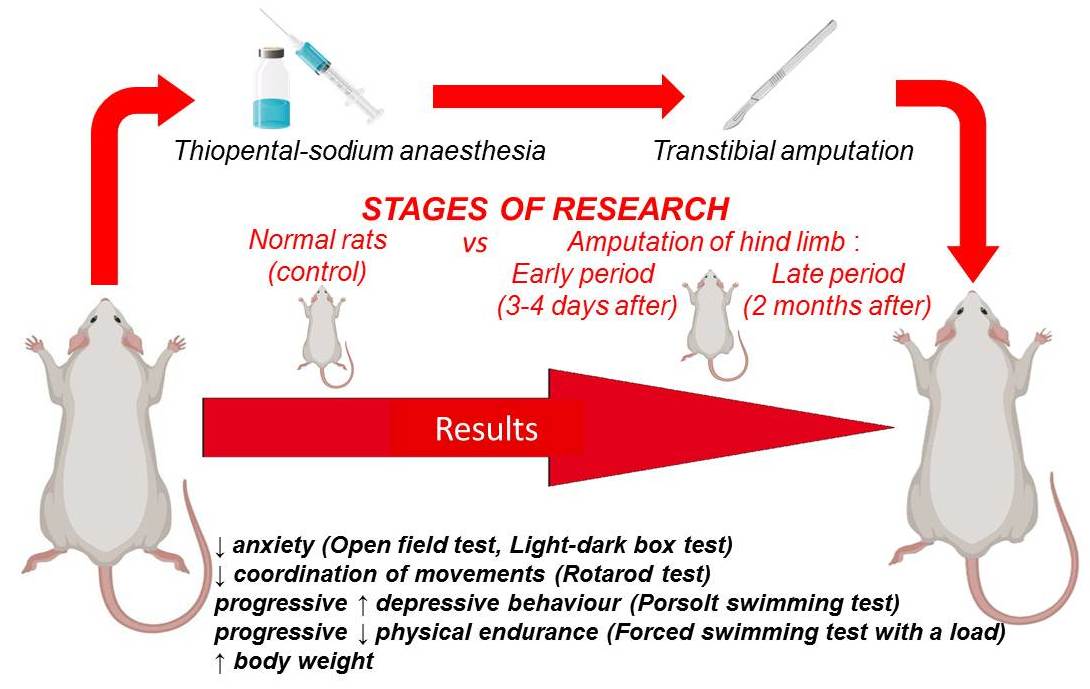
Materials and methods. The experiment was conducted on white male rats. Transtibial amputation at the level of the lower third of the hind limb was performed in aseptic conditions in 6 animals under thiopental-sodium anaesthesia (40 mg/kg intraperitoneally). The state of CNS and physical endurance was determined during the early (3-4 days after amputation) and long-term (2 months after surgery) periods. Locomotor and exploratory activity, emotional responses and vegetative support were determined in the Open field test, and anxiety was determined in the Light-dark box test. The coordination of animal movement was measured in the rotarod test, and the depression level was measured in the Porsolt swim test. The physical endurance of the rats was studied using the forced swimming test with a load (5 % of the body mass at the base of the tail) as a control were used rats with comparable body mass. STATISTICA 12.0 was used to process the results.
Results. In the early post-amputation period, exploratory behaviour and emotional results of rats in the Open field test were significantly suppressed, while in the long-term period of significance, only the reduction of emotional responses. In the Light-dark box test, the latency to enter the darkened compartment of the chamber increases reliably in both periods of observation (especially in the early period). Collectively, these results indicate changes in the reaction of animals with amputation of the hindlimb to stressful experimental conditions, in particular, an anxiety reduction, which requires further research. In the rotarod test, a significant deterioration of movement coordination of rats with amputation was found in both observation periods. After amputation, the manifestations of depressive behaviour in the Porsolt swimming test progressed, and the physical endurance in the forced swimming test with a load was significantly reduced. The body mass of rats with hindlimb amputation was significantly increased after 2 months (22 % average increase vs 4 % average increase in control, p<0.01). Results are important for experimental-based optimal rehabilitation programs after lower limb amputation.
Conclusion. An easy-to-perform model of transtibial amputation at the level of the lower third of the hindlimb in rats is proposed. It is concluded that after amputation, exploratory behaviour and emotional responses were suppressed, which indicates changes in the responses of animals with amputation of the hindlimb to stressful experimental conditions, in particular, an anxiety reduction, which differentiates this animal amputation model from human amputation. After amputation, the depressed behaviour of rats progresses, movement coordination steadily worsens, and physical endurance is significantly reduced. The body mass of rats with hindlimb amputation increases considerably
Supporting Agency
- The research was carried out within the framework of the topic “Development of soft drugs to improve the functional state of the stump during prosthetics” of the list of scientific studies of the Ministry of Health of Ukraine, carried out at the expense of the state budget of Ukraine No. 0124U001991 (Order of the Ministry of Health of Ukraine No. 82 of 16.01.2024)
References
- Rudenko, Y., Assonov, D. (2023). Psychological Consequences of Limb Amputation: Literature Review. Psychosomatic Medicine and General Practice, 8 (3). https://doi.org/10.26766/pmgp.v8i3.443
- McDonald, C. L., Westcott-McCoy, S., Weaver, M. R., Haagsma, J., Kartin, D. (2020). Global prevalence of traumatic non-fatal limb amputation. Prosthetics & Orthotics International, 45 (2), 105–114. https://doi.org/10.1177/0309364620972258
- Bochkova, N., Petsenko, N., Satanovska, C. (2024). Peculiarities of physical rehabilitation of military personnel with lower limb amputation. Scientific Journal of National Pedagogical Dragomanov University. Series 15. Scientific and Pedagogical Problems of Physical Culture (Physical Culture and Sports), 3K (176), 127–131. https://doi.org/10.31392/udu-nc.series15.2024.3k(176).27
- Prylińska, M., Husejko, J., Kwiatkowska, K., Wycech, A., Kujaciński, M., Rymarska, O. et al. (2019). Care for an elderly person after lower limb amputation. Journal of Education, Health and Sport, 9 (8), 886–894. http://dx.doi.org/10.5281/zenodo.3370924
- Kostka, A., Durlej-Kot, S., Chabowski, M., Janczak, D. (2017). Opieka pielęgniarska nad pacjentem po amputacji kończyny dolnej na podstawie międzynarodowej klasyfikacji praktyki pielęgniarskiej (ICNP®). Surgical & Vascular Nursing/Pielegniarstwo Chirurgiczne i Angiologiczne, 11 (3), 84–93. Available at https://www.termedia.pl/Opieka-pielegniarska-nad-pacjentem-po-amputacji-konczyny-dolnej-na-podstawie-Miedzynarodowej-Klasyfikacji-Praktyki-Pielegniarskiej-ICNP-,50,31234,0,0.html
- Modest, J. M., Raducha, J. E., Testa, E. J., Eberson, C. P. (2020). Management of post-amputation pain. Rhode Island medical journal, 103 (4), 19–22.
- Barritault, D., Gilbert-Sirieix, M., Rice, K. L., Siñeriz, F., Papy-Garcia, D., Baudouin, C. et al. (2016). RGTA® or ReGeneraTing Agents mimic heparan sulfate in regenerative medicine: from concept to curing patients. Glycoconjugate Journal, 34 (3), 325–338. https://doi.org/10.1007/s10719-016-9744-5
- Vivas, L. L. Y., Pauley, T., Dilkas, S., Devlin, M. (2016). Does size matter? Examining the effect of obesity on inpatient amputation rehabilitation outcomes. Disability and Rehabilitation, 39 (1), 36–42. https://doi.org/10.3109/09638288.2016.1140831
- Rosenberg, D. E., Turner, A. P., Littman, A. J., Williams, R. M., Norvell, D. C., Hakimi, K. M., Czerniecki, J. M. (2012). Body mass index patterns following dysvascular lower extremity amputation. Disability and Rehabilitation, 35 (15), 1269–1275. https://doi.org/10.3109/09638288.2012.726690
- Sitenko, O. (2023). Development of the rehabilitation system in ukraine. organizational aspects. Orthopaedics Traumatology and Prosthetics, 2, 77–83. https://doi.org/10.15674/0030-59872023277-83
- Leppik, L. P., Froemel, D., Slavici, A., Ovadia, Z. N., Hudak, L., Henrich, D. et al. (2015). Effects of electrical stimulation on rat limb regeneration, a new look at an old model. Scientific Reports, 5 (1). https://doi.org/10.1038/srep18353
- Irie, H., Kato, T., Ikebe, K., Tsuchida, T., Oniki, Y., Takagi, K. (2004). Antioxidant effect of MCI-186, a new Free-Radical scavenger, on ischemia-reperfusion injury in a rat hindlimb amputation model. Journal of Surgical Research, 120 (2), 312–319. https://doi.org/10.1016/j.jss.2003.12.004
- Luan, H., Huiru gu, Mo, Z., Ren, W., Guo, H., Chu, Z., Fan, Y. (2020). The bone alterations in hind limb amputation rats in vivo. Medicine in Novel Technology and Devices, 8, 100046. https://doi.org/10.1016/j.medntd.2020.100046
- Zepeda, J., Mraz, G., Roth, E., Hoben, G. (2023). Rat Hindlimb Amputation Model to Assess Nerve Transfers for Pain Relief. Plastic and Reconstructive Surgery – Global Open, 11 (10S), 108–108. https://doi.org/10.1097/01.gox.0000992448.01175.c5
- Directive of 22.09.2010 No. 2010/63/EU (2010). The protection of animals used for scientific purposes Text with EEA relevance. Available at: http://data.europa.eu/eli/dir/2010/63/oj
- Hock, F. J. (Ed.). (2016). Drug discovery and evaluation: Pharmacological assays. Cham: Springer International Publishing. https://doi.org/10.1007/978-3-319-05392-9
- Koval, A., Shtrygol, S. (2023). 1-(5-Acetyl-3-methyl-6-phenyl-5h-[1, 2, 4] triazolo [3, 4-b][1, 3, 4] thiadiazin-7-yl)-ethanone: dose-dependence of analgesic effect, lack of opioidergic mechanism of action, effect on behavioral reactions and acute toxicity. Acta Medica Leopoliensia, 29 (3-4), 192–203. https://doi.org/10.25040/aml2023.3-4.192
- Bourin, M., Hascoët, M. (2003). The mouse light/dark box test. European Journal of Pharmacology, 463 (1-3), 55–65. https://doi.org/10.1016/s0014-2999(03)01274-3
- Bonm, A. V., Elezgarai, I., Gremel, C. M., Viray, K., Bamford, N. S., Palmiter, R. D. et al. (2021). Control of exploration, motor coordination and amphetamine sensitization by cannabinoid CB1 receptors expressed in medium spiny neurons. European Journal of Neuroscience, 54 (3), 4934–4952. https://doi.org/10.1111/ejn.15381
- Slattery, D. A., Cryan, J. F. (2012). Using the rat forced swim test to assess antidepressant-like activity in rodents. Nature Protocols, 7 (6), 1009–1014. https://doi.org/10.1038/nprot.2012.044
- Armario, A. (2021). The forced swim test: Historical, conceptual and methodological considerations and its relationship with individual behavioral traits. Neuroscience & Biobehavioral Reviews, 128, 74–86. https://doi.org/10.1016/j.neubiorev.2021.06.014
- Harro, J. (2018). Animals, anxiety, and anxiety disorders: How to measure anxiety in rodents and why. Behavioural Brain Research, 352, 81–93. https://doi.org/10.1016/j.bbr.2017.10.016
- Kuniishi, H., Ichisaka, S., Yamamoto, M., Ikubo, N., Matsuda, S., Futora, E. et al. (2017). Early deprivation increases high-leaning behavior, a novel anxiety-like behavior, in the open field test in rats. Neuroscience Research, 123, 27–35. https://doi.org/10.1016/j.neures.2017.04.012
- Mukvych, V. V., Liashenko, V. P., Lukashov, S. M. (2017). Age-related changes of open field behavioral reactions of male and female rats. Bulletin of Zaporizhzhia National University. Biolohichni nauky, 2, 75–84. Available at: http://nbuv.gov.ua/UJRN/Vznu_bio_2017_2_12
- Rosso, M., Wirz, R., Loretan, A. V., Sutter, N. A., Pereira da Cunha, C. T., Jaric, I. et al. (2022). Reliability of common mouse behavioural tests of anxiety: A systematic review and meta-analysis on the effects of anxiolytics. Neuroscience & Biobehavioral Reviews, 143, 104928. https://doi.org/10.1016/j.neubiorev.2022.104928
- Bergo, M. F. D. C., Prebianchi, H. B. (2018). Emotional aspects present in the lives of amputees: a literature review. Psicologia: teoria e prática, 20 (1), 47–60. https://doi.org/10.5935/1980-6906/psicologia.v20n1p47-60
- Littman, A. J., Thompson, M. L., Arterburn, D. E., Bouldin, E., Haselkorn, J. K., Sangeorzan, B. J., Boyko, E. J. (2015). Lower-limb amputation and body weight changes in men. Journal of Rehabilitation Research and Development, 52 (2), 159–170. https://doi.org/10.1682/jrrd.2014.07.0166
- Bouldin, E. D., Thompson, M. L., Boyko, E. J., Morgenroth, D. C., Littman, A. J. (2016). Weight Change Trajectories After Incident Lower-Limb Amputation. Archives of Physical Medicine and Rehabilitation, 97 (1), 1-7.e1. https://doi.org/10.1016/j.apmr.2015.09.017
Downloads
Published
How to Cite
Issue
Section
License
Copyright (c) 2024 Mykyta Нutorka, Dmytro Kyrylov, Oleksandr Meklenburtsev, Sergiy Shtrygol’, Andrii Taran, Olena Ruban

This work is licensed under a Creative Commons Attribution 4.0 International License.
Our journal abides by the Creative Commons Attribution 4.0 International License copyright rights and permissions for open access journals.
Authors, who are published in this journal, agree to the following conditions:
1. The authors reserve the right to authorship of the work and pass the first publication right of this work to the journal under the terms of a Creative Commons Attribution 4.0 International License, which allows others to freely distribute the published research with the obligatory reference to the authors of the original work and the first publication of the work in this journal.
2. The authors have the right to conclude separate supplement agreements that relate to non-exclusive work distribution in the form in which it has been published by the journal (for example, to upload the work to the online storage of the journal or publish it as part of a monograph), provided that the reference to the first publication of the work in this journal is included.
3. Authors have the right to store the final accepted version of the article in an institutional, thematic, or any other repository to ensure visibility and accessibility.