Effect of a new phytocomposition based on polyphenolic extract from cranberry leaves and amino acids on the state of the pancreas in metabolic syndrome
DOI:
https://doi.org/10.15587/2519-4852.2024.318509Keywords:
metabolic syndrome, high sugar diet, large-fruited cranberry, amino acids, pancreas, liverAbstract
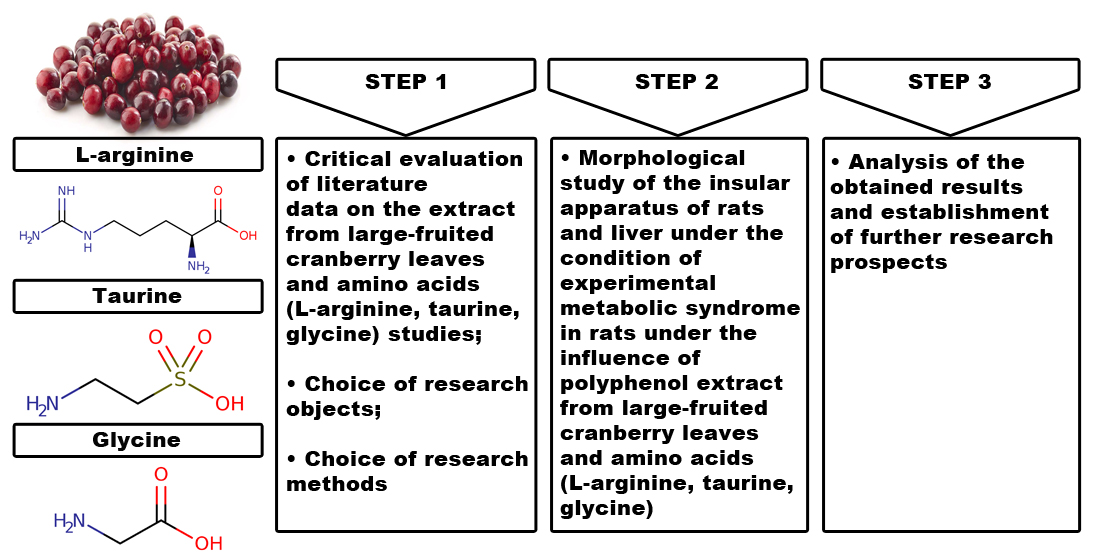
The aim of this work was to study the effect of a phytocomposition based on a polyphenol extract from large-fruited cranberry leaves and amino acids (L-arginine, taurine, glycine) on the state of the pancreas and liver in experimental metabolic syndrome in rats.
Material and methods. Metabolic syndrome was reproduced using a high-sucrose diet, which was provided by replacing drinking water with a 30 % sucrose solution in drinkers in a free-access mode for 8 weeks. A phytocomposition based on a polyphenol extract from large-fruited cranberry leaves and amino acids at a dose of 100 mg/kg and comparison drugs phytocollection "Arfazetin" and tablets "Metformin" were administered daily during the reproduction of pathology for 8 weeks. The ability of the phytocomposition to improve glucose tolerance was evaluated in an oral glucose tolerance test. Histologically, the state of the pancreas was assessed with staining sections with hematoxylin and eosin, aldehyde fuchsin according to Gomora, and morphometric measurements of pancreatic islets were carried out. The liver sections were subjected to the McManus PAS reaction to detect glycogen; to verify neutral fats, the liver sections were stained with Sudan IV.
Results. Preventive administration of a phytocomposition based on a polyphenol extract from large-fruited cranberry leaves and amino acids at a dose of 100 mg/kg for 8 weeks had significantly improved glucose tolerance, a positive effect on the morphological state of the insular apparatus of rats: in the overwhelming majority of islets, cells with normal density were observed, which were uniformly distributed over the entire area of the islet. Also, no signs of hypertrophy or dystrophy of β-cells were detected. Under the influence of the studied phytocomposition, liver hepatocytes had normal glycogen saturation and a minimum content of neutral fats in the cytoplasm. In terms of the severity of the protective effect on the insular apparatus of the pancreas of rats, the phytocomposition exceeded the "Arfazetin" collection and was not inferior to "Metformin" tablets, and in terms of the degree of restoration of impaired metabolic changes in the liver, it surpassed both comparison drugs.
Conclusion. Two-month maintenance of rats on a diet high in sucrose was characterised by impaired glucose tolerance, pathomorphological changes in the insular apparatus of the pancreas, impaired glycogen-forming function of the liver and development of steatohepatosis. Phytocomposition based on polyphenolic extract of cranberry leaves and amino acids at therapeutic and prophylactic administration on the background of a high-sugar diet significantly improved glucose tolerance, prevented dystrophic and necrobiotic changes of β-cells, depletion of glycogen stores and fat accumulation in the liver of rats. The phytocomposition based on the polyphenolic extract from large-fruited cranberry leaves and amino acids was superior to the reference preparation “Arfazetin” and practically not inferior to “Metformin” tablets in its ability to limit morphological changes in the pancreas tissue and exceeded both comparison preparations in the degree of restoration of disturbed metabolic changes in the liver. The results indicate the prospect of further experimental studies on the pharmacological properties of phytocomposition based on the polyphenolic extract of cranberry leaves and amino acids in order to create an effective phytomedicine for the correction of metabolic syndrome and type 2 diabetes mellitus manifestations
References
- Ndumele, C. E., Neeland, I. J., Tuttle, K. R., Chow, S. L., Mathew, R. O., Khan, S. S. et al. (2023). A Synopsis of the Evidence for the Science and Clinical Management of Cardiovascular-Kidney-Metabolic (CKM) Syndrome: A Scientific Statement From the American Heart Association. Circulation, 148 (20), 1636–1664. https://doi.org/10.1161/cir.0000000000001186
- Chasens, E. R., Imes, C. C., Kariuki, J. K., Luyster, F. S., Morris, J. L., DiNardo, M. M. et al. (2021). Sleep and Metabolic Syndrome. Nursing Clinics of North America, 56 (2), 203–217. https://doi.org/10.1016/j.cnur.2020.10.012
- Frankenberg, A. D. von, Reis, A. F., Gerchman, F. (2017). Relationships between adiponectin levels, the metabolic syndrome, and type 2 diabetes: a literature review. Archives of Endocrinology and Metabolism, 61 (6), 614–622. https://doi.org/10.1590/2359-3997000000316
- Di Pino, A., DeFronzo, R. A. (2019). Insulin Resistance and Atherosclerosis: Implications for Insulin-Sensitizing Agents. Endocrine Reviews, 40(6), 1447–1467. https://doi.org/10.1210/er.2018-00141
- Rochlani, Y., Pothineni, N. V., Kovelamudi, S., Mehta, J. L. (2017). Metabolic syndrome: pathophysiology, management, and modulation by natural compounds. Therapeutic Advances in Cardiovascular Disease, 11 (8), 215–225. https://doi.org/10.1177/1753944717711379
- Thomas, M. S., Calle, M., Fernandez, M. L. (2023). Healthy plant-based diets improve dyslipidemias, insulin resistance, and inflammation in metabolic syndrome. A narrative review. Advances in Nutrition, 14 (1), 44–54. https://doi.org/10.1016/j.advnut.2022.10.002
- Koshovyi, O. M., Komisarenko, M. A., Kovaleva, A. M., Ilina, T. V., Vlasova, I. K. (2020). Mineral composition of aerial parts of cranberry. Fitoterapia, 1 (1), 46–49. https://doi.org/10.33617/2522-9680-2020-1-46
- Ferlemi, A.-V., Lamari, F. (2016). Berry Leaves: An Alternative Source of Bioactive Natural Products of Nutritional and Medicinal Value. Antioxidants, 5 (2), 17. https://doi.org/10.3390/antiox5020017
- LaMoia, T. E., Shulman, G. I. (2020). Cellular and Molecular Mechanisms of Metformin Action. Endocrine Reviews, 42(1), 77–96. https://doi.org/10.1210/endrev/bnaa023
- Poriadok provedennia naukovymy ustanovamy doslidiv, eksperymentiv na tvarynakh (2012). Nakaz Ministerstva osvity, nauky, molodi ta sportu Ukrainy. Nakaz No. 249. 01.03.2012. Available at: https://zakon.rada.gov.ua/laws/show/z0416-12#Text
- Horbenko, N. I., Borikov, O. Yu., Ivanova, O. V. et al. (2019). Modeliuvannia metabolichnoho syndromu riznoho henezu u eksperymentalnykh tvaryn (metodychni rekomendatsii). Kharkiv, 38.
- Chikitkina, V., Tanska, M. (2024). Screening studies of the hypoglycemic effect of a phytocomposition based on polyphenolic extract from cranberry leaves and amino acids. Modern Medicine, Pharmacy and Psychological Health, 1 (15), 119–125. https://doi.org/10.32689/2663-0672-2024-1-21
- Maynard, R., Downes, N., Finney, B. (2014). Histological techniques: an introduction for beginners in toxicology. Cambridge: Royal Society of Chemistry, 334. https://doi.org/10.1039/9781839168895
- Kiernan, J. A. (2015). Histological and histochemical methods: theory and practice. Banbury: Scion Publishing, 571.
- Layton, C., Bancroft, J. D., Suvarna, S. K.; Suvarna, S. K., Layton, C., Bancroft, J. D. (Eds.) (2019). Fixation of tissues. Bancroft’s theory and practice of histological techniques. St. Louis: Elsevier, 40–63. https://doi.org/10.1016/b978-0-7020-6864-5.00004-9
- Horbenko, N. I. (2004). Patohenetychne obhruntuvannia efektyvnosti pokhidnoho yantarnoi kysloty – fensuktsynalu v terapii tsukrovoho diabetu ta yoho sudynnykh uskladnen (eksperymentalne doslidzhennia). [Extended abstract of doctors thesis].
- Katsuda, Y., Ohta, T., Miyajima, K., Kemmochi, Y., Sasase, T., Tong, B., Shinohara, M., Yamada, T. (2014). Diabetic Complications in Obese Type 2 Diabetic Rat Models. Experimental Animals, 63 (2), 121–132. https://doi.org/10.1538/expanim.63.121
- Weir, G. C., Bonner-Weir, S. (2004). Five Stages of Evolving Beta-Cell Dysfunction During Progression to Diabetes. Diabetes, 53(suppl_3), S16–S21. https://doi.org/10.2337/diabetes.53.suppl_3.s16
- Hudish, L. I., Reusch, J. E. B., Sussel, L. (2019). β Cell dysfunction during progression of metabolic syndrome to type 2 diabetes. Journal of Clinical Investigation, 129 (10), 4001–4008. https://doi.org/10.1172/jci129188
- Paternostro, R., Trauner, M. (2022). Current treatment of non‐alcoholic fatty liver disease. Journal of Internal Medicine, 292 (2), 190–204. https://doi.org/10.1111/joim.13531
- Alam, M. A., Subhan, N., Rahman, M. M., Uddin, S. J., Reza, H. M., Sarker, S. D. (2014). Effect of Citrus Flavonoids, Naringin and Naringenin, on Metabolic Syndrome and Their Mechanisms of Action. Advances in Nutrition, 5 (4), 404–417. https://doi.org/10.3945/an.113.005603
Downloads
Published
How to Cite
Issue
Section
License
Copyright (c) 2024 Mariia Anisimova, Nadiia Kononenko, Valentyna Chikitkina

This work is licensed under a Creative Commons Attribution 4.0 International License.
Our journal abides by the Creative Commons Attribution 4.0 International License copyright rights and permissions for open access journals.
Authors, who are published in this journal, agree to the following conditions:
1. The authors reserve the right to authorship of the work and pass the first publication right of this work to the journal under the terms of a Creative Commons Attribution 4.0 International License, which allows others to freely distribute the published research with the obligatory reference to the authors of the original work and the first publication of the work in this journal.
2. The authors have the right to conclude separate supplement agreements that relate to non-exclusive work distribution in the form in which it has been published by the journal (for example, to upload the work to the online storage of the journal or publish it as part of a monograph), provided that the reference to the first publication of the work in this journal is included.
3. Authors have the right to store the final accepted version of the article in an institutional, thematic, or any other repository to ensure visibility and accessibility.