Study of the component composition of essential oils of pentaphylloides Fruticosa (L.) О. Schwarz (Dasiphora fruticosa (L.) Rybd.) raw materials
DOI:
https://doi.org/10.15587/2519-4852.2025.326765Keywords:
Pentaphylloides fruticosa (L.) О. Schwarz, Dasiphora fruticosa (L.) Rybd., essential oil, medicinal plant raw materials, shoots, gas chromatography-mass spectrometryAbstract
Pentaphylloides fruticosa (L.) О. Schwarz (Dasiphora fruticosa (L.) Rybd.) is one of the most common species in Eurasia. There are about 150 known varieties of Pentaphylloides fruticosa, which are used as an ornamental plant. The content of tannins, polyphenols, flavonoids, and macro- and microelements was detected and determined in the above-ground part of some varieties of Pentaphylloides fruticosa. Studies on the content and composition of essential oils have not been conducted.
The aim. The aim of the work was to study the quantitative composition and identification of components of essential oil from raw materials Pentaphylloides fruticosa.
Materials and methods. Hydrodistillates obtained from dried raw materials of Pentaphylloides fruticosa, collected from different growing sites in Ivano-Frankivsk and Vinnytsia regions (Ukraine), were analyzed by gas chromatography-mass spectrometry.
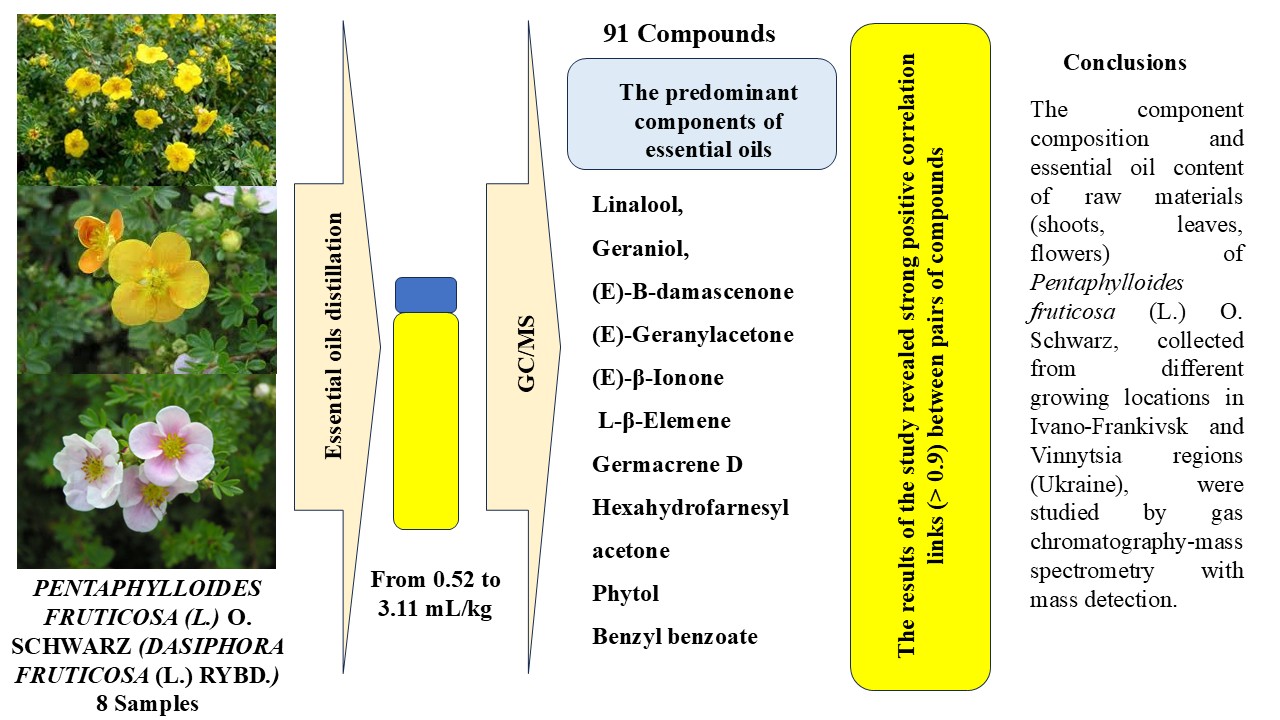
Research results. Up to 91 essential oil components were identified and quantified in the studied raw materials. The content of essential oils was from 0.52 to 3.11 mL/kg, depending on the type of raw material. The predominant essential oil compounds in the raw material of Pentaphylloides fruticosa were linalool, geraniol, (E)-β-damascenone, (E)-geranylacetone, (E)-β-ionone, L-β-elemene, germacrene D, hexahydrofarnesyl acetone, phytol, benzyl benzoate. The largest amount of essential oil components was found in shoots with yellow flowers of Pentaphylloides fruticosa. The results of the study revealed strong positive correlation links (> 0.9) between such pairs of compounds as L-carvone and hexahydrofarnesyl acetone, benzyl benzoate and 1,2-diphenoxyethane; L-β-pinene and α-muurolene, L-β-pinene and hexahydrofarnesyl acetone; L-bornyl acetate and L-β-elemene, L-bornyl acetate and benzyl benzoate, L-bornyl and 1,2-diphenoxyethane, D-limonene and eucalyptol, L-β-pinene and L-carvone.
Conclusions. In connection with the obtained research results and the identification of such compounds as linalool, geraniol, (E)-β-damascenone, (E)-geranylacetone, (E)-β-ionone, germacrene D, phytol, benzyl benzoate, it is advisable to further study the species Pentaphylloides fruticosa, its pharmacological activity and possibilities for further application in medicine
Supporting Agency
- European Union in the MSCA4Ukraine project “Design and development of 3D-printed medicines for bioactive materials of Ukrainian and Estonian medicinal plants origin” [ID number 1232466].
References
- Tomczyk, M., Latté, K. P. (2009). Potentilla – A review of its phytochemical and pharmacological profile. Journal of Ethnopharmacology, 122 (2), 184–204. https://doi.org/10.1016/j.jep.2008.12.022
- Govaerts, R., Nic Lughadha, E., Black, N., Turner, R., Paton, A. (2021). The World Checklist of Vascular Plants, a continuously updated resource for exploring global plant diversity. Scientific Data, 8 (1). https://doi.org/10.1038/s41597-021-00997-6
- Zerov, D. K. (Ed.) (1954). Flora Ukrainskoi SSR. Vol. 6. Kyiv: Izdatelstvo AN SSSR, 612.
- Flora of China. Available at: efloras.org/florataxon.aspx?flora_id=2&taxon_id=304106 Last accessed: 05.04.2021
- Barbarych, A. I., Bradis, Ye. M., Visyulin, O. D., Kotov, M. I., et al. (1965). Vyznachnyk roslyn Ukrayiny. Instytut botaniky im. M. H. Kholodnoho. Kyiv, 344. Available at: https://archive.org/details/vyznr0slyn/page/343/mode/2up
- Flora of NW Europe: Potentilla fruticosa. Available at: https://archive.org/details/floraeuropaea0005unse
- Miller, D. M. (2002). RHS pant trials and awards: Shrubby Potentilla. Available at: rhs.org.uk/plants/pdfs/plant-trials-and-awards/plant-bulletins/potentilla.pdf Last accessed: 09.04.2021
- Plants of the World Online. Facilitated by the Royal Botanic Gardens, Kew. Published on the Internet. Available at: https://powo.science.kew.org/taxon/urn:lsid:ipni.org:names:188156-2
- Poor, J. M., Brewster, N. P. (1996). Plants that merit attention: volume II. Shrubs. Portland: Timber Press, 204.
- Zeng, Y., Sun, Y.-X., Meng, X.-H., Yu, T., Zhu, H.-T., Zhang, Y.-J. (2019). A new methylene bisflavan-3-ol from the branches and leaves of Potentilla fruticosa. Natural Product Research, 34 (9), 1238–1245. https://doi.org/10.1080/14786419.2018.1557169
- Goryacha, O. V., Kovaleva, А. М., Raal, A., Ilina, Т. V., Коshovyi, О. M., Shovkova, Z. V. (2022). Elemental Composition of Dasiphora fruticosa (L.) Rybd. Varieties. The Open Agriculture Journal, 16 (1). https://doi.org/10.2174/18743315-v16-e2201240
- European Pharmacopoeia (2022). Strasbourg: Council of Europe.
- Parashchuk, E. A., Marchyshyn, S. M., Slobodianiuk, L. V. (2019). Research of volatile components of burnet saxifrage (Pimpinella Saxifraga L.). Medical and Clinical Chemistry, 4, 107–113. https://doi.org/10.11603/mcch.2410-681X.2018.v0.i4.9822
- Raal, A., Ilina, T., Kovalyova, A., Koshovyi, O. (2024). Volatile compounds in distillates and hexane extracts from the flowers of Philadelphus coronarius and Jasminum officinale. ScienceRise: Pharmaceutical Science, 6 (52), 37–46. https://doi.org/10.15587/2519-4852.2024.318497
- Hrytsyk, Y., Koshovyi, O., Lepiku, M., Jakštas, V., Žvikas, V., Matus, T. et al. (2024). Phytochemical and Pharmacological Research in Galenic Remedies of Solidago canadensis L. Herb. Phyton, 93 (9), 2303–2315. https://doi.org/10.32604/phyton.2024.055117
- Tuzin, L., Grytsyk, A., Nguyen, T. T., Raal, A., Koshovyi, O. (2025). Research in component composition of the volatile fractions from the genus Anemone plants. ScienceRise: Pharmaceutical Science, 1 (53), 106–114. https://doi.org/10.15587/2519-4852.2025.323994
- Msaada, K., Salem, N., Bachrouch, O., Bousselmi, S., Tammar, S., Alfaify, A. et al. (2015). Chemical Composition and Antioxidant and Antimicrobial Activities of Wormwood (Artemisia absinthiumL.) Essential Oils and Phenolics. Journal of Chemistry, 2015, 1–12. https://doi.org/10.1155/2015/804658
- Dubel, N., Grytsyk, A., Grytsyk, L., Koshovyi, O., Kovaleva, A. (2022). Research in components of essential oils from flowers and leaves of the genus Alchemilla L. species. ScienceRise: Pharmaceutical Science, 3 (37), 34–39. https://doi.org/10.15587/2519-4852.2022.259059
- Kamatou, G. P. P., Viljoen, A. M. (2008). Linalool – a Review of a Biologically Active Compound of Commercial Importance. Natural Product Communications, 3 (7), 1183–1192. https://doi.org/10.1177/1934578x0800300727
- van Zyl, R. L., Seatlholo, S. T., van Vuuren, S. F., Viljoen, A. M. (2006). The Biological Activities of 20 Nature Identical Essential Oil Constituents. Journal of Essential Oil Research, 18 (sup1), 129–133. https://doi.org/10.1080/10412905.2006.12067134
- Taj, T., Sultana, R., Shahin, H., Chakraborthy, M. (2021). Phytol A Phytoconstituent, Its Chemistry and Pharmacological Actions. Gis scienc Journal, 8 (1), 395–406.
- Pejin, B., Savic, A., Sokovic, M., Glamoclija, J., Ciric, A., Nikolic, M. et al. (2014). Furtherin vitroevaluation of antiradical and antimicrobial activities of phytol. Natural Product Research, 28 (6), 372–376. https://doi.org/10.1080/14786419.2013.869692
- Costa, J. P., de Oliveira, G. A. L., de Almeida, A. A. C., Islam, Md. T., de Sousa, D. P., de Freitas, R. M. (2014). Anxiolytic-like effects of phytol: Possible involvement of GABAergic transmission. Brain Research, 1547, 34–42. https://doi.org/10.1016/j.brainres.2013.12.003
- de Moraes, J., de Oliveira, R. N., Costa, J. P., Junior, A. L. G., de Sousa, D. P., Freitas, R. M. et al. (2014). Phytol, a Diterpene Alcohol from Chlorophyll, as a Drug against Neglected Tropical Disease Schistosomiasis Mansoni. PLoS Neglected Tropical Diseases, 8 (1), e2617. https://doi.org/10.1371/journal.pntd.0002617
Downloads
Published
How to Cite
Issue
Section
License
Copyright (c) 2025 Tetiana Kostashchuk, Andriy Grytsyk, Lyubov Grytsyk, Thanh Tung Nguyen, Raal Ain, Oleh Koshovyi

This work is licensed under a Creative Commons Attribution 4.0 International License.
Our journal abides by the Creative Commons Attribution 4.0 International License copyright rights and permissions for open access journals.
Authors, who are published in this journal, agree to the following conditions:
1. The authors reserve the right to authorship of the work and pass the first publication right of this work to the journal under the terms of a Creative Commons Attribution 4.0 International License, which allows others to freely distribute the published research with the obligatory reference to the authors of the original work and the first publication of the work in this journal.
2. The authors have the right to conclude separate supplement agreements that relate to non-exclusive work distribution in the form in which it has been published by the journal (for example, to upload the work to the online storage of the journal or publish it as part of a monograph), provided that the reference to the first publication of the work in this journal is included.
3. Authors have the right to store the final accepted version of the article in an institutional, thematic, or any other repository to ensure visibility and accessibility.