Development of technology for obtaining dry extract «Helminth ART» and the study of its anthelminthic activity
DOI:
https://doi.org/10.15587/2519-4852.2025.327879Keywords:
wormwood bitter, pumpkin seed, tansy flowers, garlic, dry extract, highly effective liquid chromatography, anti-nematode, anti-cestode activityAbstract
The aim. This research work is devoted to the development of an optimal method for obtaining anthelmintic dry extract "Helmint-ART" from raw materials of plants growing in Uzbekistan: aerial (aboveground) part of wormwood, pumpkin seeds, tansy flowers, garlic bulbs and to study the acute toxicity and anthelmintic activity.
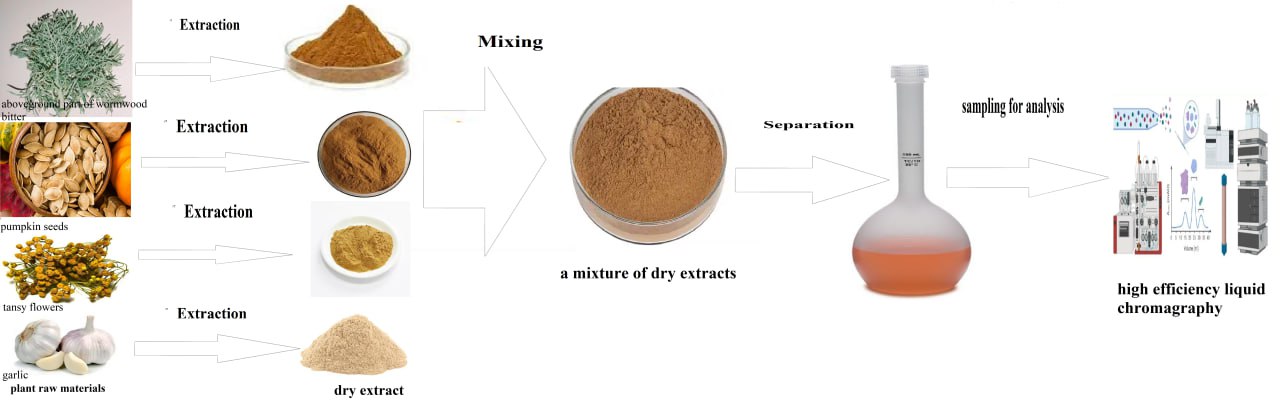
Materials and methods. Two different methods for obtaining dry extract (DE) "Helmint-ART" from plant raw materials: the aerial part of wormwood, pumpkin seeds, tansy flowers and garlic bulbs were used. The first method: prepare an extract of plants raw materials and then prepare DE substance from them. The second method: a separate DE was obtained from each selected object and then mixed in a certain ratio. Quantitative indicators of biologically active substances were determined with high-performance liquid chromatography. The study of anthelmintic effect of the DE "Helmint-ART" was carried out on intestinal parasitosis experimental models in mice: hymenolepidosis (causative agent Hymenolepis nana) and aspiculurosis (causative agent Aspiculuris tetraptera).
Results. It was found that the second method for obtaining DE named "Helminth-ART" was optimal.
Determination the "acute" toxicity showed that DE "Helminth-ART" at a dose 3000 mg/kg do not cause changes in animal’s behavior and their death. Anti-cestode activity of DE "Helmint-ART" was 74.9 % and was slightly higher (statistically unreliable) than that of comparison drug Fenasal (71.2 %) and significantly exceeded that of the infusions of common tansy flowers (50.2 %), pumpkin seeds (56.8 %). Anti-nematodosis activity (90.2 %) of DE "Helminth-ART" significantly exceeded the activity of infusions of tansy flowers (68.6 %), pumpkin seeds (76.9 %), Pyrantel (80.1 %).
Conclusions. The optimal method of the technology of the DE "Gelmint-ART" was determined based on a comparison of two methods. The second method is optimal in terms of economy of extractants, high proportion of the DE released, their quality indicators, content of the biologically active substance luteolin.
The pronounced DE "Helmint-ART" anthelmintic effect and acceptable acute toxicity were established
References
- Hotez, P. J., Brindley, P. J., Bethony, J. M., King, C. H., Pearce, E. J., Jacobson, J. (2008). Helminth infections: the great neglected tropical diseases. Journal of Clinical Investigation, 118 (4), 1311–1321. https://doi.org/10.1172/jci34261
- Jourdan, P. M., Lamberton, P. H. L., Fenwick, A., Addiss, D. G. (2018). Soil-transmitted helminth infections. The Lancet, 391 (10117), 252–265. https://doi.org/10.1016/s0140-6736(17)31930-x
- Yuldasheva, Sh. Kh. (2020). Razrabotka sostava y tekhnolohyy nastoiky na osnove pryrodnoho rastytelnoho sыria. Liky – liudyni. Suchasni problemy farmakoterapii i pryznachennia likarskykh zasobiv». Kharkiv: NFaU, 2, 645–646.
- Akhmadova, G., Mirrakhimova, T., Ismoilova, G. (2024). High-quality analysis of dry extract of prickly artichoke raw material (Cynara Scolymus L.) cultivated in Uzbekistan. ScienceRise: Pharmaceutical Science, 4 (50), 60–66. https://doi.org/10.15587/2519-4852.2024.310826
- Azizi, K., Shahidi-Hakak, F., Asgari, Q., Hatam, G. R., Fakoorziba, M. R., Miri, R., Moemenbellah-Fard, M. D. (2014). In vitro efficacy of ethanolic extract of Artemisia absinthium (Asteraceae) against Leishmania major L. using cell sensitivity and flow cytometry assays. Journal of Parasitic Diseases, 40 (3), 735–740. https://doi.org/10.1007/s12639-014-0569-5
- Ali, S. I., Gopalakrishnan, B., Venkatesalu, V. (2018). Chicory (Cichorium intybus) and wormwood (Artemisia absinthium) extracts exhibit strong larvicidal activity against mosquito vectors of malaria, dengue fever, and filariasis. Parasitology International, 67 (6), 781–786. https://doi.org/10.1016/j.parint.2018.08.005
- Ahamad, J., Naquvi, K., Ali, M., Mir, S. (2014). New Glycoside Esters from the Aerial Parts of Artemisia absinthium Linn. The Natural Products Journal, 3 (4), 260–267. https://doi.org/10.2174/221031550304140328113518
- Fernández-Calienes Valdés, A., Mendiola Martínez, J., Scull Lizama, R., Vermeersch, M., Cos, P., Maes, L. (2008). In vitro anti-microbial activity of the Cuban medicinal plants Simarouba glauca DC, Melaleuca leucadendron L and Artemisia absinthium L. Memórias Do Instituto Oswaldo Cruz, 103 (6), 615–618. https://doi.org/10.1590/s0074-02762008000600019
- Rocha, L. G., Almeida, J. R. G. S., Macêdo, R. O., Barbosa-Filho, J. M. (2005). A review of natural products with antileishmanial activity. Phytomedicine, 12 (6-7), 514–535. https://doi.org/10.1016/j.phymed.2003.10.006
- Tariku, Y., Hymete, A., Hailu, A., Rohloff, J. (2011). In vitro Evaluation of Antileishmanial Activity and Toxicity of Essential Oils of Artemisia absinthium and Echinops kebericho. Chemistry & Biodiversity, 8 (4), 614–623. https://doi.org/10.1002/cbdv.201000331
- Sushynskaia, O. A., Holiak, N. S. (2023). Technology of Obtaining Liquid Extract of Wormwood and Determination of its Quality Indicators. Recipe, 26 (4), 474–483. https://doi.org/10.34883/pi.2023.26.4.008
- Salehi, B., Capanoglu, E., Adrar, N., Catalkaya, G., Shaheen, S., Jaffer, M. et al. (2019). Cucurbits Plants: A Key Emphasis to Its Pharmacological Potential. Molecules, 24 (10), 1854. https://doi.org/10.3390/molecules24101854
- Iuldasheva, Sh. Kh. (2019). Tekhnologiia i otcenka kachestva slozhnoi nastoiki na osnove travy polyni gorkoi i semian tykvy. Nauka i obrazovanie v sovremennom mire. Karaganda: Akademiia “Bolashak”. Bolashak Basgy, 144–146.
- Godinho, L. S., Aleixo de Carvalho, L. S., Barbosa de Castro, C. C., Dias, M. M., Pinto, P. de F., Crotti, A. E. M. et al. (2014). Anthelmintic Activity of Crude Extract and Essential Oil ofTanacetum vulgare(Asteraceae) against Adult Worms ofSchistosoma mansoni. The Scientific World Journal, 2014, 1–9. https://doi.org/10.1155/2014/460342
- Iuldasheva, Sh. Kh., Tykhtaev, Kh. R. (2021). Dastarbosh gullaridan kuruk ekstrakt olishning mytadil usullarini yrganish va uning sifat taҳlili. Farmatcevtika zhurnali, 3, 75–84.
- Zolotaikina, M. Yu., Hontova, T. M., Kotov, A. H., Ilyina, T. V., Kryvoruchko, O. V. (2017). Study of dry extract of tansy (Tanacetum vulgare) using the method of highperformance liquid chromatography. Der Pharma Chemica, 9 (11), 1–4.
- Oosthuizen, C. B., Reid, A.-M., Lall, N. (2018). Garlic ( Allium sativum ) and Its Associated Molecules, as Medicine. Medicinal Plants for Holistic Health and Well-Being, 277–295. https://doi.org/10.1016/b978-0-12-812475-8.00009-3
- Urban, J., Kokoska, L., Langrova, I., Matejkova, J. (2008). In VitroAnthelmintic Effects of Medicinal Plants Used in Czech Republic. Pharmaceutical Biology, 46 (10-11), 808–813. https://doi.org/10.1080/13880200802315618
- Iuldasheva, Sh. Kh., Tykhtaev, Kh. R. (2022). Artemisia absinthium ysimlik khomashesidan kuruk ekstrakt olish tekhnologiiasi va sifat taxlili. Farmatcevtika khabarnomasi, 1, 45–51.
- Iuldasheva, Sh. Kh., Tykhtaev, Kh. R., Sotimov, G. B. (2022). Gelmintga karshi dori vositasi tarkibiga kiruvchi kovok ururi kuruk ekstrakti mytadil tekhnologiiasini yrganish. Farmatcevtika zhurnali, 1, 113–118.
- Klongsiriwet, C., Quijada, J., Williams, A. R., Mueller-Harvey, I., Williamson, E. M., Hoste, H. (2015). Synergistic inhibition of Haemonchus contortus exsheathment by flavonoid monomers and condensed tannins. International Journal for Parasitology: Drugs and Drug Resistance, 5 (3), 127–134. https://doi.org/10.1016/j.ijpddr.2015.06.001
- Yuldasheva, Sh. X., Tuxtaev, X. R. (2024). Studying the Technology of Obtaining a Mixture of Dry Extracts Against Helminths. Central Asian Journal of Medical and Natural Science, 5 (3), 570–575.
- Islamova, J. I. (2020). Pharmacological assessment of antiparasitic and prebiotic activity of plant substances of terpenoid, polyphenolic and carbohydrate nature. [Dissertation abstract of the doctor of sciences (DSc) on medical sciences].
- State Register of medicines and medical devices and medical equipment, approved for use in medical practice of the Republic of Uzbekistan (2021). Тashkent: «МUXR PRESS», 1067.
- Yuldasheva, Sh. X., Tuxtaev, X. R. (2024). Studies on the determination of the cumulative properties of the dry extract "Helminth-ART". European Journal of Medical Genetics and Clinical Biology, 1 (7). https://doi.org/10.61796/jmgcb.v1i7.696
Downloads
Published
How to Cite
Issue
Section
License
Copyright (c) 2025 Shaxlo Yuldasheva, Khakim Tukhtaev

This work is licensed under a Creative Commons Attribution 4.0 International License.
Our journal abides by the Creative Commons Attribution 4.0 International License copyright rights and permissions for open access journals.
Authors, who are published in this journal, agree to the following conditions:
1. The authors reserve the right to authorship of the work and pass the first publication right of this work to the journal under the terms of a Creative Commons Attribution 4.0 International License, which allows others to freely distribute the published research with the obligatory reference to the authors of the original work and the first publication of the work in this journal.
2. The authors have the right to conclude separate supplement agreements that relate to non-exclusive work distribution in the form in which it has been published by the journal (for example, to upload the work to the online storage of the journal or publish it as part of a monograph), provided that the reference to the first publication of the work in this journal is included.
3. Authors have the right to store the final accepted version of the article in an institutional, thematic, or any other repository to ensure visibility and accessibility.