Determination of amino acids content of the Mahonia aquifolium by GC/MS
DOI:
https://doi.org/10.15587/2519-4852.2025.327913Keywords:
Mahonia aquifolium, flowers, leaves, fruits, free amino acids, bound amino acids, GC/MSAbstract
Medicinal plants are unique sources of healing compounds that are used both for the prevention and treatment of various diseases of the human body. In this regard, one of the oldest medicinal plant families - Berberidaceae, is of great interest. The genus Mahonia Nuttall is the second largest genus in the Berberidaceae family and contains nearly 70 species which are used in traditional medicine. Mahonia aquifolium (Pursh) Nutt. (M. aquifolium) is one of the most abundant and cultivated medicinal plants of the genus Mahonia. There is insufficient information in the literature on the biologically active substances of Mahonia aquifolium. The studies of the Mahonia species have focused on alkaloids, such as berberine, jatrorrhizine, and palmatine, which are the main constituents of compounds. The Mahonia aquifolium, as an insufficiently studied plant, is a promising object of study, including amino acid composition.
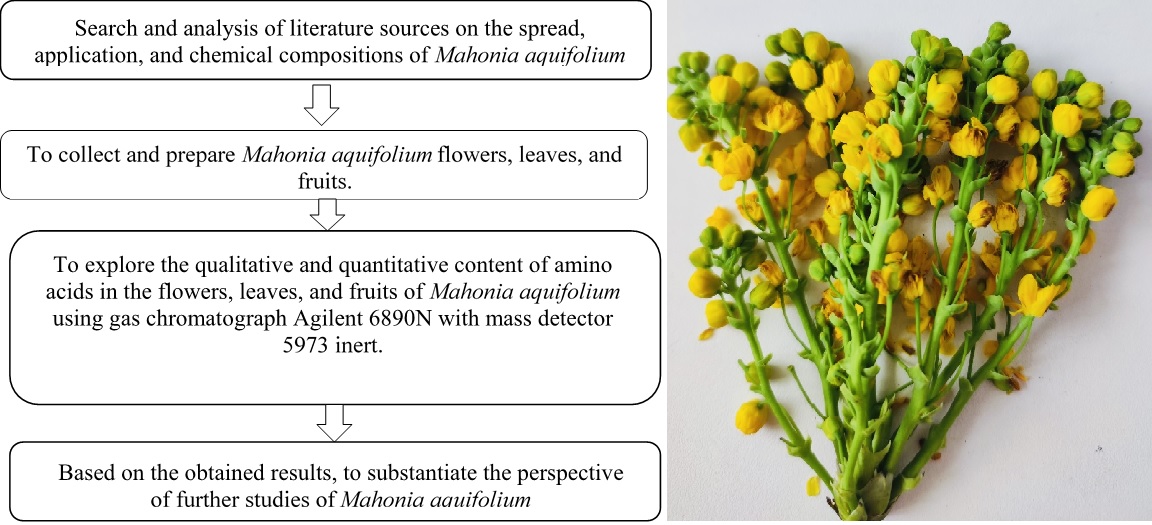
The aim. The aim of our study was to identify and determine the quantitative content of amino acids using the GC/MS method in Mahonia aquifolium fruits, flowers, and leaves.
Materials and methods. The determination of amino acids composition of Mahonia aquifolium was conducted using Agilent Technologies 6890 chromatograph with mass spectrometric detector 5973 (Agilent Technologies, USA).
Results. The results of the study revealed that the raw material of Mahonia aquifolium contains more bound and less free amino acids. Bound L-leucine was present in all the analyzed samples in the greatest amount (30.885 mg/g in the flowers, 37.765 mg/g in the leaves, and 29.053 mg/g in the fruits). L-proline was among the free amino acids with a high content in flowers (73.304 mg/g) and leaves (32.031 mg/g) of Mahonia aquifolium. In addition, a high content of glycine in free form was found in the fruits (12.212 mg/g) of the study plant.
Conclusions. Using the GC/MS method determined, the amino acids in the herb of Mahonia aquifolium. High L-proline, L-leucine, and L-aspartic acid concentrations predominate among free and bound amino acids in all the analyzed samples. These amino acids are considered distinguishing markers of the Mahonia aquifolium. This research contributes to using this plant's raw material for new remedies that may be possible in the future
References
- Slobodianiuk, L., Budniak, L., Feshchenko, H., Sverstiuk, A., Palaniza, Y. (2022). Quantitative analysis of fatty acids and monosaccharides composition in Chamerion angustifolium L. by GC/MS method. Pharmacia, 69 (1), 167–174. https://doi.org/10.3897/pharmacia.69.e76687
- Dulin, M. W., Kirchoff, B. K. (2010). Paedomorphosis, Secondary Woodiness, and Insular Woodiness in Plants. The Botanical Review, 76 (4), 405–490. https://doi.org/10.1007/s12229-010-9057-5
- Andreicuţ, A.-D., Pârvu, A. E., Moț, A. C., Pârvu, M., Fischer-Fodor, E., Feldrihan, V. et al. (2018). Anti-inflammatory and antioxidant effects of Mahonia aquifolium leaves and bark extracts. Farmacia, 66 (1), 49–58.
- Cecan, A.-D., Pârvu, A. E., Pârvu, M., Fischer, F. E., Pațiu, M. et al. (2018). Mahonia Aquifolium Flowers Extract Effects in Acute Experimental Inflammation. Bulletin of University of Agricultural Sciences and Veterinary Medicine Cluj-Napoca. Food Science and Technology, 75 (2), 189. https://doi.org/10.15835/buasvmcn-fst:2018.0019
- Hu, W., Yu, L., Wang, M.-H. (2011). Antioxidant and antiproliferative properties of water extract from Mahonia bealei (Fort.) Carr. leaves. Food and Chemical Toxicology, 49 (4), 799–806. https://doi.org/10.1016/j.fct.2010.12.001
- Bajpai, D., Vankar, P. S. (2007). Antifungal textile dyeing withMahonia napaulensis D.C. leaves extract based on its antifungal activity. Fibers and Polymers, 8 (5), 487–494. https://doi.org/10.1007/bf02875870
- He, J.-M., Mu, Q. (2015). The medicinal uses of the genus Mahonia in traditional Chinese medicine: An ethnopharmacological, phytochemical and pharmacological review. Journal of Ethnopharmacology, 175, 668–683. https://doi.org/10.1016/j.jep.2015.09.013
- Gulliver, W. P., Donsky, H. J. (2005). A Report on Three Recent Clinical Trials Using Mahonia aquifolium 10 % Topical Cream and a Review of the Worldwide Clinical Experience With Mahonia aquifolium for the Treatment of Plaque Psoriasis. American Journal of Therapeutics, 12 (5), 398–406. https://doi.org/10.1097/01.mjt.0000174350.82270.da
- Andreicut, A.-D., Pârvu, A. E., Mot, A. C., Pârvu, M., Fischer Fodor, E., Cătoi, A. F. et al. (2018). Phytochemical Analysis of Anti‐Inflammatory and Antioxidant Effects of Mahonia aquifolium Flower and Fruit Extracts. Oxidative Medicine and Cellular Longevity, 2018 (1). https://doi.org/10.1155/2018/2879793
- Goetz, P., Ghedira, K. (2014). Mahonia aquifolium (Pursh) Nutt. (Berberidaceae) : Mahonia. Phytothérapie, 12 (3), 189–193. https://doi.org/10.1007/s10298-014-0865-3
- Pyrkosz-Biardzka, K., Kucharska, A., Sokół-Łętowska, A., Strugała, P., Gabrielska, J. (2014). A Comprehensive Study on Antioxidant Properties of Crude Extracts from Fruits of Berberis vulgaris L., Cornus mas L. and Mahonia aquifolimum Nutt. Polish Journal of Food and Nutrition Sciences, 64 (2), 91–99. https://doi.org/10.2478/v10222-012-0097-x
- Slobodianiuk, L., Budniak, L., Marchyshyn, S., Kostyshyn, L., Ezhned, M. (2021). Determination of amino acids content of the Tagetes lucida Cav. by GC/MS. Pharmacia, 68 (4), 859–867.
- Vancompernolle, B., Croes, K., Angenon, G. (2016). Optimization of a gas chromatography–mass spectrometry method with methyl chloroformate derivatization for quantification of amino acids in plant tissue. Journal of Chromatography B, 1017-1018, 241–249. https://doi.org/10.1016/j.jchromb.2016.02.020
- Budniak, L., Slobodianiuk, L., Marchyshyn, S., Demydiak, O., Dakhym, I. (2021). Determination of amino acids of some plants from Gentianaceae family. Pharmacia, 68 (2), 441–448. https://doi.org/10.3897/pharmacia.68.e67052
- Chen, W.-P., Yang, X.-Y., Hegeman, A. D., Gray, W. M., Cohen, J. D. (2010). Microscale analysis of amino acids using gas chromatography–mass spectrometry after methyl chloroformate derivatization. Journal of Chromatography B, 878 (24), 2199–2208. https://doi.org/10.1016/j.jchromb.2010.06.027
- Feshchenko, H., Oleshchuk, O., Slobodianiuk, L., Milian, I. (2021). Study of Epilobium angustifolium L. amino acids content by HPLC method. ScienceRise: Pharmaceutical Science, 6 (34), 85–90. https://doi.org/10.15587/2519-4852.2021.249836
- Budniak, L., Slobodianiuk, L., Marchyshyn, S., Potishnyi, I. (2022). Determination of amino acids of plants from Angelica L. genus by HPLC method. Pharmacia, 69 (2), 437–446. https://doi.org/10.3897/pharmacia.69.e83705
- Hayat, S., Hayat, Q., Alyemeni, M. N., Wani, A. S., Pichtel, J., Ahmad, A. (2012). Role of proline under changing environments. Plant Signaling & Behavior, 7 (11), 1456–1466. https://doi.org/10.4161/psb.21949
- Hare, P. D., Cress, W. A. (1997). Metabolic implications of stress-induced proline accumulation in plants. Plant Growth Regulation, 21, 79–102. https://doi.org/10.1023/a:1005703923347
- Martínez‐Chantar, M. L., Vázquez‐Chantada, M., Ariz, U., Martínez, N., Varela, M., Luka, Z. et al. (2008). Loss of the glycine N‐methyltransferase gene leads to steatosis and hepatocellular carcinoma in mice†. Hepatology, 47 (4), 1191–1199. https://doi.org/10.1002/hep.22159
- Walrand, S., Chiotelli, E., Noirt, F., Mwewa, S., Lassel, T. (2008). Consumption of a Functional Fermented Milk Containing Collagen Hydrolysate Improves the Concentration of Collagen-Specific Amino Acids in Plasma. Journal of Agricultural and Food Chemistry, 56 (17), 7790–7795. https://doi.org/10.1021/jf800691f
- de Aguiar Picanço, E., Lopes-Paulo, F., Marques, R. G., Diestel, C. F., Caetano, C. E. R., de Souza, M. V. M. et al. (2011). L-arginine and glycine supplementation in the repair of the irradiated colonic wall of rats. International Journal of Colorectal Disease, 26 (5), 561–568. https://doi.org/10.1007/s00384-011-1154-3
- Liang, C., Curry, B. J., Brown, P. L., Zemel, M. B. (2014). Leucine Modulates Mitochondrial Biogenesis and SIRT1-AMPK Signaling in C2C12 Myotubes. Journal of Nutrition and Metabolism, 2014, 1–11. https://doi.org/10.1155/2014/239750
- Pedroso, J., Zampieri, T., Donato, J. (2015). Reviewing the Effects of l-Leucine Supplementation in the Regulation of Food Intake, Energy Balance, and Glucose Homeostasis. Nutrients, 7 (5), 3914–3937. https://doi.org/10.3390/nu7053914
- Marchyshyn, S., Mysula, Y., Kishchuk, V., Slobodianiuk, L., Parashchuk, E., & Budniak, L. (2022). Investigation of amino acids content in the herb and tubers of Stachys sieboldii. Pharmacia, 69 (3), 665–672. https://doi.org/10.3897/pharmacia.69.e86227
- Han, J. M., Jeong, S. J., Park, M. C., Kim, G., Kwon, N. H., Kim, H. K. et al. (2012). Leucyl-tRNA Synthetase Is an Intracellular Leucine Sensor for the mTORC1-Signaling Pathway. Cell, 149 (2), 410–424. https://doi.org/10.1016/j.cell.2012.02.044
- Choi, S., Song, C. W., Shin, J. H., Lee, S. Y. (2015). Biorefineries for the production of top building block chemicals and their derivatives. Metabolic Engineering, 28, 223–239. https://doi.org/10.1016/j.ymben.2014.12.007
- Li, Y., Wei, H., Wang, T., Xu, Q., Zhang, C., Fan, X. et al. (2017). Current status on metabolic engineering for the production of l-aspartate family amino acids and derivatives. Bioresource Technology, 245, 1588–1602. https://doi.org/10.1016/j.biortech.2017.05.145
- kumar, P. P., Nika, B. M., Mangala, D. S. (2017). Production of Aspartic Acid-A Short Review. International Journal of Engineering Trends and Technology, 45 (6), 254–257. https://doi.org/10.14445/22315381/ijett-v45p253
- Appleton, H., Rosentrater, K. A. (2021). Sweet Dreams (Are Made of This): A Review and Perspectives on Aspartic Acid Production. Fermentation, 7 (2), 49. https://doi.org/10.3390/fermentation7020049
Downloads
Published
How to Cite
Issue
Section
License
Copyright (c) 2025 Yelyzaveta Lastovychenko, Svitlana Marchyshyn, Liudmyla Slobodianiuk, Liliia Budniak, Vitaliy Kischuk, Olena Hlushchenko, Oksana Doroshenko

This work is licensed under a Creative Commons Attribution 4.0 International License.
Our journal abides by the Creative Commons Attribution 4.0 International License copyright rights and permissions for open access journals.
Authors, who are published in this journal, agree to the following conditions:
1. The authors reserve the right to authorship of the work and pass the first publication right of this work to the journal under the terms of a Creative Commons Attribution 4.0 International License, which allows others to freely distribute the published research with the obligatory reference to the authors of the original work and the first publication of the work in this journal.
2. The authors have the right to conclude separate supplement agreements that relate to non-exclusive work distribution in the form in which it has been published by the journal (for example, to upload the work to the online storage of the journal or publish it as part of a monograph), provided that the reference to the first publication of the work in this journal is included.
3. Authors have the right to store the final accepted version of the article in an institutional, thematic, or any other repository to ensure visibility and accessibility.