Study of ascorbic acid in commercially available edible berries, fruits, and vegetables
DOI:
https://doi.org/10.15587/2519-4852.2025.346952Keywords:
ascorbic acid, berries, fruits, vegetables, HPLCAbstract
Vitamin C, or ascorbic acid, is among the most essential and widely recognized compounds required for the healthy functioning of the human body. Consequently, vitamin C must be obtained through dietary sources or supplementation. Rich sources of ascorbic acid include a variety of fresh fruits and vegetables. It is advisable to investigate the content of ascorbic acid in the most common commercially available edible berries, fruits, and vegetables using the European Pharmacopoeia HPLC method.
The aim. The aim of this study is to perform a comparative analysis of the ascorbic acid content in commercially available edible berries, fruits, and vegetables on the Estonian market using the European Pharmacopoeia's HPLC method, and to identify the products richest in this vitamin. Such findings will enhance the knowledge of both consumers and researchers regarding the most promising dietary sources of vitamin C.
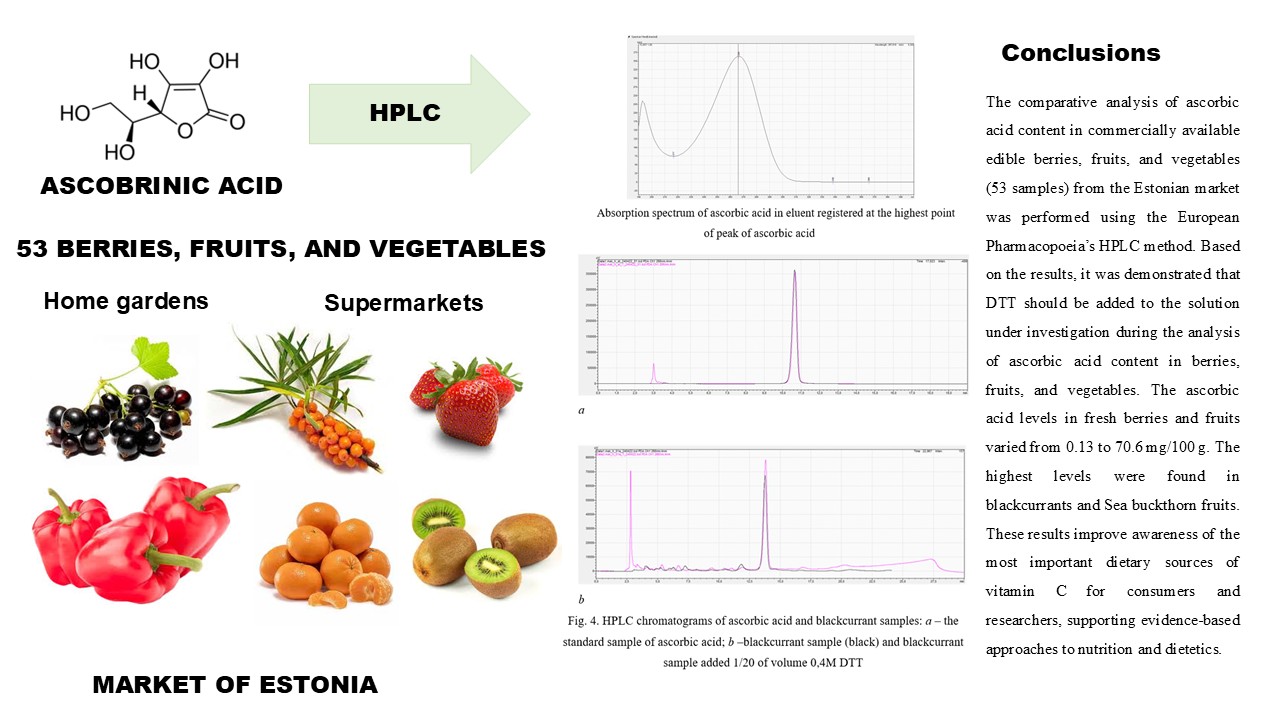
Materials and methods. Fifty-three samples of berries, fruits, and vegetables commercially available on the Estonian market have been studied. Quantitative analysis of ascorbic acid was performed using the HPLC method.
Results. This study evaluated the ascorbic acid content of commercially available and home-grown berries, fruits, and vegetables in Estonia. The highest levels were found in blackcurrants (70.6 ± 7 mg/100 g in garden samples and 53.3 ± 5 mg/100 g in market samples) and Sea buckthorn fruits (49 ± 6 mg/100 g (garden) and 43.8 ± 2 mg/100 g (market)). In general, home-grown berries and fruits were richer in ascorbic acid. Supermarket produce generally contained lower levels, although mandarins (24 mg/100 g) and red pepper (48 mg/100 g) were the richest sources. The study also demonstrated that the addition of dithiothreitol (DTT) makes the analytical results more informative. The experimental data obtained provide an overview and allow the ranking of commercially available edible berries, fruits, and vegetables according to their ascorbic acid content.
Conclusions. A comparative analysis of ascorbic acid content in 53 berries, fruits, and vegetables from the Estonian market was conducted using the European Pharmacopoeia's HPLC method. The richest dietary sources of vitamin C have been identified, providing valuable insights for both consumers and researchers and supporting rational approaches to nutrition and dietetics
Supporting Agency
- This work was supported by the European Union in the MSCA4Ukraine project “Design and development of 3D-printed medicines for bioactive materials of Ukrainian and Estonian medicinal plants origin” [ID number 1232466].
References
- Gęgotek, A., Skrzydlewska, E. (2023). Ascorbic acid as antioxidant. Vitamins and hormones. Elsevier, 247–270.
- Hoffer, A. (1989). The discovery of vitamin C: Albert Szent-Györgyi, M.D., Ph.D. 1893–1986. Journal of Orthomolecular Medicine, 4 (1), 24–26.
- May, J. M., Harrison, F. E. (2013). Role of Vitamin C in the Function of the Vascular Endothelium. Antioxidants & Redox Signaling, 19 (17), 2068–2083. https://doi.org/10.1089/ars.2013.5205
- Ströhle, A., Hahn, A. (2009). Vitamin C and immune function. Medizinische Monatsschrift für Pharmazeuten, 32 (1), 49–54.
- Crisan, D., Roman, I., Scharffetter-Kochanek, K., Crisan, M., & Badea, R. (2015). The role of vitamin C in pushing back the boundaries of skin aging: an ultrasonographic approach. Clinical, Cosmetic and Investigational Dermatology, 8, 463–470. https://doi.org/10.2147/ccid.s84903
- Juraschek, S. P., Guallar, E., Appel, L. J., Miller, E. R. (2012). Effects of vitamin C supplementation on blood pressure: a meta-analysis of randomized controlled trials. The American Journal of Clinical Nutrition, 95 (5), 1079–1088. https://doi.org/10.3945/ajcn.111.027995
- Ang, A., Pullar, J. M., Currie, M. J., Vissers, M. C. M. (2018). Vitamin C and immune cell function in inflammation and cancer. Biochemical Society Transactions, 46 (5), 1147–1159. https://doi.org/10.1042/bst20180169
- Lamarche, J., Nair, R., Peguero, A., Courville, C. (2011). Vitamin C-Induced Oxalate Nephropathy. International Journal of Nephrology, 2011, 1–4. https://doi.org/10.4061/2011/146927
- Carr, A., Maggini, S. (2017). Vitamin C and Immune Function. Nutrients, 9 (11), 1211. https://doi.org/10.3390/nu9111211
- Nowak, D. (2021). Vitamin C in Human Health and Disease. Nutrients, 13 (5), 1595. https://doi.org/10.3390/nu13051595
- Lee, W. J. (2019). Vitamin C in human health and disease: Effects, mechanisms of action, and new guidance on intake. Springer Dordrecht, 184. https://doi.org/10.1007/978-94-024-1713-5
- Doseděl, M., Jirkovský, E., Macáková, K., Krčmová, L., Javorská, L., Pourová, J. et al. (2021). Vitamin C—Sources, Physiological Role, Kinetics, Deficiency, Use, Toxicity, and Determination. Nutrients, 13 (2), 615. https://doi.org/10.3390/nu13020615
- Granger, M., Eck, P. (2018). Dietary vitamin C in human health. Advances in food and nutrition research. Elsevier, 281–310. https://doi.org/10.1016/bs.afnr.2017.11.006
- Vlasova, I., Gontova, T., Grytsyk, L., Zhumashova, G., Sayakova, G., Boshkayeva, A. et al. (2022). Determination of standardization parameters of Oxycoccus macrocarpus (Ait.) Pursh and Oxycoccus palustris Pers. Leaves. ScienceRise: Pharmaceutical Science, 3 (37), 48–57. https://doi.org/10.15587/2519-4852.2022.260352
- Paciolla, C., Fortunato, S., Dipierro, N., Paradiso, A., De Leonardis, S., Mastropasqua, L.,de Pinto, M. C. (2019). Vitamin C in Plants: From Functions to Biofortification. Antioxidants, 8 (11), 519. https://doi.org/10.3390/antiox8110519
- Belwal, T., Devkota, H. P., Hassan, H. A., Ahluwalia, S., Ramadan, M. F., Mocan, A., Atanasov, A. G. (2018). Phytopharmacology of Acerola ( Malpighia spp. ) and its potential as functional food. Trends in Food Science & Technology, 74, 99–106. https://doi.org/10.1016/j.tifs.2018.01.014
- Ain, R., Meos, A., Vutt, A., Kirsimäe, H., Ilina, Т., Kovaleva, A., Koshovyi, O. (2024). The content and stability of ascorbic acid in commercial food supplements. ScienceRise: Pharmaceutical Science, 5 (51), 28–37. https://doi.org/10.15587/2519-4852.2024.313637
- European Pharmacopoeia (2022). Strasbourg: Council of Europe.
- Golubitskii, G. B., Budko, E. V., Basova, E. M., Kostarnoi, A. V., Ivanov, V. M. (2007). Stability of ascorbic acid in aqueous and aqueous-organic solutions for quantitative determination. Journal of Analytical Chemistry, 62 (8), 742–747. https://doi.org/10.1134/s1061934807080096
- Meos, A., Zaharova, I., Kask, M., Raal, A. (2017). Content of Ascorbic Acid in Common Cowslip (Primula veris L.) Compared to Common Food Plants and Orange Juices. Acta Biologica Cracoviensia s. Botanica, 59 (1), 113–120. https://doi.org/10.1515/abcsb-2016-0020
- Raal, A., Nisuma, K., Meos, A. (2018). Pinus sylvestris L. and other conifers as natural sources of ascorbic acid. Journal of Pharmacy & Pharmacognosy Research, 6 (2), 89–95. https://doi.org/10.56499/jppres17.287_6.2.89
- Vinogradov, M., Arus, L., Raal, A., Meos, A., Starast, M. (2020). Physio-chemical characteristics of strawberry and raspberry: comparison of local and commercial cultivars with their wild relatives in Estonia. Proceedings of the Estonian Academy of Sciences, 69 (3), 197–207. https://doi.org/10.3176/proc.2020.3.03
- Hägg, M., Ylikoski, S., Kumpulainen, J. (1995). Vitamin C Content in Fruits and Berries Consumed in Finland. Journal of Food Composition and Analysis, 8 (1), 12–20. https://doi.org/10.1006/jfca.1995.1003
Downloads
Published
How to Cite
Issue
Section
License
Copyright (c) 2025 Ain Raal, Meos Andres, Kreete-Lisett Remmelgas, Anastasia Polubinskaja, Yevheniia Koshova, Uliana Sikoryn, Oleh Koshovyi

This work is licensed under a Creative Commons Attribution 4.0 International License.
Our journal abides by the Creative Commons Attribution 4.0 International License copyright rights and permissions for open access journals.
Authors, who are published in this journal, agree to the following conditions:
1. The authors reserve the right to authorship of the work and pass the first publication right of this work to the journal under the terms of a Creative Commons Attribution 4.0 International License, which allows others to freely distribute the published research with the obligatory reference to the authors of the original work and the first publication of the work in this journal.
2. The authors have the right to conclude separate supplement agreements that relate to non-exclusive work distribution in the form in which it has been published by the journal (for example, to upload the work to the online storage of the journal or publish it as part of a monograph), provided that the reference to the first publication of the work in this journal is included.
3. Authors have the right to store the final accepted version of the article in an institutional, thematic, or any other repository to ensure visibility and accessibility.


