Improvement of the model of structural-mechanical and thixotropic properties of meat batters
DOI:
https://doi.org/10.15587/2706-5448.2026.353165Keywords:
thixotropy, meat product, sausage products, meat batter, rheological parameters, structural and mechanical propertiesAbstract
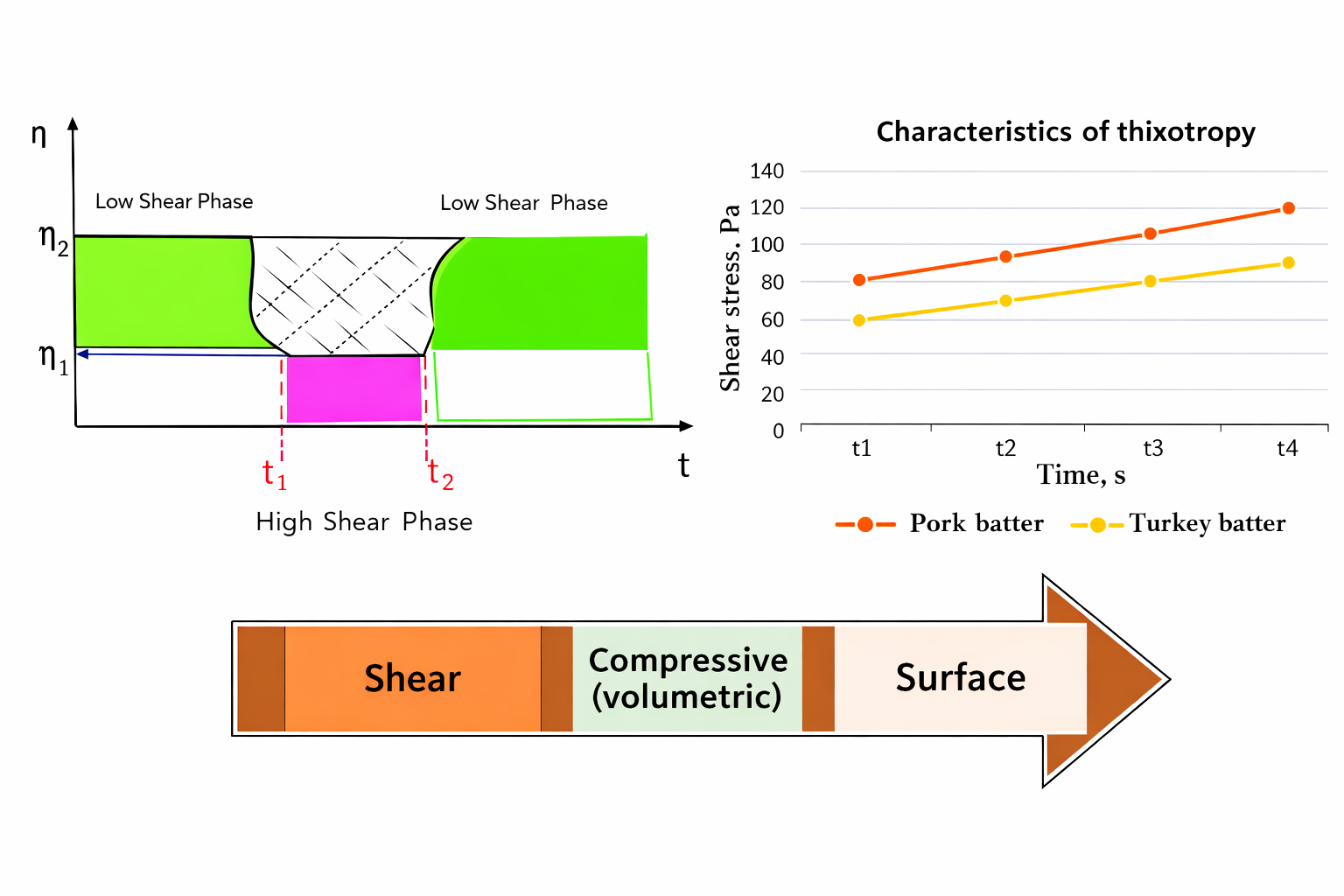
The object of research is the thixotropy of meat batters with different ingredient compositions characteristic of sausage products. The research analyzes modern approaches to evaluating the rheological properties of meat emulsion systems and summarizes the factors influencing their structural organization. The regularities of changes in viscous-plastic characteristics of pork and turkey batters under different levels of load are investigated, and the features of structural destruction and recovery are established.
A comprehensive assessment of thixotropic properties is based on the analysis of the structural-mechanical characteristics of batter systems during their formation with various ingredients. It has been demonstrated that the thixotropic state depends on the concentration of protein components and the degree of hydration of the protein system, which determines the stability of the sausage matrix during mechanical processing. The shear stress was calculated for time intervals in the range of 1–1000 s. The output parameters of the proposed model were adapted to the properties of soft meat batters: for minced pork, coefficients A = 80 Pa and B = –12 were adopted, and for minced turkey, A = 60 Pa and B = –9. Since the value of B is negative for both types of raw materials, this confirms the presence of pronounced thixotropic properties in the studied systems. Controlling these parameters allows regulation of the thixotropy of the batter to achieve optimal consistency and structural stability of the finished product.
Thixotropic properties play a crucial role in technological operations, including grinding, mixing, filling casings, and structure formation during thermal processing. Excessive structural stability complicates processing, while excessive thixotropy reduces the shape retention of products. The determination of rheological parameters allows predicting the behavior of batter systems under production conditions, ensuring stable texture and high product quality. The results obtained have practical value for optimizing technological regimes in sausage production and developing new products with predictable rheological properties.
References
- Warren, S. E., Bowker, B., Mohan, A. (2020). Physicochemical properties of beef Tongue as a value-added meat product. Journal of Food Composition and Analysis, 88. https://doi.org/10.1016/j.jfca.2020.103433
- Köppel, R., Ganeshan, A., Weber, S., Pietsch, K., Graf, C., Hochegger, R. et al. (2019). Duplex digital PCR for the determination of meat proportions of sausages containing meat from chicken, turkey, horse, cow, pig and sheep. European Food Research and Technology, 245 (4), 853–862. https://doi.org/10.1007/s00217-018-3220-3
- Harastani, R., James, L. J., Walton, J., Woolley, E. (2020). Tackling obesity: A knowledge-base to enable industrial food reformulation. Innovative Food Science & Emerging Technologies, 64. https://doi.org/10.1016/j.ifset.2020.102433
- Carvalho-Ferreira, J. P. de, da Cunha, D. T., Finlayson, G., Caldas, G., Jamar, G., Bandoni, D. H. et al. (2020). Differential impact of consuming foods perceived to be high or low in fat on subsequent food reward. Food Quality and Preference, 85. https://doi.org/10.1016/j.foodqual.2020.103977
- Rather, S. A., Masoodi, F. A., Rather, J. A., Gani, A., Wani, S. M., Ganaie, T. A., Akhter, R. (2021). Impact of thermal processing and storage on fatty acid composition and cholesterol oxidation of canned traditional low-fat meat product of India. LWT, 139. https://doi.org/10.1016/j.lwt.2020.110503
- Baune, M.-C., Schroeder, S., Witte, F., Heinz, V., Bindrich, U., Weiss, J., Terjung, N. (2021). Analysis of protein-network formation of different vegetable proteins during emulsification to produce solid fat substitutes. Journal of Food Measurement and Characterization, 15 (3), 2399–2416. https://doi.org/10.1007/s11694-020-00767-9
- Boukid, F. (2021). Plant-based meat analogues: from niche to mainstream. European Food Research and Technology, 247 (2), 297–308. https://doi.org/10.1007/s00217-020-03630-9
- He, J., Evans, N. M., Liu, H., Shao, S. (2020). A review of research on plant‐based meat alternatives: Driving forces, history, manufacturing, and consumer attitudes. Comprehensive Reviews in Food Science and Food Safety, 19 (5), 2639–2656. https://doi.org/10.1111/1541-4337.12610
- Berger, L. M., Gibis, M., Witte, F., Terjung, N., Weiss, J. (2022). Influence of meat batter addition in ground beef on structural properties and quality parameters. European Food Research and Technology, 248 (10), 2509–2520. https://doi.org/10.1007/s00217-022-04065-0
- Witte, F., Smetana, S., Heinz, V., Terjung, N. (2020). High-pressure processing of usually discarded dry aged beef trimmings for subsequent processing. Meat Science, 170. https://doi.org/10.1016/j.meatsci.2020.108241
- Nortjé, G. L., Nel, L., Jordaan, E., Naudé, R. T., Holzapfel, W. H., Grimbeek, R. J. (1989). A microbiological survey of fresh meat in the supermarket trade. Part 2: beef retail cuts. Meat Science, 25 (2), 99–112. https://doi.org/10.1016/0309-1740(89)90025-9
- Zerabruk, K., Retta, N., Muleta, D., Tefera, A. T. (2019). Assessment of Microbiological Safety and Quality of Minced Meat and Meat Contact Surfaces in Selected Butcher Shops of Addis Ababa, Ethiopia. Journal of Food Quality. https://doi.org/10.1155/2019/3902690
- Terjung, N., Witte, F., Heinz, V. (2021). The dry aged beef paradox: Why dry aging is sometimes not better than wet aging. Meat Science, 172. https://doi.org/10.1016/j.meatsci.2020.108355
- Berger, L. M., Witte, F., Terjung, N., Weiss, J., Gibis, M. (2022). Influence of Processing Steps on Structural, Functional, and Quality Properties of Beef Hamburgers. Applied Sciences, 12 (15), 7377. https://doi.org/10.3390/app12157377
- Davey, C. L., Gilbert, K. V. (1974). Temperature‐dependent cooking toughness in beef. Journal of the Science of Food and Agriculture, 25 (8), 931–938. Portico. https://doi.org/10.1002/jsfa.2740250808
- Herrero, A. M., Carmona, P., López-López, I., Jiménez-Colmenero, F. (2008). Raman Spectroscopic Evaluation of Meat Batter Structural Changes Induced by Thermal Treatment and Salt Addition. Journal of Agricultural and Food Chemistry, 56 (16), 7119–7124. https://doi.org/10.1021/jf800925s
- Tornberg, E. (2005). Effects of heat on meat proteins – Implications on structure and quality of meat products. Meat Science, 70 (3), 493–508. https://doi.org/10.1016/j.meatsci.2004.11.021
- Beneke, B. (2018). Technology alters muscle structure: Histological identification and evaluation of meat and meat products. Fleischwirtschaft, 2, 62–68.
- Foegeding, E. A. (1988). Gelation in meat batters. Reciprocal Meat Conference Proceedings, Vol. 41. Laramie, 44–47.
- Honikel, K. O., Hamm, R.; Pearson, A. M., Dutson, T. R. (Eds.) (1994). Measurement of water-holding capacity and juiciness. Quality Attributes and Their Measurement in Meat, Poultry and Fish Products. Boston: Springer, 125–161. https://doi.org/10.1007/978-1-4615-2167-9_5
- Knipe, C. L.; Dikemann, M. (Ed.) (2024). Sausages, types of: Emulsion. Encyclopedia of Meat Sciences. Amsterdam: Elsevier, 425–430. https://doi.org/10.1016/b978-0-323-85125-1.00160-5
- Tyszkiewicz, I., Kłossowska, B. M., Wieczorek, U., Jakubiec‐Puka, A. (1997). Mechanical Tenderisation of Pork Meat: Protein and Water Release due to Tissue Damage. Journal of the Science of Food and Agriculture, 73 (2), 179–185. Available at: https://doi.org/10.1002/(sici)1097-0010(199702)73:2<179::aid-jsfa699>3.0.co;2-#
- Raudsepp, P., Brüggemann, D. A., Henckel, P., Vyberg, M., Groves, K., Oksbjerg, N., Therkildsen, M. (2017). Performance of conventional histochemical methods relative to a novel immunolabeling technique in assessing degree of degradation in comminuted chicken meat. Food Control, 73, 133–139. https://doi.org/10.1016/j.foodcont.2016.07.036
- Irmscher, S. B., Böjthe, Z., Herrmann, K., Gibis, M., Kohlus, R., Weiss, J. (2013). Influence of filling conditions on product quality and machine parameters in fermented coarse meat emulsions produced by high shear grinding and vacuum filling. Journal of Food Engineering, 117 (3), 316–325. https://doi.org/10.1016/j.jfoodeng.2013.03.015
- Leseigneur-Meynier, A., Gandemer, G. (1991). Lipid composition of pork muscle in relation to the metabolic type of the fibres. Meat Science, 29 (3), 229–241. https://doi.org/10.1016/0309-1740(91)90052-r
- Melro, E., Antunes, F., Cruz, I., Ramos, P. E., Carvalho, F., Alves, L. (2020). Morphological, textural and physico-chemical characterization of processed meat products during their shelf life. Food Structure, 26. https://doi.org/10.1016/j.foostr.2020.100164
- Hamm, R. (1975). On the rheology of minced meat. Journal of Texture Studies, 6 (3), 281–296. https://doi.org/10.1111/j.1745-4603.1975.tb01126.x
- Irmscher, S. B., Gibis, M., Herrmann, K., Kohlus, R., Weiss, J. (2016). Development of a novel homogenizer using the vane pump-grinder technology for the production of meat batter. Journal of Food Engineering, 169, 10–17. https://doi.org/10.1016/j.jfoodeng.2015.08.022
- Krökki, A. S. (1995). Fat Concentration in Commercial Minced Meat. Lipid / Fett, 97 (12), 466–467. https://doi.org/10.1002/lipi.2700971210
- Cao, C., Xu, Y., Kong, B., Xia, X., Chen, Q., Zhang, H., Liu, Q. (2023). Changes of rheological behavior, thermal and microstructural properties of myofibrillar protein-κ-carrageenan mixed sol as mediated by NaCl concentration. Food Bioscience, 55. https://doi.org/10.1016/j.fbio.2023.103035
- Momcilova, M. M., Gardinarska-Ivanova, D. N., Yordanov, D. G., Zsivanovits, G. I. (2023). Microstructure and technological properties of cooked meat sausages prepared with emulsions of vegetable oils as substitutes for animal fat. Food Research, 7 (4), 22–29. https://doi.org/10.26656/fr.2017.7(4).1030
- de Huidobro, F. R., Miguel, E., Blázquez, B., Onega, E. (2005). A comparison between two methods (Warner–Bratzler and texture profile analysis) for testing either raw meat or cooked meat. Meat Science, 69 (3), 527–536. https://doi.org/10.1016/j.meatsci.2004.09.008
- Dzudie, T., Scher, J., Hardy, J., Sanchez, C. (2000). Physico‐chemical and rheological properties of low‐fat, high‐added water beef sausage extended with common bean flour. Journal of Muscle Foods, 11 (2), 129–142. https://doi.org/10.1111/j.1745-4573.2000.tb00420.x
- Profeta, A., Baune, M.-C., Smetana, S., Bornkessel, S., Broucke, K., Van Royen, G., Enneking, U., Weiss, J., Heinz, V., Hieke, S., Terjung, N. (2021). Preferences of German Consumers for Meat Products Blended with Plant-Based Proteins. Sustainability, 13 (2), 650. https://doi.org/10.3390/su13020650
Downloads
Published
How to Cite
Issue
Section
License
Copyright (c) 2026 Ihor Oshchypok, Halyna Kushniruk, Olia Masliichuk, Olga Vivcharuk, Oksana Pauk

This work is licensed under a Creative Commons Attribution 4.0 International License.
The consolidation and conditions for the transfer of copyright (identification of authorship) is carried out in the License Agreement. In particular, the authors reserve the right to the authorship of their manuscript and transfer the first publication of this work to the journal under the terms of the Creative Commons CC BY license. At the same time, they have the right to conclude on their own additional agreements concerning the non-exclusive distribution of the work in the form in which it was published by this journal, but provided that the link to the first publication of the article in this journal is preserved.