Удосконалення моделі структурно-механічних і тиксотропних властивостей м’ясних фаршів
DOI:
https://doi.org/10.15587/2706-5448.2026.353165Ключові слова:
тиксотропія, м’ясні продукти, ковбасні вироби, м’ясний фарш, реологічні параметри, структурно-механічні властивостіАнотація
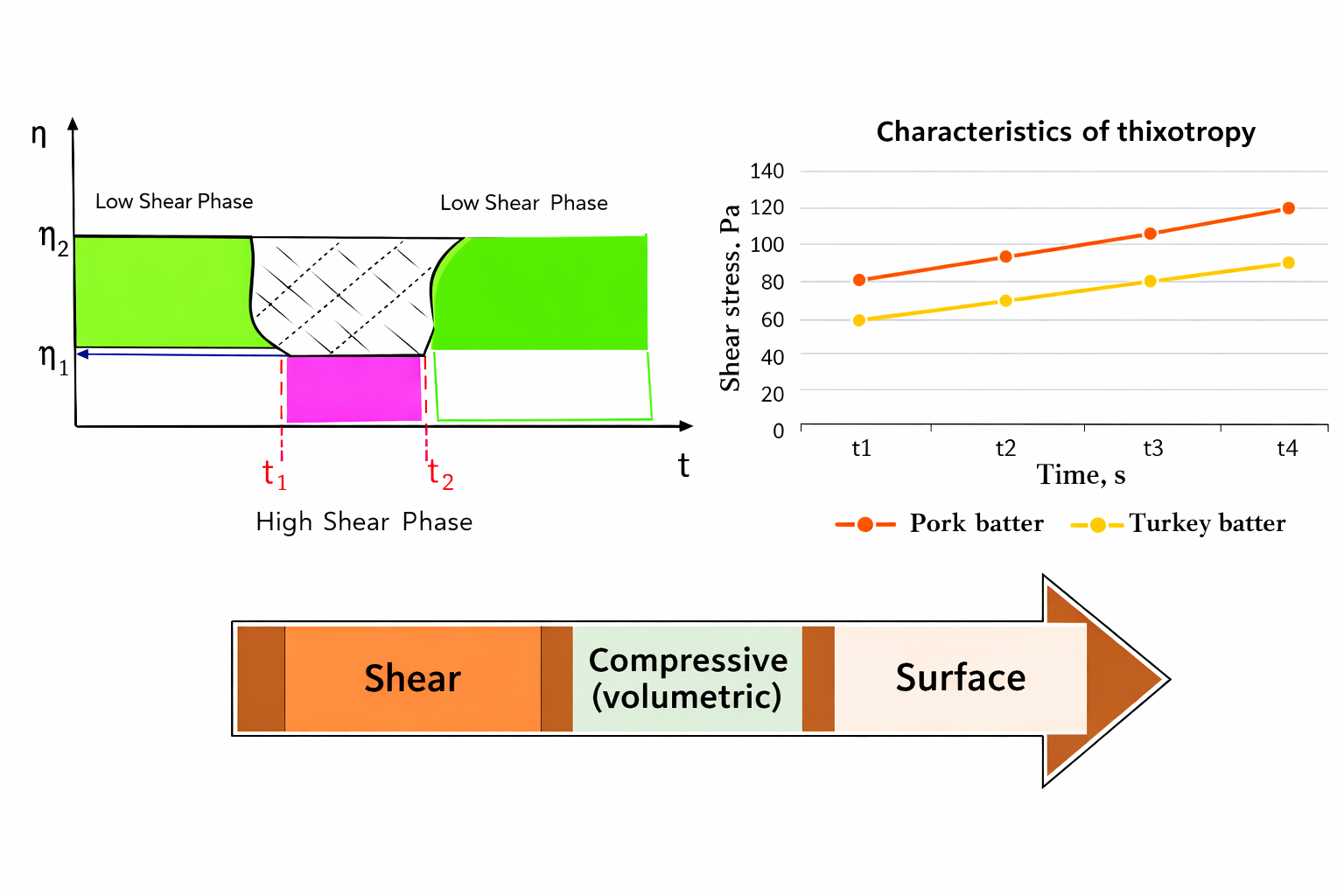
Об’єктом дослідження є тиксотропія м’ясних фаршів з різним інгредієнтним складом, характерним для ковбасних виробів. У роботі проаналізовано сучасні підходи до оцінювання реологічних властивостей м’ясних емульсійних систем та узагальнено фактори формування їх структурної організації. Досліджено закономірності зміни в’язкісно-пластичних характеристик свинячих та індичих фаршів за різних рівнів механічного навантаження, а також встановлено особливості процесів руйнування та відновлення структури.
Комплексна оцінка тиксотропних властивостей ґрунтується на аналізі структурно-механічних характеристик фаршевих систем у процесі їх формування з різними інгредієнтами. Доведено залежність тиксотропного стану від концентрації білкових компонентів і ступеня гідратації білкової системи, що визначає стабільність ковбасної матриці під час механічної обробки. Напруження зсуву розраховано для інтервалів часу у діапазоні 1–1000 с. Вихідні параметри запропонованої моделі адаптовано до властивостей м’яких м’ясних фаршів: для свинячого фаршу встановлені коефіцієнти A = 80 Па та B = –12, а для індичого фаршу – A = 60 Па та B = –9. Оскільки значення B є від’ємним для обох видів сировини, це підтверджує наявність виражених тиксотропних властивостей у досліджуваних системах. Керування цими параметрами дає змогу регулювати тиксотропію фаршу з метою досягнення оптимальної консистенції та стабільності структури готового продукту.
Тиксотропні властивості відіграють важливу роль у технологічних операціях подрібнення, перемішування, наповнення оболонок і структуроутворення під час термообробки. Надмірна стійкість структури ускладнює переробку, тоді як надмірна тиксотропність знижує формостійкість виробів. Визначення реологічних параметрів дозволяє прогнозувати поведінку фаршевих систем у виробничих умовах та забезпечувати стабільну текстуру та високу якість ковбасних виробів. Отримані результати мають практичне значення для оптимізації технологічних режимів у виробництві ковбасних виробів і розроблення нових продуктів із прогнозованими реологічними властивостями.
Посилання
- Warren, S. E., Bowker, B., Mohan, A. (2020). Physicochemical properties of beef Tongue as a value-added meat product. Journal of Food Composition and Analysis, 88. https://doi.org/10.1016/j.jfca.2020.103433
- Köppel, R., Ganeshan, A., Weber, S., Pietsch, K., Graf, C., Hochegger, R. et al. (2019). Duplex digital PCR for the determination of meat proportions of sausages containing meat from chicken, turkey, horse, cow, pig and sheep. European Food Research and Technology, 245 (4), 853–862. https://doi.org/10.1007/s00217-018-3220-3
- Harastani, R., James, L. J., Walton, J., Woolley, E. (2020). Tackling obesity: A knowledge-base to enable industrial food reformulation. Innovative Food Science & Emerging Technologies, 64. https://doi.org/10.1016/j.ifset.2020.102433
- Carvalho-Ferreira, J. P. de, da Cunha, D. T., Finlayson, G., Caldas, G., Jamar, G., Bandoni, D. H. et al. (2020). Differential impact of consuming foods perceived to be high or low in fat on subsequent food reward. Food Quality and Preference, 85. https://doi.org/10.1016/j.foodqual.2020.103977
- Rather, S. A., Masoodi, F. A., Rather, J. A., Gani, A., Wani, S. M., Ganaie, T. A., Akhter, R. (2021). Impact of thermal processing and storage on fatty acid composition and cholesterol oxidation of canned traditional low-fat meat product of India. LWT, 139. https://doi.org/10.1016/j.lwt.2020.110503
- Baune, M.-C., Schroeder, S., Witte, F., Heinz, V., Bindrich, U., Weiss, J., Terjung, N. (2021). Analysis of protein-network formation of different vegetable proteins during emulsification to produce solid fat substitutes. Journal of Food Measurement and Characterization, 15 (3), 2399–2416. https://doi.org/10.1007/s11694-020-00767-9
- Boukid, F. (2021). Plant-based meat analogues: from niche to mainstream. European Food Research and Technology, 247 (2), 297–308. https://doi.org/10.1007/s00217-020-03630-9
- He, J., Evans, N. M., Liu, H., Shao, S. (2020). A review of research on plant‐based meat alternatives: Driving forces, history, manufacturing, and consumer attitudes. Comprehensive Reviews in Food Science and Food Safety, 19 (5), 2639–2656. https://doi.org/10.1111/1541-4337.12610
- Berger, L. M., Gibis, M., Witte, F., Terjung, N., Weiss, J. (2022). Influence of meat batter addition in ground beef on structural properties and quality parameters. European Food Research and Technology, 248 (10), 2509–2520. https://doi.org/10.1007/s00217-022-04065-0
- Witte, F., Smetana, S., Heinz, V., Terjung, N. (2020). High-pressure processing of usually discarded dry aged beef trimmings for subsequent processing. Meat Science, 170. https://doi.org/10.1016/j.meatsci.2020.108241
- Nortjé, G. L., Nel, L., Jordaan, E., Naudé, R. T., Holzapfel, W. H., Grimbeek, R. J. (1989). A microbiological survey of fresh meat in the supermarket trade. Part 2: beef retail cuts. Meat Science, 25 (2), 99–112. https://doi.org/10.1016/0309-1740(89)90025-9
- Zerabruk, K., Retta, N., Muleta, D., Tefera, A. T. (2019). Assessment of Microbiological Safety and Quality of Minced Meat and Meat Contact Surfaces in Selected Butcher Shops of Addis Ababa, Ethiopia. Journal of Food Quality. https://doi.org/10.1155/2019/3902690
- Terjung, N., Witte, F., Heinz, V. (2021). The dry aged beef paradox: Why dry aging is sometimes not better than wet aging. Meat Science, 172. https://doi.org/10.1016/j.meatsci.2020.108355
- Berger, L. M., Witte, F., Terjung, N., Weiss, J., Gibis, M. (2022). Influence of Processing Steps on Structural, Functional, and Quality Properties of Beef Hamburgers. Applied Sciences, 12 (15), 7377. https://doi.org/10.3390/app12157377
- Davey, C. L., Gilbert, K. V. (1974). Temperature‐dependent cooking toughness in beef. Journal of the Science of Food and Agriculture, 25 (8), 931–938. Portico. https://doi.org/10.1002/jsfa.2740250808
- Herrero, A. M., Carmona, P., López-López, I., Jiménez-Colmenero, F. (2008). Raman Spectroscopic Evaluation of Meat Batter Structural Changes Induced by Thermal Treatment and Salt Addition. Journal of Agricultural and Food Chemistry, 56 (16), 7119–7124. https://doi.org/10.1021/jf800925s
- Tornberg, E. (2005). Effects of heat on meat proteins – Implications on structure and quality of meat products. Meat Science, 70 (3), 493–508. https://doi.org/10.1016/j.meatsci.2004.11.021
- Beneke, B. (2018). Technology alters muscle structure: Histological identification and evaluation of meat and meat products. Fleischwirtschaft, 2, 62–68.
- Foegeding, E. A. (1988). Gelation in meat batters. Reciprocal Meat Conference Proceedings, Vol. 41. Laramie, 44–47.
- Honikel, K. O., Hamm, R.; Pearson, A. M., Dutson, T. R. (Eds.) (1994). Measurement of water-holding capacity and juiciness. Quality Attributes and Their Measurement in Meat, Poultry and Fish Products. Boston: Springer, 125–161. https://doi.org/10.1007/978-1-4615-2167-9_5
- Knipe, C. L.; Dikemann, M. (Ed.) (2024). Sausages, types of: Emulsion. Encyclopedia of Meat Sciences. Amsterdam: Elsevier, 425–430. https://doi.org/10.1016/b978-0-323-85125-1.00160-5
- Tyszkiewicz, I., Kłossowska, B. M., Wieczorek, U., Jakubiec‐Puka, A. (1997). Mechanical Tenderisation of Pork Meat: Protein and Water Release due to Tissue Damage. Journal of the Science of Food and Agriculture, 73 (2), 179–185. Available at: https://doi.org/10.1002/(sici)1097-0010(199702)73:2<179::aid-jsfa699>3.0.co;2-#
- Raudsepp, P., Brüggemann, D. A., Henckel, P., Vyberg, M., Groves, K., Oksbjerg, N., Therkildsen, M. (2017). Performance of conventional histochemical methods relative to a novel immunolabeling technique in assessing degree of degradation in comminuted chicken meat. Food Control, 73, 133–139. https://doi.org/10.1016/j.foodcont.2016.07.036
- Irmscher, S. B., Böjthe, Z., Herrmann, K., Gibis, M., Kohlus, R., Weiss, J. (2013). Influence of filling conditions on product quality and machine parameters in fermented coarse meat emulsions produced by high shear grinding and vacuum filling. Journal of Food Engineering, 117 (3), 316–325. https://doi.org/10.1016/j.jfoodeng.2013.03.015
- Leseigneur-Meynier, A., Gandemer, G. (1991). Lipid composition of pork muscle in relation to the metabolic type of the fibres. Meat Science, 29 (3), 229–241. https://doi.org/10.1016/0309-1740(91)90052-r
- Melro, E., Antunes, F., Cruz, I., Ramos, P. E., Carvalho, F., Alves, L. (2020). Morphological, textural and physico-chemical characterization of processed meat products during their shelf life. Food Structure, 26. https://doi.org/10.1016/j.foostr.2020.100164
- Hamm, R. (1975). On the rheology of minced meat. Journal of Texture Studies, 6 (3), 281–296. https://doi.org/10.1111/j.1745-4603.1975.tb01126.x
- Irmscher, S. B., Gibis, M., Herrmann, K., Kohlus, R., Weiss, J. (2016). Development of a novel homogenizer using the vane pump-grinder technology for the production of meat batter. Journal of Food Engineering, 169, 10–17. https://doi.org/10.1016/j.jfoodeng.2015.08.022
- Krökki, A. S. (1995). Fat Concentration in Commercial Minced Meat. Lipid / Fett, 97 (12), 466–467. https://doi.org/10.1002/lipi.2700971210
- Cao, C., Xu, Y., Kong, B., Xia, X., Chen, Q., Zhang, H., Liu, Q. (2023). Changes of rheological behavior, thermal and microstructural properties of myofibrillar protein-κ-carrageenan mixed sol as mediated by NaCl concentration. Food Bioscience, 55. https://doi.org/10.1016/j.fbio.2023.103035
- Momcilova, M. M., Gardinarska-Ivanova, D. N., Yordanov, D. G., Zsivanovits, G. I. (2023). Microstructure and technological properties of cooked meat sausages prepared with emulsions of vegetable oils as substitutes for animal fat. Food Research, 7 (4), 22–29. https://doi.org/10.26656/fr.2017.7(4).1030
- de Huidobro, F. R., Miguel, E., Blázquez, B., Onega, E. (2005). A comparison between two methods (Warner–Bratzler and texture profile analysis) for testing either raw meat or cooked meat. Meat Science, 69 (3), 527–536. https://doi.org/10.1016/j.meatsci.2004.09.008
- Dzudie, T., Scher, J., Hardy, J., Sanchez, C. (2000). Physico‐chemical and rheological properties of low‐fat, high‐added water beef sausage extended with common bean flour. Journal of Muscle Foods, 11 (2), 129–142. https://doi.org/10.1111/j.1745-4573.2000.tb00420.x
- Profeta, A., Baune, M.-C., Smetana, S., Bornkessel, S., Broucke, K., Van Royen, G., Enneking, U., Weiss, J., Heinz, V., Hieke, S., Terjung, N. (2021). Preferences of German Consumers for Meat Products Blended with Plant-Based Proteins. Sustainability, 13 (2), 650. https://doi.org/10.3390/su13020650
##submission.downloads##
Опубліковано
Як цитувати
Номер
Розділ
Ліцензія
Авторське право (c) 2026 Ihor Oshchypok, Halyna Kushniruk, Olia Masliichuk, Olga Vivcharuk, Oksana Pauk

Ця робота ліцензується відповідно до Creative Commons Attribution 4.0 International License.
Закріплення та умови передачі авторських прав (ідентифікація авторства) здійснюється у Ліцензійному договорі. Зокрема, автори залишають за собою право на авторство свого рукопису та передають журналу право першої публікації цієї роботи на умовах ліцензії Creative Commons CC BY. При цьому вони мають право укладати самостійно додаткові угоди, що стосуються неексклюзивного поширення роботи у тому вигляді, в якому вона була опублікована цим журналом, але за умови збереження посилання на першу публікацію статті в цьому журналі.