Developing an environmental key performance indicators monitoring and control system for educational smart laboratories
DOI:
https://doi.org/10.15587/2706-5448.2026.358804Keywords:
SMART laboratory, Eco-KPI, microclimate monitoring, adaptive control, CO₂ forecasting, LCA analysisAbstract
The object of research is a set of processes for monitoring and intelligent control of energy consumption and the state of the SMART laboratory environment, aimed at improving its environmental safety.
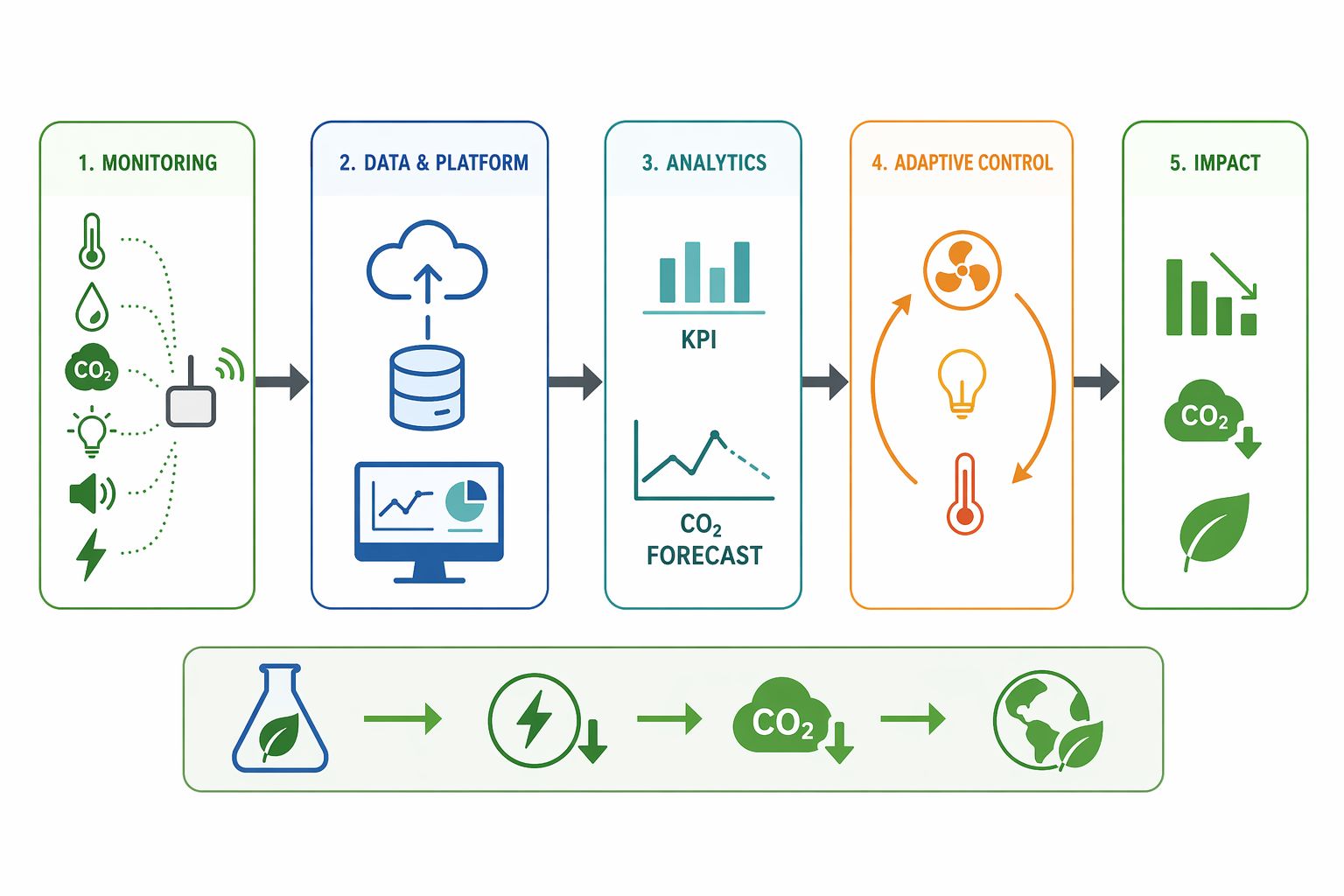
The research problem is aimed at implementing integrated automated systems based on: monitoring, forecasting and adaptive control in real time of SMART laboratories. The research used methods for synthesis and analysis of energy consumption monitoring systems, microclimate control, CO2 concentration forecasting and algorithms for adaptive control of educational environment resources.
Basic and extended key performance indicators (KPIs) have been formed for the SMART laboratory monitoring subsystem, which take into account the state of the microclimate and comfort, energy, environmental and operational indicators, and are the basis of modern eco-maps of the premises. The adaptive control subsystem uses adaptive control logic based on a predictive model. The developed open software and hardware architecture based on Node-RED integrates automation and environmental audit tools into a single analytical platform adapted to different types of educational locations. The adaptive automatic control system for SMART laboratories based on integrated predictive ML models contributes to a controlled reduction in energy consumption by more than 40%, in particular by reducing the average power from 4.1 kW to 2.4 kW. While traditional operating modes of laboratory equipment without adaptation are characterized by a high level of carbon intensity. According to the results of the LCA analysis, the total carbon footprint at the operational stage decreased from 1.85 to 0.47 kg CO2/hour. The use of the proposed monitoring and control system for SMART laboratories forms a modern technical and software solution that meets the criteria of sustainable development.
References
- Dong, Y., Hauschild, M. Z. (2017). Indicators for Environmental Sustainability. Procedia CIRP, 61, 697–702. https://doi.org/10.1016/j.procir.2016.11.173
- 17 Goals to Transform Our World. United Nations. Available at: https://www.un.org/sustainabledevelopment/
- Pro Tsili staloho rozvytku Ukrainy na period do 2030 roku (2019). Ukaz Prezydenta Ukrainy No. 722/2019. 30.09.2019. Available at: https://zakon.rada.gov.ua/laws/show/722/2019#Text
- Heink, U., Kowarik, I. (2010). What are indicators? On the definition of indicators in ecology and environmental planning. Ecological Indicators, 10 (3), 584–593. https://doi.org/10.1016/j.ecolind.2009.09.009
- Terwayet Bayouli, I., Terwayet Bayouli, H., Dell’Oca, A., Meers, E., Sun, J. (2021). Ecological indicators and bioindicator plant species for biomonitoring industrial pollution: Eco-based environmental assessment. Ecological Indicators, 125, 107508. https://doi.org/10.1016/j.ecolind.2021.107508
- Minunno, R., O’Grady, T., Morrison, G. M., Gruner, R. L. (2021). Investigating the embodied energy and carbon of buildings: A systematic literature review and meta-analysis of life cycle assessments. Renewable and Sustainable Energy Reviews, 143, 110935. https://doi.org/10.1016/j.rser.2021.110935
- Yoonus, H., Al-Ghamdi, S. G. (2020). Environmental performance of building integrated grey water reuse systems based on Life-Cycle Assessment: A systematic and bibliographic analysis. Science of the Total Environment, 712, 136535. https://doi.org/10.1016/j.scitotenv.2020.136535
- Mannan, M., Al-Ghamdi, S. G. (2020). Environmental impact of water-use in buildings: Latest developments from a life-cycle assessment perspective. Journal of Environmental Management, 261, 110198. https://doi.org/10.1016/j.jenvman.2020.110198
- Oquendo-Di Cosola, V., Olivieri, F., Ruiz-García, L. (2022). A systematic review of the impact of green walls on urban comfort: temperature reduction and noise attenuation. Renewable and Sustainable Energy Reviews, 162, 112463. https://doi.org/10.1016/j.rser.2022.112463
- Narayana, T. L., Venkatesh, C., Kiran, A., J, C. B., Kumar, A., Khan, S. B., Almusharraf, A. et al. (2024). Advances in real time smart monitoring of environmental parameters using IoT and sensors. Heliyon, 10 (7), e28195. https://doi.org/10.1016/j.heliyon.2024.e28195
- Dong, B., Prakash, V., Feng, F., O’Neill, Z. (2019). A review of smart building sensing system for better indoor environment control. Energy and Buildings, 199, 29–46. https://doi.org/10.1016/j.enbuild.2019.06.025
- Das, L., Anand, P., Anjum, A., Aarif, M., Maurya, N., Rana, A. (2023). The Impact of Smart Homes on Energy Efficiency and Sustainability. 2023 10th IEEE Uttar Pradesh Section International Conference on Electrical, Electronics and Computer Engineering (UPCON), 215–220. https://doi.org/10.1109/upcon59197.2023.10434418
- Collinge, W., Landis, A. E., Jones, A. K., Schaefer, L. A., Bilec, M. M. (2013). Indoor environmental quality in a dynamic life cycle assessment framework for whole buildings: Focus on human health chemical impacts. Building and Environment, 62, 182–190. https://doi.org/10.1016/j.buildenv.2013.01.015
- Hernández, J. L., de Miguel, I., Vélez, F., Vasallo, A. (2024). Challenges and opportunities in European smart buildings energy management: A critical review. Renewable and Sustainable Energy Reviews, 199, 114472. https://doi.org/10.1016/j.rser.2024.114472
- Chen, L.-J., Saraswat, S., Ching, F.-S., Su, C.-Y., Huang, H.-L., Pan, W.-C. (2025). Development and implementation of EcoDecibel: A low-cost and IoT-based device for noise measurement. Ecological Informatics, 85, 102968. https://doi.org/10.1016/j.ecoinf.2024.102968
- Jiaoyu, L. (2025). Real time thermal environment monitoring and interior design of intelligent buildings based on the Internet of Things. Results in Engineering, 27, 105942. https://doi.org/10.1016/j.rineng.2025.105942
- Silva, B. V. F., Holm-Nielsen, J. B., Sadrizadeh, S., Teles, M. P. R., Kiani-Moghaddam, M., Arabkoohsar, A. (2024). Sustainable, green, or smart? Pathways for energy-efficient healthcare buildings. Sustainable Cities and Society, 100, 105013. https://doi.org/10.1016/j.scs.2023.105013
- Edo, G. I., Itoje-akpokiniovo, L. O., Obasohan, P., Ikpekoro, V. O., Samuel, P. O., Jikah, A. N. et al. (2024). Impact of environmental pollution from human activities on water, air quality and climate change. Ecological Frontiers, 44 (5), 874–889. https://doi.org/10.1016/j.ecofro.2024.02.014
- Zabalza Bribián, I., Valero Capilla, A., Aranda Usón, A. (2011). Life cycle assessment of building materials: Comparative analysis of energy and environmental impacts and evaluation of the eco-efficiency improvement potential. Building and Environment, 46 (5), 1133–1140. https://doi.org/10.1016/j.buildenv.2010.12.002
- Tafesse, S., Girma, Y. E., Dessalegn, E. (2022). Analysis of the socio-economic and environmental impacts of construction waste and management practices. Heliyon, 8 (3), e09169. https://doi.org/10.1016/j.heliyon.2022.e09169
- Naidu, R., Biswas, B., Willett, I. R., Cribb, J., Kumar Singh, B., Paul Nathanail, C. et al. (2021). Chemical pollution: A growing peril and potential catastrophic risk to humanity. Environment International, 156, 106616. https://doi.org/10.1016/j.envint.2021.106616
- De Wolf, C., Cordella, M., Dodd, N., Byers, B., Donatello, S. (2023). Whole life cycle environmental impact assessment of buildings: Developing software tool and database support for the EU framework Level(s). Resources, Conservation and Recycling, 188, 106642. https://doi.org/10.1016/j.resconrec.2022.106642
- Mishra, V., Sadhu, A. (2023). Towards the effect of climate change in structural loads of urban infrastructure: A review. Sustainable Cities and Society, 89, 104352. https://doi.org/10.1016/j.scs.2022.104352
- Huang, B., Gao, X., Xu, X., Song, J., Geng, Y., Sarkis, J. et al. (2020). A Life Cycle Thinking Framework to Mitigate the Environmental Impact of Building Materials. One Earth, 3 (5), 564–573. https://doi.org/10.1016/j.oneear.2020.10.010
- Elmor, L., Ramos, G. A., Vieites, Y., Andretti, B., Andrade, E. B. (2025). Environmental sustainability considerations (or lack thereof) in consumer decision making. International Journal of Research in Marketing, 42 (4), 1203–1228. https://doi.org/10.1016/j.ijresmar.2024.08.003
- Asif, M., Naeem, G., Khalid, M. (2024). Digitalization for sustainable buildings: Technologies, applications, potential, and challenges. Journal of Cleaner Production, 450, 141814. https://doi.org/10.1016/j.jclepro.2024.141814
- García-Monge, M., Zalba, B., Casas, R., Cano, E., Guillén-Lambea, S., López-Mesa, B. et al. (2023). Is IoT monitoring key to improve building energy efficiency? Case study of a smart campus in Spain. Energy and Buildings, 285, 112882. https://doi.org/10.1016/j.enbuild.2023.112882
- Lee, J., Choi, H., Kim, J. (2024). Environmental and economic impacts of e-waste recycling: A systematic review. Chemical Engineering Journal, 494, 152917. https://doi.org/10.1016/j.cej.2024.152917
- Kiddee, P., Naidu, R., Wong, M. H. (2013). Electronic waste management approaches: An overview. Waste Management, 33 (5), 1237–1250. https://doi.org/10.1016/j.wasman.2013.01.006
- Alvarenga, R. A. F. d., da Silva Júnior, V. P., Soares, S. R. (2012). Comparison of the ecological footprint and a life cycle impact assessment method for a case study on Brazilian broiler feed production. Journal of Cleaner Production, 28, 25–32. https://doi.org/10.1016/j.jclepro.2011.06.023
- Asdrubali, F., Fronzetti Colladon, A., Segneri, L., Gandola, D. M. (2024). LCA and energy efficiency in buildings: Mapping more than twenty years of research. Energy and Buildings, 321, 114684. https://doi.org/10.1016/j.enbuild.2024.114684
- Nicholson, S., Ugursal, V. I. (2023). A lifecycle assessment-based environmental analysis of building operationally energy efficient houses in Nova Scotia. Journal of Building Engineering, 76, 107102. https://doi.org/10.1016/j.jobe.2023.107102
- Lagarde, C., Robillart, M., Bigaud, D., Pannier, M.-L. (2024). Assessing and comparing the environmental impact of smart residential buildings: A life cycle approach with uncertainty analysis. Journal of Cleaner Production, 467, 143004. https://doi.org/10.1016/j.jclepro.2024.143004
- Boulesnane-Guengant, O., Rouget, M., Becker-Scarpitta, A., Botella, C., Kumschick, S. (2025). Spatialising the ecological impacts of alien species into risk maps. Global Ecology and Conservation, 61, e03660. https://doi.org/10.1016/j.gecco.2025.e03660
- Bhatt, H., Davawala, M., Joshi, T., Shah, M., Unnarkat, A. (2023). Forecasting and mitigation of global environmental carbon dioxide emission using machine learning techniques. Cleaner Chemical Engineering, 5, 100095. https://doi.org/10.1016/j.clce.2023.100095
- Ye, L., Du, P., Wang, S. (2024). Industrial carbon emission forecasting considering external factors based on linear and machine learning models. Journal of Cleaner Production, 434, 140010. https://doi.org/10.1016/j.jclepro.2023.140010
- Giannelos, S., Bellizio, F., Strbac, G., Zhang, T. (2024). Machine learning approaches for predictions of CO2 emissions in the building sector. Electric Power Systems Research, 235, 110735. https://doi.org/10.1016/j.epsr.2024.110735
- Jin, Y., Sharifi, A. (2025). Machine learning for predicting urban greenhouse gas emissions: A systematic literature review. Renewable and Sustainable Energy Reviews, 215, 115625. https://doi.org/10.1016/j.rser.2025.115625
- Singh, A. P., Jain, V., Chaudhari, S., Kraemer, F. A., Werner, S., Garg, V. (2018). Machine Learning-Based Occupancy Estimation Using Multivariate Sensor Nodes. 2018 IEEE Globecom Workshops (GC Wkshps). Abu Dhabi: IEEE, 1–6. https://doi.org/10.1109/glocomw.2018.8644432
- Savchenko, T., Lutska, N., Vlasenko, L., Sashnova, M., Zahorulko, A., Minenko, S. et al. (2025). Risk analysis and cybersecurity enhancement of Digital Twins in dairy production. Technology Audit and Production Reserves, 2 (2 (82)), 37–49. https://doi.org/10.15587/2706-5448.2025.325422
Downloads
Published
How to Cite
Issue
Section
License
Copyright (c) 2026 Tetiana Savchenko, Nataliia Lutska, Lidiia Vlasenko , Andrii Zahorulko

This work is licensed under a Creative Commons Attribution 4.0 International License.
The consolidation and conditions for the transfer of copyright (identification of authorship) is carried out in the License Agreement. In particular, the authors reserve the right to the authorship of their manuscript and transfer the first publication of this work to the journal under the terms of the Creative Commons CC BY license. At the same time, they have the right to conclude on their own additional agreements concerning the non-exclusive distribution of the work in the form in which it was published by this journal, but provided that the link to the first publication of the article in this journal is preserved.