Розробка системи моніторингу та управління на основі екологічних ключових показників ефективності для освітніх SMART-лабораторій
DOI:
https://doi.org/10.15587/2706-5448.2026.358804Ключові слова:
SMART-лабораторія, Eco-KPI, моніторинг мікроклімату, адаптивне управління/control, прогнозування CO₂, LCA-аналізАнотація
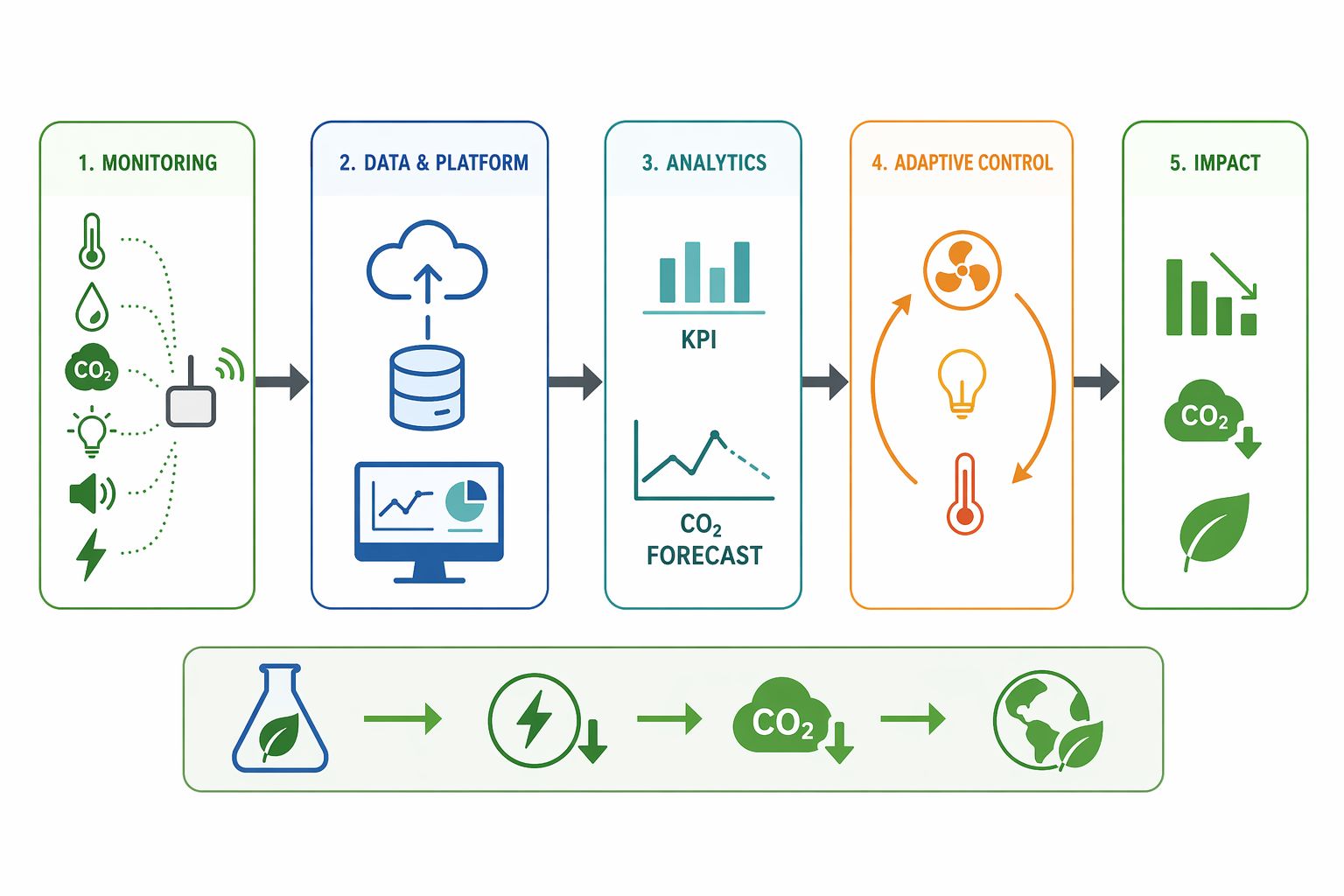
Об’єктом дослідження є сукупність процесів моніторингу та інтелектуального управління енергоспоживанням і станом середовища SMART-лабораторії, спрямованих на підвищення її екологічної безпеки.
Проблематика досліджень спрямована на впровадження інтегрованих автоматизованих систем на основі: моніторингу, прогнозування та адаптивного керування у реальному часі SMART-лабораторіями. В дослідженнях використані методи синтезу та аналізу систем моніторингу енергоспоживання, контролю мікроклімату, прогнозування концентрації CO2 та алгоритмів адаптивного керування ресурсами освітнього середовища.
Для підсистеми моніторингу SMART-лабораторії сформовано базові та розширені ключові показники ефективності (KPIs), які враховують стан мікроклімату та комфорту, енергетичні, екологічні та експлуатаційні показники, і є основою сучасних еко-карт приміщення. Підсистема адаптивного керування використовує адаптивну логіку керування на основі прогнозної моделі. Розроблена відкрита програмно-апаратна архітектура на базі Node-RED інтегрує інструменти автоматизації та екологічного аудиту в єдину аналітичну платформу, адаптовану до різнотипних освітніх локацій. Адаптивна автоматична система керування SMART-лабораторіями на основі інтегровано-прогнозованих ML-моделей сприяє контрольованому зниженню енергоспоживання понад 40%, зокрема за рахунок зменшенням середньої потужності з 4,1 kW до 2,4 kW. Тоді, як традиційні режими експлуатації обладнання лабораторій без адаптації характеризуються високим рівнем вуглецевої інтенсивності. Згідно з результатами LCA-аналізу, загальний вуглецевий слід на експлуатаційній стадії скоротився з 1,85 до 0,47 kg CO2/hour. Використання запропонованої системи моніторингу та керування SMART-лабораторіями формує сучасне технічне та програмне рішення, що відповідає критеріям сталого розвитку.
Посилання
- Dong, Y., Hauschild, M. Z. (2017). Indicators for Environmental Sustainability. Procedia CIRP, 61, 697–702. https://doi.org/10.1016/j.procir.2016.11.173
- 17 Goals to Transform Our World. United Nations. Available at: https://www.un.org/sustainabledevelopment/
- Pro Tsili staloho rozvytku Ukrainy na period do 2030 roku (2019). Ukaz Prezydenta Ukrainy No. 722/2019. 30.09.2019. Available at: https://zakon.rada.gov.ua/laws/show/722/2019#Text
- Heink, U., Kowarik, I. (2010). What are indicators? On the definition of indicators in ecology and environmental planning. Ecological Indicators, 10 (3), 584–593. https://doi.org/10.1016/j.ecolind.2009.09.009
- Terwayet Bayouli, I., Terwayet Bayouli, H., Dell’Oca, A., Meers, E., Sun, J. (2021). Ecological indicators and bioindicator plant species for biomonitoring industrial pollution: Eco-based environmental assessment. Ecological Indicators, 125, 107508. https://doi.org/10.1016/j.ecolind.2021.107508
- Minunno, R., O’Grady, T., Morrison, G. M., Gruner, R. L. (2021). Investigating the embodied energy and carbon of buildings: A systematic literature review and meta-analysis of life cycle assessments. Renewable and Sustainable Energy Reviews, 143, 110935. https://doi.org/10.1016/j.rser.2021.110935
- Yoonus, H., Al-Ghamdi, S. G. (2020). Environmental performance of building integrated grey water reuse systems based on Life-Cycle Assessment: A systematic and bibliographic analysis. Science of the Total Environment, 712, 136535. https://doi.org/10.1016/j.scitotenv.2020.136535
- Mannan, M., Al-Ghamdi, S. G. (2020). Environmental impact of water-use in buildings: Latest developments from a life-cycle assessment perspective. Journal of Environmental Management, 261, 110198. https://doi.org/10.1016/j.jenvman.2020.110198
- Oquendo-Di Cosola, V., Olivieri, F., Ruiz-García, L. (2022). A systematic review of the impact of green walls on urban comfort: temperature reduction and noise attenuation. Renewable and Sustainable Energy Reviews, 162, 112463. https://doi.org/10.1016/j.rser.2022.112463
- Narayana, T. L., Venkatesh, C., Kiran, A., J, C. B., Kumar, A., Khan, S. B., Almusharraf, A. et al. (2024). Advances in real time smart monitoring of environmental parameters using IoT and sensors. Heliyon, 10 (7), e28195. https://doi.org/10.1016/j.heliyon.2024.e28195
- Dong, B., Prakash, V., Feng, F., O’Neill, Z. (2019). A review of smart building sensing system for better indoor environment control. Energy and Buildings, 199, 29–46. https://doi.org/10.1016/j.enbuild.2019.06.025
- Das, L., Anand, P., Anjum, A., Aarif, M., Maurya, N., Rana, A. (2023). The Impact of Smart Homes on Energy Efficiency and Sustainability. 2023 10th IEEE Uttar Pradesh Section International Conference on Electrical, Electronics and Computer Engineering (UPCON), 215–220. https://doi.org/10.1109/upcon59197.2023.10434418
- Collinge, W., Landis, A. E., Jones, A. K., Schaefer, L. A., Bilec, M. M. (2013). Indoor environmental quality in a dynamic life cycle assessment framework for whole buildings: Focus on human health chemical impacts. Building and Environment, 62, 182–190. https://doi.org/10.1016/j.buildenv.2013.01.015
- Hernández, J. L., de Miguel, I., Vélez, F., Vasallo, A. (2024). Challenges and opportunities in European smart buildings energy management: A critical review. Renewable and Sustainable Energy Reviews, 199, 114472. https://doi.org/10.1016/j.rser.2024.114472
- Chen, L.-J., Saraswat, S., Ching, F.-S., Su, C.-Y., Huang, H.-L., Pan, W.-C. (2025). Development and implementation of EcoDecibel: A low-cost and IoT-based device for noise measurement. Ecological Informatics, 85, 102968. https://doi.org/10.1016/j.ecoinf.2024.102968
- Jiaoyu, L. (2025). Real time thermal environment monitoring and interior design of intelligent buildings based on the Internet of Things. Results in Engineering, 27, 105942. https://doi.org/10.1016/j.rineng.2025.105942
- Silva, B. V. F., Holm-Nielsen, J. B., Sadrizadeh, S., Teles, M. P. R., Kiani-Moghaddam, M., Arabkoohsar, A. (2024). Sustainable, green, or smart? Pathways for energy-efficient healthcare buildings. Sustainable Cities and Society, 100, 105013. https://doi.org/10.1016/j.scs.2023.105013
- Edo, G. I., Itoje-akpokiniovo, L. O., Obasohan, P., Ikpekoro, V. O., Samuel, P. O., Jikah, A. N. et al. (2024). Impact of environmental pollution from human activities on water, air quality and climate change. Ecological Frontiers, 44 (5), 874–889. https://doi.org/10.1016/j.ecofro.2024.02.014
- Zabalza Bribián, I., Valero Capilla, A., Aranda Usón, A. (2011). Life cycle assessment of building materials: Comparative analysis of energy and environmental impacts and evaluation of the eco-efficiency improvement potential. Building and Environment, 46 (5), 1133–1140. https://doi.org/10.1016/j.buildenv.2010.12.002
- Tafesse, S., Girma, Y. E., Dessalegn, E. (2022). Analysis of the socio-economic and environmental impacts of construction waste and management practices. Heliyon, 8 (3), e09169. https://doi.org/10.1016/j.heliyon.2022.e09169
- Naidu, R., Biswas, B., Willett, I. R., Cribb, J., Kumar Singh, B., Paul Nathanail, C. et al. (2021). Chemical pollution: A growing peril and potential catastrophic risk to humanity. Environment International, 156, 106616. https://doi.org/10.1016/j.envint.2021.106616
- De Wolf, C., Cordella, M., Dodd, N., Byers, B., Donatello, S. (2023). Whole life cycle environmental impact assessment of buildings: Developing software tool and database support for the EU framework Level(s). Resources, Conservation and Recycling, 188, 106642. https://doi.org/10.1016/j.resconrec.2022.106642
- Mishra, V., Sadhu, A. (2023). Towards the effect of climate change in structural loads of urban infrastructure: A review. Sustainable Cities and Society, 89, 104352. https://doi.org/10.1016/j.scs.2022.104352
- Huang, B., Gao, X., Xu, X., Song, J., Geng, Y., Sarkis, J. et al. (2020). A Life Cycle Thinking Framework to Mitigate the Environmental Impact of Building Materials. One Earth, 3 (5), 564–573. https://doi.org/10.1016/j.oneear.2020.10.010
- Elmor, L., Ramos, G. A., Vieites, Y., Andretti, B., Andrade, E. B. (2025). Environmental sustainability considerations (or lack thereof) in consumer decision making. International Journal of Research in Marketing, 42 (4), 1203–1228. https://doi.org/10.1016/j.ijresmar.2024.08.003
- Asif, M., Naeem, G., Khalid, M. (2024). Digitalization for sustainable buildings: Technologies, applications, potential, and challenges. Journal of Cleaner Production, 450, 141814. https://doi.org/10.1016/j.jclepro.2024.141814
- García-Monge, M., Zalba, B., Casas, R., Cano, E., Guillén-Lambea, S., López-Mesa, B. et al. (2023). Is IoT monitoring key to improve building energy efficiency? Case study of a smart campus in Spain. Energy and Buildings, 285, 112882. https://doi.org/10.1016/j.enbuild.2023.112882
- Lee, J., Choi, H., Kim, J. (2024). Environmental and economic impacts of e-waste recycling: A systematic review. Chemical Engineering Journal, 494, 152917. https://doi.org/10.1016/j.cej.2024.152917
- Kiddee, P., Naidu, R., Wong, M. H. (2013). Electronic waste management approaches: An overview. Waste Management, 33 (5), 1237–1250. https://doi.org/10.1016/j.wasman.2013.01.006
- Alvarenga, R. A. F. d., da Silva Júnior, V. P., Soares, S. R. (2012). Comparison of the ecological footprint and a life cycle impact assessment method for a case study on Brazilian broiler feed production. Journal of Cleaner Production, 28, 25–32. https://doi.org/10.1016/j.jclepro.2011.06.023
- Asdrubali, F., Fronzetti Colladon, A., Segneri, L., Gandola, D. M. (2024). LCA and energy efficiency in buildings: Mapping more than twenty years of research. Energy and Buildings, 321, 114684. https://doi.org/10.1016/j.enbuild.2024.114684
- Nicholson, S., Ugursal, V. I. (2023). A lifecycle assessment-based environmental analysis of building operationally energy efficient houses in Nova Scotia. Journal of Building Engineering, 76, 107102. https://doi.org/10.1016/j.jobe.2023.107102
- Lagarde, C., Robillart, M., Bigaud, D., Pannier, M.-L. (2024). Assessing and comparing the environmental impact of smart residential buildings: A life cycle approach with uncertainty analysis. Journal of Cleaner Production, 467, 143004. https://doi.org/10.1016/j.jclepro.2024.143004
- Boulesnane-Guengant, O., Rouget, M., Becker-Scarpitta, A., Botella, C., Kumschick, S. (2025). Spatialising the ecological impacts of alien species into risk maps. Global Ecology and Conservation, 61, e03660. https://doi.org/10.1016/j.gecco.2025.e03660
- Bhatt, H., Davawala, M., Joshi, T., Shah, M., Unnarkat, A. (2023). Forecasting and mitigation of global environmental carbon dioxide emission using machine learning techniques. Cleaner Chemical Engineering, 5, 100095. https://doi.org/10.1016/j.clce.2023.100095
- Ye, L., Du, P., Wang, S. (2024). Industrial carbon emission forecasting considering external factors based on linear and machine learning models. Journal of Cleaner Production, 434, 140010. https://doi.org/10.1016/j.jclepro.2023.140010
- Giannelos, S., Bellizio, F., Strbac, G., Zhang, T. (2024). Machine learning approaches for predictions of CO2 emissions in the building sector. Electric Power Systems Research, 235, 110735. https://doi.org/10.1016/j.epsr.2024.110735
- Jin, Y., Sharifi, A. (2025). Machine learning for predicting urban greenhouse gas emissions: A systematic literature review. Renewable and Sustainable Energy Reviews, 215, 115625. https://doi.org/10.1016/j.rser.2025.115625
- Singh, A. P., Jain, V., Chaudhari, S., Kraemer, F. A., Werner, S., Garg, V. (2018). Machine Learning-Based Occupancy Estimation Using Multivariate Sensor Nodes. 2018 IEEE Globecom Workshops (GC Wkshps). Abu Dhabi: IEEE, 1–6. https://doi.org/10.1109/glocomw.2018.8644432
- Savchenko, T., Lutska, N., Vlasenko, L., Sashnova, M., Zahorulko, A., Minenko, S. et al. (2025). Risk analysis and cybersecurity enhancement of Digital Twins in dairy production. Technology Audit and Production Reserves, 2 (2 (82)), 37–49. https://doi.org/10.15587/2706-5448.2025.325422
##submission.downloads##
Опубліковано
Як цитувати
Номер
Розділ
Ліцензія
Авторське право (c) 2026 Tetiana Savchenko, Nataliia Lutska, Lidiia Vlasenko , Andrii Zahorulko

Ця робота ліцензується відповідно до Creative Commons Attribution 4.0 International License.
Закріплення та умови передачі авторських прав (ідентифікація авторства) здійснюється у Ліцензійному договорі. Зокрема, автори залишають за собою право на авторство свого рукопису та передають журналу право першої публікації цієї роботи на умовах ліцензії Creative Commons CC BY. При цьому вони мають право укладати самостійно додаткові угоди, що стосуються неексклюзивного поширення роботи у тому вигляді, в якому вона була опублікована цим журналом, але за умови збереження посилання на першу публікацію статті в цьому журналі.