Development of the composition and technology of preparation of a suspension with adapalene for the treatment of acne taking into account the biopharmaceutical factors
DOI:
https://doi.org/10.15587/2519-4852.2025.321250Keywords:
suspension, adapalene, hyaluronic acid, liquid aloe extract, zinc oxide, composition, technology of preparation, acneAbstract
The aim of the research is the development of the suspension with adapalene for use in the symptomatic block of complex acne therapy composition and technology of preparation.
Materials and methods. The objects of the study were suspension samples, which included active pharmaceutical ingredients (adapalene, hyaluronic acid, liquid aloe extract and zinc oxide), and purified water.
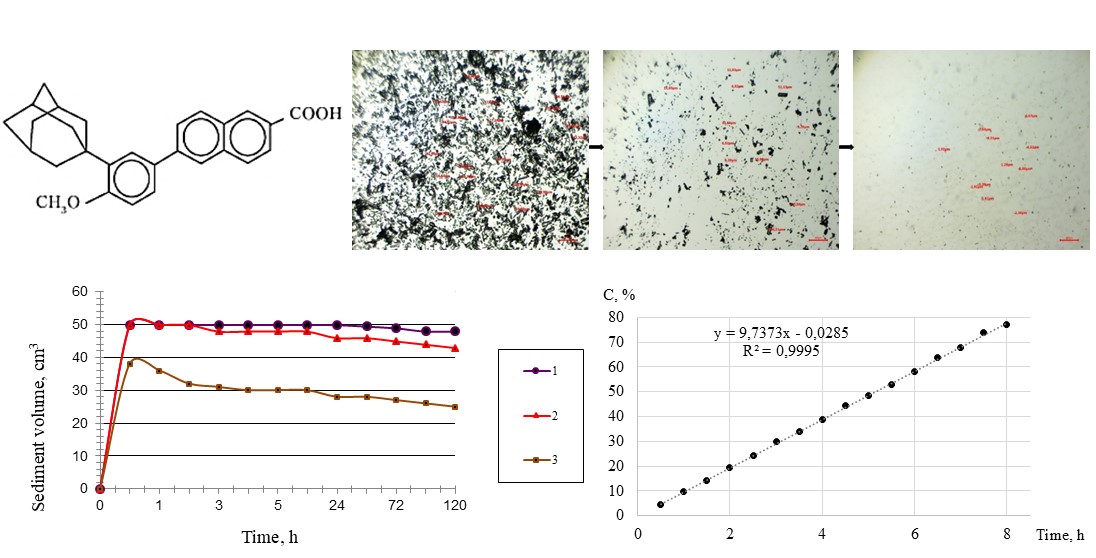
Results. Hyaluronic acid was determined as the optimal stabilizer and its concentration was selected using the resuspension method, at which the suspension is a stable system. It was established that the samples, which include adapalene, zinc oxide, liquid aloe extract, hyaluronic acid and purified water, have satisfactory physical and chemical properties.
Conducted rheological studies showed that due to the potentiation of associative thickening, optimal rheological indicators of the suspension, which affect both the extrusion and consumption properties of the developed suspension, were obtained.
The quantitative content of adapalene in the developed suspension was confirmed by the method of alkalimetry. The completeness and speed of release of adapalene from the suspension was confirmed by the method of dialysis through a semipermeable membrane.
Conclusions. An extemporaneous suspension, based on adapalene, zinc oxide and liquid aloe extract, with the addition of a stabilizer – hyaluronic acid, was developed. The proposed suspension has satisfying consumer, physical and chemical properties, and meets the quality requirements established for suspensions
References
- Bungau, A. F., Radu, A.-F., Bungau, S. G., Vesa, C. M., Tit, D. M., Purza, A. L., Endres, L. M. (2023). Emerging Insights into the Applicability of Essential Oils in the Management of Acne Vulgaris. Molecules, 28 (17), 6395. https://doi.org/10.3390/molecules28176395
- Acne vulgaris: management. NICE guideline [NG198]. (2021). National Institute for Health and Care Excellence. Available at: https://www.nice.org.uk/guidance/ng198
- Xu, J., Chong, J., Wang, D. (2021). Opposite roles of transcription elongation factors Spt4/5 and Elf1 in RNA polymerase II transcription through B-form versus non-B DNA structures. Nucleic Acids Research, 49 (9), 4944–4953. https://doi.org/10.1093/nar/gkab240
- Wilcock, J., Kuznetsov, L., Ravenscroft, J., Rafiq, M. I., Healy, E. (2021). New NICE guidance on acne vulgaris: implications for first-line management in primary care. British Journal of General Practice, 71 (713), 568–570. https://doi.org/10.3399/bjgp21x717977
- Adapalene. European Department for the Quality of Medicines (2013). European Pharmacopoeia. Strasbourg, 1485.
- Cervantes, J., Eber, A. E., Perper, M., Nascimento, V. M., Nouri, K., & Keri, J. E. (2017). The role of zinc in the treatment of acne: A review of the literature. Dermatologic Therapy, 31 (1), e12576. https://doi.org/10.1111/dth.12576
- Zhong, H., Li, X., Zhang, W., Shen, X., Lu, Y., Li, H. (2021). Efficacy of a New Non-drug Acne Therapy: Aloe Vera Gel Combined With Ultrasound and Soft Mask for the Treatment of Mild to Severe Facial Acne. Frontiers in Medicine, 8. https://doi.org/10.3389/fmed.2021.662640
- Mehrabi, J., Shehadeh, W., Gallo, E. S., Artzi, O., Horovitz, T. (2023). Comparison of 2 Hyaluronic Acid-based Fillers for the Treatment of Acne Scars: Structural Lifting Versus Biostimulatory Effect. Dermatologic Surgery, 49 (6), 581–586. https://doi.org/10.1097/dss.0000000000003789
- Kompendium. Dovidnyk likarskykh preparativ. Available at: https://compendium.com.ua/
- Adapalene. National Library of Medicine MedlinePlus. Available at: https://medlineplus.gov/druginfo/meds/a604001.html
- Zuikina, Y., Рolovko, N., Strilets, O., Strelnikov, L. (2021). The in vitro release testing and the antimicrobial activity of semi-solid dosage forms which contain salicylic acid. Farmacia, 69 (6), 1073–1079. https://doi.org/10.31925/farmacia.2021.6.8
- Kumar, R. S., Yagnesh, T. N. (2016). Pharmaceutical suspensions: Patient compliance oral dosage forms. World Journal of Pharmacy and Pharmaceutical Sciences, 7 (12), 1471–1437.
- Emmerich, V. K., Purvis, C. G., Feldman, S. R. (2021). An overview of adapalene and benzoyl peroxide once-daily topical gel as a therapeutic option for acne. Expert Opinion on Pharmacotherapy, 22 (13), 1661–1667. https://doi.org/10.1080/14656566.2021.1939678
- Kovregin, O., Soldatov, D., Kukhtenko, O., Vladymyrova, I. (2024). Development of technology for obtaining tablets by double granulation method with Pipsissewa (Chimaphila Umbellata) extract. ScienceRise: Pharmaceutical Science, 6 (52), 124–133. https://doi.org/10.15587/2519-4852.2024.319206
- Derzhavna farmakopeia Ukrainy. Vol. 2 (2015). Kharkiv: DP «Ukrainskyi naukovyi tsentr yakosti likarskykh zasobiv», 724.
- Bose, A., Zakani, B., Grecov, D. (2025). Influence of buffer on colloidal stability, microstructure, and rheology of cellulose nanocrystals in hyaluronic acid suspensions. Journal of Colloid and Interface Science, 678, 1194–1211. https://doi.org/10.1016/j.jcis.2024.08.264
- Starosta, V. I., Yanchuk, O. M. (2014). Koloidna khimiia. Praktykum. Lutsk: Skhidnoievrop. nats. un-t im. Lesi Ukrainky, 360.
- Derzhavna farmakopeia Ukrainy. Vol. 1 (2015). Kharkiv: DP «Ukrainskyi naukovyi tsentr yakosti likarskykh zasobiv», 1128.
- Acid Value. European Department for the Quality of Medicines (2013). European Pharmacopoeia. Strasbourg, 155.
- Pro zatverdzhennia Pravyl vyrobnytstva (vyhotovlennia) ta kontroliu yakosti likarskykh zasobiv v aptekakh (2012). Nakaz MOZ Ukrainy No. 812. 17.10.2012. Available at: https://zakon.rada.gov.ua/laws/show/z1846-12#Text
- Shmalko, O., Kovalova, T., Bodnar, L., Kovalov, V., Yakovenko, V., Vyshnevska, L. (2024). Development of an emulsion composition with fennel and caraway essential oils for use in the combined therapy of ulcerative colitis. ScienceRise: Pharmaceutical Science, 2 (48), 74–82. https://doi.org/10.15587/2519-4852.2024.302941
- European Pharmacopoeia (2022). Strasbourg: European Directorate for the Quality of Medicines & Health Care. Available at: https://pheur.edqm.eu/subhome/10-8
Downloads
Published
How to Cite
Issue
Section
License
Copyright (c) 2025 Marina Buryak, Liubov Bodnar, Natalya Shtuchna, Svitlana Oliinyk, Kateryna Semchenko, Liliia Vyshnevska

This work is licensed under a Creative Commons Attribution 4.0 International License.
Our journal abides by the Creative Commons Attribution 4.0 International License copyright rights and permissions for open access journals.
Authors, who are published in this journal, agree to the following conditions:
1. The authors reserve the right to authorship of the work and pass the first publication right of this work to the journal under the terms of a Creative Commons Attribution 4.0 International License, which allows others to freely distribute the published research with the obligatory reference to the authors of the original work and the first publication of the work in this journal.
2. The authors have the right to conclude separate supplement agreements that relate to non-exclusive work distribution in the form in which it has been published by the journal (for example, to upload the work to the online storage of the journal or publish it as part of a monograph), provided that the reference to the first publication of the work in this journal is included.
3. Authors have the right to store the final accepted version of the article in an institutional, thematic, or any other repository to ensure visibility and accessibility.