Polysaccharide profile, acute toxicity and bile secretion effects of the choleretic herbal preparation 'Safroart herbal tea'
DOI:
https://doi.org/10.15587/2519-4852.2025.327605Keywords:
choleretic collection, Safroart herbal tea, IR spectrum, alcohol-soluble sugars, acute toxicity, bile secretion effect, WSPS, PS, hemicellulose, gas chromatographyAbstract
The aim. The aim of this study was to determine the polysaccharide composition of the choleretic collection "Safroart herbal tea", focusing on the identification of key carbohydrate fractions and their monosaccharide composition, as well as to evaluate its acute toxicity and choleretic activity. This investigation contributes to understanding the biochemical and pharmacological properties underlying the plant's therapeutic effects.
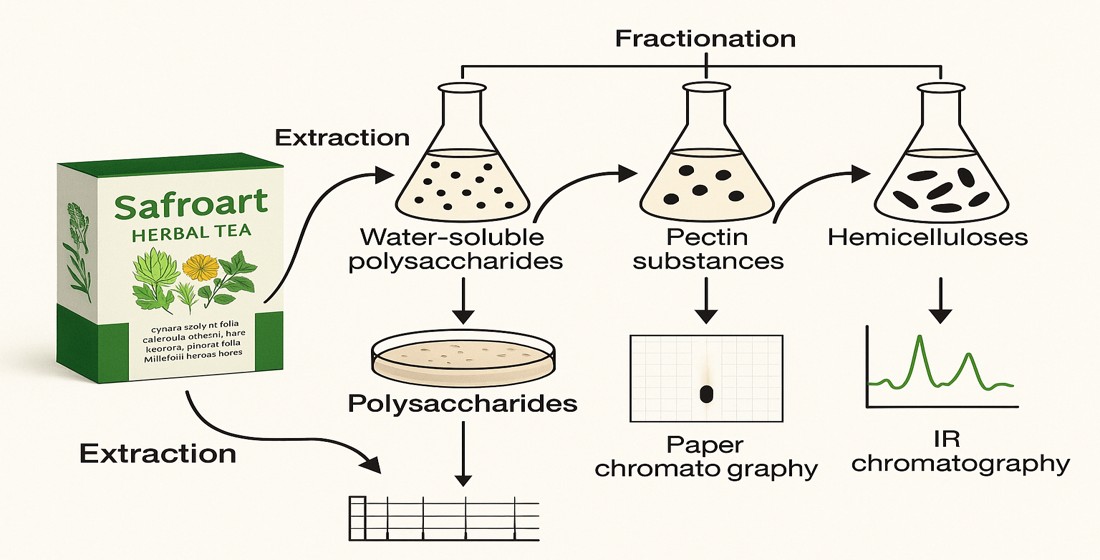
Materials and methods. The herbal collection was subjected to sequential extraction to isolate its polysaccharides, which were fractionated into water-soluble polysaccharides (WSPS), pectin substances (PS), and hemicelluloses (HMC). These fractions were analyzed using paper chromatography, gas chromatography (GC), and infrared (IR) spectroscopy. For pharmacological evaluation, acute toxicity was assessed in mice using a single-dose administration protocol, and the choleretic effect was studied in rats by measuring bile secretion over a 4-hour period following administration of a 10 % aqueous infusion.
Results. Alcohol-soluble sugars, including sucrose and fructose, were identified. WSPS were primarily composed of glucose, galactose, and arabinose, while PS and HMC contained rhamnose, arabinose, and xylose. IR spectroscopy confirmed the structural features of the fractions. The herbal collection was classified as practically non-toxic (LD₅₀ > 4000 mg/kg). In vivo studies revealed a 27.4 % increase in bile secretion in treated rats compared to controls, confirming a significant choleretic effect.
Conclusions.‘Safroart herbal tea’ contains a complex mixture of polysaccharides with distinct monosaccharide profiles and demonstrates both safety and choleretic efficacy in experimental models. These findings support its potential use as a natural hepatobiliary remedy and contribute to the phytochemical and pharmacological understanding of its therapeutic action
References
- Olimov Kh.K., Mirrakhimova T.A. Changes in the Dynamics of Registration of Choleretic Drugs in Uzbekistan from 2022 to 2024 // Pharmacy, Scientific and Practical Journal, No. 5, 2024, pp. 44-48.
- Mirrakhimova T.A., Tulyaganov R.T. Study of Acute Toxicity and Choleretic Activity of a Liquid Extract Based on Cynara scolymus // Pharmaceutical Journal, No. 1, 2020, pp. 90-92.
- Zuparova, Z. A., Ismoilova, G. M., Mirrakhimova, T. A. (2024). Determination of the composition and technological properties of the substance for Immunacea Bio Tab tablets. American Journal of Biomedical Science & Pharmaceutical Innovation, 1 (4), 34–38. https://doi.org/10.37547/ajbspi/Volume04Issue01-06
- Akhmadova, G., Mirrakhimova, T., Ismoilova, G. (2024). High-quality analysis of dry extract of prickly artichoke raw material (Cynara Scolymus L.) cultivated in Uzbekistan. ScienceRise: Pharmaceutical Science, 4 (50), 60–66. https://doi.org/10.15587/2519-4852.2024.310826
- Zuparova Z.A. Infrared Spectroscopic Study of the Polysaccharide Composition of a Collection Obtained from Echinacea Purpurea // Pharmaceutical Bulletin of Uzbekistan. Scientific and Practical Pharmaceutical Journal, No. 4, 2019, pp. 77-81.
- Ashurov, A. Y., Dzhonmurodov, A. S., Usmanova, S. R., Kholov, Sh. E., Mukhydynov, Z. K. (2021). Characterization of polysaccharides from Eremurus hissaricus roots by FTIR spectroscopy. University Proceedings. Applied Chemistry and Biotechnology, 11 (2), 281–289. https://doi.org/10.21285/2227-2925-2021-11-2-281-289
- Kodiralieva, F. A., Rakhmanberdyeva, R. K. (2011). Polysaccharides from Crotalaria alata. Chemistry of Natural Compounds, 47 (1), 7–9. https://doi.org/10.1007/s10600-011-9818-3
- Cai, W., Xie, L., Chen, Y., Zhang, H. (2013). Purification, characterization and anticoagulant activity of the polysaccharides from green tea. Carbohydrate Polymers, 92 (2), 1086–1090. https://doi.org/10.1016/j.carbpol.2012.10.057
- Jiang, H., Sun, P., He, J., Shao, P. (2012). Rapid purification of polysaccharides using novel radial flow ion-exchange by response surface methodology from Ganoderma lucidum. Food and Bioproducts Processing: Transactions of the Institution of Chemical Engineers, Part C, 90 (1), 1–8. https://doi.org/10.1016/j.fbp.2010.12.001
- Kacurakova, M., Capek, P., Sasinkova, V., Wellner, N., Ebringerova, A. (2000). FT-IR study of plant cell wall model compounds: Pectic polysaccharides and HMC. Carbohydrate Polymers, 43 (2), 195–203. https://doi.org/10.1016/S0144-8617(00)00151-X
- Samout, N., Bouzenna, H., Dhibi, S., Ncib, S., El Feki, A., Hfaiedh, N. (2016). Therapeutic effect of apple pectin in obese rats. Biomedicine & Pharmacotherapy, 83, 1233–1238. https://doi.org/10.1016/j.biopha.2016.08.038
- Yuliarti, O., Goh, K. K. T., Matia-Merino, L., Mawson, J., Brennan, C. (2015). Extraction and characterisation of pomace pectin from gold kiwifruit (Actinidia chinensis). Food Chemistry, 187, 290–296. https://doi.org/10.1016/j.foodchem.2015.03.148
- Minzanova S.T., Mironov V.F., Mindubaev A.Z., Tsepaeva O.V., et al. Isolation and Physicochemical Properties of Pectic Polysaccharides from Amaranth Leaves // Agricultural Biology, 2021, Vol. 56, No. 3, pp. 591-601.
- Mirrakhimova T.A., Yuldasheva Sh.S. Comparative Characterization of the Amino Acid and Polysaccharide Composition of Cynara scolymus Leaves and Receptacle // Bulletin of the South Kazakhstan Medical Academy, No. 4(84), 2018, pp. 54-58.
- Zuparova, Z. A., Ismoilova, G. M., Olimov, N. K., Khasanova, B. J. (2020). Determination of high quality of Echinaceae purpurae herba grown in Uzbekistan and the prospect of creating immunomodulatory medicinal products on its base. International Journal of Psychosocial Rehabilitation, 24 (4), 2355–2366. https://doi.org/10.37200/IJPR/V24I4/PR201346
- Mirrakhimova, T. A., Ismoilova, G. M., Olimov, N. K., Abdullaev, B. (2020). Determination of qualitative and quantitative indicators of lyophilized water extract of Echinacea purpurea. Solid State Technology, 63 (6), 15382–15391.
- Zuparova Z.A., Ismoilova G.M., Hakimova M.S. Determination of the Polysaccharide Composition of the Encapsulated Substance in the Pharmaceutical Form "Immunacea" // Pharmacy, Immunity, and Vaccine, Scientific and Practical Journal, No. 3, 2022, pp. 81-86.
- Akhmadova, G., Azizov, I. (2024). Study of the primary metabolits of seed the local plant amaranth idea ta (amaranthus caudatus ll.): Orginal langulage: Uzbek. Problems and Perspectives of Pharmaceutics and Drug Discovery, 1 (2), 20–24. Available at: https://journal.pharmi.uz/pppndd/article/view/70
- Mirrakhimova T. A., Yunuskhodzhaev A. N. The prickly artichoke is a promising medicinal plant //Publishing and printing creative house named after Chulpan. Tashkent-2015. P-206. – 2015.
- Ng, T. B. (2006). Pharmacological activity of sanchi ginseng (Panax notoginseng). Journal of Pharmacy and Pharmacology, 58 (8), 1007–1019. https://doi.org/10.1211/jpp.58.8.0001
- Malikova, M. Kh., Siddikova, A. A., Rakhmanberdieva, R. K. (2016). Seasonal Dynamics of the Content and Composition of Carbohydrates in Stachys hissarica (Family: Lamiaceae). Plant Resources Journal, 52 (3), 397–405.
- Kolisnyk, S. V., Umarov, U. A., Dynnyk, K. V., Fathullaeva, M., Shabilalov, A. A., Gazieva, A. S. (2020). The study of the acute toxicity and the laxative effect of pectins from Pimpinella anisum herb. Clinical Pharmacy, 24 (2), 52–55. https://doi.org/10.24959/cphj.20.1528
- Khusainova R. A. et al. (2021). Study On Acute Toxicity And Antidote Activity Of Lyophobic Drug “Calcium Folinate”. 湖南大学学报 (自然科学版), 48 (10).
- Azizov, I. K., Akhmadova, G. A. (2021). Amino acid composition of the seeds of kiwicha (Amaranthus caudatus) growing in Uzbekistan. Farmaciya (Pharmacy), 70 (7), 37–40. https://doi.org/10.29296/25419218-2021-07-06
Downloads
Published
How to Cite
Issue
Section
License
Copyright (c) 2025 Khairulla Olimov, Tanzila Mirrakhimova, Gulrano Akhmadova

This work is licensed under a Creative Commons Attribution 4.0 International License.
Our journal abides by the Creative Commons Attribution 4.0 International License copyright rights and permissions for open access journals.
Authors, who are published in this journal, agree to the following conditions:
1. The authors reserve the right to authorship of the work and pass the first publication right of this work to the journal under the terms of a Creative Commons Attribution 4.0 International License, which allows others to freely distribute the published research with the obligatory reference to the authors of the original work and the first publication of the work in this journal.
2. The authors have the right to conclude separate supplement agreements that relate to non-exclusive work distribution in the form in which it has been published by the journal (for example, to upload the work to the online storage of the journal or publish it as part of a monograph), provided that the reference to the first publication of the work in this journal is included.
3. Authors have the right to store the final accepted version of the article in an institutional, thematic, or any other repository to ensure visibility and accessibility.