Полісахаридний профіль, гостра токсичність та жовчовидільна активність жовчогінного фітопрепарату «Фіточай сафроарт»
DOI:
https://doi.org/10.15587/2519-4852.2025.327605Ключові слова:
жовчогінний збір, фіточай Сафроарт, ІЧ-спектр, спирторозчинні цукри, гостра токсичність, жовчовидільна дія, ВРПС, ПР, геміцелюлоза, газова хроматографіяАнотація
Мета. Метою даного дослідження було визначити полісахаридний склад жовчогінного збору «Фіточай Сафроарт», зосередившись на ідентифікації ключових вуглеводних фракцій та їх моносахаридного складу, а також оцінити його гостру токсичність і жовчогінну активність. Це дослідження сприяє розумінню біохімічних і фармакологічних властивостей, що лежать в основі терапевтичних ефектів рослини.
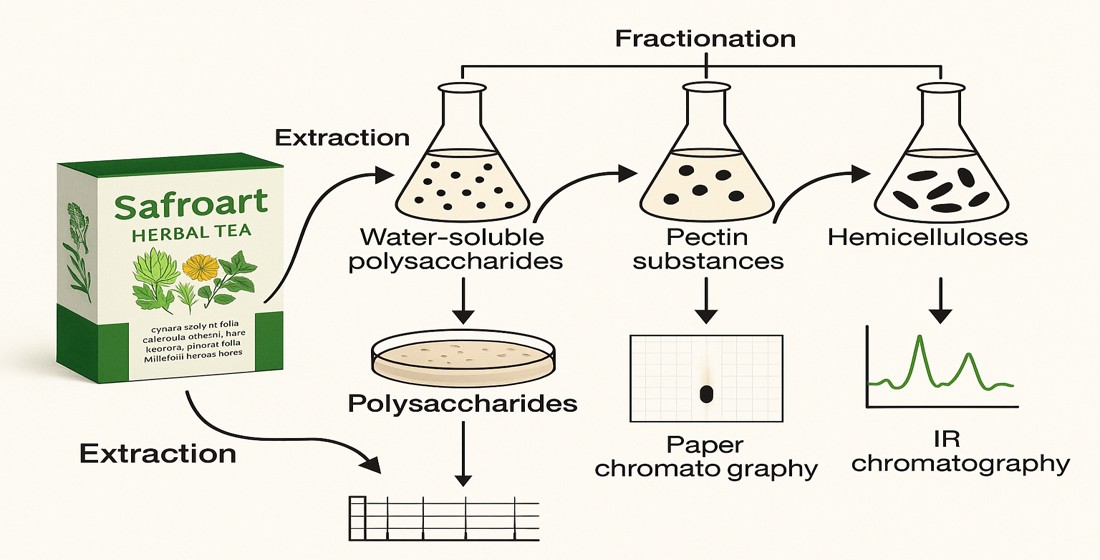
Матеріали та методи. Трав'яний збір піддавали послідовної екстракції з метою виділення з нього полісахаридів, які фракціонували на водорозчинні полісахариди (ВРПС), пектинові речовини (ПР) і геміцелюлози (ГМЦ). Ці фракції аналізували за допомогою паперової хроматографії, газової хроматографії (ГХ) та інфрачервоної (ІЧ) спектроскопії. Для фармакологічної оцінки гостру токсичність оцінювали у мишей за допомогою протоколу введення одноразової дози, а холеретичний ефект вивчали у щурів шляхом вимірювання секреції жовчі протягом 4-годинного періоду після введення 10 % водного розчину.
Результати. Виявлено розчинні в спирті цукри, зокрема сахарозу та фруктозу. ВРПС в основному складалися з глюкози, галактози та арабінози, тоді як ПР і ГМЦ містили рамнозу, арабінозу та ксилозу. ІЧ-спектроскопія підтвердила структурні особливості фракцій. Трав'яний збір класифікували як практично нетоксичний (LD₅₀ > 4000 мг/кг). Дослідження in vivo показали збільшення секреції жовчі на 27,4 % у щурів, які отримували лікування, порівняно з контрольною групою, що підтверджує значний жовчогінний ефект.
Висновки. Трав’яний чай «Сафроарт» містить складну суміш полісахаридів з чіткими моносахаридними профілями та демонструє як безпечність, так і жовчогінну ефективність на експериментальних моделях. Ці висновки підтверджують його потенційне використання як природного гепатобіліарного засобу та сприяють фітохімічному та фармакологічному розумінню його терапевтичної дії
Посилання
- Olimov Kh.K., Mirrakhimova T.A. Changes in the Dynamics of Registration of Choleretic Drugs in Uzbekistan from 2022 to 2024 // Pharmacy, Scientific and Practical Journal, No. 5, 2024, pp. 44-48.
- Mirrakhimova T.A., Tulyaganov R.T. Study of Acute Toxicity and Choleretic Activity of a Liquid Extract Based on Cynara scolymus // Pharmaceutical Journal, No. 1, 2020, pp. 90-92.
- Zuparova, Z. A., Ismoilova, G. M., Mirrakhimova, T. A. (2024). Determination of the composition and technological properties of the substance for Immunacea Bio Tab tablets. American Journal of Biomedical Science & Pharmaceutical Innovation, 1 (4), 34–38. https://doi.org/10.37547/ajbspi/Volume04Issue01-06
- Akhmadova, G., Mirrakhimova, T., Ismoilova, G. (2024). High-quality analysis of dry extract of prickly artichoke raw material (Cynara Scolymus L.) cultivated in Uzbekistan. ScienceRise: Pharmaceutical Science, 4 (50), 60–66. https://doi.org/10.15587/2519-4852.2024.310826
- Zuparova Z.A. Infrared Spectroscopic Study of the Polysaccharide Composition of a Collection Obtained from Echinacea Purpurea // Pharmaceutical Bulletin of Uzbekistan. Scientific and Practical Pharmaceutical Journal, No. 4, 2019, pp. 77-81.
- Ashurov, A. Y., Dzhonmurodov, A. S., Usmanova, S. R., Kholov, Sh. E., Mukhydynov, Z. K. (2021). Characterization of polysaccharides from Eremurus hissaricus roots by FTIR spectroscopy. University Proceedings. Applied Chemistry and Biotechnology, 11 (2), 281–289. https://doi.org/10.21285/2227-2925-2021-11-2-281-289
- Kodiralieva, F. A., Rakhmanberdyeva, R. K. (2011). Polysaccharides from Crotalaria alata. Chemistry of Natural Compounds, 47 (1), 7–9. https://doi.org/10.1007/s10600-011-9818-3
- Cai, W., Xie, L., Chen, Y., Zhang, H. (2013). Purification, characterization and anticoagulant activity of the polysaccharides from green tea. Carbohydrate Polymers, 92 (2), 1086–1090. https://doi.org/10.1016/j.carbpol.2012.10.057
- Jiang, H., Sun, P., He, J., Shao, P. (2012). Rapid purification of polysaccharides using novel radial flow ion-exchange by response surface methodology from Ganoderma lucidum. Food and Bioproducts Processing: Transactions of the Institution of Chemical Engineers, Part C, 90 (1), 1–8. https://doi.org/10.1016/j.fbp.2010.12.001
- Kacurakova, M., Capek, P., Sasinkova, V., Wellner, N., Ebringerova, A. (2000). FT-IR study of plant cell wall model compounds: Pectic polysaccharides and HMC. Carbohydrate Polymers, 43 (2), 195–203. https://doi.org/10.1016/S0144-8617(00)00151-X
- Samout, N., Bouzenna, H., Dhibi, S., Ncib, S., El Feki, A., Hfaiedh, N. (2016). Therapeutic effect of apple pectin in obese rats. Biomedicine & Pharmacotherapy, 83, 1233–1238. https://doi.org/10.1016/j.biopha.2016.08.038
- Yuliarti, O., Goh, K. K. T., Matia-Merino, L., Mawson, J., Brennan, C. (2015). Extraction and characterisation of pomace pectin from gold kiwifruit (Actinidia chinensis). Food Chemistry, 187, 290–296. https://doi.org/10.1016/j.foodchem.2015.03.148
- Minzanova S.T., Mironov V.F., Mindubaev A.Z., Tsepaeva O.V., et al. Isolation and Physicochemical Properties of Pectic Polysaccharides from Amaranth Leaves // Agricultural Biology, 2021, Vol. 56, No. 3, pp. 591-601.
- Mirrakhimova T.A., Yuldasheva Sh.S. Comparative Characterization of the Amino Acid and Polysaccharide Composition of Cynara scolymus Leaves and Receptacle // Bulletin of the South Kazakhstan Medical Academy, No. 4(84), 2018, pp. 54-58.
- Zuparova, Z. A., Ismoilova, G. M., Olimov, N. K., Khasanova, B. J. (2020). Determination of high quality of Echinaceae purpurae herba grown in Uzbekistan and the prospect of creating immunomodulatory medicinal products on its base. International Journal of Psychosocial Rehabilitation, 24 (4), 2355–2366. https://doi.org/10.37200/IJPR/V24I4/PR201346
- Mirrakhimova, T. A., Ismoilova, G. M., Olimov, N. K., Abdullaev, B. (2020). Determination of qualitative and quantitative indicators of lyophilized water extract of Echinacea purpurea. Solid State Technology, 63 (6), 15382–15391.
- Zuparova Z.A., Ismoilova G.M., Hakimova M.S. Determination of the Polysaccharide Composition of the Encapsulated Substance in the Pharmaceutical Form "Immunacea" // Pharmacy, Immunity, and Vaccine, Scientific and Practical Journal, No. 3, 2022, pp. 81-86.
- Akhmadova, G., Azizov, I. (2024). Study of the primary metabolits of seed the local plant amaranth idea ta (amaranthus caudatus ll.): Orginal langulage: Uzbek. Problems and Perspectives of Pharmaceutics and Drug Discovery, 1 (2), 20–24. Available at: https://journal.pharmi.uz/pppndd/article/view/70
- Mirrakhimova T. A., Yunuskhodzhaev A. N. The prickly artichoke is a promising medicinal plant //Publishing and printing creative house named after Chulpan. Tashkent-2015. P-206. – 2015.
- Ng, T. B. (2006). Pharmacological activity of sanchi ginseng (Panax notoginseng). Journal of Pharmacy and Pharmacology, 58 (8), 1007–1019. https://doi.org/10.1211/jpp.58.8.0001
- Malikova, M. Kh., Siddikova, A. A., Rakhmanberdieva, R. K. (2016). Seasonal Dynamics of the Content and Composition of Carbohydrates in Stachys hissarica (Family: Lamiaceae). Plant Resources Journal, 52 (3), 397–405.
- Kolisnyk, S. V., Umarov, U. A., Dynnyk, K. V., Fathullaeva, M., Shabilalov, A. A., Gazieva, A. S. (2020). The study of the acute toxicity and the laxative effect of pectins from Pimpinella anisum herb. Clinical Pharmacy, 24 (2), 52–55. https://doi.org/10.24959/cphj.20.1528
- Khusainova R. A. et al. (2021). Study On Acute Toxicity And Antidote Activity Of Lyophobic Drug “Calcium Folinate”. 湖南大学学报 (自然科学版), 48 (10).
- Azizov, I. K., Akhmadova, G. A. (2021). Amino acid composition of the seeds of kiwicha (Amaranthus caudatus) growing in Uzbekistan. Farmaciya (Pharmacy), 70 (7), 37–40. https://doi.org/10.29296/25419218-2021-07-06
##submission.downloads##
Опубліковано
Як цитувати
Номер
Розділ
Ліцензія
Авторське право (c) 2025 Khairulla Olimov, Tanzila Mirrakhimova, Gulrano Akhmadova

Ця робота ліцензується відповідно до Creative Commons Attribution 4.0 International License.
Наше видання використовує положення про авторські права Creative Commons Attribution 4.0 International License для журналів відкритого доступу.
Автори, які публікуються у цьому журналі, погоджуються з наступними умовами:
1. Автори залишають за собою право на авторство своєї роботи та передають журналу право першої публікації цієї роботи на умовах ліцензії Creative Commons Attribution 4.0 International License, котра дозволяє іншим особам вільно розповсюджувати опубліковану роботу з обов'язковим посиланням на авторів оригінальної роботи та першу публікацію роботи у цьому журналі.
2. Автори мають право укладати самостійні додаткові угоди щодо неексклюзивного розповсюдження роботи у тому вигляді, в якому вона була опублікована цим журналом (наприклад, розміщувати роботу в електронному сховищі установи або публікувати у складі монографії), за умови збереження посилання на першу публікацію роботи у цьому журналі.
3. Автори мають право зберігати остаточну прийняту версію статті в інституційному, тематичному або будь-якому іншому репозитарії з метою забезпечення видимості та доступності.