Analysis of the status of provision of pharmaceutical care to patients with multiple sclerosis in Ukraine
DOI:
https://doi.org/10.15587/2519-4852.2025.329991Keywords:
multiple sclerosis, pharmaceutical care, drugs, pharmacistAbstract
Considering modern approaches to the treatment of chronic non-communicable diseases, as well as the experience of active involvement of pharmacists in multidisciplinary teams of healthcare professionals, it is relevant to determine the professional role of a pharmacist in teams providing medical and social care to patients with multiple sclerosis (MS).
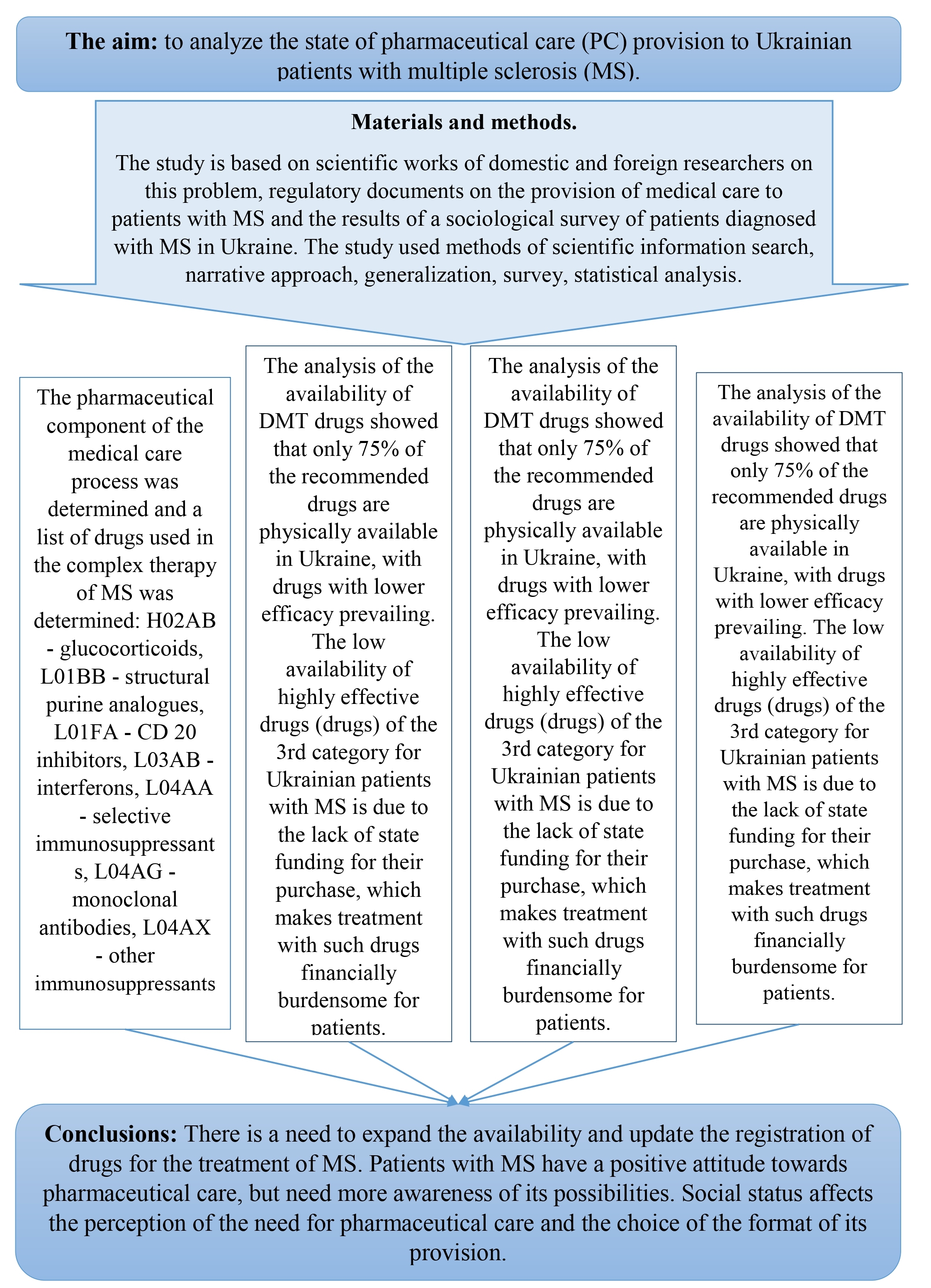
The aim: to analyze the state of pharmaceutical care (PC) provision to Ukrainian patients with multiple sclerosis (MS).
Materials and methods. The study is based on scientific works of domestic and foreign researchers on this problem, regulatory documents on the provision of medical care to patients with MS and the results of a sociological survey of patients diagnosed with MS. The study used methods of scientific information search, narrative approach, generalization, survey, statistical analysis, and others.
Results. The pharmaceutical component of the medical care process was determined and a list of drugs used in the complex therapy of MS was determined: H02AB - glucocorticoids, L01BB - structural purine analogues, L01FA - CD 20 inhibitors, L03AB - interferons, L04AA - selective immunosuppressants, L04AG - monoclonal antibodies, L04AX - other immunosuppressants.
The analysis of the availability of DMT drugs showed that only 75 % of the recommended drugs are physically available in Ukraine, with drugs with lower efficacy prevailing. The low availability of highly effective drugs (drugs) of the 3rd category for Ukrainian patients with MS is due to the lack of state funding for their purchase, which makes treatment with such drugs financially burdensome for patients.
The survey found that 64.5 % of patients would like to receive additional support from pharmacists. Possible elements of pharmaceutical care that are important for patients with MS were identified, such as counselling, coordination with public organizations, explanation of new treatment options, and symptom monitoring.
When assessing patients' adherence to PC, factors such as age, gender, location, displaced status, work restrictions, or time since diagnosis did not significantly influence patients' positive attitudes. Furthermore, these factors did not influence patients' preferences for preferred pharmacist interaction format (face-to-face, mixed, or telepharmacy).
Conclusions: There is a need to expand the availability and update the registration of drugs for the treatment of MS. Patients with MS have a positive attitude towards pharmaceutical care, but need more awareness of its possibilities. Social status affects the perception of the need for pharmaceutical care and the choice of the format of its provision
References
- Atlas MS. Multiple Sclerosis National Federation. Available at: https://www.atlasofms.org/map/global/epidemiology/number-of-people-newly-diagnosed-with-ms
- Liu, R., Du, S., Zhao, L., Jain, S., Sahay, K., Rizvanov, A. et al. (2022). Autoreactive lymphocytes in multiple sclerosis: Pathogenesis and treatment target. Frontiers in Immunology, 13. https://doi.org/10.3389/fimmu.2022.996469
- Moghaddam, V. K., Dickerson, A. S., Bazrafshan, E., Seyedhasani, S. N., Najafi, F., Hadei, M. et al. (2021). Socioeconomic determinants of global distribution of multiple sclerosis: an ecological investigation based on Global Burden of Disease data. BMC Neurology, 21 (1). https://doi.org/10.1186/s12883-021-02170-3
- von Drathen, S., Gold, S. M., Peper, J., Rahn, A. C., Ramien, C., Magyari, M. et al. (2024). Stress and Multiple Sclerosis – Systematic review and meta-analysis of the association with disease onset, relapse risk and disability progression. Brain, Behavior, and Immunity, 120, 620–629. https://doi.org/10.1016/j.bbi.2024.06.004;
- Jiang, J., Abduljabbar, S., Zhang, C., Osier, N. (2022). The relationship between stress and disease onset and relapse in multiple sclerosis: A systematic review. Multiple Sclerosis and Related Disorders, 67, 104142. https://doi.org/10.1016/j.msard.2022.104142
- Bowen, J., Mehta, R., Pelletier, C., Tian, M., Noxon, V., Johnson, B. H., Bonafede, M. (2020). Treatment Patterns Among Patients with Multiple Sclerosis Initiating Second-Line Disease-Modifying Therapy. Advances in Therapy, 37 (7), 3163–3177. https://doi.org/10.1007/s12325-020-01367-1
- Shah, P. (2015). Symptomatic management in multiple sclerosis. Annals of Indian Academy of Neurology, 18 (5), 35–42. https://doi.org/10.4103/0972-2327.164827
- Talanki Manjunatha, R., Habib, S., Sangaraju, S. L., Yepez, D., Grandes, X. A. (2022). Multiple Sclerosis: Therapeutic Strategies on the Horizon. Cureus, 14 (5), e24895. https://doi.org/10.7759/cureus.24895
- Beretich, B., Beretich, T. (2009). Explaining multiple sclerosis prevalence by ultraviolet exposure: a geospatial analysis. Multiple Sclerosis Journal, 15 (8), 891–898. https://doi.org/10.1177/1352458509105579
- Mahat, K., Thapa, B. (2019). Multi-sectoral Approach to Non-Communicable Diseases Control: Easier Said than Done. Journal of Nepal Medical Association, 57 (220), 467–470. https://doi.org/10.31729/jnma.4729
- Rahayu, S. A., Widianto, S., Defi, I. R., Abdulah, R. (2021). Role of Pharmacists in the Interprofessional Care Team for Patients with Chronic Diseases. Journal of Multidisciplinary Healthcare, 14, 1701–1710. https://doi.org/10.2147/jmdh.s309938
- Angibaud, M., Jourdain, M., Girard, S., Rouxel, L., Mouhib, A., Nogueira, A. et al. (2024). Involving community pharmacists in interprofessional collaboration in primary care: a systematic review. BMC Primary Care, 25 (1). https://doi.org/10.1186/s12875-024-02326-3
- Kotvitska, A., Volkova, A., Nozdrina, A., Surikova, I. (2024). Determination of the socially oriented role of pharmacists in the prevention, diagnosis and treatment of patients with viral hepatitis. ScienceRise: Pharmaceutical Science, 5 (51), 104–112. https://doi.org/10.15587/2519-4852.2024.314295
- Resolution CM/Res (2020)3 on the implementation of pharmaceutical care for the benefit of patients and Health services: Resolution no. CM/Res (2020)3. Council of Europe. Available at: https://rm.coe.int/09000016809cdf26
- Sukhera, J. (2022). Narrative Reviews: Flexible, Rigorous, and Practical. Journal of Graduate Medical Education, 14 (4), 414–417. https://doi.org/10.4300/jgme-d-22-00480.1
- International Ethical Guidelines for Health-related Research Involving Humans (2016). Geneva: Council for International Organizations of Medical Sciences (CIOMS). Available at: https://cioms.ch/wp-content/uploads/2017/01/WEB-CIOMS-EthicalGuidelines.pdf
- Albert, B., Tullis, T., Tedesco, D. (2010). Planning the Study. Beyond the Usability Lab, 17–47. https://doi.org/10.1016/b978-0-12-374892-8.00002-8
- Jager, J., Putnick, D. L., Bornstein, M. H. (2017). II. More than just convenient: the scientific merits of homogeneous convenience samples. Monographs of the Society for Research in Child Development, 82 (2), 13–30. https://doi.org/10.1111/mono.12296
- Rossi, R. J. (2018). Mathematical Statistics: An Introduction to Likelihood Based Inference. New York: John Wiley & Sons. 227. https://doi.org/10.1002/9781118771075
- Osnovy zakonodavstva Ukrainy pro okhoronu zdorovia (1992). Zakon Ukrainy No. 2801-XII. 19.11.1992. Available at: https://zakon.rada.gov.ua/laws/show/2801-12#Text
- Pro derzhavni finansovi harantii medychnoho obsluhovuvannia naselennia (2017). Zakon Ukrainy No. 2168-VIII. 19.10.2017. Available at: https://zakon.rada.gov.ua/laws/show/2168-19#Text
- Pro likarski zasoby (1996). Zakon Ukrainy No. 123/96-VR. 04.04.1996. Available at: https://zakon.rada.gov.ua/laws/show/123/96-%D0%B2%D1%80#Text
- Deiaki pytannia zakupivli likarskykh zasobiv, medychnykh vyrobiv ta dopomizhnykh zasobiv do nykh (2022). Postanova KM Ukrainy No. 216. 07.03.2022. Available at: https://zakon.rada.gov.ua/laws/show/216-2022-%D0%BF?find=1&text=%D1%80%D0%BE%D0%B7%D1%81%D1%96%D1%8F%D0%BD%D0%B8%D0%B9+%D1%81%D0%BA%D0%BB%D0%B5%D1%80%D0%BE%D0%B7#w1_2
- Novyi klinichnyi protokol medychnoi dopomohy rozsiianyi skleroz u doroslykh (2024). Nakaz MOZ Ukrainy No. 1142. 01.07.2024. Available at: https://www.dec.gov.ua/wp-content/uploads/2024/07/nkpmd-rs-z-nomerom-pdf.pdf
- Likuvannia boliu ta spastychnosti v patsiientiv iz rozsiianym sklerozom (2024). NEIRONEWS© Zbirnyk klinichnykh rekomendatsii, 84–91. Available at: https://neuronews.com.ua/uploads/sborniki/2024/articles/articles/nn-zkr-24__84-91.pdf
- Gozzo, L., Romano, G. L., Brancati, S., Longo, L., Vitale, D. C., Drago, F. (2023). The therapeutic value of treatment for multiple sclerosis: analysis of health technology assessments of three European countries. Frontiers in Pharmacology, 14. https://doi.org/10.3389/fphar.2023.1169400
- Pro vnesennia zmin do pereliku likarskykh zasobiv ta medychnykh vyrobiv, yaki zakupovuiutsia na pidstavi uhod shchodo zakupivli iz spetsializovanymy orhanizatsiiamy, yaki zdiisniuiut zakupivli za napriamamy vykorystannia biudzhetnykh koshtiv u 2018 rotsi za prohramoiu “Zabezpechennia medychnykh zakhodiv okremykh derzhavnykh prohram ta kompleksnykh zakhodiv prohramnoho kharakteru” (2018). Postanova KMU No. 520. 20.06.2018. Available at: https://zakon.rada.gov.ua/laws/show/520-2018-%D0%BF#Text
- Vysnovok upovnovazhenoho orhanu z derzhavnoi otsinky medychnykh tekhnolohii: kladrybin (2023). Derzhavne pidpryiemstvo «derzhavnyi ekspertnyi tsentr ministerstva okhorony zdorovia Ukrainy», 43. Available at: https://www.dec.gov.ua/wp-content/uploads/2022/02/vysnovok-z-derzhavnoyi-omt-kladrybin-mavenklad-vid-14.08.2023.pdf
- Vysnovok upovnovazhenoho orhanu z derzhavnoi otsinky tekhnolohii: okrelizuma (2023). Derzhavne pidpryiemstvo «derzhavnyi ekspertnyi tsentr ministerstva okhorony zdorovia Ukrainy», 32. Available at: https://www.dec.gov.ua/wp-content/uploads/2022/02/vysnovok-z-derzhavnoyi-omt-okrelizumab-vid-05.07.2023.pdf
- Vysnovok upovnovazhenoho orhanu z derzhavnoi otsinky tekhnolohii: alemtuzumab (2023). Derzhavne pidpryiemstvo «derzhavnyi ekspertnyi tsentr ministerstva okhorony zdorovia Ukrainy», 21. Available at: https://www.dec.gov.ua/wp-content/uploads/2022/02/vysnovok-upovnovazhenogo-organu-z-derzhavnoyi-omt-lz-alemtuzumab-sajt.pdf
- Gasperini, C., Battaglia, M. A., Balzani, F., Chiarini, E., Pani, M., Pasqualetti, P. et al. (2024). Unveiling preferences in multiple sclerosis care: insights from an Italian discrete-choice experiment with patients and healthcare professionals. Journal of Neurology, 272 (1). https://doi.org/10.1007/s00415-024-12725-2
- Bauer, B., Brockmeier, B., Devonshire, V., Charbonne, A., Wach, D., Hendin, B. (2020). An International Discrete Choice Experiment Assessing patients’ Preferences for disease-modifying Therapy Attributes in Multiple Sclerosis. Neurodegenerative Disease Management, 10 (6), 369–382. https://doi.org/10.2217/nmt-2020-0034
- Li, P., Ladage, V. P., Berger, J., Chahin, S., Jhaveri, M., Geremakis, C., Doshi, J. A. (2020). Disease-Modifying Therapy Adherence and Associated Factors in a National Sample of Medicare Patients With Multiple Sclerosis. Value in Health, 23 (3), 328–334. https://doi.org/10.1016/j.jval.2019.10.011
- Martínez-López, I., Maurino, J., Sanmartín-Fenollera, P., Ontañon-Nasarre, A., Santiago-Pérez, A., Moya-Carmona, I. et al. (2020). Assessing Pharmacists’ Preferences towards Efficacy Attributes of Disease-Modifying Therapies in Relapsing-Remitting Multiple Sclerosis. Pharmacy, 8 (2), 61. https://doi.org/10.3390/pharmacy8020061
- Flemmen, H. Ø., Simonsen, C. S., Broch, L., Brunborg, C., Berg-Hansen, P., Moen, S. M. et al. (2022). The influence of socioeconomic factors on access to disease modifying treatment in a Norwegian multiple sclerosis cohort. Multiple Sclerosis and Related Disorders, 61, 103759. https://doi.org/10.1016/j.msard.2022.103759
- Hadjigeorgiou, G., Dardiotis, E., Tsivgoulis, G., Doskas, T., Petrou, D., Makris, N. et al. (2014). Observational Study Assessing Demographic, Economic and Clinical Factors Associated with Access and Utilization of Health Care Services of Patients with Multiple Sclerosis under Treatment with Interferon Beta-1b (EXTAVIA). PLoS ONE, 9 (11), e113933. https://doi.org/10.1371/journal.pone.0113933
- Ruiz-Ramos, J., Hernández, M. H., Juanes-Borrego, A. M., Milà, R., Mangues-Bafalluy, M. A., Mestres, C. (2021). The Impact of Pharmaceutical Care in Multidisciplinary Teams on Health Outcomes: Systematic Review and Meta-Analysis. Journal of the American Medical Directors Association, 22 (12), 2518–2526. https://doi.org/10.1016/j.jamda.2021.05.038
- Kremin, Y., Lesyk, L., Lesyk, R., Levytska, O., Hromovyk, B. (2023). Detailing the Ten Main Professional Roles of a Pharmacist to Provide the Scope of Professional Functions. Scientia Pharmaceutica, 91 (1), 5. https://doi.org/10.3390/scipharm91010005
- Johnson, D. (2023). How to work effectively as part of a multidisciplinary team. Pharmaceutical Journal, 311 (7978). https://doi.org/10.1211/pj.2023.1.199023
Downloads
Published
How to Cite
Issue
Section
License
Copyright (c) 2025 Natalia Tkachenko, Svitlana Ryzhkova, Аnzhela Olkhovska

This work is licensed under a Creative Commons Attribution 4.0 International License.
Our journal abides by the Creative Commons Attribution 4.0 International License copyright rights and permissions for open access journals.
Authors, who are published in this journal, agree to the following conditions:
1. The authors reserve the right to authorship of the work and pass the first publication right of this work to the journal under the terms of a Creative Commons Attribution 4.0 International License, which allows others to freely distribute the published research with the obligatory reference to the authors of the original work and the first publication of the work in this journal.
2. The authors have the right to conclude separate supplement agreements that relate to non-exclusive work distribution in the form in which it has been published by the journal (for example, to upload the work to the online storage of the journal or publish it as part of a monograph), provided that the reference to the first publication of the work in this journal is included.
3. Authors have the right to store the final accepted version of the article in an institutional, thematic, or any other repository to ensure visibility and accessibility.