Morphological and size characterization of zinc oxide nanoparticles and evaluation of their cytotoxicity on the MCF-7 cell line
DOI:
https://doi.org/10.15587/2519-4852.2025.338297Keywords:
zinc oxide nanoparticles, green synthesis, Scutellaria Iscanderi, breast cancer, MCF-7, cytotoxicity, atomic force microscopy (AFM), scanning electron microscopy (SEM), dynamic light scattering (DLS)Abstract
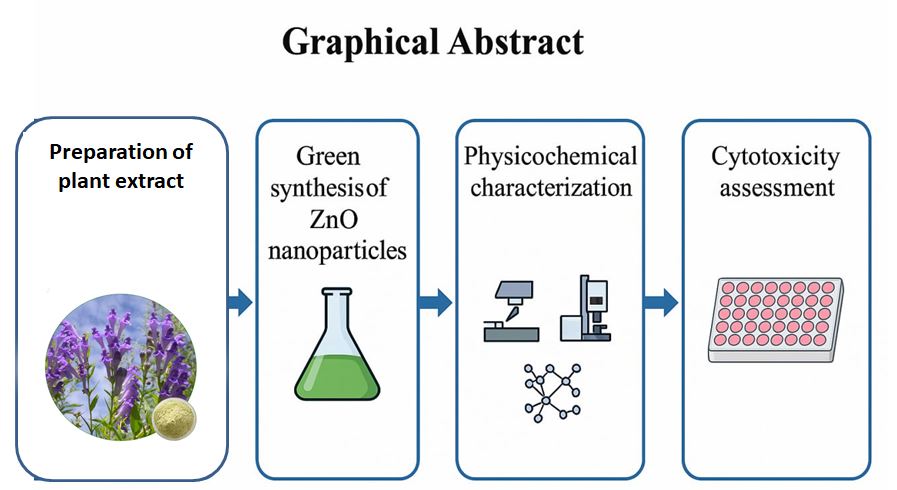
The aim. This study aimed to synthesize zinc oxide nanoparticles (ZnO NPs) using a green method based on Scutellaria Iscanderi L. extract and to evaluate their physicochemical properties and in vitro cytotoxic effects on MCF-7 human breast cancer cells.
Methods. ZnO nanoparticles were obtained via green synthesis using the aqueous extract of Scutellaria Iscanderi L. as a reducing and stabilizing agent. The morphology, size, and distribution of the nanoparticles were analyzed by atomic force microscopy (AFM), scanning electron microscopy (SEM), and dynamic light scattering (DLS). Elemental composition was determined by SEM-EDX. Cytotoxic activity was assessed using the CCK-8 assay on MCF-7 breast adenocarcinoma cells.
Results. The synthesized ZnO NPs exhibited predominantly spherical morphology with a size range of 40–120 nm. DLS measurements showed a mean particle diameter of ~40 nm and a polydispersity index of 0.3, indicating good colloidal stability. EDX confirmed the presence of zinc with a content of 6.87% by mass. Cytotoxicity analysis revealed a dose-dependent reduction in cell viability, with an IC₅₀ value of 126.4 µg/mL.
Conclusion. Green-synthesized ZnO nanoparticles demonstrated favorable structural characteristics and moderate cytotoxic effects against MCF-7 cells. These findings suggest their potential application as a basis for further development of anticancer nanotherapeutics
References
- Cheng, R., Wang, S., Moslova, K., Mäkilä, E., Salonen, J., Li, J. et al. (2021). Quantitative Analysis of Porous Silicon Nanoparticles Functionalization by 1H NMR. ACS Biomaterials Science & Engineering, 8 (10), 4132–4139. https://doi.org/10.1021/acsbiomaterials.1c00440
- Okaiyeto, K., Gigliobianco, M. R., Di Martino, P. (2024). Biogenic Zinc Oxide Nanoparticles as a Promising Antibacterial Agent: Synthesis and Characterization. International Journal of Molecular Sciences, 25 (17), 9500. https://doi.org/10.3390/ijms25179500
- Jha, S., Rani, R., Singh, S. (2023). Biogenic Zinc Oxide Nanoparticles and Their Biomedical Applications: A Review. Journal of Inorganic and Organometallic Polymers and Materials, 33 (6), 1437–1452. https://doi.org/10.1007/s10904-023-02550-x
- Singh, H., Desimone, M. F., Pandya, S., Jasani, S., George, N., Adnan, M. et al. (2023). Revisiting the Green Synthesis of Nanoparticles: Uncovering Influences of Plant Extracts as Reducing Agents for Enhanced Synthesis Efficiency and Its Biomedical Applications. International Journal of Nanomedicine, 18, 4727–4750. https://doi.org/10.2147/ijn.s419369
- Harbeck, N., Gnant, M. (2017). Breast cancer. The Lancet, 389 (10074), 1134–1150. https://doi.org/10.1016/s0140-6736(16)31891-8
- Fisusi, F. A., Akala, E. O. (2019). Drug Combinations in Breast Cancer Therapy. Pharmaceutical Nanotechnology, 7 (1), 3–23. https://doi.org/10.2174/2211738507666190122111224
- Akhmadova, G., Mirrakhimova, T., Ismoilova, G. (2024). High-quality analysis of dry extract of prickly artichoke raw material (Cynara Scolymus L.) cultivated in Uzbekistan. ScienceRise: Pharmaceutical Science, 4 (50), 60–66. https://doi.org/10.15587/2519-4852.2024.310826
- Olimov, K., Mirrakhimova, T., Akhmadova, G. (2025). Polysaccharide profile, acute toxicity and bile secretion effects of the choleretic herbal preparation “Safroart herbal tea.” ScienceRise: Pharmaceutical Science, 2 (54), 59–68. https://doi.org/10.15587/2519-4852.2025.327605
- Shermatova, I. B., Faizullaeva, M. R. (2022). Nanochastitcy serebra – primenenie v meditcine. Eurasian journal of medical and natural sciences, 2 (6), 482–492. https://doi.org/10.5281/zenodo.6758025
- Xu, M., Liu, J., Feng, L., Hu, J., Guo, W., Lin, H. et al. (2025). Designing a Sulfur Vacancy Redox Disruptor for Photothermoelectric and Cascade-Catalytic-Driven Cuproptosis-Ferroptosis-Apoptosis Therapy. Nano-Micro Letters, 17 (1). https://doi.org/10.1007/s40820-025-01828-8
- Zhao, Y., Zhang, W., Zhang, R., Yu, C., Sun, Y., Sharipov, A. et al. (2025). Piezoelectric quantum dots as electron donors for optimizing the nanocatalytic activity of single–atom nanoenzyme. Chemical Engineering Journal, 519, 164875. https://doi.org/10.1016/j.cej.2025.164875
- Mirzayeva, M., Saidkarimova, N., Yunuskhodjaev, A. (2024). A Raman spectroscopy study of alkaloids in the plant Vinca erecta. Science and Innovation, 3 (D9), 47–51. https://doi.org/10.5281/zenodo.13828288
- Rizaev, K. S., Shermatova, I. B. Q. (2025). Research on the Study of the Specific Activity of a Medicinal Substance with Gold Nanoparticles. Journal of Neonatal Surgery, 14 (22S), 535–538. Available at: https://www.jneonatalsurg.com/index.php/jns/article/view/5550 Last accessed: 10.05,2025
- Shermatova, I. B., Rizaev, K. S. (2025). Technology of obtaining and studying the process of green synthesis with gold nanoparticles. Journal of Neonatal Surgery, 14 (22S), 529–534. Available at: https://www.jneonatalsurg.com/index.php/jns/article/view/5551
- Akhmadova, G., Azizov, I. (2024). Study of the primary metabolits of seed the local plant amaranth idea ta (Amaranthus Caudatus L). Problems and Perspectives of Pharmaceutics and Drug Discovery, 1 (2), 20–24.
- Basalo, O. B., Bulahan, G. O., Degamon, A. L., Lavilla, J. V., Lebosada, R. G. R., Iwamoto, H., Lavilla Jr, C. A. (2025). Synthesis and evaluation of zinc–quercetin complex: in vitro anti-glycation and DNA methylation analysis with molecular docking studies. ScienceRise: Pharmaceutical Science, 3 (55), 65–73. https://doi.org/10.15587/2519-4852.2025.333614
- Kryshchyshyn-Dylevych, A., Lesyk, R. (2025). Application of clustering algorithms and pharmacophore screening for identification of thiazolidinone and pyrazoline derivatives with dual antiparasitic and anticancer activity. ScienceRise: Pharmaceutical Science, 3 (55), 17–29. https://doi.org/10.15587/2519-4852.2025.328968
- Mandal, A. K., Katuwal, S., Tettey, F., Gupta, A., Bhattarai, S., Jaisi, S. et al. (2022). Current Research on Zinc Oxide Nanoparticles: Synthesis, Characterization, and Biomedical Applications. Nanomaterials, 12 (17), 3066. https://doi.org/10.3390/nano12173066
- Anjum, S., Hashim, M., Malik, S. A., Khan, M., Lorenzo, J. M., Abbasi, B. H., Hano, C. (2021). Recent Advances in Zinc Oxide Nanoparticles (ZnO NPs) for Cancer Diagnosis, Target Drug Delivery, and Treatment. Cancers, 13 (18), 4570. https://doi.org/10.3390/cancers13184570
- Mongy, Y., Shalaby, T. (2024). Green synthesis of zinc oxide nanoparticles using Rhus coriaria extract and their anticancer activity against triple-negative breast cancer cells. Scientific Reports, 14 (1). https://doi.org/10.1038/s41598-024-63258-7
- Abdelbaky, A. S., Abd El-Mageed, T. A., Babalghith, A. O., Selim, S., Mohamed, A. M. H. A. (2022). Green Synthesis and Characterization of ZnO Nanoparticles Using Pelargonium odoratissimum (L.) Aqueous Leaf Extract and Their Antioxidant, Antibacterial and Anti-inflammatory Activities. Antioxidants, 11 (8), 1444. https://doi.org/10.3390/antiox11081444
- Channa, G. M., Iturbe-Ek, J., Sustaita, A. O., Melo-Maximo, D. V., Bhatti, A., Esparza-Sanchez, J. et al. (2025). Eco-Friendly Synthesis of ZnO Nanoparticles from Natural Agave, Chiku, and Soursop Extracts: A Sustainable Approach to Antibacterial Applications. Crystals, 15 (5), 470. https://doi.org/10.3390/cryst15050470
- Perumalsamy, H., Balusamy, S. R., Sukweenadhi, J., Nag, S., MubarakAli, D., El-Agamy Farh, M. et al. (2024). A comprehensive review on Moringa oleifera nanoparticles: importance of polyphenols in nanoparticle synthesis, nanoparticle efficacy and their applications. Journal of Nanobiotechnology, 22 (1). https://doi.org/10.1186/s12951-024-02332-8
- Trachootham, D., Alexandre, J., Huang, P. (2009). Targeting cancer cells by ROS-mediated mechanisms: a radical therapeutic approach? Nature Reviews Drug Discovery, 8 (7), 579–591. https://doi.org/10.1038/nrd2803
Downloads
Published
How to Cite
Issue
Section
License
Copyright (c) 2025 Shermatova Iroda Bakhtiyor kizi, Sagdullayev Shamansur Shakhsaidovich , Khusniddinova Azizakhon Ravshan kizi, Akhmadova Gulrano, Rajabova Nargiza Khalimovna, Tayirova Dilobar Bakhtiyarovna

This work is licensed under a Creative Commons Attribution 4.0 International License.
Our journal abides by the Creative Commons Attribution 4.0 International License copyright rights and permissions for open access journals.
Authors, who are published in this journal, agree to the following conditions:
1. The authors reserve the right to authorship of the work and pass the first publication right of this work to the journal under the terms of a Creative Commons Attribution 4.0 International License, which allows others to freely distribute the published research with the obligatory reference to the authors of the original work and the first publication of the work in this journal.
2. The authors have the right to conclude separate supplement agreements that relate to non-exclusive work distribution in the form in which it has been published by the journal (for example, to upload the work to the online storage of the journal or publish it as part of a monograph), provided that the reference to the first publication of the work in this journal is included.
3. Authors have the right to store the final accepted version of the article in an institutional, thematic, or any other repository to ensure visibility and accessibility.