Морфологічна та розмірна характеризація наночастинок оксиду цинку та оцінка їх цитотоксичності на клітинній лінії MCF-7
DOI:
https://doi.org/10.15587/2519-4852.2025.338297Ключові слова:
наночастинки оксиду цинку, зелений синтез, Scutellaria Iscanderi, рак молочної залози, MCF-7, цитотоксичність, атомно-силова мікроскопія (АСМ), скануюча електронна мікроскопія (СЕМ), динамічне розсіювання світла (ДРС)Анотація
Мета. Метою цього дослідження було синтезувати наночастинки оксиду цинку (ZnO NP) за допомогою екологічно чистого методу на основі екстракту Scutellaria Iscanderi L. та оцінити їхні фізико-хімічні властивості та цитотоксичну дію in vitro на клітини раку молочної залози людини MCF-7.
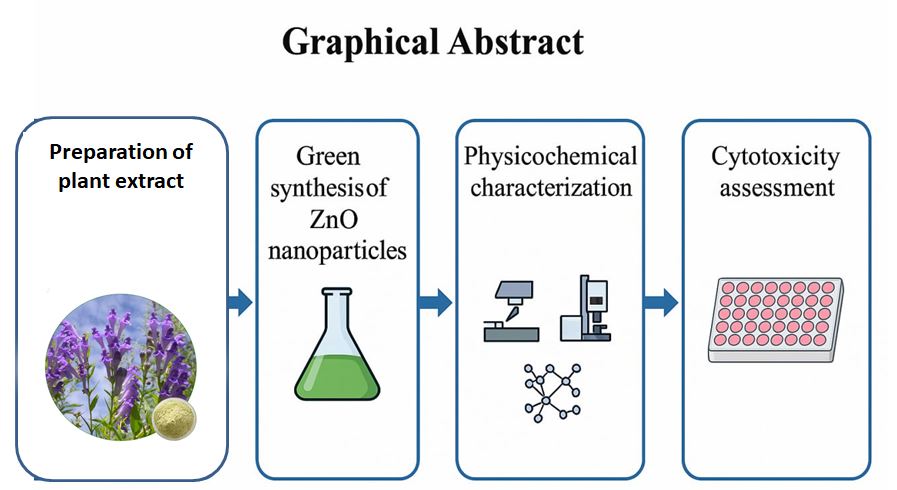
Методи. Наночастинки ZnO були отримані за допомогою екологічно чистого синтезу з використанням водного екстракту Scutellaria Iscanderi L. як відновлювального та стабілізуючого агента. Морфологію, розмір та розподіл наночастинок аналізували за допомогою атомно-силової мікроскопії (АСМ), скануючої електронної мікроскопії (СЕМ) та динамічного розсіювання світла (ДРС). Елементний склад визначали за допомогою СЕМ-ЕДX. Цитотоксичну активність оцінювали за допомогою аналізу CCK-8 на клітинах аденокарциноми молочної залози MCF-7.
Результати. Синтезовані наночастинки ZnO демонстрували переважно сферичну морфологію з діапазоном розмірів 40–120 нм. Вимірювання ДРС показали середній діаметр частинок ~40 нм та індекс полідисперсності 0,3, що свідчить про добру колоїдну стабільність. EDX підтвердив наявність цинку з вмістом 6,87% за масою. Аналіз цитотоксичності виявив дозозалежне зниження життєздатності клітин зі значенням IC₅₀ 126,4 мкг/мл.
Висновки. Зелений синтез наночастинок ZnO продемонстрував сприятливі структурні характеристики та помірний цитотоксичний ефект проти клітин MCF-7. Ці результати свідчать про їх потенційне застосування як основи для подальшого розвитку протипухлинної нанотерапії
Посилання
- Cheng, R., Wang, S., Moslova, K., Mäkilä, E., Salonen, J., Li, J. et al. (2021). Quantitative Analysis of Porous Silicon Nanoparticles Functionalization by 1H NMR. ACS Biomaterials Science & Engineering, 8 (10), 4132–4139. https://doi.org/10.1021/acsbiomaterials.1c00440
- Okaiyeto, K., Gigliobianco, M. R., Di Martino, P. (2024). Biogenic Zinc Oxide Nanoparticles as a Promising Antibacterial Agent: Synthesis and Characterization. International Journal of Molecular Sciences, 25 (17), 9500. https://doi.org/10.3390/ijms25179500
- Jha, S., Rani, R., Singh, S. (2023). Biogenic Zinc Oxide Nanoparticles and Their Biomedical Applications: A Review. Journal of Inorganic and Organometallic Polymers and Materials, 33 (6), 1437–1452. https://doi.org/10.1007/s10904-023-02550-x
- Singh, H., Desimone, M. F., Pandya, S., Jasani, S., George, N., Adnan, M. et al. (2023). Revisiting the Green Synthesis of Nanoparticles: Uncovering Influences of Plant Extracts as Reducing Agents for Enhanced Synthesis Efficiency and Its Biomedical Applications. International Journal of Nanomedicine, 18, 4727–4750. https://doi.org/10.2147/ijn.s419369
- Harbeck, N., Gnant, M. (2017). Breast cancer. The Lancet, 389 (10074), 1134–1150. https://doi.org/10.1016/s0140-6736(16)31891-8
- Fisusi, F. A., Akala, E. O. (2019). Drug Combinations in Breast Cancer Therapy. Pharmaceutical Nanotechnology, 7 (1), 3–23. https://doi.org/10.2174/2211738507666190122111224
- Akhmadova, G., Mirrakhimova, T., Ismoilova, G. (2024). High-quality analysis of dry extract of prickly artichoke raw material (Cynara Scolymus L.) cultivated in Uzbekistan. ScienceRise: Pharmaceutical Science, 4 (50), 60–66. https://doi.org/10.15587/2519-4852.2024.310826
- Olimov, K., Mirrakhimova, T., Akhmadova, G. (2025). Polysaccharide profile, acute toxicity and bile secretion effects of the choleretic herbal preparation “Safroart herbal tea.” ScienceRise: Pharmaceutical Science, 2 (54), 59–68. https://doi.org/10.15587/2519-4852.2025.327605
- Shermatova, I. B., Faizullaeva, M. R. (2022). Nanochastitcy serebra – primenenie v meditcine. Eurasian journal of medical and natural sciences, 2 (6), 482–492. https://doi.org/10.5281/zenodo.6758025
- Xu, M., Liu, J., Feng, L., Hu, J., Guo, W., Lin, H. et al. (2025). Designing a Sulfur Vacancy Redox Disruptor for Photothermoelectric and Cascade-Catalytic-Driven Cuproptosis-Ferroptosis-Apoptosis Therapy. Nano-Micro Letters, 17 (1). https://doi.org/10.1007/s40820-025-01828-8
- Zhao, Y., Zhang, W., Zhang, R., Yu, C., Sun, Y., Sharipov, A. et al. (2025). Piezoelectric quantum dots as electron donors for optimizing the nanocatalytic activity of single–atom nanoenzyme. Chemical Engineering Journal, 519, 164875. https://doi.org/10.1016/j.cej.2025.164875
- Mirzayeva, M., Saidkarimova, N., Yunuskhodjaev, A. (2024). A Raman spectroscopy study of alkaloids in the plant Vinca erecta. Science and Innovation, 3 (D9), 47–51. https://doi.org/10.5281/zenodo.13828288
- Rizaev, K. S., Shermatova, I. B. Q. (2025). Research on the Study of the Specific Activity of a Medicinal Substance with Gold Nanoparticles. Journal of Neonatal Surgery, 14 (22S), 535–538. Available at: https://www.jneonatalsurg.com/index.php/jns/article/view/5550 Last accessed: 10.05,2025
- Shermatova, I. B., Rizaev, K. S. (2025). Technology of obtaining and studying the process of green synthesis with gold nanoparticles. Journal of Neonatal Surgery, 14 (22S), 529–534. Available at: https://www.jneonatalsurg.com/index.php/jns/article/view/5551
- Akhmadova, G., Azizov, I. (2024). Study of the primary metabolits of seed the local plant amaranth idea ta (Amaranthus Caudatus L). Problems and Perspectives of Pharmaceutics and Drug Discovery, 1 (2), 20–24.
- Basalo, O. B., Bulahan, G. O., Degamon, A. L., Lavilla, J. V., Lebosada, R. G. R., Iwamoto, H., Lavilla Jr, C. A. (2025). Synthesis and evaluation of zinc–quercetin complex: in vitro anti-glycation and DNA methylation analysis with molecular docking studies. ScienceRise: Pharmaceutical Science, 3 (55), 65–73. https://doi.org/10.15587/2519-4852.2025.333614
- Kryshchyshyn-Dylevych, A., Lesyk, R. (2025). Application of clustering algorithms and pharmacophore screening for identification of thiazolidinone and pyrazoline derivatives with dual antiparasitic and anticancer activity. ScienceRise: Pharmaceutical Science, 3 (55), 17–29. https://doi.org/10.15587/2519-4852.2025.328968
- Mandal, A. K., Katuwal, S., Tettey, F., Gupta, A., Bhattarai, S., Jaisi, S. et al. (2022). Current Research on Zinc Oxide Nanoparticles: Synthesis, Characterization, and Biomedical Applications. Nanomaterials, 12 (17), 3066. https://doi.org/10.3390/nano12173066
- Anjum, S., Hashim, M., Malik, S. A., Khan, M., Lorenzo, J. M., Abbasi, B. H., Hano, C. (2021). Recent Advances in Zinc Oxide Nanoparticles (ZnO NPs) for Cancer Diagnosis, Target Drug Delivery, and Treatment. Cancers, 13 (18), 4570. https://doi.org/10.3390/cancers13184570
- Mongy, Y., Shalaby, T. (2024). Green synthesis of zinc oxide nanoparticles using Rhus coriaria extract and their anticancer activity against triple-negative breast cancer cells. Scientific Reports, 14 (1). https://doi.org/10.1038/s41598-024-63258-7
- Abdelbaky, A. S., Abd El-Mageed, T. A., Babalghith, A. O., Selim, S., Mohamed, A. M. H. A. (2022). Green Synthesis and Characterization of ZnO Nanoparticles Using Pelargonium odoratissimum (L.) Aqueous Leaf Extract and Their Antioxidant, Antibacterial and Anti-inflammatory Activities. Antioxidants, 11 (8), 1444. https://doi.org/10.3390/antiox11081444
- Channa, G. M., Iturbe-Ek, J., Sustaita, A. O., Melo-Maximo, D. V., Bhatti, A., Esparza-Sanchez, J. et al. (2025). Eco-Friendly Synthesis of ZnO Nanoparticles from Natural Agave, Chiku, and Soursop Extracts: A Sustainable Approach to Antibacterial Applications. Crystals, 15 (5), 470. https://doi.org/10.3390/cryst15050470
- Perumalsamy, H., Balusamy, S. R., Sukweenadhi, J., Nag, S., MubarakAli, D., El-Agamy Farh, M. et al. (2024). A comprehensive review on Moringa oleifera nanoparticles: importance of polyphenols in nanoparticle synthesis, nanoparticle efficacy and their applications. Journal of Nanobiotechnology, 22 (1). https://doi.org/10.1186/s12951-024-02332-8
- Trachootham, D., Alexandre, J., Huang, P. (2009). Targeting cancer cells by ROS-mediated mechanisms: a radical therapeutic approach? Nature Reviews Drug Discovery, 8 (7), 579–591. https://doi.org/10.1038/nrd2803
##submission.downloads##
Опубліковано
Як цитувати
Номер
Розділ
Ліцензія
Авторське право (c) 2025 Shermatova Iroda Bakhtiyor kizi, Sagdullayev Shamansur Shakhsaidovich , Khusniddinova Azizakhon Ravshan kizi, Akhmadova Gulrano, Rajabova Nargiza Khalimovna, Tayirova Dilobar Bakhtiyarovna

Ця робота ліцензується відповідно до Creative Commons Attribution 4.0 International License.
Наше видання використовує положення про авторські права Creative Commons Attribution 4.0 International License для журналів відкритого доступу.
Автори, які публікуються у цьому журналі, погоджуються з наступними умовами:
1. Автори залишають за собою право на авторство своєї роботи та передають журналу право першої публікації цієї роботи на умовах ліцензії Creative Commons Attribution 4.0 International License, котра дозволяє іншим особам вільно розповсюджувати опубліковану роботу з обов'язковим посиланням на авторів оригінальної роботи та першу публікацію роботи у цьому журналі.
2. Автори мають право укладати самостійні додаткові угоди щодо неексклюзивного розповсюдження роботи у тому вигляді, в якому вона була опублікована цим журналом (наприклад, розміщувати роботу в електронному сховищі установи або публікувати у складі монографії), за умови збереження посилання на першу публікацію роботи у цьому журналі.
3. Автори мають право зберігати остаточну прийняту версію статті в інституційному, тематичному або будь-якому іншому репозитарії з метою забезпечення видимості та доступності.