Towards the chemical standardisation of Epilobium hirsutum leaves
DOI:
https://doi.org/10.15587/2519-4852.2026.349856Keywords:
Epilobium hirsutum, стандартизація, фенольні сполуки, енотеїн B, флавоноїди, ВЕТШХ, ВЕРХ-ДАДAbstract
Epilobium hirsutum L. is widely used in traditional European medicine to treat urological and inflammatory conditions. Despite its widespread use, no pharmacopoeial monographs on its plant material have been published to date. The aim of this study was to establish physicochemical parameters and identify marker phenolic compounds for the standardisation of plant leaves.
Method. Seven E. hirsutum leaf samples collected in Ukraine, Lithuania, and Poland for analysis. The following parameters were analysed: loss on drying, total ash, and acid-insoluble ash content according to the State Pharmacopoeia of Ukraine. The qualitative composition was analysed using high-performance thin-layer chromatography (HPTLC), and the quantitative analysis of total phenolic compounds, flavonoids, and specific marker compounds was performed using UV spectrophotometry and HPLC-DAD.
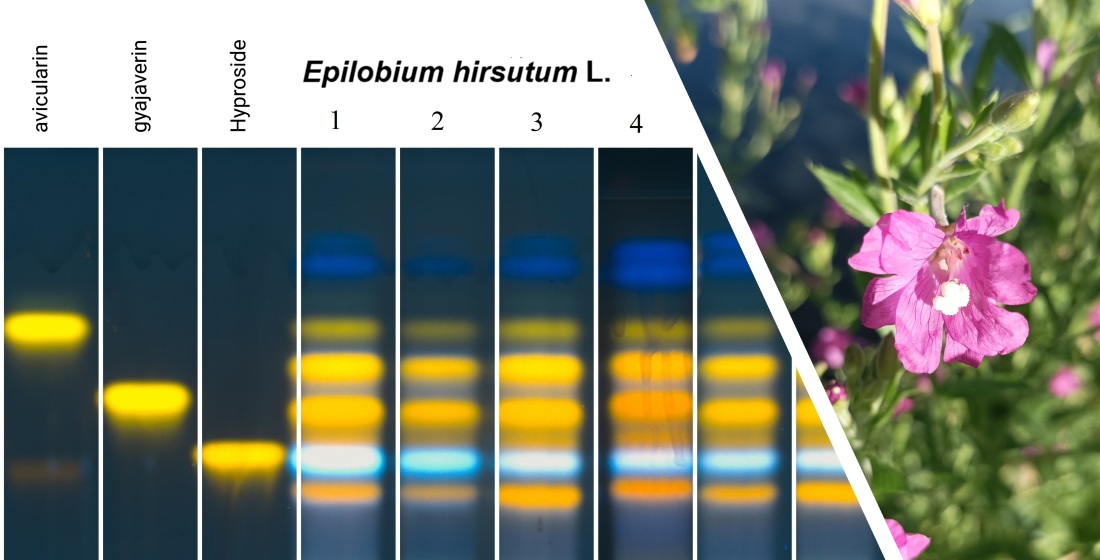
Results. As a result, it was established that the content of foreign impurities did not exceed 2% in the analysed samples, the drying loss was 6.4–8.1%, and the total ash was 4.0–5.7%. The HPTLC method was used to determine gallic acid, isoquercitrin, avicularin, guijaverin and hyperoside as key compounds for the plant quality control. Total phenolics ranged between 0.78 and 1.52 mg GAE/g dw, while total flavonoid content was 1.9–5.5 mg HE/g dw. The HPLC method showed that the dominant polyphenolics is oenothein B (39.9–65.7 mg/g), followed by oenothein A, gallic, chlorogenic, and ellagic acids, hyperoside, isoquercitrin, and quercetin. The present components can be proposed for the development of raw material standardisation parameters.
Conclusion. The obtained data confirm that E. hirsutum leaves meet requirements of the State Pharmacopeia of Ukraine and European Pharmacopoeia and can serve as the basis for developing a monograph. Oenothein B, hyperoside, and gallic acid can be proposed as identification markers; in addition, the total phenolic content can be assessed
References
- Indrayanto, G. (2024). Regulation and standardization of herbal drugs: Current status, limitation, challenge’s and future prospective. Profiles of Drug Substances, Excipients and Related Methodology, 153–199. https://doi.org/10.1016/bs.podrm.2023.11.003
- Aware, C. B., Patil, D. N., Suryawanshi, S. S., Mali, P. R., Rane, M. R., Gurav, R. G. et al. (2022). Natural bioactive products as promising therapeutics: A review of natural product-based drug development. South African Journal of Botany, 151, 512–528. https://doi.org/10.1016/j.sajb.2022.05.028
- Herbs of commerce (1992). American Herbal Products Association. Available at: https://law.resource.org/pub/us/cfr/ibr/001/ahpa.herbs.1992.pdf
- Guideline on quality of herbal medicinal products2/traditional herbal medicinal products. (2022). European Medicinal Agency. Available at: https://www.ema.europa.eu/en/quality-herbal-medicinal-products-traditional-herbal-medicinal-products-scientific-guideline
- Dmytrenko, O., Golembiovska, O., Pashuk, V., Zgonnyk, S. (2025). Problems of classification, safety assessment and risk management of medical devices with biologically active substances. ScienceRise: Pharmaceutical Science, 2 (54), 86–104. https://doi.org/10.15587/2519-4852.2025.328031
- Ak, G., Zengin, G., Mahomoodally, M. F., Llorent-Martínez, E., Orlando, G., Chiavaroli, A. et al. (2021). Shedding Light into the Connection between Chemical Components and Biological Effects of Extracts from Epilobium hirsutum: Is It a Potent Source of Bioactive Agents from Natural Treasure? Antioxidants, 10 (9), 1389. https://doi.org/10.3390/antiox10091389
- Stolarczyk, M., Naruszewicz, M., Kiss, A. K. (2013). Extracts from Epilobium sp. herbs induce apoptosis in human hormone-dependent prostate cancer cells by activating the mitochondrial pathway. Journal of Pharmacy and Pharmacology, 65 (7), 1044–1054. https://doi.org/10.1111/jphp.12063
- Assessment report on Epilobium angustifolium L. and/or Epilobium parviflorum Schreb., herba (2016). European Medicines Agency, 20. Available at: https://www.scribd.com/document/524645489/epilobium-parviflorum-schreb-herba-en-1?language_settings_changed=English
- Epilobii herba (willow herb) (2024). ESCOP, 1–16. Available at: https://www.escop.com/downloads/epilobii-herba-willow-herb/
- Barakat, H. H., Hussein, S. A. M., Marzouk, M. S., Merfort, I., Linscheid, M., Nawwar, M. A. M. (1997). Polyphenolic metabolites of Epilobium hirsutum. Phytochemistry, 46 (5), 935–941. https://doi.org/10.1016/s0031-9422(97)00370-1
- Karakurt, S., Semiz, A., Celik, G., Gencler-Ozkan, A. M., Sen, A., Adali, O. (2016). Contribution of ellagic acid on the antioxidant potential of medicinal plant Epilobium hirsutum. Nutrition and Cancer, 68 (1), 173–183. https://doi.org/10.1080/01635581.2016.1115092
- Kiss, A. K., Bazylko, A., Filipek, A., Granica, S., Jaszewska, E., Kiarszys, U. et al. (2011). Oenothein B’s contribution to the anti-inflammatory and antioxidant activity of Epilobium sp. Phytomedicine, 18 (7), 557–560. https://doi.org/10.1016/j.phymed.2010.10.016
- Mohammadi Bazargani, M., Falahati-Anbaran, M., Rohloff, J. (2021). Comparative Analyses of Phytochemical Variation Within and Between Congeneric Species of Willow Herb, Epilobium hirsutum and E. parviflorum: Contribution of Environmental Factors. Frontiers in Plant Science, 11. https://doi.org/10.3389/fpls.2020.595190
- Sheikh, N. A., Desai, T. R., Patel, R. D. (2016). Pharmacognostic Evaluation of Epilobium hirsutum Linn. Pharmacognosy Journal, 8 (3), 226–229. https://doi.org/10.5530/pj.2016.3.8
- Uminska, K., Korinek, M., Ivanauskas, L., El‐Shazly, M., Georgiyants, V., Chen, Y.et al. (2025). Assessment of the Phenolics Content in Epilobium angustifolium and Epilobium hirsutum Extracts and Their Pharmacological Activity. Archiv Der Pharmazie, 358 (5). https://doi.org/10.1002/ardp.202400765
- Vlase, A.-M., Toiu, A., Tomuță, I., Vlase, L., Muntean, D., Casian, T. et al. (2022). Epilobium Species: From Optimization of the Extraction Process to Evaluation of Biological Properties. Antioxidants, 12 (1), 91. https://doi.org/10.3390/antiox12010091
- Vlase, A.-M., Toiu, A., Gligor, O., Muntean, D., Casian, T., Vlase, L. et al. (2024). Investigation of Epilobium hirsutum L. Optimized Extract’s Anti-Inflammatory and Antitumor Potential. Plants, 13 (2), 198. https://doi.org/10.3390/plants13020198
- Mykhailenko, O., Jalil, B., Uminska, K., Ivanauskas, L., Gudžinskas, Z., Heinrich, M. (2025). The phenology of Epilobium hirsutum L.: assessing marker compounds variability of a pharmaceutically important plant remedy. Frontiers in Pharmacology, 16. https://doi.org/10.3389/fphar.2025.1602819
- Derzhavna farmakopeia Ukrainy (2015). Kharkiv: Derzhavne pidpryiemstvo «Ukrainskyi naukovyi farmakopeinyi tsentr yakosti likarskykh zasobiv», 1128. Available at: https://sphu.org/wp-content/uploads/2024/09/content_1t_2-izd.pdf
- Vilkickyte, G., Petrikaite, V., Marksa, M., Ivanauskas, L., Jakstas, V., Raudone, L. (2023). Fractionation and Characterization of Triterpenoids from Vaccinium vitis-idaea L. Cuticular Waxes and Their Potential as Anticancer Agents. Antioxidants, 12 (2), 465. https://doi.org/10.3390/antiox12020465
- Hawthorn leaf and flower (Crataegi folium cum flore) (2008). European Pharmacopoeia. Available at: http://www.uspbpep.com/ep60/hawthorn%20leaf%20and%20flower%201432e.pdf
- Ivanauskas, L., Uminska, K., Gudžinskas, Z., Heinrich, M., Georgiyants, V., Kozurak, A. et al. (2024). Phenological Variations in the Content of Polyphenols and Triterpenoids in Epilobium angustifolium Herb Originating from Ukraine. Plants, 13 (1), 120. https://doi.org/10.3390/plants13010120
- Wagner, H., Bladt, S. (Eds.) (1996). Plant Drug Analysis. Flavonoid drugs including Ginkgo biloba and Echinaceae species. Berlin: Springer, 195–245. https://doi.org/10.1007/978-3-642-00574-9
- Harborne, J. B. (1998). Phytochemical methods. A guide to modern technique of plant analysis. London: Chapman and Hill, 285. Available at: https://link.springer.com/book/9780412572609
- Bobkova, І., Burianova, V., Honcharuk, S., Dunaievska, O., Uminska, K., Khranivska, V. (2022). Anatomical investigation of sheets Chamenerion angustifolium (L.) SCOP. Fitoterapia, 1, 77–81. https://doi.org/10.33617/2522-9680-2022-1-77
- Granica, S., Piwowarski, J. P., Czerwińska, M. E., Kiss, A. K. (2014). Phytochemistry, pharmacology and traditional uses of different Epilobium species (Onagraceae): A review. Journal of Ethnopharmacology, 156, 316–346. https://doi.org/10.1016/j.jep.2014.08.036
- Remmel, I., Vares, L., Toom, L., Matto, V., Raal, A. (2012). Phenolic Compounds in Five Epilobium Species Collected from Estonia. Natural Product Communications, 7 (10). https://doi.org/10.1177/1934578x1200701017
- Jürgenson, S., Matto, V., Raal, A. (2012). Vegetational variation of phenolic compounds inEpilobium angustifolium. Natural Product Research, 26 (20), 1951–1953. https://doi.org/10.1080/14786419.2011.643310
- Everette, J. D., Bryant, Q. M., Green, A. M., Abbey, Y. A., Wangila, G. W., Walker, R. B. (2010). Thorough Study of Reactivity of Various Compound Classes toward the Folin−Ciocalteu Reagent. Journal of Agricultural and Food Chemistry, 58 (14), 8139–8144. https://doi.org/10.1021/jf1005935
Downloads
Published
How to Cite
Issue
Section
License
Copyright (c) 2026 Kateryna Uminska, Liudas Ivanauskas, Laurynas Jarukas, Victoriya Georgiyants, Olha Mykhailenko

This work is licensed under a Creative Commons Attribution 4.0 International License.
Our journal abides by the Creative Commons Attribution 4.0 International License copyright rights and permissions for open access journals.
Authors, who are published in this journal, agree to the following conditions:
1. The authors reserve the right to authorship of the work and pass the first publication right of this work to the journal under the terms of a Creative Commons Attribution 4.0 International License, which allows others to freely distribute the published research with the obligatory reference to the authors of the original work and the first publication of the work in this journal.
2. The authors have the right to conclude separate supplement agreements that relate to non-exclusive work distribution in the form in which it has been published by the journal (for example, to upload the work to the online storage of the journal or publish it as part of a monograph), provided that the reference to the first publication of the work in this journal is included.
3. Authors have the right to store the final accepted version of the article in an institutional, thematic, or any other repository to ensure visibility and accessibility.