До питання хімічної стандартизації листя Epilobium hirsutum
DOI:
https://doi.org/10.15587/2519-4852.2026.349856Ключові слова:
Epilobium hirsutum, standardisation, phenolic compounds, oenothein B, flavonoids, HPTLC, HPLC-DADАнотація
Epilobium hirsutum L. широко використовується в традиційній європейській медицині для лікування урологічних та запальних захворювань. Незважаючи на широке використання, до сьогодні не опубліковано жодної фармакопейної монографії про його рослинну сировину. Метою цього дослідження було встановлення фізико-хімічних параметрів та ідентифікація маркерних фенольних сполук для стандартизації листя рослин.
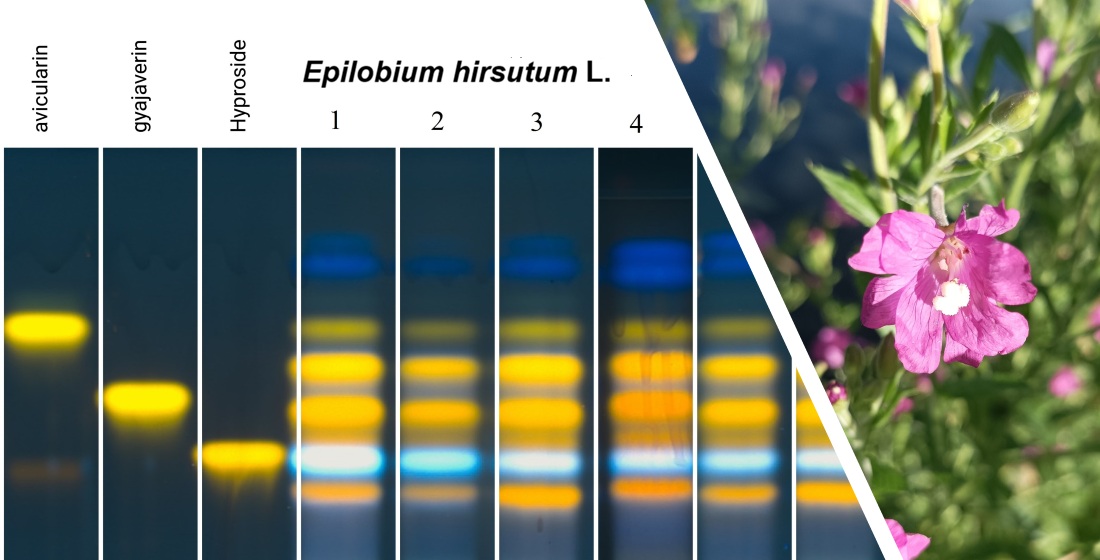
Метод. Для дослідження було зібрано сім зразків листя E. hirsutum в Україні, Литві та Польщі. Були проаналізовані такі параметри: втрати в масі при висушуванні, зола загальна та зола, нерозчинна в соляній кислоті згідно вимог Державної фармакопеї України. Якісний склад аналізували за допомогою високоефективної тонкошарової хроматографії (ВЕТШХ), а кількісний аналіз загальних фенольних сполук, флавоноїдів та специфічних маркерних сполук проводили за допомогою УФ-спектрофотометрії та ВЕРХ-DAD.
Результати. В результаті було встановлено, що вміст сторонніх домішок не перевищував 2% в аналізованих зразках, втрати при сушінні становили 6,4–8,1%, а загальна зола – 4,0–5,7%. Метод високоефективної хроматографії високої щільності (ВЕТШХ) був використаний для визначення галової кислоти, ізокверцетину, авікулярину, гвайаверину та гіперозиду як ключових сполук для контролю якості рослин. Загальний вміст фенолів коливався від 0,78 до 1,52 мг ГЕА/г сухої маси, тоді як загальний вміст флавоноїдів становив 1.9–5.5 мг ГЕ/ г сухої маси. Метод ВЕРХ показав, що домінуючим поліфенолом є енотеїн B (39,9–65,7 мг/г), далі йдуть енотеїн A, галова, хлорогенова та елагова кислоти, гіперозид, ізокверцитрин та кверцетин. Ці компоненти можуть бути запропоновані для розробки параметрів стандартизації сировини.
Висновок. Отримані дані підтверджують, що листя E. hirsutum відповідає вимогам Державної фармакопеї України та Європейської фармакопеї та можуть слугувати основою для розробки монографії. Енотеїн B, гіперозид та галова кислота можуть бути запропоновані як ідентифікаційні маркери; Крім того, можна оцінити загальний вміст фенолів
Посилання
- Indrayanto, G. (2024). Regulation and standardization of herbal drugs: Current status, limitation, challenge’s and future prospective. Profiles of Drug Substances, Excipients and Related Methodology, 153–199. https://doi.org/10.1016/bs.podrm.2023.11.003
- Aware, C. B., Patil, D. N., Suryawanshi, S. S., Mali, P. R., Rane, M. R., Gurav, R. G. et al. (2022). Natural bioactive products as promising therapeutics: A review of natural product-based drug development. South African Journal of Botany, 151, 512–528. https://doi.org/10.1016/j.sajb.2022.05.028
- Herbs of commerce (1992). American Herbal Products Association. Available at: https://law.resource.org/pub/us/cfr/ibr/001/ahpa.herbs.1992.pdf
- Guideline on quality of herbal medicinal products2/traditional herbal medicinal products. (2022). European Medicinal Agency. Available at: https://www.ema.europa.eu/en/quality-herbal-medicinal-products-traditional-herbal-medicinal-products-scientific-guideline
- Dmytrenko, O., Golembiovska, O., Pashuk, V., Zgonnyk, S. (2025). Problems of classification, safety assessment and risk management of medical devices with biologically active substances. ScienceRise: Pharmaceutical Science, 2 (54), 86–104. https://doi.org/10.15587/2519-4852.2025.328031
- Ak, G., Zengin, G., Mahomoodally, M. F., Llorent-Martínez, E., Orlando, G., Chiavaroli, A. et al. (2021). Shedding Light into the Connection between Chemical Components and Biological Effects of Extracts from Epilobium hirsutum: Is It a Potent Source of Bioactive Agents from Natural Treasure? Antioxidants, 10 (9), 1389. https://doi.org/10.3390/antiox10091389
- Stolarczyk, M., Naruszewicz, M., Kiss, A. K. (2013). Extracts from Epilobium sp. herbs induce apoptosis in human hormone-dependent prostate cancer cells by activating the mitochondrial pathway. Journal of Pharmacy and Pharmacology, 65 (7), 1044–1054. https://doi.org/10.1111/jphp.12063
- Assessment report on Epilobium angustifolium L. and/or Epilobium parviflorum Schreb., herba (2016). European Medicines Agency, 20. Available at: https://www.scribd.com/document/524645489/epilobium-parviflorum-schreb-herba-en-1?language_settings_changed=English
- Epilobii herba (willow herb) (2024). ESCOP, 1–16. Available at: https://www.escop.com/downloads/epilobii-herba-willow-herb/
- Barakat, H. H., Hussein, S. A. M., Marzouk, M. S., Merfort, I., Linscheid, M., Nawwar, M. A. M. (1997). Polyphenolic metabolites of Epilobium hirsutum. Phytochemistry, 46 (5), 935–941. https://doi.org/10.1016/s0031-9422(97)00370-1
- Karakurt, S., Semiz, A., Celik, G., Gencler-Ozkan, A. M., Sen, A., Adali, O. (2016). Contribution of ellagic acid on the antioxidant potential of medicinal plant Epilobium hirsutum. Nutrition and Cancer, 68 (1), 173–183. https://doi.org/10.1080/01635581.2016.1115092
- Kiss, A. K., Bazylko, A., Filipek, A., Granica, S., Jaszewska, E., Kiarszys, U. et al. (2011). Oenothein B’s contribution to the anti-inflammatory and antioxidant activity of Epilobium sp. Phytomedicine, 18 (7), 557–560. https://doi.org/10.1016/j.phymed.2010.10.016
- Mohammadi Bazargani, M., Falahati-Anbaran, M., Rohloff, J. (2021). Comparative Analyses of Phytochemical Variation Within and Between Congeneric Species of Willow Herb, Epilobium hirsutum and E. parviflorum: Contribution of Environmental Factors. Frontiers in Plant Science, 11. https://doi.org/10.3389/fpls.2020.595190
- Sheikh, N. A., Desai, T. R., Patel, R. D. (2016). Pharmacognostic Evaluation of Epilobium hirsutum Linn. Pharmacognosy Journal, 8 (3), 226–229. https://doi.org/10.5530/pj.2016.3.8
- Uminska, K., Korinek, M., Ivanauskas, L., El‐Shazly, M., Georgiyants, V., Chen, Y.et al. (2025). Assessment of the Phenolics Content in Epilobium angustifolium and Epilobium hirsutum Extracts and Their Pharmacological Activity. Archiv Der Pharmazie, 358 (5). https://doi.org/10.1002/ardp.202400765
- Vlase, A.-M., Toiu, A., Tomuță, I., Vlase, L., Muntean, D., Casian, T. et al. (2022). Epilobium Species: From Optimization of the Extraction Process to Evaluation of Biological Properties. Antioxidants, 12 (1), 91. https://doi.org/10.3390/antiox12010091
- Vlase, A.-M., Toiu, A., Gligor, O., Muntean, D., Casian, T., Vlase, L. et al. (2024). Investigation of Epilobium hirsutum L. Optimized Extract’s Anti-Inflammatory and Antitumor Potential. Plants, 13 (2), 198. https://doi.org/10.3390/plants13020198
- Mykhailenko, O., Jalil, B., Uminska, K., Ivanauskas, L., Gudžinskas, Z., Heinrich, M. (2025). The phenology of Epilobium hirsutum L.: assessing marker compounds variability of a pharmaceutically important plant remedy. Frontiers in Pharmacology, 16. https://doi.org/10.3389/fphar.2025.1602819
- Derzhavna farmakopeia Ukrainy (2015). Kharkiv: Derzhavne pidpryiemstvo «Ukrainskyi naukovyi farmakopeinyi tsentr yakosti likarskykh zasobiv», 1128. Available at: https://sphu.org/wp-content/uploads/2024/09/content_1t_2-izd.pdf
- Vilkickyte, G., Petrikaite, V., Marksa, M., Ivanauskas, L., Jakstas, V., Raudone, L. (2023). Fractionation and Characterization of Triterpenoids from Vaccinium vitis-idaea L. Cuticular Waxes and Their Potential as Anticancer Agents. Antioxidants, 12 (2), 465. https://doi.org/10.3390/antiox12020465
- Hawthorn leaf and flower (Crataegi folium cum flore) (2008). European Pharmacopoeia. Available at: http://www.uspbpep.com/ep60/hawthorn%20leaf%20and%20flower%201432e.pdf
- Ivanauskas, L., Uminska, K., Gudžinskas, Z., Heinrich, M., Georgiyants, V., Kozurak, A. et al. (2024). Phenological Variations in the Content of Polyphenols and Triterpenoids in Epilobium angustifolium Herb Originating from Ukraine. Plants, 13 (1), 120. https://doi.org/10.3390/plants13010120
- Wagner, H., Bladt, S. (Eds.) (1996). Plant Drug Analysis. Flavonoid drugs including Ginkgo biloba and Echinaceae species. Berlin: Springer, 195–245. https://doi.org/10.1007/978-3-642-00574-9
- Harborne, J. B. (1998). Phytochemical methods. A guide to modern technique of plant analysis. London: Chapman and Hill, 285. Available at: https://link.springer.com/book/9780412572609
- Bobkova, І., Burianova, V., Honcharuk, S., Dunaievska, O., Uminska, K., Khranivska, V. (2022). Anatomical investigation of sheets Chamenerion angustifolium (L.) SCOP. Fitoterapia, 1, 77–81. https://doi.org/10.33617/2522-9680-2022-1-77
- Granica, S., Piwowarski, J. P., Czerwińska, M. E., Kiss, A. K. (2014). Phytochemistry, pharmacology and traditional uses of different Epilobium species (Onagraceae): A review. Journal of Ethnopharmacology, 156, 316–346. https://doi.org/10.1016/j.jep.2014.08.036
- Remmel, I., Vares, L., Toom, L., Matto, V., Raal, A. (2012). Phenolic Compounds in Five Epilobium Species Collected from Estonia. Natural Product Communications, 7 (10). https://doi.org/10.1177/1934578x1200701017
- Jürgenson, S., Matto, V., Raal, A. (2012). Vegetational variation of phenolic compounds inEpilobium angustifolium. Natural Product Research, 26 (20), 1951–1953. https://doi.org/10.1080/14786419.2011.643310
- Everette, J. D., Bryant, Q. M., Green, A. M., Abbey, Y. A., Wangila, G. W., Walker, R. B. (2010). Thorough Study of Reactivity of Various Compound Classes toward the Folin−Ciocalteu Reagent. Journal of Agricultural and Food Chemistry, 58 (14), 8139–8144. https://doi.org/10.1021/jf1005935
##submission.downloads##
Опубліковано
Як цитувати
Номер
Розділ
Ліцензія
Авторське право (c) 2026 Kateryna Uminska, Liudas Ivanauskas, Laurynas Jarukas, Victoriya Georgiyants, Olha Mykhailenko

Ця робота ліцензується відповідно до Creative Commons Attribution 4.0 International License.
Наше видання використовує положення про авторські права Creative Commons Attribution 4.0 International License для журналів відкритого доступу.
Автори, які публікуються у цьому журналі, погоджуються з наступними умовами:
1. Автори залишають за собою право на авторство своєї роботи та передають журналу право першої публікації цієї роботи на умовах ліцензії Creative Commons Attribution 4.0 International License, котра дозволяє іншим особам вільно розповсюджувати опубліковану роботу з обов'язковим посиланням на авторів оригінальної роботи та першу публікацію роботи у цьому журналі.
2. Автори мають право укладати самостійні додаткові угоди щодо неексклюзивного розповсюдження роботи у тому вигляді, в якому вона була опублікована цим журналом (наприклад, розміщувати роботу в електронному сховищі установи або публікувати у складі монографії), за умови збереження посилання на першу публікацію роботи у цьому журналі.
3. Автори мають право зберігати остаточну прийняту версію статті в інституційному, тематичному або будь-якому іншому репозитарії з метою забезпечення видимості та доступності.