Comparative analysis of biologically active compounds in Tagetes patula L. and Tagetes erecta L.
DOI:
https://doi.org/10.15587/2519-4852.2026.358839Keywords:
Tagetes patula L., Tagetes erecta L., biologically active compounds, amino acids, flavonoids, water-soluble vitamins, polysaccharides, pectins, phytochemical analysis, medicinal plant raw materialsAbstract
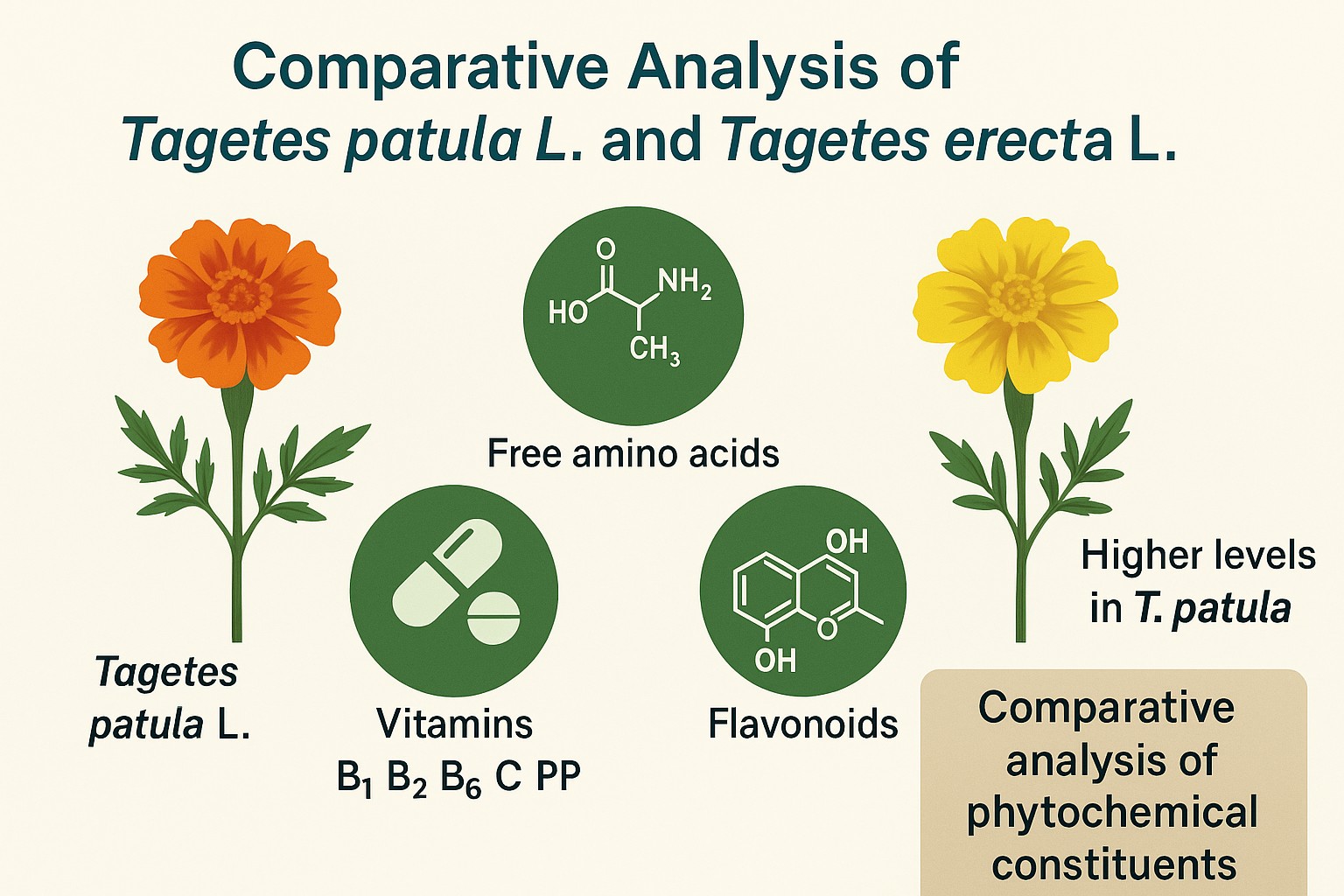
The aim. The aim of this study was to conduct a comparative analysis of biologically active compounds accumulated in two species – Tagetes patula L. and Tagetes erecta L. – in order to identify the most promising plant material for pharmaceutical development. The research focused on evaluating the qualitative and quantitative composition of free amino acids, water-soluble vitamins, flavonoids, and polysaccharides, as well as assessing their structural characteristics using titrimetric and phytochemical methods.
Methods. Plant raw materials consisting of inflorescences (flowers) of Tagetes patula L. and Tagetes erecta L., collected during the flowering period, were used for analysis. Free amino acids were identified and quantified using chromatographic methods. Water-soluble vitamins were determined spectrophotometrically. The flavonoid profile was established through chromatographic identification of dihydroquercetin, luteolin, rutin, rosavin, quercetin, salidroside, and cynaroside. Polysaccharides, pectic substances, and hemicelluloses were isolated, and their monosaccharide composition was assessed. Titrimetric analysis was used to determine free and methoxylated carboxyl groups and to calculate the degree of esterification of pectic substances. Comparative evaluation between the two species was carried out for all analyzed parameters.
Results. A total of 20 free amino acids were identified in both species, including eight essential amino acids. The total amino acid content was significantly higher in T. patula (57.053 mg/g) compared with T. erecta (38.020 mg/g). Both species contained equivalent qualitative sets of water-soluble vitamins–thiamine, riboflavin, pyridoxine, folic, nicotinic, and ascorbic acids–while T. patula demonstrated considerably higher quantitative levels. The flavonoid composition of both species was identical qualitatively; however, the total flavonoid content was markedly higher in T. patula. Polysaccharide analysis showed that pectic substances and hemicelluloses predominated in both species, with lower levels of water-soluble polysaccharides. The degree of esterification indicated highly esterified pectins, with T. patula containing higher levels of both free and methoxylated carboxyl groups.
Discussion. The results indicate that Tagetes patula L. contains substantially higher quantities of key biologically active substances–including amino acids, vitamins, flavonoids, and structurally active polysaccharides–compared to Tagetes erecta L. The richer phytochemical profile of T. patula supports its greater pharmacological potential, including anti-inflammatory, antioxidant, antimicrobial, gastroprotective, and anthelmintic properties traditionally attributed to Tagetes species. Structural analysis of polysaccharides further demonstrates their suitability for use as bioactive excipients in dosage forms.
Conclusions. Comparative phytochemical evaluation of Tagetes patula L. and Tagetes erecta L. demonstrated that T. patula accumulates significantly higher levels of biologically active compounds. Based on the obtained data, Tagetes patula L. can be considered the optimal species for use as medicinal plant raw material in the development of modern phytopharmaceuticals with pronounced therapeutic activity
References
- Berdei, T. S. (2015). Pharmacognostic study of plants of the genus Tagetes. Kharkiv National University of Pharmacy.
- Berdei, T., Stoyko, L. (2013). The content of flavonoids and hydroxycinnamic acids in plants of the genus Tagetes L. Plant – the Source of Research Material. Lublin, 77.
- Kushwaha, D., Verma, Y. (2017). Evaluation of Antioxidant and Free Radical Scavenging Activity of Tagetes patula. Annual Research & Review in Biology, 13 (6), 1–8. https://doi.org/10.9734/arrb/2017/34349
- Babu, K. G. D., Kaul, V. K. (2007). Variations in quantitative and qualitative characteristics of wild marigold (Tagetes minuta L.) oils distilled under vacuum and at NTP. Industrial Crops and Products, 26 (3), 241–251. https://doi.org/10.1016/j.indcrop.2007.03.013
- Vasudevan, P., Kashyap, S., Sharma, S. (1997). Tagetes: A multipurpose plant. Bioresource Technology, 62 (1-2), 29–35. https://doi.org/10.1016/s0960-8524(97)00101-6
- Kashif, M., Bano, S., Naqvi, S., Faizi, S., Lubna, Ahmed Mesaik, M. et al. (2014). Cytotoxic and antioxidant properties of phenolic compounds from Tagetes patulaflower. Pharmaceutical Biology, 53 (5), 672–681. https://doi.org/10.3109/13880209.2014.936471
- Padalia, H., Chanda, S. (2015). Antimicrobial Efficacy of Different Solvent Extracts of Tagetes erecta L. Flower, Alone and in Combination with Antibiotics. Applied Microbiology: Open Access, 1 (1). https://doi.org/10.4172/2471-9315.1000106
- Politi, F. A. S., Nascimento, J. D., da Silva, A. A., Moro, I. J., Garcia, M. L., Guido, R. V. C. et al. (2016). Insecticidal activity of an essential oil of Tagetes patula L. (Asteraceae) on common bed bug Cimex lectularius L. and molecular docking of major compounds at the catalytic site of ClAChE1. Parasitology Research, 116 (1), 415–424. https://doi.org/10.1007/s00436-016-5305-x
- Xu, L., Chen, J., Qi, H., Shi, Y. (2012). Phytochemicals and their biological activities of plants in Tagetes L. Chinese Herbal Medicines, 4, 103–117. https://doi.org/10.3969/j.issn.1674-6384.2012.02.004
- Wang, Y.-M., Ran, X.-K., Riaz, M., Yu, M., Cai, Q., Dou, D.-Q. et al. (2019). Chemical Constituents of Stems and Leaves of Tagetespatula L. and Its Fingerprint. Molecules, 24 (21), 3911. https://doi.org/10.3390/molecules24213911
- Yasukawa, K., Kasahara, Y. (2013). Effects of Flavonoids from French Marigold (Florets ofTagetes patulaL.) on Acute Inflammation Model. International Journal of Inflammation, 2013, 1–5. https://doi.org/10.1155/2013/309493
- Quackenbush, F. W., Miller, S. L. (1972). Composition and Analysis of the Carotenoids in Marigold Petals. Journal of AOAC INTERNATIONAL, 55 (3), 617–621. https://doi.org/10.1093/jaoac/55.3.617
- Quackenbush, F. W. (1973). Use of Heat to Saponify Xanthophyll Esters and Speed Analysis for Carotenoids in Feed Materials: Collaborative Study. Journal of AOAC INTERNATIONAL, 56 (3), 748–753. https://doi.org/10.1093/jaoac/56.3.748
- Bhardwaj, D. K., Bisht, M. S., Uain, S. C., Mehta, C. K., Sharma, G. C. (1980). Quercetagetin 5-methyl ether from the petals of Tagetes patula. Phytochemistry, 19 (4), 713–714. https://doi.org/10.1016/0031-9422(80)87053-1
- Garg, S. N., Charles, R., Kumar, S. (1999). A new acyclic monoterpene glucoside from the capitula of Tagetes patula. Fitoterapia, 70 (5), 472–474. https://doi.org/10.1016/s0367-326x(99)00044-1
- Zhao, C.-C., Shao, J.-H., Li, X., Kang, X.-D., Zhang, Y.-W., Meng, D.-L., Li, N. (2008). Flavonoids fromGalium verumL. Journal of Asian Natural Products Research, 10 (7), 611–615. https://doi.org/10.1080/10286020802133217
- Bakhtiyor kizi, S. I., Shakhsaidovich, S. S., Ravshan kizi, K. A., Gulrano, A., Khalimovna, R. N., Bakhtiyarovna, T. D. (2025). Morphological and size characterization of zinc oxide nanoparticles and evaluation of their cytotoxicity on the MCF-7 cell line. ScienceRise: Pharmaceutical Science, 4 (56), 88–96. https://doi.org/10.15587/2519-4852.2025.338297
- Akhmadova, G., Mirrakhimova, T., Ismoilova, G. (2024). High-quality analysis of dry extract of prickly artichoke raw material (Cynara Scolymus L.) cultivated in Uzbekistan. ScienceRise: Pharmaceutical Science, 4 (50), 60–66. https://doi.org/10.15587/2519-4852.2024.310826
- Olimov, K., Mirrakhimova, T., Akhmadova, G. (2025). Polysaccharide profile, acute toxicity and bile secretion effects of the choleretic herbal preparation “Safroart herbal tea.” ScienceRise: Pharmaceutical Science, 2 (54), 59–68. https://doi.org/10.15587/2519-4852.2025.327605
- Rizaeva, N., Akhmadova, G., Akhmedova, M., Bakhriddinova, D., Aripova, N., Sharipova, I. et al. (2025). Pharmaceutical cream with Carthamus tinctorius L. extract: formulation and evaluation. ScienceRise: Pharmaceutical Science, 5 (57), 102–111. https://doi.org/10.15587/2519-4852.2025.342475
- Ibrahim, A., Khalifa, S. I., Khafagi, I., Youssef, D. T., Khan, S., Mesbah, M., Khan, I. (2008). Microbial Metabolism of Biologically Active Secondary Metabolites from Nerium oleander L. Chemical and Pharmaceutical Bulletin, 56 (9), 1253–1258. https://doi.org/10.1248/cpb.56.1253
- Nair, V. D., Niznik, H. B., Mishra, R. K. (1996). Interaction of NMDA and Dopamine D2L Receptors in Human Neuroblastoma SH‐SY5Y Cells. Journal of Neurochemistry, 66 (6), 2390–2393. https://doi.org/10.1046/j.1471-4159.1996.66062390.x
Downloads
Published
How to Cite
Issue
Section
License
Copyright (c) 2026 Charos Toshtemirova, Guzaloy Ismoilova, Zulfiya Zuparova, Dildora Pulatova, Gulrano Akhmadova, Utkirbek Mamaraimovich Jalilov, Nazira Abdugaffarovna Madatova

This work is licensed under a Creative Commons Attribution 4.0 International License.
Our journal abides by the Creative Commons Attribution 4.0 International License copyright rights and permissions for open access journals.
Authors, who are published in this journal, agree to the following conditions:
1. The authors reserve the right to authorship of the work and pass the first publication right of this work to the journal under the terms of a Creative Commons Attribution 4.0 International License, which allows others to freely distribute the published research with the obligatory reference to the authors of the original work and the first publication of the work in this journal.
2. The authors have the right to conclude separate supplement agreements that relate to non-exclusive work distribution in the form in which it has been published by the journal (for example, to upload the work to the online storage of the journal or publish it as part of a monograph), provided that the reference to the first publication of the work in this journal is included.
3. Authors have the right to store the final accepted version of the article in an institutional, thematic, or any other repository to ensure visibility and accessibility.