Research on the use of medicinal plant materials and herbal-based medicines in the treatment of children, pregnant and breastfeeding women
DOI:
https://doi.org/10.15587/2519-4852.2026.359138Keywords:
medicinal plants, herbal treatment, childhood, pregnant women, breastfeeding women, potential risksAbstract
Plants have been the primary therapeutic agents for humanity for millennia. Parents are increasingly seeking alternative treatments that appear safer to improve their children's health, utilizing Herbal Medicine Substances (HMS).
The aim of the study was to provide evidence-based information for physicians and the public on the most commonly used medicinal plant materials and herbal remedies for treating children, pregnant women, and breastfeeding mothers, and to assess potential risks.
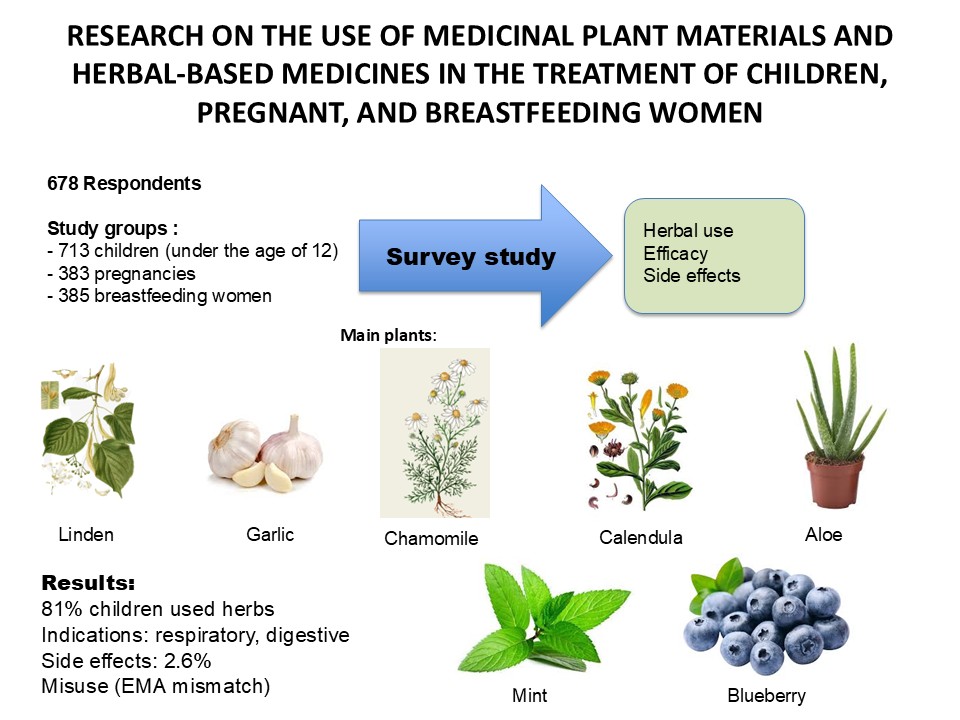
Materials and Methods. Data were collected about 713 children under the age of 12, represented by 678 respondents, and 383 of them about pregnancy and 385 women about breastfeeding. The study analyzed information on the herbal remedies used, their frequency of application, indications for use, treatment efficacy, and potential side effects of herbal preparations. The study examined seven specific objects: linden flowers (Tiliae flos), garlic bulbs (Allii sativi bulbus), chamomile flowers (Matricariae flos), calendula flowers (Calendulae flos), aloe leaves (Aloe folium), mint leaves (Menthae piperitae folium), and blueberry fruits (Myrtilli fructus). The analysis of the current state of HMS research was conducted based on data from PubMed, Embase, Best Evidence, EMA, and the British Medical Journal.
Results. Within the studied continuum, 81% of children used medicinal plant materials or herb-based preparations. The predominant indications for use were respiratory infections (colds) and digestive disorders. It was established that the use of herbal remedies only partially complied with the recommendations of the European Medicines Agency (EMA). For instance, 54% of children used aloe leaves to treat skin inflammation, which the EMA does not recommend for this age group. The study also revealed the use of medicinal plant materials not recommended by the EMA, specifically coltsfoot leaves, St. John's wort herb, and ginkgo biloba leaves. Side effects were recorded in 2.6% of children, most frequently associated with the use of garlic bulbs and mint leaves. Furthermore, the use of raw materials not recommended during pregnancy and lactation, such as motherwort herb, was identified. The systematized data served as the basis for recommendations for physicians and the public regarding the core criteria of phytotherapy in pediatrics, and for pregnant and breastfeeding women.
Conclusions. Since medicinal plant materials and herb-based preparations play a significant role in pediatric treatment, as well as during pregnancy and lactation, and study results indicate the use of products not recommended by the EMA, there is an urgent need to inform physicians and the general public about the correct application of herbal remedies and the potential risks associated with their use
Supporting Agency
- European Union in the MSCA4Ukraine project “Design and development of 3D-printed medicines for bioactive materials of Ukrainian and Estonian medicinal plants origin” [ID number 1232466]
References
- Lie, Y. (2024). The Rise of Herbal Medicines: A Global Perspective. Journal of Basic and Clinical Pharmacy, 15 (5), 386.
- Bareetseng, S. (2022). The Worldwide Herbal Market: Trends and Opportunities. Journal of Biomedical Research & Environmental Sciences, 3 (5), 575–584. https://doi.org/10.37871/jbres1482
- Herbal Nutraceuticals Market Size and Share Forecast Outlook 2025 to 2035.. Global Market Analysis Report – 2035. Herbal Nutraceuticals Market. Available at: https://www.futuremarketinsights.com/reports/herbal-nutraceuticals-market
- Leach, M. J., Veziari, Y., Flanagan, C., Schloss, J. (2024). Prevalence of Complementary Medicine Use in Children and Adolescents: A Systematic Review. Journal of Pediatric Health Care, 38 (4), 505–519. https://doi.org/10.1016/j.pedhc.2023.12.010
- Rigillo, G., Blom, J. M. C., Cocchi, A., Martinucci, V., Favaro, F., Baini, G. et al. (2025). Medicinal Plants for Child Mental Health: Clinical Insights, Active Compounds, and Perspectives for Rational Use. Children, 12 (9), 1142. https://doi.org/10.3390/children12091142
- Raal, A., Volmer, D., Sõukand, R., Hratkevitš, S., Kalle, R. (2013). Complementary Treatment of the Common Cold and Flu with Medicinal Plants – Results from Two Samples of Pharmacy Customers in Estonia. PLoS ONE, 8 (3), e58642. https://doi.org/10.1371/journal.pone.0058642
- Sepp, J., Shepeleva, O., Kask, A., Nelis, G., Huttunen, A.-P., Kogermann, K. et al. (2024). Production, marketing and consumption of herbal drugs in Estonia. Journal of Applied Research on Medicinal and Aromatic Plants, 40, 100544. https://doi.org/10.1016/j.jarmap.2024.100544
- Villako, P., Volmer, D., Raal, A. (2012). Factors influencing purchase of and counselling about prescription and OTC medicines at community pharmacies in Tallinn, Estonia. Acta Poloniae Pharmaceutica, 69 (2), 335–340.
- Volmer, D., Raal, A., Kalle, R., Sõukand, R. (2016). The use of Panax ginseng and its analogues among pharmacy customers in estonia: a cross-sectional study. Acta Poloniae Pharmaceutica, 73 (3), 795–802.
- WHO global report on traditional, complementary and integrative medicine 2024 (2025). WHO. Available at: https://www.who.int/publications/i/item/9789240111387
- Hensel, A., Bauer, R., Heinrich, M., Hempel, G., Kelber, O., Kraft, K. et al. (2024). Rationalising Optimal Dosing of Phytotherapeutics For Use In Children: Current Status – Potential Solutions – Actions Needed. Planta Medica, 90 (6), 416–425. https://doi.org/10.1055/a-2294-5259
- Polat, S., Gürol, A.; Akram, M. (Ed.) (2021). Safety of Herbal Medicines in Children. Alternative Medicine – Update. IntechOpen. https://doi.org/10.5772/intechopen.94545
- Du, Y., Wolf, I.-K., Zhuang, W., Bodemann, S., Knöss, W., Knopf, H. (2014). Use of herbal medicinal products among children and adolescents in Germany. BMC Complementary and Alternative Medicine, 14 (1). https://doi.org/10.1186/1472-6882-14-218
- Stierman, B., Mishra, S., Gahche, J. J., Potischman, N., Hales, C. M. (2020). Dietary Supplement Use in Children and Adolescents Aged ≤19 Years — United States, 2017–2018. MMWR. Morbidity and Mortality Weekly Report, 69 (43), 1557–1562. https://doi.org/10.15585/mmwr.mm6943a1
- Petran, M., Dragoș, D., Stoian, I., Vlad, A., Gilca, M. (2024). Current use of medicinal plants for children’s diseases among mothers in Southern Romania. Frontiers in Pharmacology, 15. https://doi.org/10.3389/fphar.2024.1377341
- Mancak Karakuş, M., Tapisiz, A., Mutlu Karakaş, N., Deniz, M., Koca Çalişkan, U. (2023). Use of Herbal Tea/Herbal Preparations for Children with Symptoms of Viral Upper Respiratory Infections. Turkish Journal of Pharmaceutical Sciences, 20 (1), 8–15. https://doi.org/10.4274/tjps.galenos.2022.65475
- Popova, A., Mihaylova, D., Spasov, A. (2021). Plant-based Remedies with Reference to Respiratory Diseases – A Review. The Open Biotechnology Journal, 15 (1), 46–58. https://doi.org/10.2174/1874434602015010046
- Tervisestatistika ja terviseuuringute andmebaas. Available at: https://statistika.tai.ee/pxweb/et/Andmebaas/
- Common Cold in Children. Stanford Medicine Children’s Health. Available at: https://www.stanfordchildrens.org/en/topic/default%3Fid%3Dcommon-cold-in-children-90-P02966
- Long, S. S., Prober, C. G., Fischer, M. (2018). Principles and Practice of Pediatric Infectious Diseases. Elsevier. https://doi.org/10.1016/C2013-0-19020-4
- Illamola, S. M., Amaeze, O. U., Krepkova, L. V., Birnbaum, A. K., Karanam, A., Job, K. M. et al. (2020). Use of Herbal Medicine by Pregnant Women: What Physicians Need to Know. Frontiers in Pharmacology, 10. https://doi.org/10.3389/fphar.2019.01483
- Devi, P., Kumar, P.; Izah, S. C., Ogwu, M. C., Akram, M. (Eds.) (2023). Herbal Medicine and Pregnancy. Herbal Medicine Phytochemistry. Cham: Springer International Publishing, 1–31. https://doi.org/10.1007/978-3-031-21973-3_25-1
- Im, H. B., Hwang, J. H., Choi, D., Choi, S. J., Han, D. (2024). Patient–physician communication on herbal medicine use during pregnancy: a systematic review and meta-analysis. BMJ Global Health, 9 (3), e013412. https://doi.org/10.1136/bmjgh-2023-013412
- Regulatory Situation of Herbal Medicines. A worldwide Review (1998). WHO. Available at: https://www.who.int/publications/i/item/WHO-TRM-98.1
- Sethi, S. S., Bhardwaj, T., Sethi, S. K., Kaur, S., Rimpi, Baldi, A. (2025). Advancing herbal medicine safety: the need for a global pharmacovigilance approach. Naunyn-Schmiedeberg’s Archives of Pharmacology, 398 (10), 13499–13514. https://doi.org/10.1007/s00210-025-04066-2
- Sujithra, M., Puthiyedath, R., Pillai, Z. S. (2025). Drug–herb interactions: a challenge and clinical concern in primary healthcare. Frontiers in Pharmacology, 12. https://doi.org/10.3389/fmed.2025.1657005
- Gupta, A., Kumari, K., Hasan, F., Kumar, V., Kumar, P. (2024). Herb-Drug Interactions: A Critical Exploration in Modern Healthcare Practices. Journal of Medicinal Natural Products. https://doi.org/10.53941/jmnp.2025.100014
- Jovanović, M., Vučićević, K. (2022). Pediatric pharmacokinetic considerations and implications for drug dosing. Arhiv Za Farmaciju, 72 (3), 340–352. https://doi.org/10.5937/arhfarm72-37605
- Ekor, M. (2014). The growing use of herbal medicines: issues relating to adverse reactions and challenges in monitoring safety. Frontiers in Pharmacology, 4. https://doi.org/10.3389/fphar.2013.00177
- Başaran, N., Paslı, D., Başaran, A. A. (2022). Unpredictable adverse effects of herbal products. Food and Chemical Toxicology, 159, 112762. https://doi.org/10.1016/j.fct.2021.112762
- Sartori, D., Aronson, J. K., Brand, J. S., Gauffin, O., Hedfors Vidlin, S., Norén, G. N., Onakpoya, I. J. (2025). Signals of Adverse Reactions to Herbal Medicines: Evidence and Document Analysis Based on a Scoping Review. Drug Safety, 48 (12), 1339–1352. https://doi.org/10.1007/s40264-025-01580-3
- Di Lorenzo, C., Ceschi, A., Kupferschmidt, H., Lüde, S., De Souza Nascimento, E., Dos Santos, A. et al. (2015). Adverse effects of plant food supplements and botanical preparations: a systematic review with critical evaluation of causality. British Journal of Clinical Pharmacology, 79 (4), 578–592. https://doi.org/10.1111/bcp.12519
- Lombardi, N., Crescioli, G., Bettiol, A., Menniti-Ippolito, F., Maggini, V., Gallo, E. et al. (2019). Safety of complementary and alternative medicine in children: A 16-years retrospective analysis of the Italian Phytovigilance system database. Phytomedicine, 61, 152856. https://doi.org/10.1016/j.phymed.2019.152856
- Committee on Herbal Medicinal Products. European Union herbal monographs: Overview of recommendations for the uses of herbal medicinal products in the paediatric population (2023). EMA. Paediatric uses of herbal medicines. Available at: https://www.ema.europa.eu/en/documents/other/european-union-herbal-monographs-overview-recommendations-uses-herbal-medicinal-products-paediatric-population_en.pdf
- Lowance, M., Franco, J., Wang, E., Milanaik, R. (2025). Navigating nature’s remedies: herbal and botanically derived complementary alternative medicine for children. Current Opinion in Pediatrics, 37 (5), 495–507. https://doi.org/10.1097/mop.0000000000001493
- Barnes, L. A. J., Barclay, L., McCaffery, K., Aslani, P. (2019). Women’s health literacy and the complex decision‐making process to use complementary medicine products in pregnancy and lactation. Health Expectations, 22 (5), 1013–1027. https://doi.org/10.1111/hex.12910
- Italia, S., Wolfenstetter, S. B., Teuner, C. M. (2014). Patterns of Complementary and Alternative Medicine (CAM) use in children: a systematic review. European Journal of Pediatrics, 173 (11), 1413–1428. https://doi.org/10.1007/s00431-014-2300-z
- Chiru, T., Fursenco, C., Ciobanu, N., Dinu, M., Popescu, E., Ancuceanu, R. et al. (2020). Use of medicinal plants in complementary treatment of the common cold and influenza – Perception of pharmacy customers in Moldova and Romania. Journal of Herbal Medicine, 21, 100346. https://doi.org/10.1016/j.hermed.2020.100346
- European Union herbal monograph on Vaccinium myrtillus L., fructus siccus (2015). European Medicines Agency. Available at: https://www.ema.europa.eu/en/documents/herbal-monograph/draft-european-union-herbal-monograph-vaccinium-myrtillus-l-fructus-siccus_en.pdf
- European Union herbal monograph on Vaccinium myrtillus L., fructus recens (2015). European Medicines Agency. Available at: https://www.ema.europa.eu/en/documents/herbal-monograph/final-european-union-herbal-monograph-vaccinium-myrtillus-l-fructus-recens_en.pdf
- Ansary, J., Forbes-Hernández, T. Y., Gil, E., Cianciosi, D., Zhang, J., Elexpuru-Zabaleta, M. et al. (2020). Potential Health Benefit of Garlic Based on Human Intervention Studies: A Brief Overview. Antioxidants, 9 (7), 619. https://doi.org/10.3390/antiox9070619
- European Union herbal monograph on Allium sativum L., bulbus (2016). European Medicines Agency. Available at: https://www.ema.europa.eu/en/documents/herbal-monograph/draft-european-union-herbal-monograph-allium-sativum-l-bulbus_en.pdf
- Sahidur, M. R., Islam, S., Jahurul, M. H. A. (2023). Garlic (Allium sativum) as a natural antidote or a protective agent against diseases and toxicities: A critical review. Food Chemistry Advances, 3, 100353. https://doi.org/10.1016/j.focha.2023.100353
- European Union herbal monograph on Aloe barbadensis Mill. and on Aloe (various species, mainly Aloe ferox Mill. and its hybrids), folii succus siccatus (2016). European Medicines Agency. Available at: https://www.ema.europa.eu/en/documents/herbal-monograph/final-european-union-herbal-monograph-aloe-barbadensis-mill-and-aloe-various-species-mainly-aloe-ferox-mill-and-its-hybrids-folii-succus-siccatus_en.pdf
- Hekmatpou, D., Mehrabi, F., Rahzani, K., Aminiyan, A. (2019). The Effect of Aloe Vera Clinical Trials on Prevention and Healing of Skin Wound: A Systematic Review. Iranian Journal of Medical Sciences, 44 (1), 1–9.
- Kennedy, D. A., Lupattelli, A., Koren, G., Nordeng, H. (2016). Safety classification of herbal medicines used in pregnancy in a multinational study. BMC Complementary and Alternative Medicine, 16 (1). https://doi.org/10.1186/s12906-016-1079-z
- Im, H. B., Ghelman, R., Portella, C. F. S., Hwang, J. H., Choi, D., Kunwor, S. K. et al. (2023). Assessing the safety and use of medicinal herbs during pregnancy: a cross-sectional study in São Paulo, Brazil. Frontiers in Pharmacology, 14. https://doi.org/10.3389/fphar.2023.1268185
- Zheng, T., Yao, D., Chen, W., Hu, H., Ung, C. O. L., Harnett, J. E. (2019). Healthcare providers’ role regarding the safe and appropriate use of herbal products by breastfeeding mothers: A systematic literature review. Complementary Therapies in Clinical Practice, 35, 131–147. https://doi.org/10.1016/j.ctcp.2019.01.011
Downloads
Published
How to Cite
Issue
Section
License
Copyright (c) 2026 Ain Raal, Elen Nikker, Tetiana Ilina, Alla Kovalyova, Oleh Koshovyi

This work is licensed under a Creative Commons Attribution 4.0 International License.
Our journal abides by the Creative Commons Attribution 4.0 International License copyright rights and permissions for open access journals.
Authors, who are published in this journal, agree to the following conditions:
1. The authors reserve the right to authorship of the work and pass the first publication right of this work to the journal under the terms of a Creative Commons Attribution 4.0 International License, which allows others to freely distribute the published research with the obligatory reference to the authors of the original work and the first publication of the work in this journal.
2. The authors have the right to conclude separate supplement agreements that relate to non-exclusive work distribution in the form in which it has been published by the journal (for example, to upload the work to the online storage of the journal or publish it as part of a monograph), provided that the reference to the first publication of the work in this journal is included.
3. Authors have the right to store the final accepted version of the article in an institutional, thematic, or any other repository to ensure visibility and accessibility.